Tag the questions with any skills you have. Your dashboard will track each student's mastery of each skill.
Give this quiz to my class
Q 1/20
Score 0
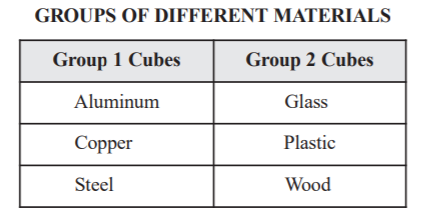
Matthew has six cubes of different materials. Each cube has a mass of 10 grams (g). Matthew sorts the cubes into two groups using one physical property.
Which physical property did Matthew most likely use to sort the cubes into two groups?
120
Electrical conductivity
Density
Melting point
Magnetism
Q 2/20
Score 0
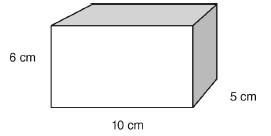
Imagine that the block shown below is made of pure gold. If Ana cuts this block into two equal pieces, which of these statements best describes the pieces?
120
The volume of each piece is the same as that of the original block.
The mass of each piece is the same as that of the original block
The density of each piece is the same as that of the original block.
The weight of each piece is the same as that of the original block
20 questions
Q.
Matthew has six cubes of different materials. Each cube has a mass of 10 grams (g). Matthew sorts the cubes into two groups using one physical property.
Which physical property did Matthew most likely use to sort the cubes into two groups?
1
120 sec
Q.
Imagine that the block shown below is made of pure gold. If Ana cuts this block into two equal pieces, which of these statements best describes the pieces?
2
120 sec
Q.
The graph compares the density, in grams per cubic centimeter (g/cm3) , of four different substances.
Based on information from the graph, which of the following best compares the physical properties of two of the substances?
3
120 sec
Q.
Look at the two pictures below. They show what happened when two solid blocks were each put in a jar containing a liquid.
Based just on what you can see in the pictures, what can you say about the blocks and the jars?
4
120 sec
Q.
Density is the ratio of mass to volume. Troy listed the density of four metals at 20 °C.
If Troy has a 4-cm cube of each of these metals, which cube will have the greatest mass?
Brass
5
120 sec
Q.
The illustration below shows a rectangular solid.
What is the volume of this solid?
6
120 sec
Q.
Amanda dropped a rock into a graduated cylinder containing water. The water level in the cylinder increased. Which property of the rock is this experiment designed to measure?
7
120 sec
Q.
What is the volume of the rock?
8
120 sec
Q.
A piece of titanium has a mass of 18 grams. Using a graduated cylinder partly filled with water, a scientist found that the titanium displaced 4 milliliters of water.
What is the density of titanium? (Density = Mass/ Volume)
9
120 sec
Q.
Paul placed an ice cube into a beaker on a hot plate. The ice cube changed from a solid to a liquid and then to a gas.
During this process, which property of the ice cube remained unchanged?
10
120 sec
Q.
A metal coin has certain properties that can be measured. Which property of a coin is different on the moon than it is on Earth?
11
120 sec
Q.
The gravitational force on Mars is about one-third that of Earth’s gravitational force.
If a space probe has a mass of 300 kg and a weight of about 660 Newtons on Earth, what would be the mass and approximate weight of this probe on Mars?
12
120 sec
Q.
Which process is an example of a chemical change?
13
120 sec
Q.
Pablo notices that ice cream begins to melt when left out at room temperature.
What is Pablo observing?
14
120 sec
Q.
When a candle is lit, the wick burns, the wax melts, the candle changes shape, and the air around the candle heats up.
Which of the following is an example of a chemical change?
15
120 sec
Q.
Gordon adds a piece of solid zinc metal to a test tube containing hydrochloric acid. He identifies the products as zinc chloride and hydrogen gas.
Which process took place in the beaker?
16
120 sec
Q.
Sarah and Jake were each given a ball of clay of exactly the same mass. Both students used all of their clay to make an object. Sarah rolled hers into a ball, Jake made a long, skinny rope. What is the mass of the clay figures now?
17
120 sec
Q.
It is important to understand the differences between chemical and physical changes. Chemical changes result in new substances, but physical changes do not.
Which process is an example of a physical change?
18
120 sec
Q.
Trini adds 10 g of baking soda to 100 g of vinegar. The mixture begins to bubble. When the bubbling stops, Trini finds the mass of the resulting mixture. She determines its mass is 105 g.
Why has the mass changed?
19
120 sec
Q.
Belinda makes a sugar solution, as shown in the picture. How much sugar did Belinda dissolve in the water?