Determine the area of composite two-dimensional figures comprised of a combination of triangles, parallelograms, trapezoids, kites, regular polygons, or sectors of circles to solve problems using appropriate units of measure
Determine and describe how changes in the linear dimensions of a shape affect its perimeter, area, surface area, or volume, including proportional and non-proportional dimensional change.
Determine the lengths of sides and measures of angles in a right triangle by applying the trigonometric ratios sine, cosine, and tangent to solve problems
Track each student's skills and progress in your Mastery dashboards
Give this quiz to my class
Q 1/9
Score 0
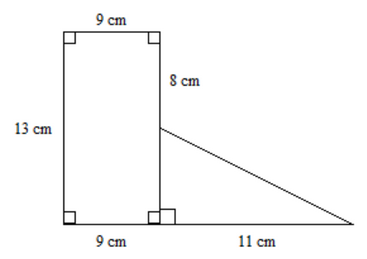
Find the area of the composite figure.
300
50 cm^2
144.5 cm^2
127 cm^2
172 cm^2
Q 2/9
Score 0
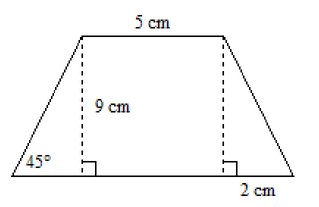
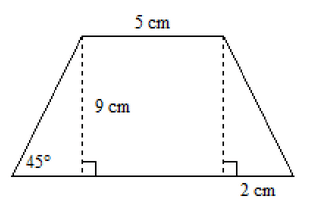
What is the area of the trapezoid?
300
31.5 cm^2
94.5 cm^2
81 cm^2
7 cm^2
9 questions
Q.
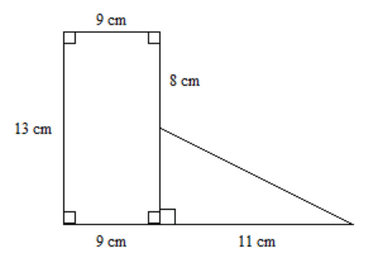
Find the area of the composite figure.
1
300 sec
111.41.C.11.B
Q.
What is the area of the trapezoid?
2
300 sec
111.41.C.11.B
Q.
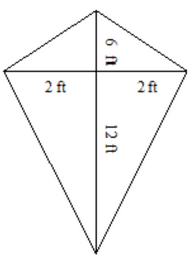
Find the area of the kite.
3
300 sec
111.41.C.11.B
Q.
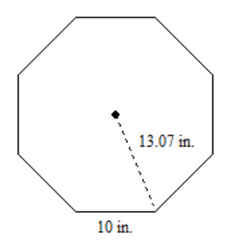
Find the area of the regular octagon.
4
300 sec
111.41.C.11.A
Q.
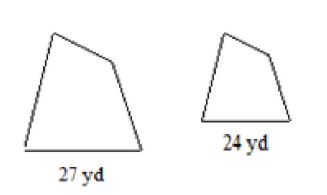
The figures are similar. Give the ratios for the perimeter and the area of both figures.
5
300 sec
111.41.C.10.B
Q.
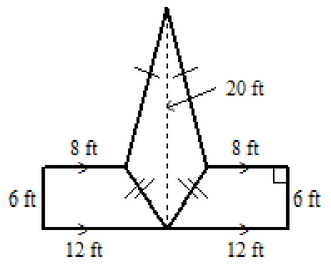
Find the area of the composite figure.
6
300 sec
111.41.C.11.B
Q.
The area of a regular octagon is 35 cm^2. What is the area of an octagon with sides five times as long?
7
300 sec
111.41.C.11.A
Q.
Two triangles each have two sides length 120 and 180. One has an included angle of 60 degrees and the other has an included angle of 40 degrees. What is the difference between their areas?
8
300 sec
111.41.C.9.A
Q.
Find the area of an equilateral triangle with one side of 10.