Loading...


1.1 Creating the Constitution CR
Quiz by Mr. Galda
Customize this quiz to suit your class
Instantly translate to 100+ languages
Tag the questions with any skills you have. Your dashboard will track each student's mastery of each skill.
Give this quiz to my class
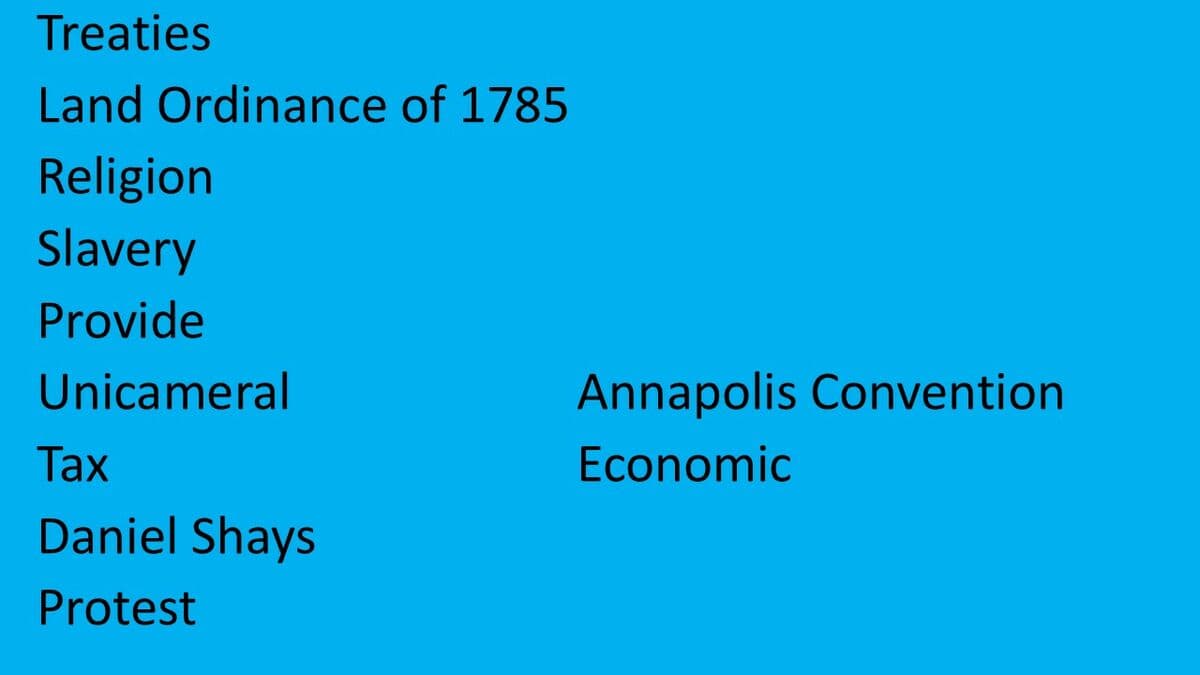
With the articles of Confederation, the United States was able to negotiate ______.
The ____allowed the United States to survey and sell western lands
With the articles of Confederation, the United States was able to negotiate ______.
The ____allowed the United States to survey and sell western lands
_____ was a freedom that was protected by the Northwest Ordinance of 1787
The Northwest Ordinance of 1787 prohibited______ in the Northwest Territory.
The Articles of Confederation did not _____ for a strong central government.
_____ is a one house legislature
The Congress did not have the power to ____under the Articles of Confederation.
____led the rebellion that exposed the weaknesses of the Articles of Confederation
Shays' Rebellion was a _____by farmers against high taxes and economic hardship.
The ______ led directly to the drafting of the U.S. Constitution.
The Articles did not grant the federal government the power to regulate interstate commerce, resulting in ________issues.
 RPMS Quiz: Quality vs. Efficiency 1. A teacher spends five hours creating a highly interactive digital game for a single 40-minute lesson. This is an example of prioritizing: • A) Quality over Efficiency • B) Efficiency over Quality • C) Administrative Competence • D) Resource Management • Hint: The focus is on high-level engagement, but the time investment is very high. 2. Which of the following best describes "Efficiency" in the context of the RPMS? • A) Submitting all MOVs and reports on or before the deadline with minimal errors. • B) Ensuring 100% of students pass the quarterly examination. • C) Creating the most aesthetically pleasing portfolio in the department. • D) Conducting home visits for every single student in a class of 50. • Hint: Look for the option that emphasizes timeliness and resource use. 3. Using a "template" or a "reusable slide deck" for lesson planning is a strategy to improve: • A) Efficiency • B) Instructional Diversity • C) Subject Matter Mastery • D) Classroom Discipline • Hint: Templates reduce the time spent on repetitive formatting. 4. If a teacher provides detailed, personalized feedback to every student but submits the grades two weeks late, they have achieved: • A) High Quality, Low Efficiency • B) Low Quality, High Efficiency • C) High Quality, High Efficiency • D) Low Quality, Low Efficiency • Hint: The work itself is excellent, but the timing is poor. 5. Which tool improves Efficiency without sacrificing the Quality of assessment data? • A) Automated Google Forms for multiple-choice quizzes. • B) Giving everyone a passing grade to save time on checking. • C) Writing long paragraphs of feedback on 200 paper-based essays. • D) Skipping assessments entirely to finish the syllabus faster. • Hint: Look for a balance where technology handles the "busy work." 6. When discussing Quality in your RPMS portfolio, which "Means of Verification" (MOV) is most appropriate? • A) Sample of student work with constructive teacher comments. • B) A logbook showing you arrived at school at 7:00 AM daily. • C) A certificate for attending a 1-hour webinar. • D) A photo of your organized teacher's cabinet. • Hint: Quality is evidenced by the impact on student learning. 7. The concept of "Doing the right things" (Effectiveness) represents: • A) Quality • B) Efficiency • C) Speed • D) Compliance • Hint: "Doing the right things" is about results; "Doing things right" is about process. 8. How does "Efficiency" help a teacher maintain "Quality" in the long run? • A) It prevents burnout by optimizing workload, leaving energy for creative teaching. • B) It allows the teacher to take more side jobs. • C) It ensures the teacher never has to talk to parents. • D) It proves that the teacher is smarter than their peers. • Hint: Consider the relationship between teacher well-being and performance. 9. If a teacher's RPMS rating for Quality is 5 (Outstanding) but Efficiency is 2 (Fair), what is the most likely reason? • A) The teacher produces excellent work but often misses deadlines. • B) The teacher is very fast but makes many mistakes in their reports. • C) The teacher is both slow and produces poor results. • D) The students are failing despite the teacher being very organized. • Hint: Check the gap between the high-standard output and the slow delivery. 10. What is the ultimate goal of balancing Quality and Efficiency in the PPST-RPMS? • A) To achieve sustainable professional excellence that benefits the learners. • B) To get a higher salary increase only. • C) To impress the School Head during the observation. • D) To finish the school year with the least amount of work possible. • Hint: It's about long-term growth for both teacher and student. ________________________________________ Answer Key: 1. A | 2. A | 3. A | 4. A | 5. A | 6. A | 7. A | 8. A | 9. A | 10. A ________________________________________Use the questions and answers below to make a 10 question quiz: Which principle of interactive media is most impacted by its ‘ubiquity’? A) Restricted access control B) Global market presence and integration C) Limited reach to specific user demographics D) Single-channel broadcasting Answer: B Which feature of interactive media ensures that users can actively control and manipulate the content they access? A) Multimedia integration B) UI simplification C) User interactivity D) System automation Answer: C How does globalisation enhance user experience in interactive media systems, according to 1.1.1? A) By reducing content to a single cultural standard B) By supporting diverse user needs through varied, accessible content C) By enforcing a common global pricing structure D) By allowing one-way communication only Answer: B Why is copyright compliance critical in the context of interactive media? A) It allows users to freely distribute content B) It supports ethical use and protects creators from unauthorized distribution C) It restricts all users from accessing online media D) It focuses solely on preventing duplication of digital games Answer: B In interactive media, 'UX' primarily focuses on what aspect of user engagement? A) Monitoring users’ online activities B) Enabling dynamic user experiences tailored to user intent and satisfaction C) Simplifying multimedia formats to save storage D) Reducing user interaction to maintain control Answer: B What is a key distinction between ‘social issues’ and ‘ethical issues’ in interactive media development? A) Social issues focus on technical concerns, while ethical issues are user-centered B) Social issues relate to user interactions, while ethical issues focus on moral responsibilities C) Social issues address individual rights, whereas ethical issues involve systemic improvements D) Social issues are about compliance, whereas ethical issues concern legal standards Answer: B Which component is crucial to creating an accessible interactive media system for users with disabilities? A) High-end processing units B) Customizable UI elements, such as voice and visual aids C) Limited content based on user demographics D) Exclusive copyright protections Answer: B How does data quality contribute to an interactive media system's success? A) By maximizing data storage for multimedia content B) By ensuring content is relevant, current, and accurate for the intended audience C) By focusing on visual appeal over functionality D) By reducing interaction requirements to enhance performance Answer: B Which factor in interactive media systems enhances global engagement through a seamless user experience? A) Interactivity B) Ubiquity C) Restricted Access D) Content Redundancy Answer: B Why might legal implications arise in interactive media systems despite ethical intentions? A) Compliance with global standards B) Misinterpretations of user intent in a diverse cultural context C) Excessive content validation D) Limited user feedback channels Answer: BLesson 2: USES OF SOIL PRETEST Color the pictures that show how we can use soil. SOMETHING TO READ Soil is very useful to us. We can use it in many ways. Let us find out the different uses of soil one by one. Uses of soil a. Sand is used in making our houses. It is also used in making hollow blocks. OBJECTIVES: - Enumerates things that we can with soil - Demonstrates ways for making play things out of soil SCIENCE 2 – MODULE 7 SEIBO COLLEGE 9 b. Soil is made up of minerals, nutrients, water and air that support growing plants. It also keeps the plant’s roots on the ground. c. Animals like earthworm and ants lives in the soil. They create tunnels in it to allow air and water to pass through it. d. Clay soil is used in making pots and vases. We can play with it. We can make different objects that we can use to play with. e. When we are at the shore of the beach, we can play with sand and build sand castles. SOMETHING TO DO ACTIVITY 1 Creating Things I Like Objective: In this activity, children will learn that they can create things out of clay. What you need: SCIENCE 2 – MODULE 7 SEIBO COLLEGE 10 2 bars of clay (any color) 1 pc. 1/8 illustration board or any hard board What to do: 1. Using the bars of clay, create things that you like then place them on the illustration board. 2. Show your work to your facilitator. Observation: 1. Is it easy for you to create things that you like out of clay? __________________________________________________ 2. What is the texture of the clay? ________________________ 3. Did you have fun dong this activity? _____________________ Conclusion: I therefore conclude that _Certainly, let's expand on each section in detail so you can learn more from the provided text: # Summary This text aims to explain various aspects related to technology, particularly focusing on a concept known as "Tech Disruption." It explores how technology affects different sectors, outlines the conditions for tech disruption, discusses the industrial revolutions, introduces the laws of disruption, and mentions factors influencing technology choices. ## Concept of Technology **Technology** encompasses a range of elements within organizations. It includes **expertise, equipment, and procedures** used to convert inputs, such as resources or raw materials, into outputs, which can be products or services. This involves various aspects, such as **product design, production techniques, quality assurance measures, human resource development, and management systems**. In essence, technology represents the tools and knowledge used to create and deliver goods or services effectively. ## What is Tech Disruption **Tech Disruption** refers to a phenomenon where smaller companies with limited resources successfully challenge well-established incumbent businesses. This disruption is primarily driven by **technology**, which acts as the catalyst, enabler, or even the sole reason behind the change. The significance of this concept lies in the fact that entrepreneurs must make careful and thoughtful decisions when it comes to adopting and investing in technology. **Why it's Important?** These decisions are crucial because they involve significant investments and will have a substantial impact on a company's ability to create, innovate, and operate its services in a sustainable and cost-effective manner. ## Four Main Impact **Tech Disruption** has four main impacts on businesses and industries: 1. **Shifting Customer Expectations**: As technology evolves, customer expectations change. Companies must adapt to meet these evolving demands to remain competitive. 2. **Enhanced Products Through Data**: Data-driven insights improve the productivity and efficiency of assets, leading to better products and services. 3. **New Partnerships and Collaboration**: Tech disruption encourages companies to form new partnerships and collaborations, recognizing the importance of working together to stay relevant. 4. **Transformation of Operating Models**: Traditional operating models are being transformed into digital models, where technology plays a central role in how businesses operate and deliver value. ## The 11 Macro Sources of Distribution The **11 Macro Sources of Distribution** represent various factors that influence the distribution of resources and opportunities in society. These factors include: 1. **Wealth Distribution**: How wealth is distributed among individuals and entities. 2. **Education**: The availability and quality of education opportunities. 3. **Infrastructure**: The state of infrastructure, such as transportation and communication networks. 4. **Government**: Government policies and regulations that impact resource distribution. 5. **Geopolitics**: Geopolitical factors, such as international relations and conflicts. 6. **Economy**: Economic conditions and trends, including markets and financial systems. 7. **Public Health**: The state of healthcare and public health systems. 8. **Demographics**: Characteristics of the population, such as age and gender. 9. **Environment**: Environmental factors and sustainability concerns. 10. **Media and Telecommunications**: The role of media and communication technologies. 11. **Technology**: Technological advancements and their impact on society. ## When Does Tech Disruption Happen? **Tech Disruption** occurs when specific conditions are met: ### Technology Is Mature Enough - **Technology Accessibility**: Technology must be accessible to a wide range of people and organizations. - **Critical Mass**: It should have reached a critical mass where it can create significant impact. - **Affordability**: Technology must be affordable for businesses to adopt. ### Sector Is Ready For Change - **Tech Infrastructure**: The sector should have the necessary technological infrastructure in place. - **Policy Framework**: A conducive policy framework is essential to support and regulate the use of technology. - **Lack of Disruption**: If the sector is stagnant or facing issues, it becomes ripe for tech disruption. ### Sector + Technology + Timing + Product - **Mature Technology with an Unready Sector**: If technology is mature but the sector is not ready, it can lead to building the wrong product based on incorrect assumptions. - **Unmatured Technology with a Ready Sector**: Conversely, if technology is not matured but the sector is ready, it may take longer to develop the product. ## Ready for Industri 5.0? This section briefly outlines the five industrial revolutions: 1. **Industri 1.0 (1784)**: Marked by mass production assembly lines using electrical power. 2. **Industri 2.0 (1870)**: Introduced mechanization, steam, and water power. 3. **Industri 3.0 (1969)**: Characterized by automated production, computers, IT systems, and robotics. 4. **Industri 4.0 (Present)**: Involves smart factories, autonomous systems, IoT (Internet of Things), and machine learning. 5. **Industri 5.0 (Future)**: Envisions mass customization and cyber-physical cognitive systems. ## Three Laws of Disruption These laws explain the nature of disruption: 1. **Disruption Comes to All**: Disruption is a universal phenomenon; it affects all industries and businesses sooner or later. 2. **Product-Market Fit**: Disruption occurs due to changes in Product-Market Fit, which means aligning a product with its target market effectively. 3. **Methods to Change Product-Market Fit**: To address disruption, a company can change the product, the target market, or influence people's preferences regarding the product. ## The 40% Rule This rule provides a framework for evaluating the fit between a product and its market: - **Value Proposition**: The product should solve customers' problems effectively. - **Channels**: The product should be able to reach customers cost-effectively. - **Monetization**: Customers should be willing to pay for the product. ## PMF Framework: 5 Steps to Product/Market Fit The **PMF (Product/Market Fit) Framework** consists of five steps: 1. **Business Modeling**: Developing a business model that aligns with the market. 2. **Market Validation**: Confirming that there is demand for the product in the market. 3. **Customer Interviews**: Gaining insights from potential customers. 4. **Product Development and Customer Acquisition**: Creating the product and acquiring customers. 5. **Product Analytics**: Using data to determine if the product has achieved Product/Market Fit. ## Factors Determining the Choice of Technology Several factors influence the choice of technology: 1. **Government Policy**: Government regulations and policies can encourage or restrict the adoption of specific technologies. 2. **Available Resources**: The resources, both financial and human, impact the adoption of technology. 3. **Technological Capability**: The organization's technological capabilities influence the choice of technology. 4. **Existing Technological Level**: The current technological state of the industry or organization plays a role. 5. **Institutional Arrangement**: Organizational structures and arrangements affect technology choices. ## Conclusion In conclusion, the text emphasizes the critical role of technology in driving change and disruption in various industries. It highlights the need for informed decision-making when it comes to technology investments, as well as the conditions necessary for tech disruption to occur. Understanding the historical context of industrial revolutions, the laws of disruption, and the factors influencing technology choices is essential in today's fast-paced and tech-driven business environment. Embracing technology disruption is crucial for transforming business models and adapting to evolving market dynamics.Creating Fun in the Office - FY24 July Week 1 Here is the survey with all bold text removed: --- Survey: Feedback on Noones' New Liquidity-Providing Outsourcing Tool We’re excited to introduce a new feature at Noones.com, allowing users to create buy and sell offers without needing upfront capital. By partnering with liquidity providers, users can earn passive income by setting markups on trades that are automatically fulfilled by our providers. Your feedback will help us refine this feature and understand its potential to benefit our users. Thank you for your time and insights! 1. Are you interested in a feature that allows you to create buy/sell offers without holding crypto or capital, by outsourcing fulfillment to liquidity providers? - [ ] Very interested - [ ] Somewhat interested - [ ] Neutral - [ ] Not very interested - [ ] Not interested at all 2. How likely are you to use a feature that lets you set markup rates on trades that are then automatically fulfilled by liquidity providers? - [ ] Very likely - [ ] Likely - [ ] Neutral - [ ] Unlikely - [ ] Very unlikely 3. If available, how often would you consider creating offers using the liquidity provider option? - [ ] Daily - [ ] Weekly - [ ] Monthly - [ ] Occasionally - [ ] Not interested in creating offers 4. How valuable do you find the following aspects of the liquidity-providing feature? - Earning passive income without capital investment - [ ] Very valuable - [ ] Valuable - [ ] Neutral - [ ] Not valuable - Setting custom markups and earning the difference - [ ] Very valuable - [ ] Valuable - [ ] Neutral - [ ] Not valuable - Automated trading with hands-free fulfillment - [ ] Very valuable - [ ] Valuable - [ ] Neutral - [ ] Not valuable 5. Would a feature like this make you more likely to recommend Noones to friends or colleagues? - [ ] Definitely - [ ] Probably - [ ] Not sure - [ ] Probably not - [ ] Definitely not 6. What would be your primary motivation for using this feature? - [ ] Earning passive income - [ ] Low barrier to entry (no capital required) - [ ] Scalability and flexibility in setting markups - [ ] Reliable, hands-free trading - [ ] All of the above 7. Do you have any concerns about this feature? (Select all that apply) - [ ] Security of trades and transactions - [ ] Understanding the markup and fee structure - [ ] Reliability of liquidity provider fulfillment - [ ] Potential profits or earnings - [ ] Other: _____________ 8. How likely are you to use Noones as your primary trading platform if this feature is implemented? - [ ] Very likely - [ ] Likely - [ ] Neutral - [ ] Unlikely - [ ] Very unlikely 9. How confident are you that this feature could increase your trading profits? - [ ] Very confident - [ ] Confident - [ ] Neutral - [ ] Not very confident - [ ] Not confident at all 10. Please share any additional thoughts on how this feature could enhance your experience with Noones, or any improvements you’d like to see. - ______________________________________________________________ Thank you for helping us make Noones better! Your feedback is invaluable in shaping features that support your trading goals and enhance your experience with us.Create me a multiple choice test questions with 4 options on the following topic:Consumer Education for Different Audience 1. Children and Youth: - Focus: Building foundational knowledge about basic consumer concepts, making safe choices, understanding money and value, and recognizing scams and unsafe situations. 2. Teens and Young Adults: - Focus: Building financial literacy, responsible debt management, understanding contracts and agreements, responsible technology use, online safety, and consumer rights. 3. Working Adults and Families: - Focus: Managing budgets, making informed purchasing decisions, understanding credit and debt, finding consumer protection resources, and navigating complex financial products (mortgages, insurance, investments). 4. Seniors: - Focus: Protecting themselves from scams and fraud, understanding common consumer issues like telemarketing, identity theft, and online scams, managing medications and healthcare costs, and accessing community resources. 5. Special Populations: - Focus: Adapting consumer education programs to the specific needs of people with disabilities, immigrants, refugees, and other marginalized communities. 6. Business and Industry:- Focus: Understanding ethical marketing practices, complying with consumer protection laws, and providing clear and accurate information to consumers. 7. Policymakers and Regulators: - Focus: Understanding consumer needs, developing effective consumer protection laws, enforcing regulations, and ensuring a fair and competitive marketplace. Adapting consumer education programs for children, teens, and seniors requires tailoring content and delivery methods to their unique needs and learning styles. Children (Ages 5-12): - Understanding the concept of money: Teaching children about saving, spending, and the value of money. - Developing basic budgeting skills: Helping children learn to make choices about how to spend their allowance or pocket money. EFFECTIVE STRATEGIES •Focus on basic concepts: Introduce core concepts like saving, spending, and budgeting in a fun and engaging way. Use simple language and relatable examples. •Real-life scenarios: Use age-appropriate scenarios to illustrate financial concepts, like buying toys or snacks. •Parental involvement: Encourage parent participation and provide resources to help them reinforce lessons at home. Teens (Ages 13-18): - Building budgeting and financial planning skills: Teaching teens how to manage their money, set financial goals, and plan for the future. - Navigating the digital marketplace: Equipping teens with the knowledge and skills to make safe and informed online purchases, understand digital marketing, and protect themselves from scams. EFFECTIVE STRATEGIES • Practical skills: Focus on skills relevant to teens, like managing money for social activities, saving for college, and understanding credit cards. • Digital literacy: Address the growing influence of online shopping, social media advertising, and financial scams. • Real-world applications: Connect financial concepts to real-life decisions teens make, like choosing a part-time job or making purchases online. Seniors (Ages 65+) - Managing retirement savings and healthcare costs: Providing information and resources on retirement planning, Medicare and Medicaid, and other healthcare options. - Navigating the digital world: Offering technology training and resources to help seniors access online services and information safely and securely. EFFECTIVE STRATEGIES • Addressing specific concerns: Focus on topics relevant to senior citizens, like retirement planning, managing healthcare expenses, and avoiding scams. • Clear and concise communication: Use simple language and visual aids to ensure easy understanding. • Social interaction: Create opportunities for seniors to share experiences and learn from each other. Teaching Financial Literacy in school and Communities In Schools: Curriculum Integration: Financial literacy concepts can be seamlessly integrated into existing subjects, making learning more relevant and engaging. - Math: Budgeting exercises, calculating interest rates, analyzing financial data, and understanding compound interest are all natural applications of math skills. - Social Studies: Exploring the history of money, financial institutions, economic systems, and the impact of financial decisions on society provide valuable context. - Economics: Discussions about supply and demand, inflation, investment, and the role of consumers in the economy enhance financial literacy. Dedicated Courses: Offering elective courses or workshops specifically focused on personal finance provides deeper dives into crucial topics. - Personal Finance: Cover budgeting, saving, investing, credit, debt management, and insurance. - Entrepreneurship: Introduce concepts like business planning, marketing, financial forecasting, and managing cash flow. In Communities: Community Centers and Libraries: Workshops, seminars, and classes tailored to adults and families provide accessible learning opportunities. - Financial Planning: Cover budgeting, retirement planning, debt management, and estate planning. - Homeownership: Provide guidance on buying, selling, and maintaining a home. - Consumer Protection: Educate individuals about their rights and how to avoid scams. Partnerships with Financial Institutions: Collaborations with banks, credit unions, and financial advisors offer valuable resources, workshops, and financial literacy programs. Consumer Education for Low-Income and Vulnerable Populations Low-income refers to individuals or households with limited financial resources, typically below a certain threshold. Low-income individuals may face challenges like: 1. Limited education and job opportunities 2. Poor living conditions and housing 3. Food insecurity and malnutrition Causes of low income: 1. Unemployment or underemployment 2. Low-paying jobs or minimum wage 3. Limited education or skills 4. Single parenthood or large family size Vulnerable population'' is a term that is used to describe a group of people who possess some sort of disadvantage. elderly people, people with low incomes, homeless people, people in prison, migrant workers, pregnant women, Family Consumer Education: Managing Household Finances and Resources Financial literacy is the ability to understand and manage personal finances effectively. 1. Debt Debt is money you spend that isn’t yours. If you borrow money from the bank, use a credit card, or take out a short-term loan, or a payday loan, you are accumulating debt. Good debt is considered money borrowed for things that are absolutely necessary for making a life e.g. a house and for advancing your money-making potential e.g. an education. Bad debt is considered borrowing money or using a credit card to pay for things you don’t need, such as expensive clothes, hi-tech electronics, eating out at restaurants, going on holidays, etc. 2. Saving Saving is an essential part of financial wellness, a secure present, and a happy future. 3. Budgeting Budgeting is the life skill of planning and managing your money. By understanding exactly where your money goes every month, you are empowered to create an actionable plan by which you can spend less, by curtailing those unnecessary expenses and saving more for the things you need and want. 4. Investing Investing is all about creating and growing the wealth you need to enjoy a financially secure and happy future. It’s about putting your money into something that will make you a profit over time, such as property, retirement funds, and unit trusts Integrating Consumer Education into the Home Economics Curriculum. Integrating consumer education into the home economics curriculum can provide students with essential skills for making informed choices about their personal finances, food, clothing, and overall well-being. Here are some strategies and ideas for effectively incorporating consumer education: Financial Literacy Budgeting: Teach students how to create and manage a personal budget, including setting financial goals, tracking expenses, and understanding savings. Saving and Investment: Cover the basics of saving, including different saving accounts, and introduce concepts related to investing. Food and Nutrition Food Label Literacy: Engage students in learning how to read and interpret food labels, including nutrition facts and ingredient lists. Grocery Shopping Skills: Teach students how to compare product costs, understand unit pricing, and make healthy, budget-friendly choices while shopping. Clothing and Textile Education Consumer Choices in Clothing:Discuss factors influencing clothing purchases, such as quality, price, and sustainability. Fashion and Trends: Analyze the impact of marketing and advertising on consumer behavior regarding clothing. Sustainable Purchasing Eco-Friendly Choices: Raise awareness about environmentally friendly products and the importance of sustainability in consumer choices. Project-Based Learning - Assign real-life projects where students must apply their knowledge, such as creating a meal plan within a budget, planning a shopping list based on nutrient needs, or evaluating the cost-effectiveness of different products. Technology Integration - Use technology to teach students about online shopping, price comparison websites, and apps that aid budgeting and financial planning. Collaborative Learning Opportunities - Organize team projects where students work together to solve consumer-related problems, emphasizing teamwork and communication skills. Assessment and Reflection - Incorporate assessments that allow students to reflect on what they have learned about consumer education and how they can apply these skills in their daily lives. MIL 12 - The Power of Media and Information in Creating Change QUIZ 1