Loading...


1.1 Foundations of Government CR
Quiz by Mr. Galda
Customize this quiz to suit your class
Instantly translate to 100+ languages
Tag the questions with any skills you have. Your dashboard will track each student's mastery of each skill.
Give this quiz to my class
________is a government in which the people rule
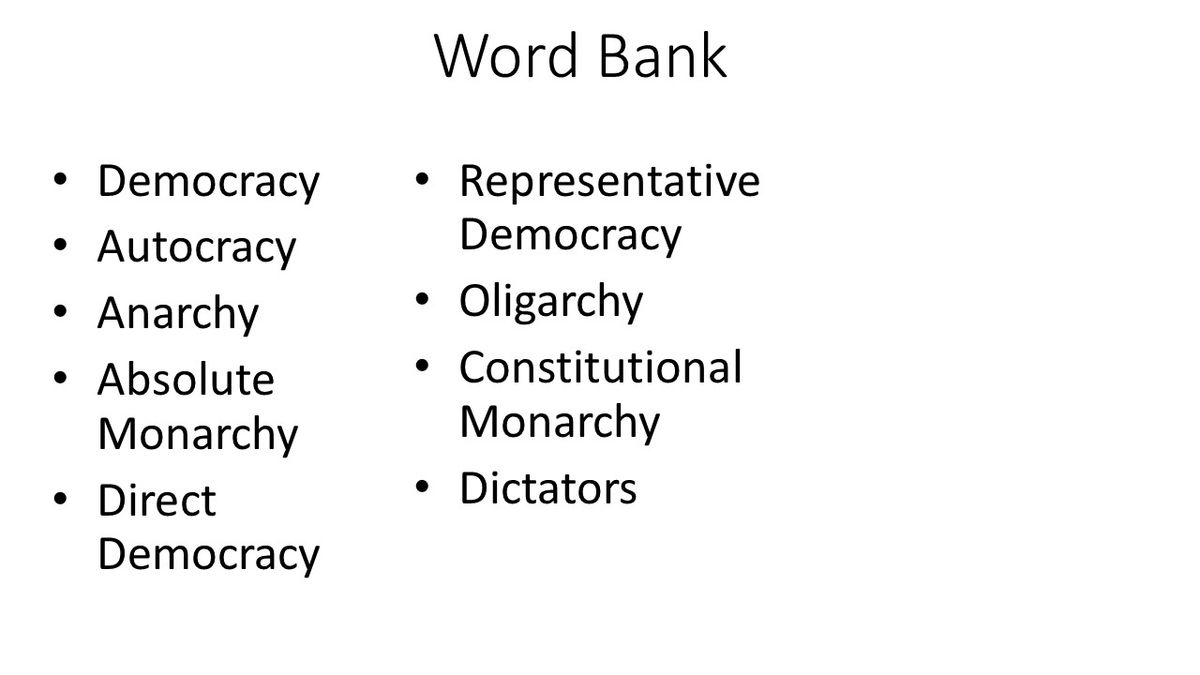
One ruler controlling a country is called a(n) _______.
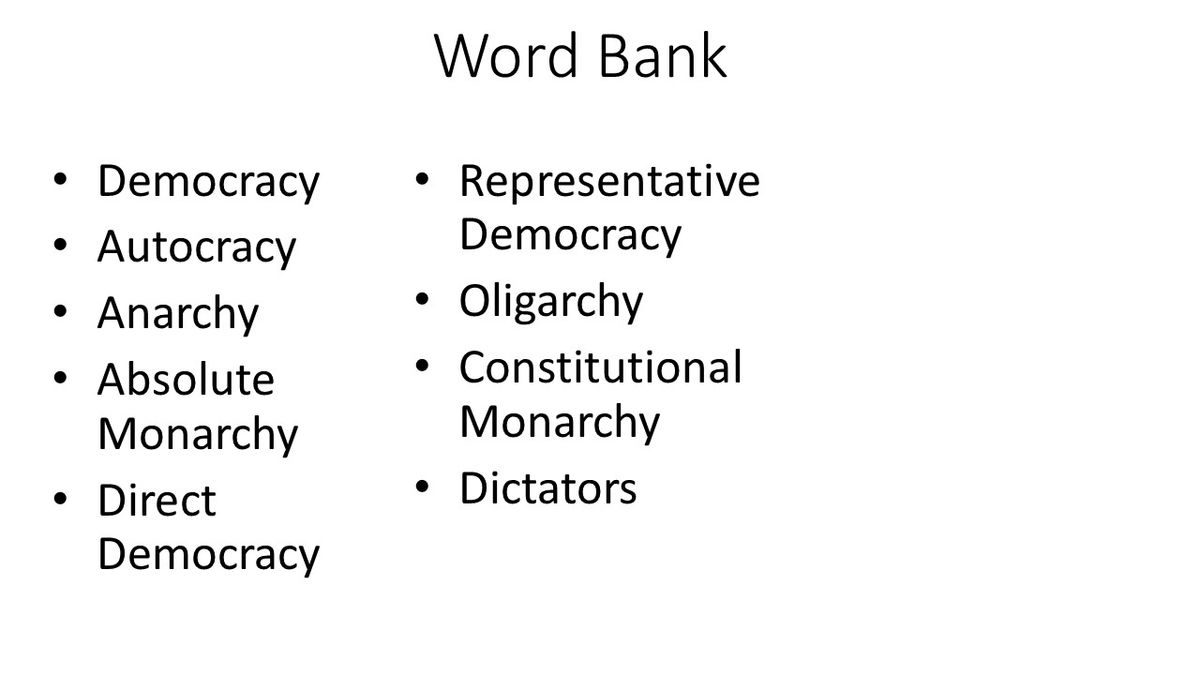
________is a government in which the people rule

One ruler controlling a country is called a(n) _______.
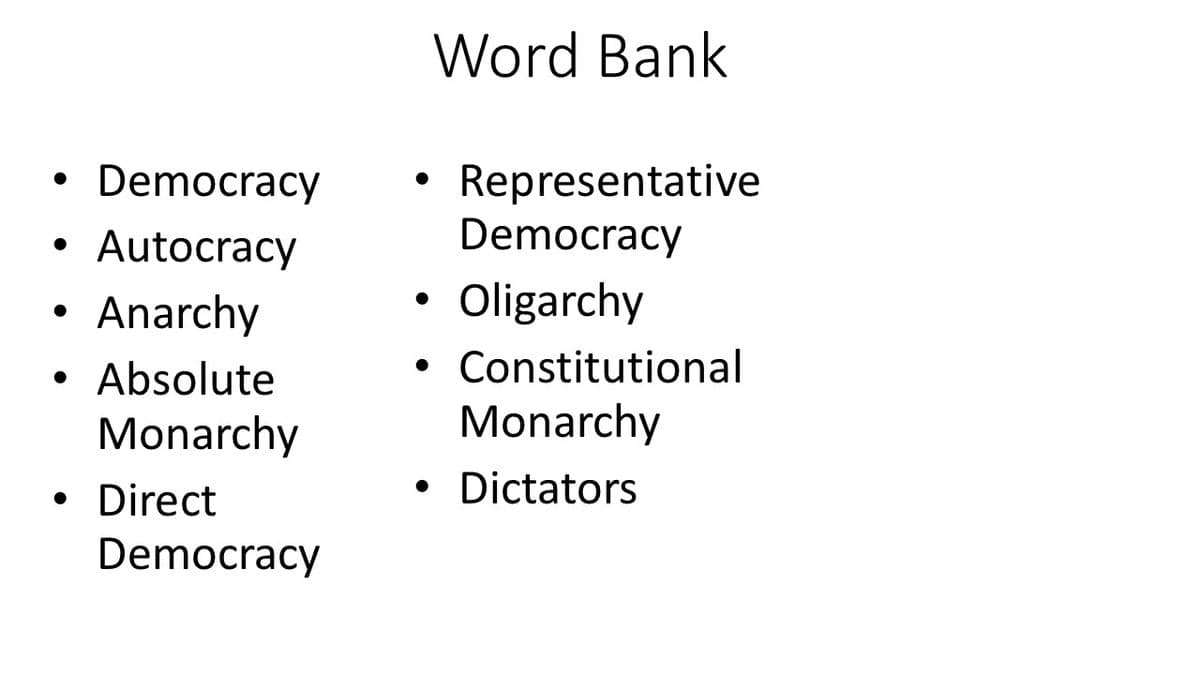
____is when no one rules a country
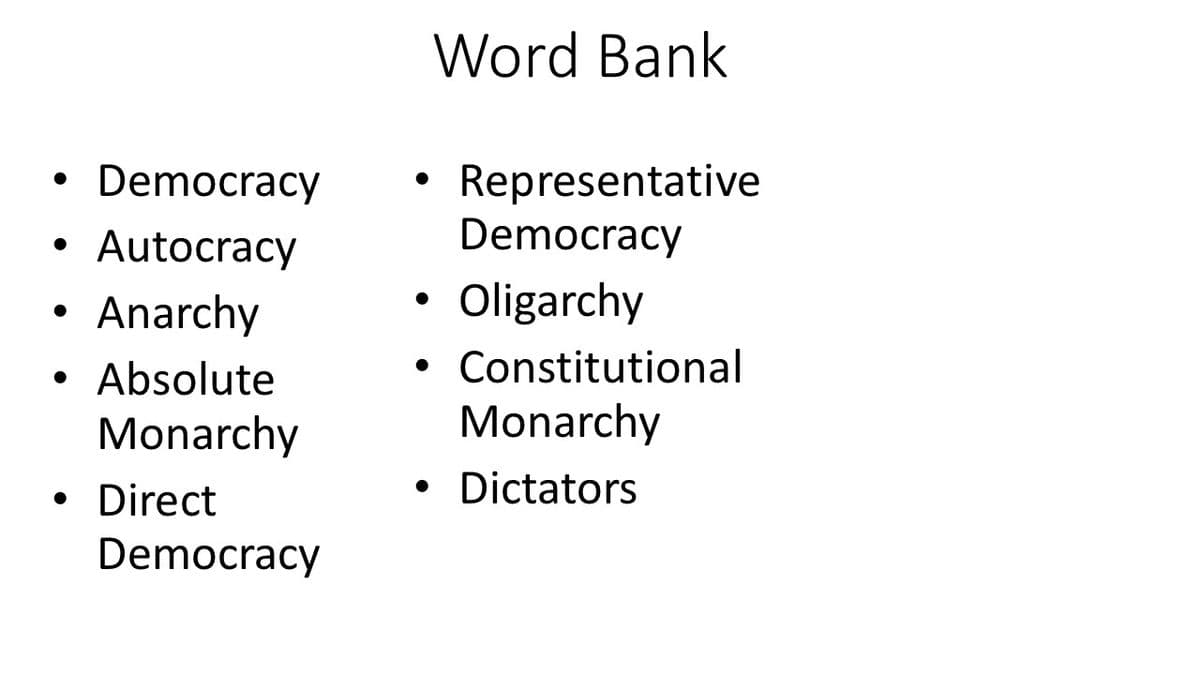
A king or queen ruling with total power is called _.
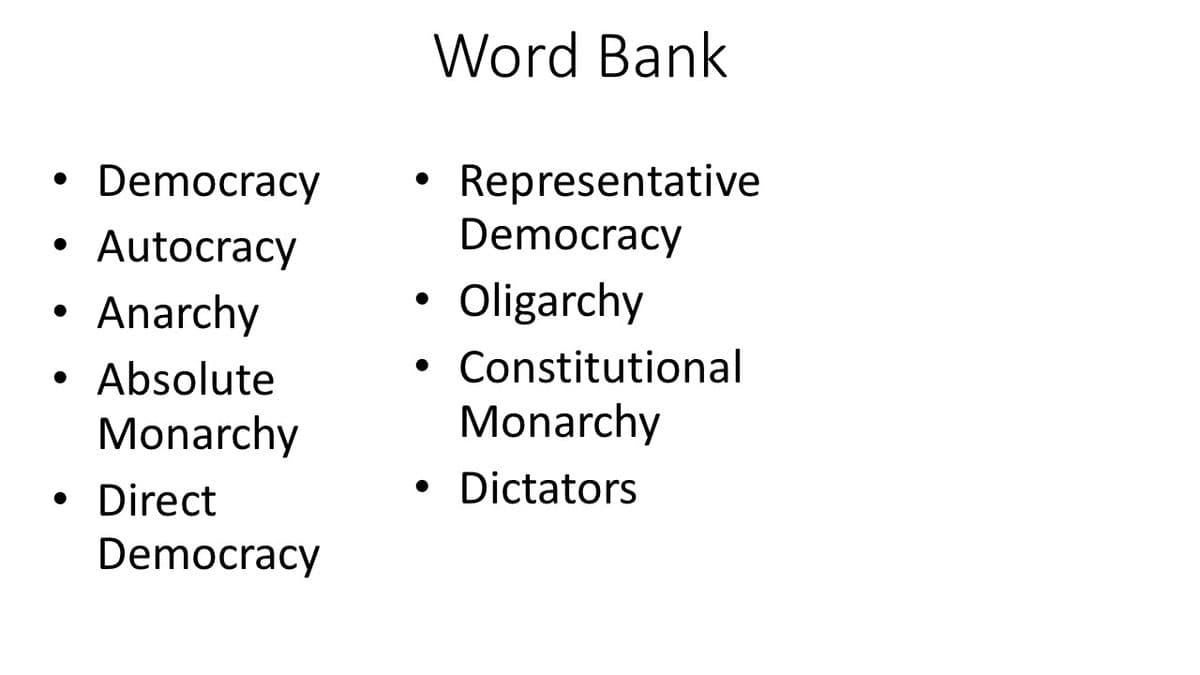
A government in which the people rule by voting on each issue is called_.
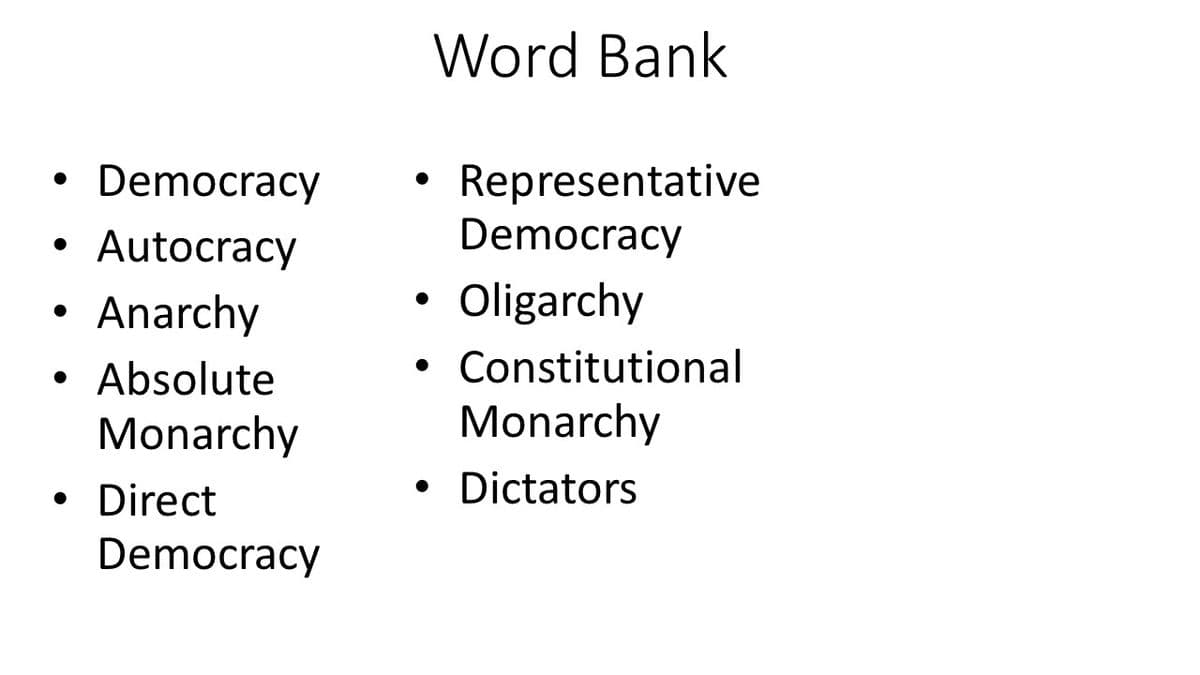
____is the people rule by electing representatives who run the government.
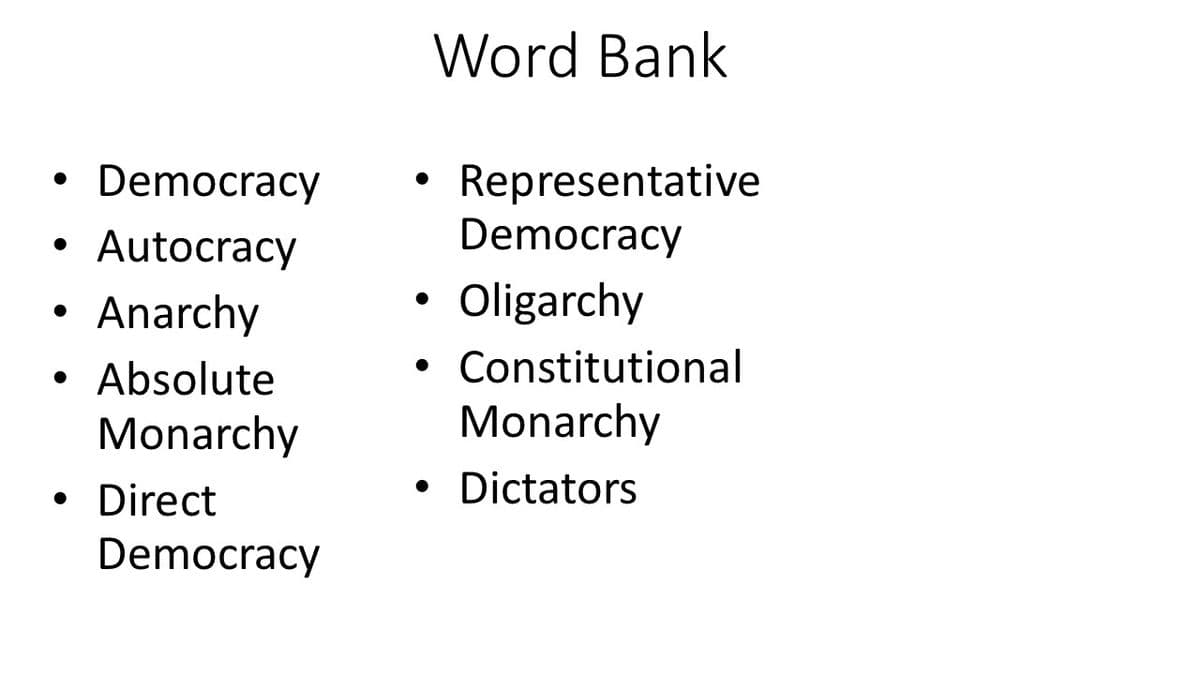
A small group is in charge, often designated by a social class is called _.
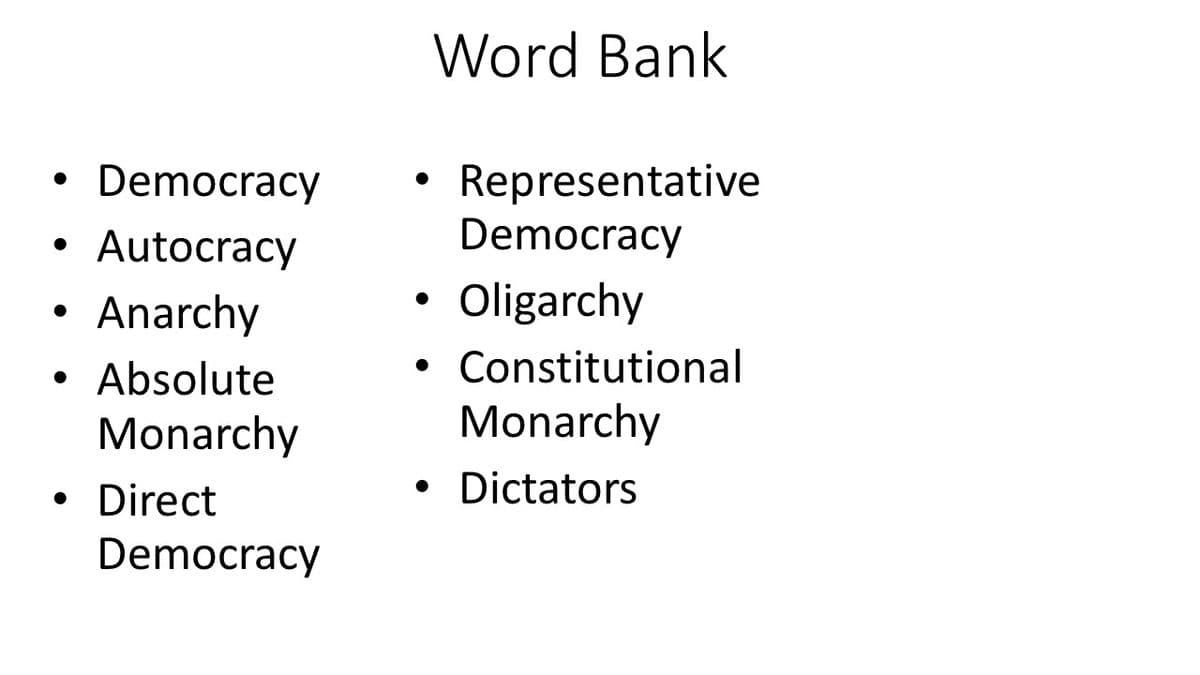
_is when a king or queen rules, but their power is limited by a constitution
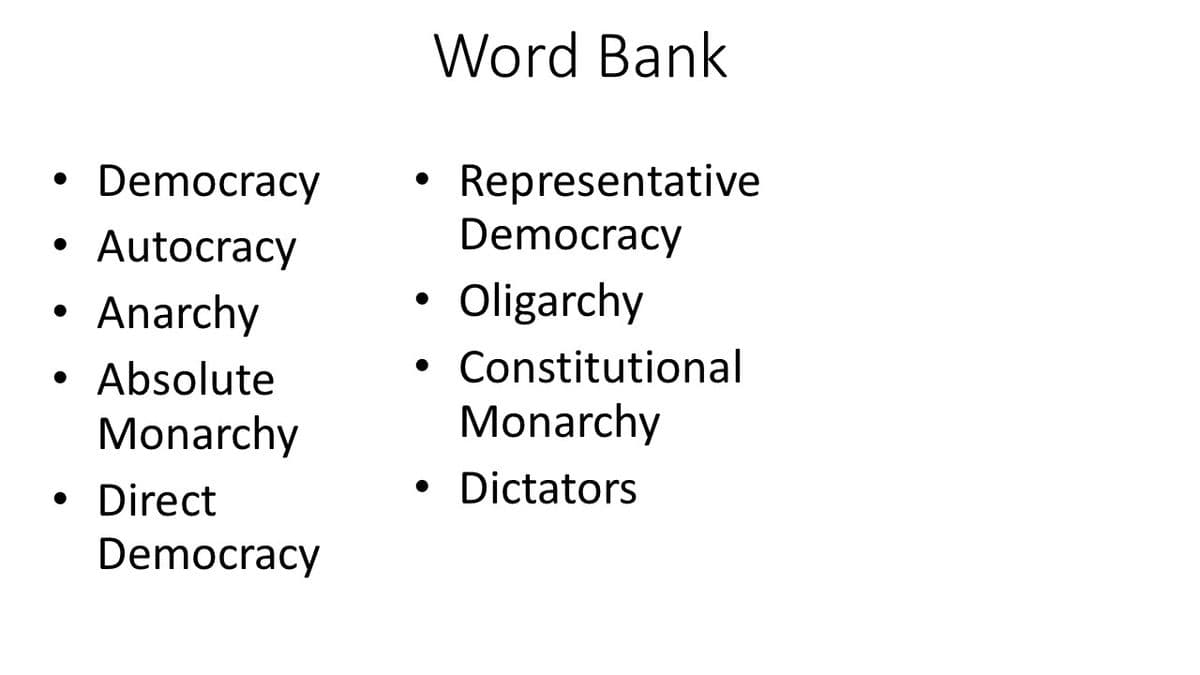
_____often obtain power by military force and they are a single ruler that has total control.
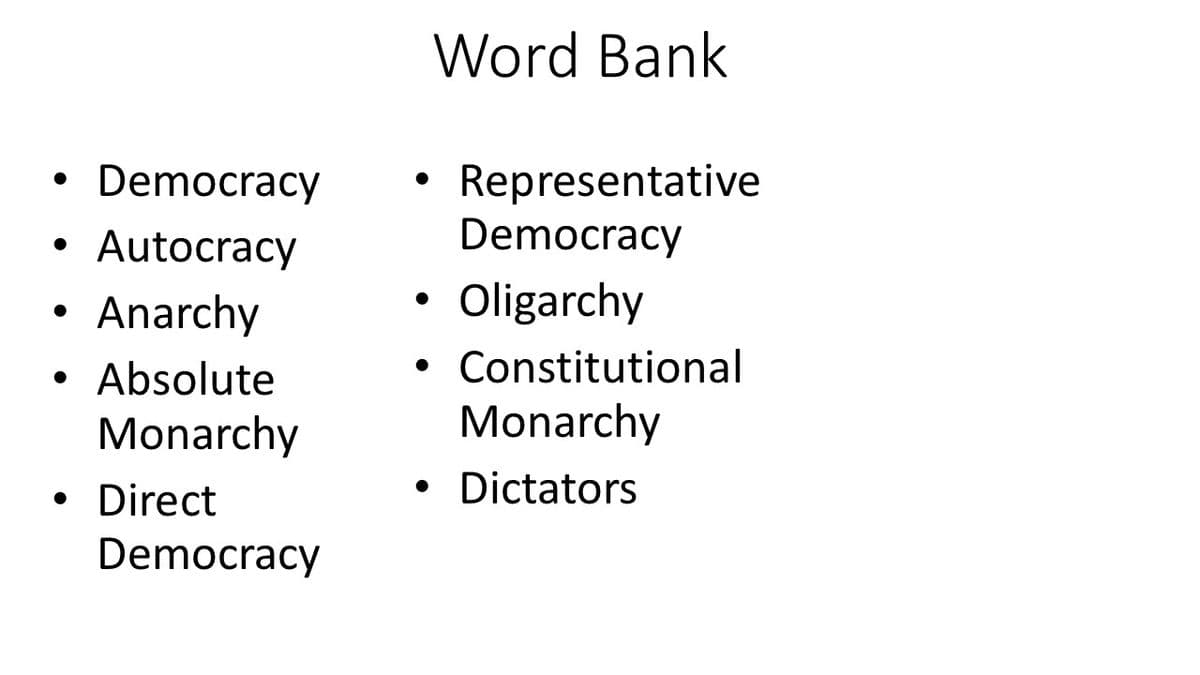
Match the type of government with who rules
Match the government with the example
Ancient India Review QuizWhat is a crime A crime is generally defined as an act or omission that is prohibited by criminal law Two critical ingredients of a crime are: 1) the commission of an act (Actus reus) 2) the mental intent to commit the act (Mens rea) A crime occurs when a person Commits an act or fails to commit an act when under a legal responsibility to do so Has the intent or mens rea to commit the act Does not have a legal defence or justification for committing the act and Violates a provision in criminal law The Social construction of crime Important to distinguish between behaviours that may be considered deviant by society and crimes Deviance is behaviour that is contrary to the norms and values of the larger society Crime is behaviour that breaks the law Deviance includes: Criminal behaviour and Wide range of other behaviours not against the law: May be frowned upon by the larger society What is viewed as deviant changes over time Crime includes: Social construction of crime Legal status of behaviours is not determined by behaviour itself but result of social response to the behaviour/persons/groups engaged in it Criminologists often conduct historical analyses to understand how social, economic and political environments may influence legislation Moral entrepreneurs Often play a key role in criminalizing certain activities Individuals, groups or organizations, seek action against certain groups of people/behaviours and bring pressure on legislators to enact criminal statutes The Origins and Application of the Criminal Law Differing perspectives on where criminal laws come from/ applied via the criminal justice system are reflected in two models 1) Value consensus model 2) Conflict Model Value consensus model Behaviours are defined as criminal/punishment imposed, reflect opinions/limits of tolerance Application of law, society reaffirms acceptable behaviours/social cohesion Conflict Model Crime and punishment reflect the power some groups have to influence, formulation/application of criminal law rich/privileged have an advantage in influencing law reform/criminal justice system The Canadian Legal System Is a common law system, with exception of Quebec which has a civil law system (Based on the French Code Napoleon) Common law is law based on custom, tradition, practice and generally unwritten Precedent is a judicial decision may be use as a standard in subsequent similar cases Canadian Courts Canadian courts organised in a hierarchy Supreme court of Canada is the highest court Stare decisis- principle whereby higher courts set precedents that lower courts must follow “To stand by what was decided” Like cases should be treated alike All courts below SSC bound to apply that same ruling in subsequent cases Criminal Law Body of law deals with conduct considered so harmful to society as a whole that it is prohibited by statute and prosecuted and punished by the government Functions of the Criminal Law In Canadian society, Criminal law provides the following functions Acts as a mechanism of social control Defines the parameters of acceptable behaviour Reduces the risk of personal retaliation Assists in general and specific deterrence Prosecutes criminalized behaviour Protects groups interests Principles of Canadian Law The Rule of Law The requirement that governments as well as individuals be subjected to Traced back to the English Magna Carta The essence of the rule of law is that No one person is above the law All persons are bound by the law All are entitled to protection by the law The law should be observed and enforced equally There is a standard to which criminal justice officials must adhere and will be held accountable Criminal Law Vs. Civil (Tort) Law Summary Crime is a social construction and is a reflection of changing time and mores Criminal law is not static and what behaviour legislatively defined as criminal can change overnight There are instances in which controversy arises when the criminal law is applied to issues of ethics, morality and religion The criminal law was identified as one type of public law and the functions of the criminal law were set out The rule of law and the charter of rights and freedoms are two key parts of the foundation of the criminal justice system There are several principles that also provide the foundation for Canadian law The role, principles origins and application of the criminal law were examined and a number of case studies were presented to illustrate the dynamic nature of the criminal law in a diverse society New Trends in Agriculture Extension approaches Extension has been, and still is, under attack from a wide spectrum of politicians and economists over its cost and financing. As a result, Extension Systems have had to make changes, by restating the system’s mission, developing a new vision for the future, and formulating plans for the necessary transition to achieve the desired change. 1. Privatization of Agricultural Extension Service Privatization: Process of funding and delivering the extension services by private individual or organization is called Private Extension. Concept: Privatization of extension refers to services rendered in rural area & allied aspects of extension personnel working in private agencies or organization for which farmers are expected to pay a fee & it can be viewed as supplementary or alternative to public extension services (Sarvanan & Shivalinge 1980). Privatization approaches ➢ Share cropping system ➢ Village extension contract system ➢ Public extension through private delivery ➢ Service for vouchers Strengths of Private Extension System ➢ More demand - driven rather than supply – driven ➢ High quality of services in terms of satisfying information needs of clientele, trained manpower, sustained finances and resource allocation ➢ Provides for an information mix and choices available to farmers ➢ Enhanced efficiency of staff ➢ Assure continuous supply and quality agricultural products ➢ More effective because farmer can select an adviser who is the best able to help ➢ Healthy competition among service provider will lead to better quality and lower costs for service Weakness of Private Extension System ➢ Concentrate on area having favorable physical environment ➢ More face-to-face contacts (person oriented) ➢ Increased dependence of farmers and hence exploitation ➢ No education role ➢ Deprivation of small farmers ➢ Hamper the free flow of information 2. Cyber Extension or e-extension Concepts Cyber space: it is the imaginary or virtual space of computers connected with each other on Networks, across the Globe. Cyber extension: it means 'using the power of online networks, computer communications and digital interactive multimedia to facilitate dissemination of agriculture technology. Cyber Extension thus can be defined as the extension over cyber space. Important tools of cyber extension E-Mail, Telnet, File Transfer Protocol (FTP), Gopher, Archie and World Wide Web (WWW) Strengths of Cyber Extension ➢ Access to the astounding information and continuously available ➢ Information rich and instantaneously available of information ➢ Interactive communication ➢ The information is available from any point on the globe ➢ Communication is dynamic ➢ Cut steps from traditional process ➢ Save money, time and effort ➢ Multiplicity of purpose Issues and Concerns of Cyber Extension ➢ Lack of Reliable Telecom Infrastructure in Rural Areas ➢ Erratic or no Power Supply ➢ Lack of ICT Trained manpower (willing to serve) in Rural Areas ➢ Lack of content (locally relevant and in local languages) ➢ Lack of Information Services to Rural Clientele ➢ Low Purchasing power of the Rural communities ➢ Lack of Holistic Approaches ➢ Issues of Sustainability Application of cyber extension ➢ Village information shops Dr. M.S. SwaminathanResearch Foundation, Chennai ➢ Information villagers MANAGE in Ranga Reddy District in Andhra pradesh ➢ Gyandoot net initiative of District Dhar, Madhya Pradesh. ➢ Warna wired village of National Informatics Center (NIC) in Kolhapur- Sangli Districts of Maharashtra 3. Market-Led-Extension (MLE) Concepts Market: A congregation of prospective buyers & sellers with a common motive of trading a particular commodity. Extension: It is the spreading/reaching out to the mass Market-led-extension: Agriculture & economics coupled with extension is the perfect blend for reaching at the door steps of common man with the help of technology. Dimensions of market-led extension ➢ Marketing mix: A planned mix of the controllable elements of a product's marketing plan commonly termed as 4Ps: product, price, place, and promotion. These four elements are adjusted until the right combination is found that serves the needs of the product's customers, while generating optimum income. ➢ Marketing plan: A marketing plan is a comprehensive document that outlines a business and marketing efforts for the coming year. It describes business activities involved in accomplishing specific marketing objectives within a set time frame. A marketing plan also includes a description of the current marketing position of a business, a discussion of the target market and a description of the marketing mix that a business will use to achieve their marketing goals. ➢ Market Intelligence: It is the information relevant to a company’s markets, gathered and analyzed specifically for the purpose of accurate and confident decision making. Market intelligence includes the process of gathering data from the company’s external environment, whereas the business intelligence process is primarily based on internal recorded events – such as sales, shipments and purchases. ➢ Market oriented production ➢ Use of Technology Strengths of market-led extension ➢ SWOT analysis of the market ➢ Organization of Farmers’ Interest Groups (FIGs) ➢ Enhancing the interactive and communication skills of the farmers ➢ Establishing marketing and agro-processing linkages ➢ Advice on product planning ➢ Educating the farming community ➢ Direct marketing ➢ Acquiring complete market intelligence ➢ Publication of agricultural market information Production of video films of success stories ➢ Challenges to market-led extension ➢ Gigantic size of extension system ➢ Information technology Diverse conditions ➢ Market intelligence ➢ Reforms in agricultural extension system Government Initiatives ➢ Central warehousing Corporation-1965 ➢ MSP by Commission for Agricultural Cost and Price (CACP) ➢ Food Corporation of India ➢ Then some others as: Cotton Corporation of India (CCI), Jute Corporation of India (JCI), National Dairy Development Board (NDDB), Agriculture and Processed food Export Development Authority (APEDA) etc. 4. Farmer--Led-Extension (FLE) Farmer--led-extension is defined as 'the provision of training by farmers to farmers, often through the creation of a structure of farmer promoters and farmer trainers' (Scarborough et al., 1997). Philosophy and principles ➢ Farmers and local institutions (e.g. producer organizations or village leaders) should play a key role in selecting farmer-trainers and monitoring and evaluating them. This helps make the programmes more accountable to the community or groups that they serve. ➢ Farmer-trainers are ‘of the community’; they communicate in local languages and are more sensitive to local cultures, mannerisms, farming practices, and farmers’ needs. ➢ Farmer-trainers should be selected on the basis of their skills and interest in sharing information, not just on their farming expertise. ➢ Farmer-trainers need strong linkages with and support from development agents (whether government, non-government organization (NGO), or private), the people who train and backstop them. Farmer-trainers generally serve as a complement to existing extension systems, rather than being a substitute for them. ➢ Facilitating organizations and local institutions need to be proactive in ensuring that women as well as men become farmer-trainers. ➢ Simple and appropriate reference materials should be made available to the farmer trainers. Essential Elements of Farmer--led-extension ➢ The group ➢ The Field ➢ The Facilitator ➢ The curriculum ➢ Programme leader ➢ Financing Special features of Farmer--led-extension ➢ All learning is field based & it is primary venue for learning ➢ FLE group learning constantly over the experimentation period ➢ FLE promotes healthy decisions & quality decisions ➢ Farmers conduct their own field studies with comparisons or treatments ➢ Facilitates Farmer-to-Farmer communication ➢ Field staff serve as facilitators ➢ FLE is a unique way to educate farmers ➢ It is an effective platform for sharing of experiences and collectively solving agriculture related problems. 5. Expert system Expert system is an intelligent computer program that uses knowledge and inferences procedures to solve problems (Daniel Hunt, 1986). Objectives of developing expert system ➢ To enhance the performance of agricultural extension personnel and farmer ➢ To make farming more efficient and profitable ➢ To reduce the time required in solving the problems ➢ To maintain the expert system by continuously upgrading the database Advantages of expert system ➢ Solves critical problems by making logical deductions without taking much time ➢ It combines experimental and conventional knowledge with the reasoning skills of specialists ➢ To enhance the performance of average worker to the level of an expert Limitations of expert system ➢ Expensive computer program ➢ Mostly developed not in regional languages ➢ Requires AC power and internet connection all the time ➢ Complex software requires computer skilled personnel Modules of expert system in agriculture ➢ COMAX: Integrated crop management in cotton ➢ SOYEX: Soybean oil extraction expert system ➢ PLANT/ds: Diagnosis of soybean diseases ➢ MAIZE: Maize expert system for field crop management ➢ SEMAGI: Weed control decision making in sunflowers ➢ Rice Crop Doctor: Developed by National Institute of Agricultural Extension Management (MANAGE) Difference between conventional and expert system of extension Conventional Extension ➢ Universal approachability of same information is a problem ➢ Information is given whatever is available without considering needs and resources ➢ No Cost benefit analysis ➢ Information flow depends on availability of agent ➢ Require users to draw their own conclusion from facts Expert System of Extension ➢ Universal approachability of same information is possible ➢ Information is chosen based on their needs and resources ➢ Cost benefit analysis ➢ Information through Cyber Cafe at any place at any time ➢ Conclusion is drawn based on the decision given by the expertTEST Ch 1 Foundations of GovernmentUS Gov Part 1 Foundations of GovernmentUnit 1 Foundations of American GovernmentUnit 1: Foundations of American GovernmentFoundations of Government Unit 1 Test