Loading...


1.1 Road to the Civil War CR
Quiz by Mr. Galda
Customize this quiz to suit your class
Instantly translate to 100+ languages
Tag the questions with any skills you have. Your dashboard will track each student's mastery of each skill.
Give this quiz to my class
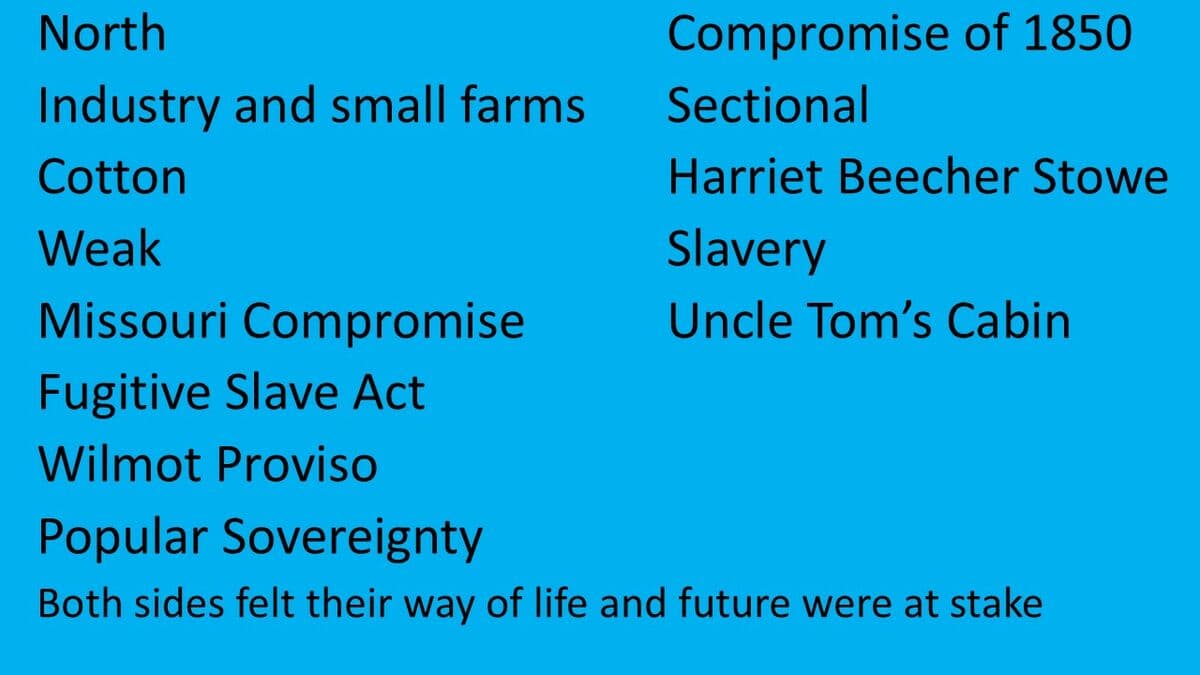
In the ____, slavery was begininng to fade away in the 1800s.
The North's economy could be described as _______.
In the ____, slavery was begininng to fade away in the 1800s.
The North's economy could be described as _______.
______was a major crop in the South that they believed depended on enslaved labor.
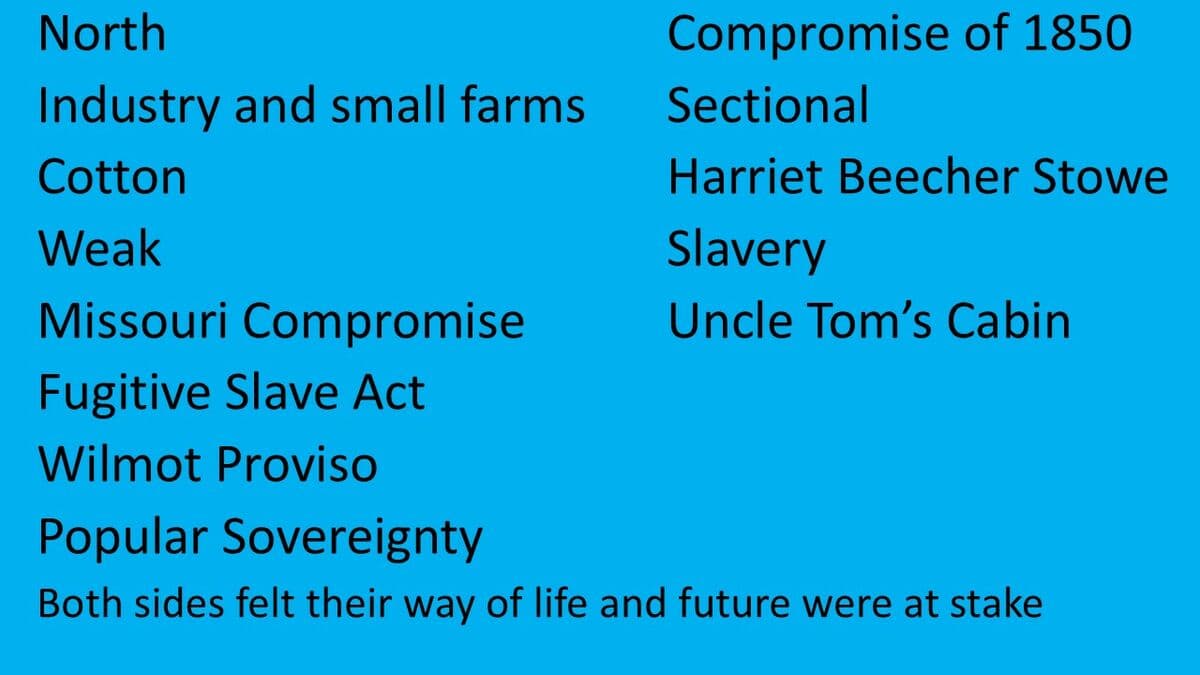
The South supported a _____ federal government to protect its interests.
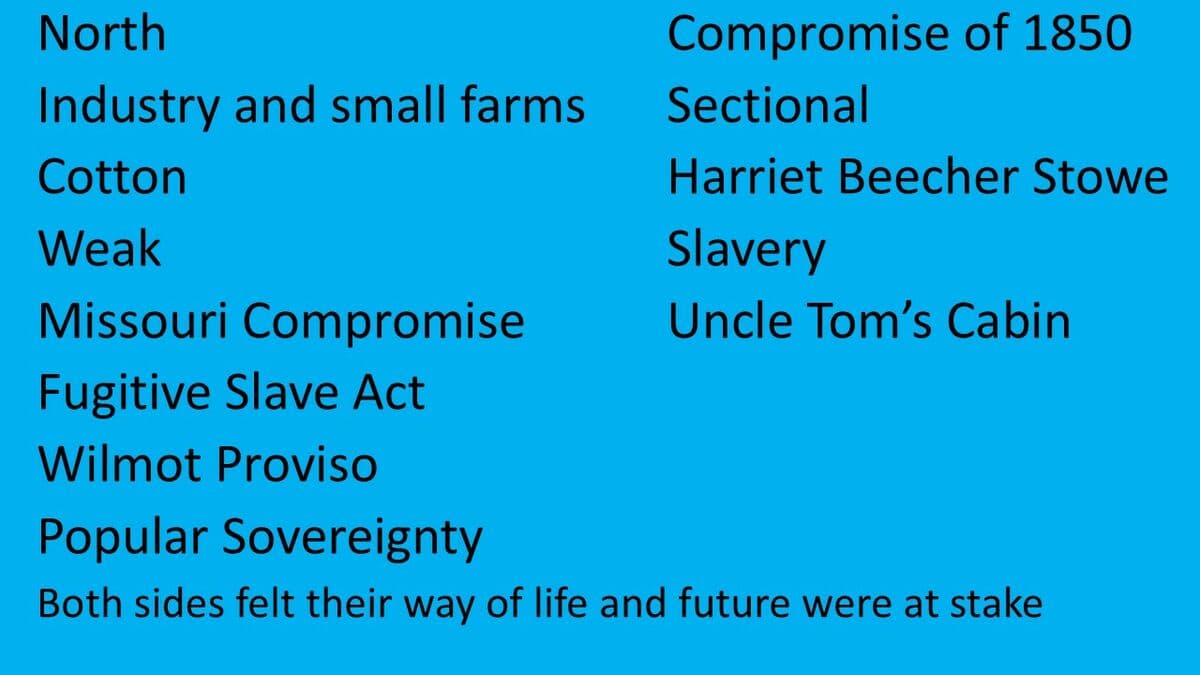
_______was written to decide where slavery would be allowed in new states.
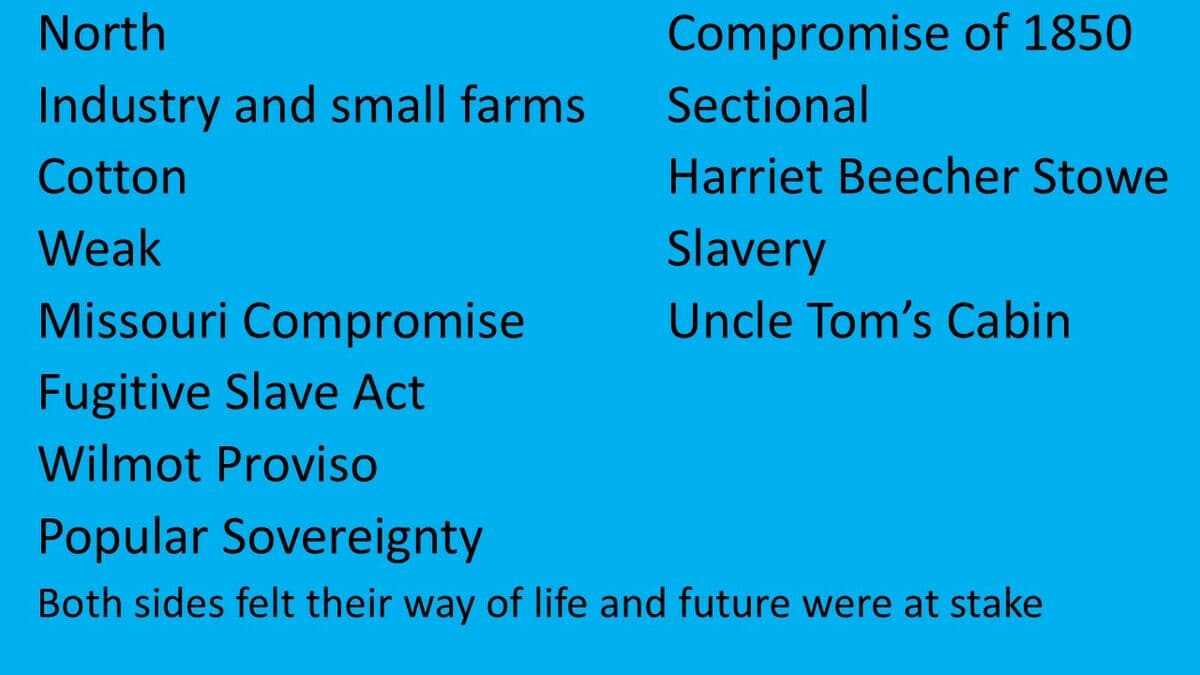
____required Northerners to help return escaped slaves to their owners
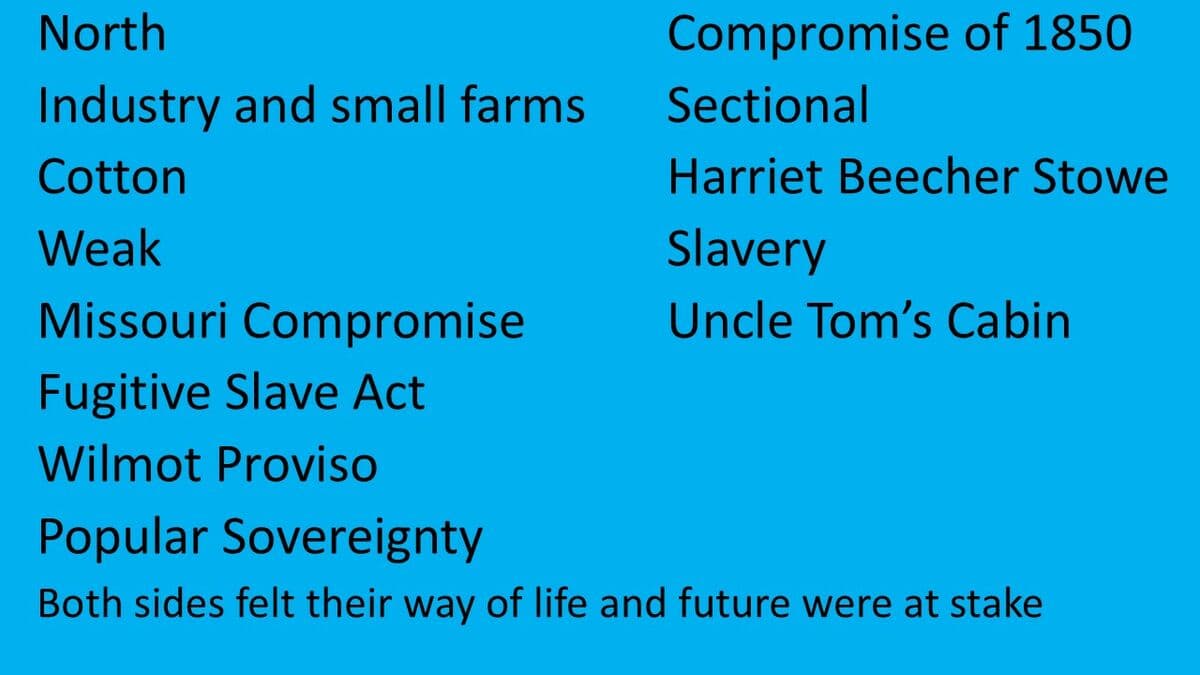
_____proposed to ban slavery in any territory won from Mexico
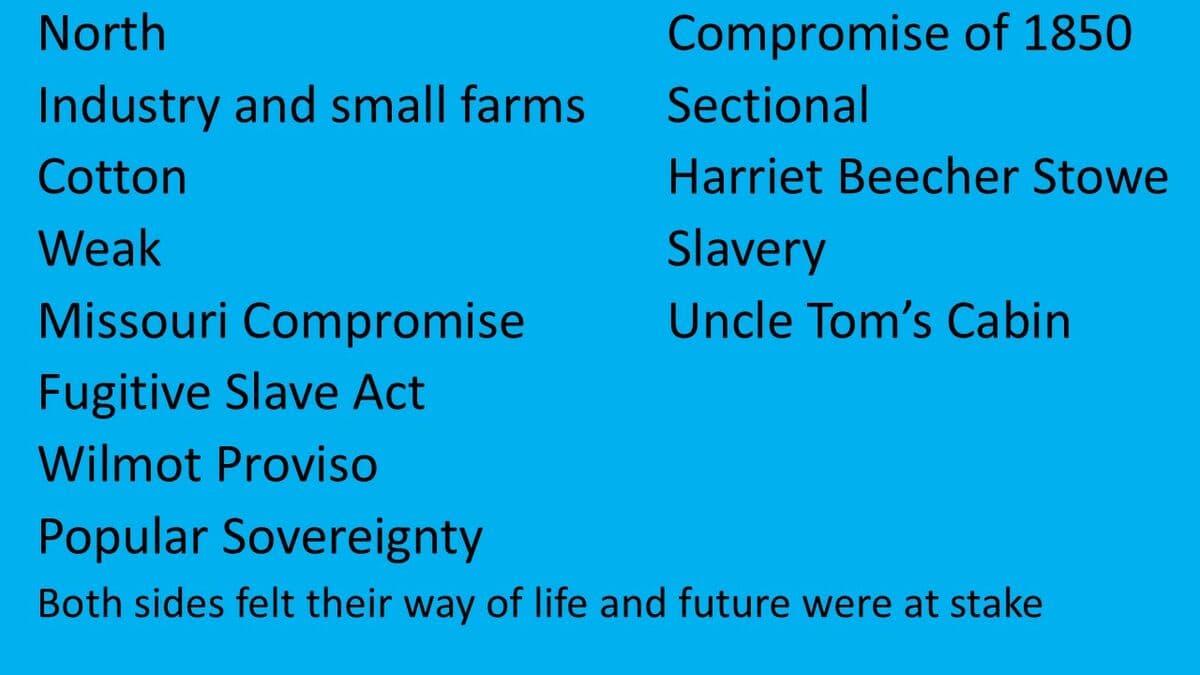
People in each territory voting on whether to allow slavery is called _____.
_____allowed California to enter as a free state and included a stricter Fugitive Slave Act
____wrote Uncle Tom's Cabin, a novel that fueled anti-slavery feelings in the North
______tension increased after the 1850s, and compromise became more difficult.
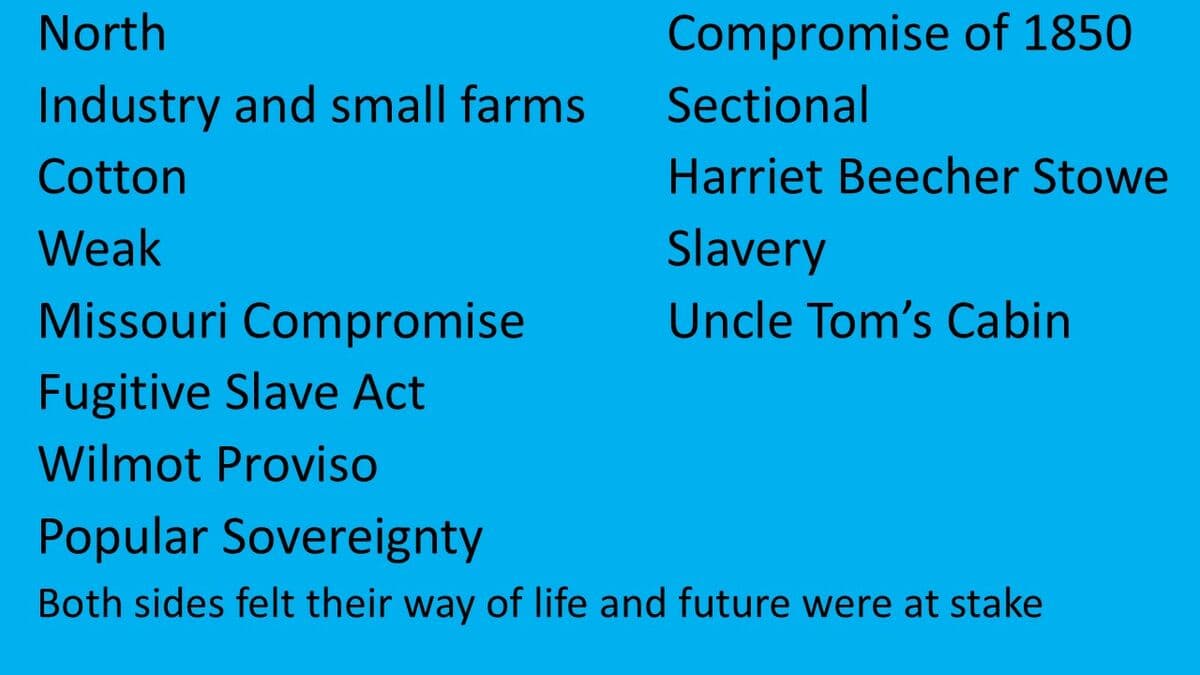
The growing conflict over _____ in the territories led directly to the Civil War.
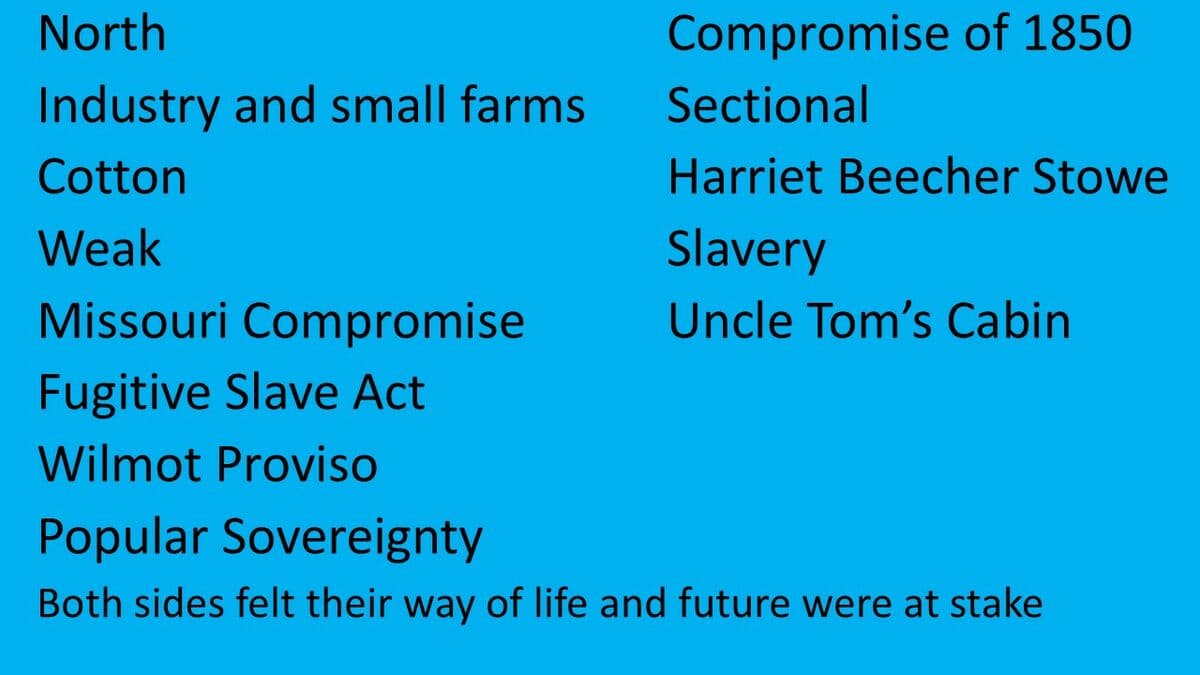
_____represents the power of literature in changing public opinion about slavery
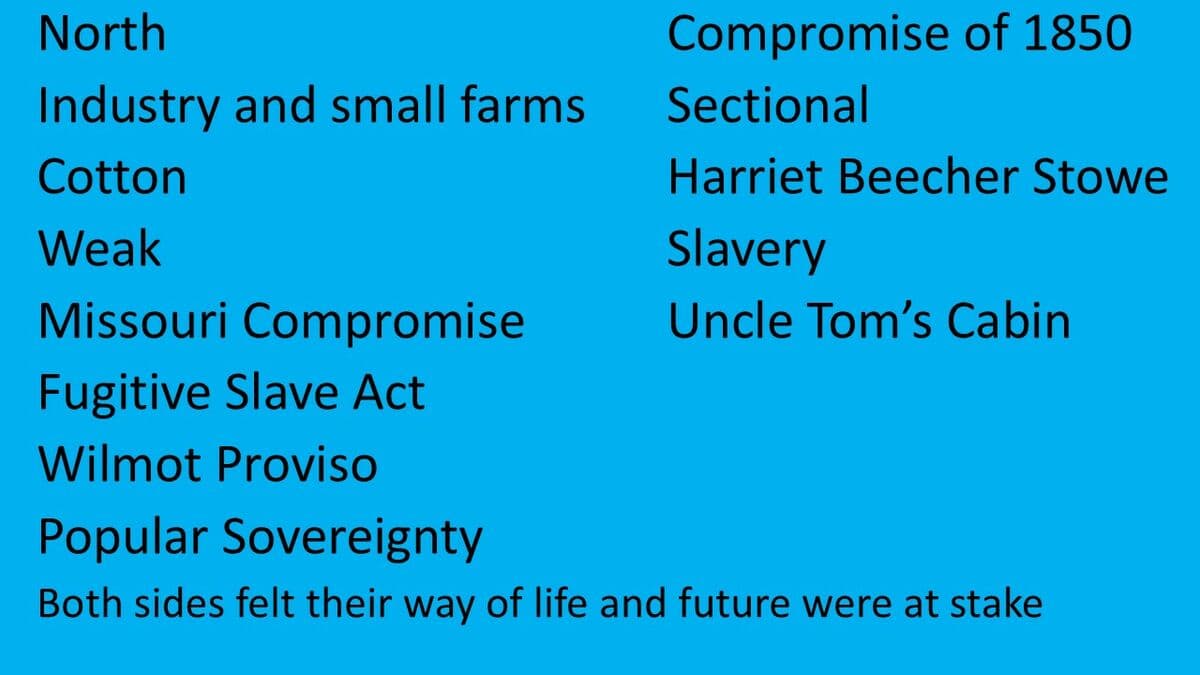
____was the main reason that compromise over slavery became impossible by the 1850s
 L'attentato alle Torri Gemelle dell'11 settembre 2001 è stato orchestrato dall'organizzazione terroristica al-Qaida, guidata da Osama bin Laden. Al-Qaida, un gruppo estremista islamico, aveva l'obiettivo di colpire gli Stati Uniti per una serie di motivi, tra cui la loro presenza militare in Medio Oriente, il sostegno a Israele e le politiche economiche e geopolitiche percepite come oppressive nei confronti dei Paesi musulmani. L'attacco ha coinvolto 19 terroristi, che hanno dirottato quattro aerei commerciali: due hanno colpito le Torri Gemelle a New York, un altro il Pentagono vicino a Washington, D.C., mentre il quarto, United Airlines Flight 93, è precipitato in un campo in Pennsylvania dopo che i passeggeri hanno tentato di riprendere il controllo dell'aereo. Osama bin Laden ha rivendicato la responsabilità dell'attentato, che ha provocato circa 3.000 morti e ha avuto un impatto duraturo sulla politica internazionale, portando alle guerre in Afghanistan e Iraq e a significativi cambiamenti nella sicurezza globale Il fatto che quattro aerei dirottati siano riusciti a deviare dalla loro rotta senza un immediato intervento da parte delle autorità aeree è legato a una serie di fattori: 1. **Dirottamenti inattesi**: Prima dell'11 settembre 2001, il protocollo per gestire i dirottamenti aerei era molto diverso. I dirottamenti aerei, quando accadevano, di solito erano gestiti attraverso negoziazioni e si presumeva che i dirottatori cercassero principalmente attenzione o denaro, non attacchi suicidi. Non c'era una preparazione specifica per l'eventualità che gli aerei venissero usati come armi. 2. **Interruzione delle comunicazioni**: I dirottatori hanno spento i transponder sugli aerei (dispositivi che inviano segnali radar con informazioni su altitudine e posizione), rendendo difficile per i controllori del traffico aereo tracciare con precisione gli aerei. Gli aerei risultavano ancora visibili sui radar primari, ma senza i dati specifici del transponder era difficile capire immediatamente che c'era una deviazione fuori rotta. 3. **Tempo di reazione**: Gli eventi si sono svolti in un breve arco di tempo. I primi segni di problemi sui voli sono emersi intorno alle 8:14 (con l'American Airlines Flight 11), e il primo schianto contro la Torre Nord è avvenuto alle 8:46. Tra l'inizio dei dirottamenti e gli impatti, il tempo per reagire è stato limitato. La portata dell'attacco era senza precedenti, e nessuno si aspettava che i dirottatori avrebbero usato gli aerei come armi contro obiettivi civili. 4. **Coordination failures**: Anche se ci sono stati segnali di problemi, la comunicazione tra le varie agenzie coinvolte (Federal Aviation Administration, NORAD, ecc.) non era ottimale. La procedura per attivare la difesa aerea in caso di dirottamento era complessa, e la possibilità che aerei civili venissero utilizzati come armi suicide non era contemplata nei protocolli. 5. **NORAD e tempi di risposta**: Il NORAD (North American Aerospace Defense Command), incaricato della difesa aerea, aveva una capacità limitata di intercettare rapidamente aerei dirottati nello spazio aereo interno. Prima dell'11 settembre, le operazioni di difesa erano concentrate su possibili minacce esterne, e non su attacchi interni. Anche quando i caccia furono inviati, era troppo tardi per impedire gli impatti. Questi fattori, combinati con l'incredulità che un tale attacco potesse realmente accadere, hanno reso possibile che quattro aerei fossero dirottati e usati come armi senza un intervento preventivo efficace. Dopo l'11 settembre, furono apportati significativi cambiamenti ai protocolli di sicurezza aerea per prevenire simili attacchi in futuro. L'idea che l'11 settembre abbia fornito un "pretesto" per attaccare l'Afghanistan è stata ipotizzata da diverse teorie del complotto e punti di vista critici sulla politica estera degli Stati Uniti. Tuttavia, è importante distinguere tra i fatti documentati e le ipotesi non verificate. ### Fatti documentati: 1. **Al-Qaida e Osama bin Laden**: Gli attacchi dell'11 settembre sono stati rivendicati da al-Qaida, che aveva il suo quartier generale in Afghanistan sotto la protezione del regime talebano. Gli Stati Uniti hanno chiesto ai talebani di consegnare Osama bin Laden, ma il governo talebano ha rifiutato. Questo ha portato all'intervento militare in Afghanistan con l'obiettivo dichiarato di smantellare al-Qaida e rimuovere i talebani dal potere. 2. **Legittimazione internazionale**: L'invasione dell'Afghanistan è stata ampiamente appoggiata a livello internazionale, con il sostegno delle Nazioni Unite e della NATO. Il Consiglio di Sicurezza delle Nazioni Unite ha approvato risoluzioni che condannavano gli attacchi e riconoscevano il diritto di difesa degli Stati Uniti. ### Teorie del complotto: Alcuni teorici sostengono che l'11 settembre potrebbe essere stato usato come pretesto per giustificare una guerra che rientrava in più ampi interessi geopolitici. Secondo questa visione, l'invasione dell'Afghanistan non riguardava solo la lotta contro il terrorismo, ma anche: - **Influenza geopolitica**: Gli Stati Uniti avrebbero cercato di stabilire una maggiore presenza militare e influenza in una regione strategica, vicina a Paesi come l'Iran, la Cina e la Russia. - **Risorse naturali**: L'Afghanistan ha un'importanza geopolitica anche per i suoi potenziali corridoi energetici e per le sue risorse minerarie, anche se non ha ricchezze petrolifere significative come altri Paesi del Medio Oriente. ### Critiche legittime: Al di là delle teorie del complotto, ci sono critiche legittime alla risposta degli Stati Uniti e all'espansione della guerra al terrorismo. Ad esempio: - **La guerra in Iraq**: Mentre l'invasione dell'Afghanistan fu largamente supportata, l'invasione dell'Iraq nel 2003 fu molto più controversa. Molti analisti ritengono che l'amministrazione Bush abbia sfruttato la paura generata dall'11 settembre per giustificare un attacco all'Iraq, anche se non c'erano prove concrete di un collegamento tra il regime di Saddam Hussein e al-Qaida. - **Durata della guerra**: La guerra in Afghanistan si è trasformata in un conflitto di lunga durata, che molti vedono come fallimentare, con risultati incerti nonostante il grande impegno militare ed economico. ### Conclusione: Sebbene sia possibile che alcune figure politiche o militari abbiano sfruttato l'attacco dell'11 settembre per portare avanti agende geopolitiche preesistenti, i fatti storici mostrano che l'invasione dell'Afghanistan fu una reazione diretta agli attacchi e alla minaccia di al-Qaida. Le decisioni successive, in particolare l'espansione della "guerra al terrorismo", sono state oggetto di forti critiche e controversie, ma non ci sono prove concrete che l'11 settembre sia stato pianificato o lasciato accadere per giustificare un'invasione. La **caduta delle Torri Gemelle** l'11 settembre 2001 è stata causata principalmente dai **danni strutturali provocati dall'impatto degli aerei e dal conseguente incendio**, secondo le indagini ufficiali. Le teorie che ipotizzano l'uso di esplosivi sono state ampiamente investigate ma smentite dalle analisi tecniche e dalle prove disponibili. ### Versione ufficiale: 1. **Impatto degli aerei**: Gli aerei di linea colpirono le Torri Gemelle a una velocità molto elevata, causando danni immediati e significativi alle colonne portanti esterne e interne degli edifici. Questi danni strutturali compromettevano già parte della stabilità delle torri. 2. **Incendi**: L'impatto degli aerei ha causato l'esplosione del carburante contenuto nei serbatoi, innescando vasti incendi. Il calore generato dagli incendi all'interno degli edifici raggiunse temperature estremamente elevate (fino a 1000°C o più), che indebolirono ulteriormente l'acciaio delle strutture portanti. 3. **Cedimento strutturale**: L'acciaio non deve necessariamente fondere per perdere la sua capacità portante; a temperature elevate, l'acciaio diventa più malleabile e perde resistenza. Questo, unito al danno meccanico già causato dall'impatto degli aerei, ha portato al cedimento progressivo delle strutture superiori, che sono collassate sui piani inferiori in una sorta di effetto domino. Questo spiega il "crollo verticale" delle torri. ### Investigazioni tecniche: 1. **Rapporto del NIST**: Il **National Institute of Standards and Technology (NIST)** ha condotto un'indagine approfondita sulla caduta delle torri. Secondo il rapporto del NIST, **non ci sono prove** che suggeriscano l'uso di esplosivi o ordigni nei crolli delle torri. I crolli sono stati attribuiti esclusivamente ai danni strutturali causati dagli impatti e agli incendi successivi. 2. **Simulazioni e analisi**: Gli ingegneri hanno simulato il comportamento degli edifici durante l'attacco e hanno concluso che l'indebolimento delle strutture portanti a causa del calore è stato sufficiente a spiegare il collasso. Il crollo avvenne in maniera progressiva e non con le caratteristiche di una demolizione controllata, come l'uso di esplosivi. ### Teorie del complotto: Nonostante le spiegazioni tecniche ufficiali, alcune persone sostengono che il crollo sia stato causato da esplosivi piazzati all'interno delle torri. Queste teorie si basano su: - **Testimonianze di esplosioni**: Alcune persone hanno riportato di aver sentito rumori di esplosioni prima o durante i crolli. Tuttavia, gli esperti hanno spiegato che questi rumori possono essere attribuiti a numerosi fattori, come i cedimenti strutturali e le esplosioni secondarie dovute al cedimento di infrastrutture interne (ad esempio, serbatoi di gas o trasformatori elettrici). - **Crollo simmetrico**: Alcuni teorici sostengono che il crollo delle torri sia stato troppo "ordinato" per essere casuale. Tuttavia, il collasso verticale è stato spiegato come il risultato del cedimento simultaneo di più colonne portanti indebolite dal calore. - **Teoria del crollo controllato**: Alcuni sostengono che le torri siano cadute con la rapidità e la precisione di una demolizione controllata. Tuttavia, studi dettagliati del NIST e altre organizzazioni non hanno trovato alcuna prova di esplosivi o segni di una demolizione pianificata. ### Conclusione: Le indagini ufficiali e i rapporti tecnici indicano chiaramente che il crollo delle Torri Gemelle è stato causato dagli impatti degli aerei e dai successivi incendi che hanno indebolito la struttura, portando al collasso progressivo. Le teorie che ipotizzano l'uso di esplosivi sono state esaminate ma non supportate da prove concrete. L'11 settembre 2001 ha avuto un impatto profondo anche sulla musica, influenzando artisti di diversi generi e portandoli a esprimere il dolore, la rabbia, la riflessione e la speranza che l'evento ha generato. La musica ha raccontato l'episodio da diverse prospettive, esplorando sia il trauma individuale che quello collettivo, e offrendo una forma di guarigione o commemorazione per chi l'ha vissuto. ### Canzoni che hanno affrontato l'11 settembre: 1. **Bruce Springsteen – "The Rising" (2002)** Questo album è uno dei più emblematici legati all'11 settembre. La title track, "The Rising", racconta la storia di un pompiere che sale verso le Torri Gemelle e riflette sul sacrificio e la speranza. L'intero album esplora i temi della perdita e della resilienza attraverso il prisma dell'America post-11 settembre, e rappresenta una sorta di catarsi per molte persone che hanno cercato conforto nella musica. 2. **Paul McCartney – "Freedom" (2001)** Paul McCartney era a New York il giorno degli attacchi e ha scritto questa canzone in risposta, cercando di trasmettere un messaggio di forza e resistenza. "Freedom" è stata eseguita al concerto benefico **"The Concert for New York City"**, un evento organizzato per raccogliere fondi per le vittime dell'attacco e celebrare il coraggio dei soccorritori. 3. **Toby Keith – "Courtesy of the Red, White and Blue (The Angry American)" (2002)** Questa canzone country ha rappresentato il lato più patriottico e arrabbiato della reazione americana agli attentati. Toby Keith esprime il desiderio di giustizia (o vendetta), e la canzone è diventata molto popolare tra coloro che volevano una risposta forte agli attacchi. Sebbene controversa per i suoi toni duri, ha rappresentato una parte significativa del sentimento nazionale. 4. **Alan Jackson – "Where Were You (When the World Stopped Turning)" (2001)** Questa ballata country ha cercato di catturare lo shock, la confusione e il dolore collettivo che l'11 settembre ha causato. La canzone pone domande che molti si sono fatti: "Dov'eri quando il mondo si è fermato?" Il tono è riflessivo e malinconico, ed è diventata una delle canzoni più ricordate che trattano direttamente dell'evento. 5. **U2 – "Walk On" (2001)** Sebbene scritta prima dell'11 settembre, "Walk On" è diventata una sorta di inno di resilienza dopo l'attacco. U2 ha dedicato diverse performance della canzone alle vittime dell'11 settembre, e il testo, che parla di andare avanti di fronte alle avversità, è stato interpretato come un messaggio di forza per chi cercava di ricostruire la propria vita. 6. **Neil Young – "Let’s Roll" (2001)** Questa canzone è stata ispirata dagli atti eroici dei passeggeri del volo United 93, che si sono ribellati contro i dirottatori, impedendo che l'aereo colpisse un obiettivo a terra. La frase "Let's roll" era ciò che uno dei passeggeri, Todd Beamer, ha detto mentre guidava la ribellione. Neil Young ha scritto questo brano per onorare quei passeggeri coraggiosi. ### Concerti e eventi musicali commemorativi: - **The Concert for New York City (2001)** Subito dopo gli attacchi, questo grande concerto benefico si è tenuto al Madison Square Garden per raccogliere fondi a favore delle vittime e per rendere omaggio ai soccorritori. Vi hanno partecipato artisti come Paul McCartney, The Who, Mick Jagger, David Bowie e molti altri. L'evento è stato una celebrazione dell'unità e della solidarietà di fronte alla tragedia. - **America: A Tribute to Heroes (2001)** Questo telethon, trasmesso a livello nazionale, ha visto la partecipazione di artisti come Bruce Springsteen, U2, Celine Dion e molti altri. Lo scopo era quello di raccogliere fondi per le vittime e i loro familiari, e molte delle performance erano riflessive e piene di emozione, offrendo un momento di unità e commiserazione collettiva. ### Effetti sull’industria musicale: L'11 settembre ha avuto anche un impatto diretto sull'industria musicale: - **Censura e sensibilità**: Molte canzoni che potevano essere considerate inappropriate o troppo aggressive dopo l'11 settembre furono temporaneamente rimosse dalle playlist radiofoniche, come "Imagine" di John Lennon (per il suo messaggio pacifista) o "New York, New York" di Frank Sinatra, per il legame con la città colpita. - **Modifiche ai testi e alle copertine**: Alcuni artisti modificarono testi o copertine di album che potevano sembrare insensibili o inappropriate nel clima post-11 settembre. Ad esempio, i Dream Theater cambiarono la copertina del loro album "Live Scenes from New York" perché raffigurava il World Trade Center in fiamme, una coincidenza che uscì pochi giorni prima degli attacchi. ### Conclusione: La musica ha offerto un modo per elaborare il trauma dell'11 settembre, sia attraverso canzoni che commemorano i caduti, sia con inni che hanno ispirato resistenza e speranza. Artisti di ogni genere hanno interpretato l'evento in modi diversi, riflettendo la complessità delle emozioni che ha suscitato, dall'angoscia e la perdita alla forza e la solidarietà. Sì, le **Dixie Chicks** (oggi conosciute come **The Chicks**) hanno avuto notevoli problemi, ma non per aver trattato direttamente il tema dell'11 settembre. I problemi che hanno affrontato sono legati alle loro critiche alla guerra in Iraq e alla presidenza di **George W. Bush**, che erano strettamente connesse al clima politico post-11 settembre. ### Contesto: Nel marzo 2003, durante un concerto a Londra, la cantante **Natalie Maines**, frontwoman delle Dixie Chicks, fece una dichiarazione che scatenò una controversia a livello nazionale negli Stati Uniti. Mentre l'invasione dell'Iraq era imminente, Maines disse al pubblico: > **"Just so you know, we’re ashamed that the President of the United States is from Texas."** Questa dichiarazione era una critica diretta al presidente **George W. Bush**, nato in Texas come Maines e il resto della band. La critica arrivava in un momento in cui il patriottismo e il sostegno alla guerra erano fortemente presenti negli Stati Uniti, specialmente nel Sud, dove le Dixie Chicks avevano una vasta base di fan nella comunità country. ### Conseguenze: 1. **Boicottaggi e censure**: Dopo il commento di Maines, molte stazioni radio, soprattutto quelle country, **boicottarono le Dixie Chicks**, rimuovendo le loro canzoni dalle playlist. In alcune parti degli Stati Uniti, i fan organizzarono pubblici **roghi dei loro album**. 2. **Perdita di supporto nel mondo country**: La comunità della musica country, che spesso riflette valori patriottici e conservatori, si rivolse contro di loro. Molti artisti e fan country criticarono duramente le Dixie Chicks per aver espresso opinioni contro la guerra e contro il presidente in un momento in cui il sostegno alla leadership nazionale era considerato importante. 3. **Minacce e ostilità**: Le Dixie Chicks ricevettero **minacce di morte** e furono soggette a intense campagne di odio. Questo dimostrò quanto fossero polarizzate le opinioni politiche negli Stati Uniti all'epoca, specialmente nell'industria della musica country. 4. **Carriera messa in pausa**: Dopo la controversia, la loro carriera negli Stati Uniti subì un grave colpo. Le vendite dei loro album calarono, e per diversi anni furono considerate una "band alienata" dall'industria country. Tuttavia, il gruppo trovò maggiore supporto nel pubblico internazionale e in generi musicali non tradizionalmente legati al country. ### La risposta delle Dixie Chicks: Le Dixie Chicks risposero alla controversia con coraggio e determinazione. Nel 2006, pubblicarono l'album **"Taking the Long Way"**, che includeva la famosa canzone **"Not Ready to Make Nice"**. Questo brano affrontava direttamente le critiche ricevute e il loro rifiuto di scusarsi per aver espresso le proprie opinioni. > **"Not Ready to Make Nice"** fu un grande successo e vinse diversi Grammy Awards, incluso quello per il **Miglior Album dell'Anno** e la **Canzone dell'Anno**. L'album rappresentava un chiaro messaggio: non erano pronte a cedere alla pressione e non si scusavano per aver esercitato la loro libertà di espressione. ### Riflessione sulla controversia: La controversia rifletteva una tensione più ampia nella società americana post-11 settembre, dove il patriottismo era visto da molti come un valore sacro e la critica alle politiche governative, specialmente riguardo alla guerra, poteva essere percepita come un tradimento. Le Dixie Chicks divennero un simbolo di questa polarizzazione e del conflitto tra libertà di espressione e patriottismo. ### Conclusione: Sebbene le Dixie Chicks non abbiano trattato direttamente l'11 settembre, la loro critica alla guerra in Iraq e a George W. Bush, strettamente connessa agli eventi post-11 settembre, portò a una delle più grandi controversie nella storia della musica country. Tuttavia, con il tempo, il gruppo è riuscito a superare le difficoltà e ha ottenuto una sorta di redenzione artistica e pubblica, guadagnando il rispetto di molti per la loro integrità e il loro coraggio nel difendere le proprie opinioni. Sì, i **Green Day** hanno trattato indirettamente i temi legati all'11 settembre e le sue conseguenze, soprattutto attraverso il loro album più famoso, **"American Idiot"** (2004). L'album non affronta direttamente gli attacchi dell'11 settembre, ma esplora il clima politico e sociale che si è sviluppato negli Stati Uniti dopo gli attentati, in particolare la guerra in Iraq, il patriottismo estremo e la manipolazione dei media. ### Contesto di "American Idiot": "American Idiot" è un concept album che segue un personaggio chiamato **Jesus of Suburbia**, che rappresenta la frustrazione e l'alienazione della generazione cresciuta nell'America post-11 settembre. L'album racconta una storia di rabbia, disillusione e ribellione contro il governo, i media e la società americana dell'epoca. ### Temi principali legati all'11 settembre e alle sue conseguenze: 1. **Critica ai media e alla manipolazione dell'informazione**: - La title track, **"American Idiot"**, critica aspramente la manipolazione dei media e il modo in cui la società americana è stata spinta verso un patriottismo cieco e un clima di paura. La canzone si scaglia contro l'idea che gli americani vengano indotti a seguire passivamente le direttive dei media e del governo, un tema strettamente legato alla narrazione post-11 settembre e alla propaganda che ha accompagnato la guerra in Iraq. > "Don't wanna be an American idiot, Don't want a nation under the new media." Qui, la band esprime il loro disgusto per l'influenza della propaganda mediatica e la crescente polarizzazione politica. 2. **Disillusione verso il governo e la guerra**: - Il brano **"Holiday"** è una feroce critica alla guerra in Iraq e alla politica estera dell'amministrazione Bush, spesso vista come una conseguenza diretta degli attacchi dell'11 settembre. La canzone denuncia l'ipocrisia e l'avidità che, secondo i Green Day, hanno guidato la decisione di invadere l'Iraq. > "This is the dawning of the rest of our lives, On holiday." Il termine "holiday" viene usato sarcasticamente per indicare una pausa dalla realtà, mentre la guerra viene condotta senza una giustificazione morale valida. 3. **Riflessioni sulla paura e l'ansia della generazione post-11 settembre**: - **"Boulevard of Broken Dreams"** esplora temi più personali di alienazione e solitudine, ma riflette anche l'ansia e la disillusione che molti americani, specialmente giovani, hanno provato nell'era post-11 settembre. Il senso di isolamento e la perdita di speranza di Jesus of Suburbia rappresentano simbolicamente il malessere di una generazione confusa e incerta sul futuro. > "I walk a lonely road, The only one that I have ever known." 4. **Rabbia verso l'apatia sociale**: - In **"Wake Me Up When September Ends"**, molti hanno visto una connessione simbolica con gli attacchi dell'11 settembre. Sebbene la canzone sia stata scritta dal frontman **Billie Joe Armstrong** come una riflessione personale sulla morte di suo padre, è diventata una sorta di inno per chiunque cercasse di elaborare il dolore e il trauma degli eventi del 2001. L'uso di "September" nel titolo ha portato molti a collegare il brano agli eventi dell'11 settembre e al desiderio di superare quel periodo buio. > "Here comes the rain again, Falling from the stars, Drenched in my pain again, Becoming who we are." La canzone evoca sentimenti di perdita e desiderio di guarigione, temi che risuonano con l'atmosfera post-attentati. ### Impatto di "American Idiot": "American Idiot" è stato un successo enorme e ha avuto un impatto culturale significativo. L'album ha dato voce a una generazione di giovani disillusi dalla politica americana e dalla guerra, riflettendo il malcontento diffuso verso l'amministrazione Bush e il modo in cui il paese aveva reagito agli eventi dell'11 settembre. Il successo dell'album ha portato anche alla produzione di un musical omonimo, che ha continuato a esplorare questi temi. ### Conclusione: I Green Day non hanno trattato direttamente gli attacchi dell'11 settembre, ma il loro album "American Idiot" è una risposta critica alle conseguenze politiche e sociali di quell'evento, in particolare la guerra in Iraq, la manipolazione dei media e la disillusione dei giovani. L'album è stato un potente veicolo di protesta contro il clima politico dell'epoca e ha dato voce alla frustrazione di molti americani.ENGLISH GROUP PROJECT: THE GLOBAL VENTURE (Thailand) Comprehensive Presentation Script & Role Outline (5-Person Distribution) 1. Strategic Role & Workload Distribution Matrix Role / Name Core Domain / Responsibility Presentation Delivery Scope Member 1Member 1 Tan Finance & Housing (Rent, cost of living, deposits, urban/rural margins)Finance & Housing (Rent, cost of living, deposits, urban/rural margins) Slide 3: Finance Lead, Slide 8: Data VisualizerSlide 3: Finance Lead, Slide 8: Data Visualizer Member 2Member 2 Huy Work Culture & Professional Etiquette (Hierarchy, industry growth, networking)Work Culture & Professional Etiquette (Hierarchy, industry growth, networking) Slide 3: Culture Lead, Slide 9: Adaptation ExpertSlide 3: Culture Lead, Slide 9: Adaptation Expert Member 3Member 3 Minh Legal, Immigration & Visa Pathways (Non-Immigrant B visas, extensions, 90-day rules)Legal, Immigration & Visa Pathways (Non-Immigrant B visas, extensions, 90-day rules) Slide 3: Legal Anchor, Slide 4: Legal FrameworkSlide 3: Legal Anchor, Slide 4: Legal Framework Member 4Member 4 THanh Healthcare Ecosystem & Public Safety (Insurance, emergency networks, local hazards)Healthcare Ecosystem & Public Safety (Insurance, emergency networks, local hazards) Slide 3: Safety Anchor, Slide 10: Matrix PresenterSlide 3: Safety Anchor, Slide 10: Matrix Presenter Member 5Member 5 Sơn(project manager),Kiên Logistics, Climate & Project Manager (Transit, weather, group synthesis)Logistics, Climate & Project Manager (Transit, weather, group synthesis) Slide 1-2: Opener, Slide 6: Email Lead, Slide 11-12: CloserSlide 1-2: Opener, Slide 6: Email Lead, Slide 11-12: Closer 3. Complete Presentation Script (Slide-by-Slide) Execution Note: During delivery, presenters should display the corresponding slide from the HTML presentation tool. Speak clearly, maintaining eye contact with the grading panel. 12-Slide Presentation Guide: Secondments in Thailand Slide 1: Title Slide Purpose: Introduce the topic clearly. Content guide: Include the presentation title, group members’ names, course/module name, and date. Speaker guide: Briefly say that the presentation explains what employees and companies should consider before sending someone on secondment to Thailand. Slide 2: Agenda / Overview Welcome everyone. Our presentation is about secondments in Thailand. We will cover the main areas that a company and employee should prepare for before relocation. These include finance and housing, work culture, legal and visa requirements, healthcare and safety, and daily logistics such as transport and climate. By the end of the presentation, we hope to show that a successful secondment depends not only on the job itself, but also on good planning before and after arrival in Thailand. Slide 3: What Is a Secondment? A secondment is a temporary work assignment where an employee is transferred to another country, branch, client site, or partner organization while usually remaining connected to the original employer. Secondments require coordination between the employee, home employer, host organization, and local authorities. Slide 4: Finance & Housing — Cost of Living Finance and housing are one of the first things a secondee should plan before moving to Thailand. The cost of living can vary a lot depending on whether the employee is based in Bangkok, another major city, or a regional area. Urban areas usually have higher rent, but they also offer better access to transport, hospitals, offices, and international services. In smaller cities or rural areas, rent may be lower, but transport and convenience can become bigger concerns. So, the key point is that secondees should not only compare prices, but also consider location, commute, and what support the employer provides. Slide 6: Work Culture — Hierarchy & Etiquette Purpose: Help secondees understand workplace expectations. Content guide: Cover respect for seniority, polite communication, indirect feedback, saving face, punctuality, proper greetings, and professional dress. Speaker guide: Explain that foreign employees should avoid being too blunt in meetings and should observe how local colleagues communicate with managers or senior staff. Suggested visual: “Do and Don’t” etiquette list. Slide 7: Work Culture — Industry Growth & Networking Purpose: Connect secondments to career and business opportunities. Content guide: Mention sectors where Thailand often attracts foreign professionals, such as manufacturing, tourism, logistics, finance, technology, and regional business operations. Discuss relationship-building and networking. Speaker guide: Emphasize that trust and long-term relationships are important in Thai professional settings. Networking can happen through industry events, chambers of commerce, company introductions, and informal business meals. Suggested visual: Thailand industry opportunity map or sector icons. Slide 8: Legal & Immigration — Visa Pathways Purpose: Explain the main legal entry pathway for work-related secondments. Content guide: Introduce the Non-Immigrant B visa as a common work/business visa category. Mention that supporting documents may include passport, application forms, employment or company letters, and other evidence requested by Thai authorities. Speaker guide: Make clear that a visa alone may not be enough to legally work; seconded employees normally need the correct visa and work authorization. The exact process depends on the employer, role, nationality, and assignment structure. Suggested visual: Simple flowchart: Home employer → Host company → Visa application → Arrival → Work permit/compliance. Slide 9: Legal & Immigration — Compliance Rules Purpose: Explain ongoing responsibilities after arrival. Content guide: Cover visa extensions, work permit validity, re-entry permits, address reporting, and 90-day reporting for eligible long-stay foreigners. Speaker guide: Stress that compliance is not a one-time task. Employees and HR teams should track deadlines carefully because missing reporting or renewal dates can cause fines, delays, or legal issues. Suggested visual: Compliance checklist or timeline. Slide 10: Healthcare & Public Safety Purpose: Explain how secondees should prepare for health and safety risks. Content guide: Cover international health insurance, access to private hospitals, emergency numbers, vaccinations or health checks if required, and common local hazards such as road safety, flooding, heat, food hygiene, and mosquito-borne illnesses. Speaker guide: Explain that Thailand has strong healthcare options in major cities, but employees should confirm insurance coverage before arrival. They should also know what to do in an emergency and save important contact numbers. Suggested visual: Emergency preparation checklist. Slide 11: Logistics & Climate Purpose: Explain practical relocation and daily-life planning. Content guide: Cover public transit, taxis, ride-hailing, domestic travel, airport access, SIM cards, banking, weather, rainy season, heat, and packing needs. Speaker guide: Mention that weather affects commuting, clothing, housing choice, and travel planning. Employees should plan around heat, rain, and possible flooding, especially during the rainy season. Suggested visual: Seasonal calendar showing hot, rainy, and cool periods. Slide 12: Project Manager / Group Synthesis Purpose: Bring the presentation together and end with key recommendations. Content guide: Summarize the main risks and preparation steps: budget early, secure compliant visa/work permit arrangements, understand workplace culture, arrange insurance, and prepare for climate/logistics. Speaker guide: Conclude by saying that a successful secondment in Thailand depends on both professional readiness and personal relocation planning. End with 3–5 recommendations for companies and employees. Suggested visual: Final checklist: “Before departure,” “Upon arrival,” and “During secondment.” A simple way to divide the work is: Member 1: Slides 1–3 introduction. Member 2: Slides 4–5 finance and housing. Member 3: Slides 6–7 work culture. Member 4: Slides 8–9 legal and immigration. Member 5: Slides 10–12 healthcare, logistics, and conclusion. Element Definition Example from Text Theme Main message or lesson Be yourself; self-acceptance Tone Author’s attitude toward the subject Encouraging, humorous Diction Word choice Weird, perfect, brave Denotation Literal meaning of a word Weird = unusual Connotation Emotional meaning of a word Weird = negative or unique Allusion Reference to another literary or cultural work Harry Potter, The Last Battle Genre Type of writing Letter Writer Author Letter writer to her teen self Title Name of the text Just Be Yourself Dear Teen Me, Psst! Hey! You in the corner of the library with your nose stuck in a book. Yes, you. Don’t recognize me without that awful perm, do you? (Remind me again why you thought that was a good idea?) Anyway, I hope you don’t mind if I sit with you for a minute, but we need to talk. Don’t worry about the “no talking in the library” rule. I’m sure we’ll be fine. Librarians aren’t as bad as they seem. Judging from the hair and braces I’d have to guess you’re in your junior year. Yes? Thought so. I’d forgotten how many lonely lunch hours you spent in the school library. You have some friends in the cafeteria that you could sit with, but you don’t feel like you really fit in, do you? That’s why you joined every school club you could. I just counted and you’re in eighteen, not to mention the numerous after-school activities you’re involved in. I mean honestly, you joined the ROTC.1 You don’t even like ROTC! And I won’t even bother bringing up that time you tried ballet. I’m still having nightmares about the fifth position! Let me ask you, how’s it all working out? Not very well, am I right? By spending so much time trying to find yourself, you’re slowly losing yourself. We don’t all have one single rock-star talent, and honestly, I think those of us who don’t are the lucky ones. Life isn’t about finding the one thing you’re good at and never doing anything else; it’s about exploring yourself and finding out who you really are on your own terms and in your own way. You don’t have to exhaust yourself to do that. Oh, don’t be so down in the dumps about it. You’ll eventually find something you’re good at, I promise. It’s a long, winding road to get there, but you’ll find it. Being able to spend all day doing what you love (or one of the things that you love) is the most amazing feeling in the world. And no, I won’t tell you what it is, so don’t even ask me. Just remember to always be yourself, because there’s nobody else who can do it for you. I think E. E. Cummings put it best when he said, “It takes courage to grow up and become who you really are.” Looks like the bell is about to ring so I’ll leave you to your book. What are you reading, anyway? Oh, The Last Battle by C. S. Lewis. I should have guessed. You should give those Harry Potter books a try. I saw you roll your eyes! I know they seem like just another fad, but trust me, they’re better than you think. They’ve got a real future! finding out who you really are on your own terms and in your own way. You don’t have to exhaust yourself to do that. Oh, don’t be so down in the dumps about it. You’ll eventually find something you’re good at, I promise. It’s a long, winding road to get there, but you’ll find it. Being able to spend all day doing what you love (or one of the things that you love) is the most amazing feeling in the world. And no, I won’t tell you what it is, so don’t even ask me. Just remember to always be yourself, because there’s nobody else who can do it for you. I think E. E. Cummings put it best when he said, “It takes courage to grow up and become who you really are.” Looks like the bell is about to ring so I’ll leave you to your book. What are you reading, anyway? Oh, The Last Battle by C. S. Lewis. I should have guessed. You should give those Harry Potter books a try. I saw you roll your eyes! I know they seem like just another fad, but trust me, they’re better than you think. They’ve got a real future! i need you to tell me how can i start this text and i need you to add these essential questions: What are some milestones on the path to gr owing up?, What makes an experience memorable? What makes it life changing? and then Denotation, Connotation, Allusions, Diction, Tone, Genre, Writer, Title, Theme in a table and i need u to add definitions for each one and extract examples from the text1. Sit down – Sit on a chair or lower your body. Example: "Please sit down and relax." (Сядьте и расслабьтесь.) 2. Lie down – Recline or rest horizontally. Example: "You should lie down if you're tired." (Тебе следует прилечь, если ты устал.) 3. Turn down – Refuse an offer or reduce volume/heat. Example: "She turned down the job offer." (Она отказалась от предложения о работе.) 4. Slow down – Reduce speed. Example: "Slow down! The road is icy." (Сбавь скорость! Дорога скользкая.) 5. Calm down – Become less angry or anxious. Example: "Calm down and tell me what happened." (Успокойся и расскажи, что случилось.) 6. Break down – Stop working (machine) or lose control emotionally. Example: "My car broke down yesterday." (Моя машина сломалась вчера.) 7. Write down – Record something on paper. Example: "Write down the phone number." (Запиши номер телефона.) 8. Put down – Place something on a surface or insult someone. Example: "Put down the book on the table." (Положи книгу на стол.) 9. Bring down – Reduce (prices, temperature) or make someone sad. Example: "The news brought her down." (Новость расстроила ее.) 10. Cut down – Reduce consumption (e.g., food, expenses). Example: "I need to cut down on sugar." (Мне нужно сократить потребление сахара.) 11. Let down – Disappoint someone. Example: "He let me down by not coming." (Он меня подвел, не прийдя.) 12. Shut down – Close a business or turn off a machine. Example: "The factory shut down last year." (Фабрика закрылась в прошлом году.) 13. Knock down – Demolish or hit someone to the ground. Example: "They knocked down the old building." (Они снесли старое здание.) 14. Settle down – Start living a stable life or calm down. Example: "They want to settle down and have kids." (Они хотят остепениться и завести детей.) 15. Go down – Decrease or descend. Example: "The price of gas went down." (Цена на бензин снизилась.) 16. Come down – Move from a higher place or become cheaper. Example: "Come down the stairs carefully." (Спускайся по лестнице осторожно.) 17. Hold down – Keep a job or suppress something. Example: "He holds down two jobs." (Он работает на двух работах.) 18. Burn down – Destroy by fire.Transportation is the means of moving people, goods and services from one place to another. There are three means of transportation, that is, land, water and air. Land transportation is the means of moving from one place to another on land. The means of transportation used in Nigeria varies from one locality to another. In the riverine areas, the most widely used means of transportation is by canoe or boat. This is because the people live on the water. TYPES OF TRANSPORTATION The following are the main types of transportation: 1. Land transportation 2. Air transportation 3. Water transportation FORMS OF LAND TRANSPORTATION The forms of land transportation include: (i) Roads: This includes the use of cars, trucks, buses, motorcycles, bicycles etc. (ii) Rail: The use of trains. (iii) Trekking on foot. (iv) The use of animals like donkeys, camels, horses etc. They are called beast of burden. PROBLEMS OF LAND TRANSPORTATION The following are the problems of land transportation: 1. Transportation facilities are not sufficient for the number of people using them. 2. Too many accidents on the road. 3. The spare parts are very expensive. 4. High cost of transportation. 5. Potholes on the road, thereby causing a lot of damage to vehicles. 6. Reckless driving on the road by some drivers. SOLUTIONS TO THE PROBLEMS OF ROAD TRANSPORTATION ARE: 1. Drivers should not drink before and while driving. 2. Government should help repair damaged roads. 3. Drivers should avoid reckless driving. 4. Traffic offenders should be punished. 5. The cost of transportation should be reduced. 6. Spare parts should be made available at cheaper prices. 7. Road signs should be placed at major locations. 8. Road users should be educated on the use of the road and road signs.HEALTH EDUCATION 3. SPECIFIC OBJECTIVES: Students should able to know about_______ 1. definition of health education 2. aims of health education 3. objectives of health education 4. principles of health education 5. scope of health education 6. planning of health education 7. steps in planning health education 8. levels of health education 9. doctors s responsibility 4. INTRODUCTION: Health education is a term frequently used by health care professional. its aims at individual and community health. Health education is the translation of what is known about health into desirable individual and community behaviour pattern by means of an education process. Definition: “A process aimed at encouraging people to want to be healthy , to know how to stay healthy, to do what they can individually and collectively to maintain health And seek help when needed”. OBJECTIVES - To inform people or disseminate scientific knowledge about prevention of disease and promotion of health - To motivate people to change their habits and lifestyle that are harmful to their health also motivate people to adopt habits and ways of living conducive to healthy living. - To guide the people who need help to adapt and maintain healthy practices and lifestyle by showing proper community resources. --- PRINCIPLES OF HEALTH EDUCATION - Credibility Of Message: It is the degree to which the message to be communicated is perceived as trustworthy by the receiver. - Creating interest among participants: It is a psychological principle that people are unlikely to listen to things that are not of their interest. If a health programme is based on the felt needs, people will participate in the programme willingly. - Motivating the participants: Motivation is like a petrol engine that drives the mental engine. It is the fundamental desire in every person to learn. Motivation is contagious; one motivated person may spread motivation throughout the group. 13. - Enhance comprehension of content: It means health education should be based on the level of understanding, education and literacy of people at whom the teaching is directed. Teaching should be within the mental capacity of the audience. - Ensure reinforcement: Repetition at intervals is necessary to promote learning. Without reinforcement and feedback, students can go back to the pre-awareness stage. - Encourage active participation: Health education should aim at encouraging people to work actively with health workers and others in identifying their own health problems and also in developing solutions. 14. - Learning by doing: Teaching is effective when individuals actively participate in health education. Learning becomes active and quicker if the individuals are made active physically as well as psychologically. - Known to unknown: The people in a community know something and the health educator enlarges this knowledge. If the health educator links new knowledge with the old knowledge, it can enhance learning. - Maintaining good human relations: Sharing of information, ideas and feelings happens most easily between people who have a good relationship. 15. - Setting an example: The health educators should set a good example in the topic they are dealing with as it fosters better understanding. - Regular feedback: Feedback is one of the key concepts of the system approach. The health educator can modify the elements of the system in light of the feedback from his audience. For effective communication, feedback is of paramount importance - Efficient leadership: Leaders are agents of change and they can be made use of in health education work. Psychologists have shown and established that we learn best from people we respect and regard. 16. The essential attributes of a leader are as follows - Understands the needs of the community. - Provides proper guidance. - Takes initiative. - Is receptive to the views and suggestions of people. - Identifies himself with the community. Is selfless, honest, impartial, considerate and sincere. - Is easily accessible to people. 17. SCOPE OF HEALTH EDUCATION 1. Nutrition 2. Hygiene 3. Family health 4. Disease prevention and cantrol 5. Psychological health 6. Prevention of accident 7. Use of health services 8. Human biology 19. - Nutrition: The aim of nutrition education is to guide people to choose optimum and balanced diets, remove prejudices and promote good dietary habits. nutrition education is a major intervention for the prevention of malnutrition, promotion of health and improving the quality of life. 20. - Hygiene: This has two aspects: personal and environmental. Personal: The aim of personal hygiene is to promote standards of personal cleanliness . Environmental: Has two aspects: Domestic and community. All environmental sanitation programmes should include health education 21. - Family health: The family is the first defence as well as the chief reliance for the well-being of its members. One of the main tasks of health education is to promote family self-reliance, especially regarding the family's responsibilities in child bearing, child rearing, self-care and in influencing their children to adopt a healthy lifestyle. 22. - Disease prevention and control: Drugs alone will not solve health problems. Without health education, a person may fall sick again and again from the same disease. Educating the people about the prevention and control of locally endemic diseases is the first of the eight essential activities in primary health care. 23. - Psychological health: Psychological health problem can occur everywhere. There is a tendency to an increase in the prevalence of psychological diseases when there is a change in society from agriculture to an industrial economy and when people move from the warm intimacy of a village. 24. - Prevention of accidents: Accidents are a feature of the complexity of modern life. Accidents can occur in home, road and place of work. The predominant factor in accidents is carelessness that can be tackled by health education. 25. - Use of health services: Many people, particularly in rural areas, do not know what health services are available and many more do not know. There is a communication gap between the public and state health administration in the form of feedback for further improvement of health services. One of the declared aims of health education is to inform people about the health services available in their community. 26. PLANNING FOR HEALTH EDUCATION planning: is the process of making thoughtful and systemic decision about what needs to be done , how it has to be done, by whom And with what sources. 27. Principles of planning health education 1) Focus on actual current needs and context of community: It is important that plans are made with the needs and context of the community in mind. Health education should try to understand what is currently happening in the community one works in. 2) Plan for basic needs and interest of the community: Consider the basic needs and interests of the community. If the local needs and interests are not kept under consideration, the plans may not be effective. 28. 3) Planning with actual beneficiaries of health education: Plan with the people involved in the implementation of an activity. If people are included in planning, they will be more likely to participate and the plan will be more likely to succeed. 4) Identify and use all relevant community resources: It is essential that the health educator identify all the relevant resources that are locally available which could be used for benefit of people receiving the health education. 29. 5) Follow principle of flexibility: Planning should be flexible, not rigid. One should be able to modify the plans when necessary. For example, you would have to change your priorities if a new problem needing an urgent response arose. 6) A realistic plan not hypothetical: The planned activity should be achievable and take into consideration the financial, personal resources available and time constraints. Planning must be realistic; do not plan unachievable activities. 30. Steps in planning health education Planning is a continuous process. It does not just happen at the start of project . Health education must be well planned to actually improve and promote individual, family and community health 31. - Needs assessment: Conducting needs assessment is the first and probably the most important step in any successful planning process. assessment is the process of identifying and understanding the health problems of the community and their possible causes. - Identify priorities: After identifying the needs and resources of the community, the next is to identify their priorities because each community may have several problems but the urgent have to be given top priority in health education. For example: goitre 32. - Set the goals and objectives: In planning the process of health education, setting goals and objectives is the third and most essential step because these goals and objectives serve as consciously thought baseline parameters to be achieved during health education. - Develop strategies: Prior to the implementation of the health education intervention one must plan, develop and evaluate the several alternative strategies to achieve the set goals and objectives of health education because each problem and target community is quite unique. 33. - Implementation: This is the core phase of the health education process which includes carrying out the planned strategies so that the set goals and objectives of health education may be achieved. - Monitor and evaluation: This is the final step of the planning process of health education where continuous monitoring as well as end evaluation is carried out to ensure the degree to which stated goals and objectives have been achieved. 34. LEVELS/APPROACH OF HEALTH EDUCATION 35. INDIVIDUAL LEVEL - Individual Approach: The health education must first create an atmosphere of friendship and allow the individual to talk as much as possible. In this individual teaching we can discuss, argue and persuade the individual to change his behaviour. But by this we can reach to a small population and who come in contact with us. Methods of individual health education 1) Home visit 2) Personal contact/ counselling 3) Personnel letters 36. 1) Home visit: A home visit is one of the best approaches for individual health education because it can become one of the best opportunities for health education with individuals and their families. Home visits are important to understand the real background of families, their living conditions and the environment in which they live. 37. 2) Personal contact/counseling : Personal contacts or counselling (one-to-one communication) is a helping process where one person explicitly and purposefully gives his or her time to assist people explore their situations and act on a solution. After this the counsellor needs to work together with the person to find solutions that are appropriate to their situation. 38. 3) personal letters: Personal letters may also be used for individual health education, where health educators may get an opportunity to dispatch letters or printed education material to the people in a target community. 39. GROUP LEVEL Group health education may be useful way to deliver health education massages in efficient manner. A well organized group permits sharing of experiences and skills so that people are able to learn from each other. 40. Methods of group discussion 1)Lecture method: (Chalk & Talk ) A lecture may be defined as carefully prepared oral presentation of facts organized thoughts and ideas by a qualified person. The group should not be more than 30 and talk should not exceed 15-20 minutes. By using suitable audiovisual aids. 2) Group discussion: A group is an aggregation of people interacting in a face to face situation. It is a very effective method of health communication. 41. 3) Demonstration: A demonstration is a carefully prepared presentation to show how to perform a skill. This procedure is carried out step by step before an audience. 4) Panel discussion: In a panel discussion 4-8 qualified persons talk about the topic. Sit and discuss a given topic in front of a large group/audience. The chairman opens the meeting. Panel comprises of a chair person and 4-8 speakers. After the main aspect of the subject are explored, the audience is invited to take part. 42. 5) Symposium: It is a series of speeches on a selected subject. Each expert person present it briefly and at the end of session the chair person make a comprehensive summary. Audience are allowed to raise question. 6) Workshops : It consists of series of meetings usually 4 or more with emphasis on an individual work, within the group and with the help of consultants and response personnel. 7) Role play: This is a brief acting out of an actual situation for the benefit of the audience for better understanding. 43. 8) Conference and seminars: This programmes are usually held on a regional, state/national level. Where several experts from different disciplines meet to deliberate on a particular theme, to appraise others of latest knowledge and research in a particular field. 9) Open forum: It refers to the public meeting which are held for various purposes in the community, for example: gram sabha 44. COMMUNITY LEVEL It is meant for a defined community and is not only to create awareness but also to help people understand their health problems and needs, find alternatives solutions to their problems and needs , implement them, evaluate and get feedback and accordingly do the needful. For health education at the community level, it is better to approach local leaders who are influential and who have the people’s confidence. These may include local officers such as gramsevak, panchayat sarpanch ,police officer or block development officer etc . 45. HOSPITAL LEVEL 1) Health Education in OPD/Outdoor: The patient and his attendants have to spend a lot of time in the outpatient department for health check-up, treatment, registration, diagnosis, admission procedure etc. This period can be utilised for health education. For this, the following means/devices can be used: - Exhibiting pictures, posters, charts, bulletin board and models in the waiting hall. - Arranging group discussion, slide show, or documentary film in a proper place and on a proper topic. - Giving health education on a personal level in the consulting room. This mainly includes nutrition clinic, family planning clinic, psychiatric clinic etc. 46. - Distributing pamphlets. - Arranging street plays or nukkad naatak in the outpatient department or its neighbourhood. 47. 2) Health Education in wards/ IPD: While taking care of the patients the indoor patients, doctors s have the opportunities to educate them. This period can be fully utilised to give health education to the patients. For this the following methods can be effective: - Conversation with the patient and motivating him for change in his behaviour. - Imparting health education by arranging live demonstration for nutrition, treatment, diagnosis etc. - Providing clinical or bedside teaching. - Providing incidental teaching to patient and his attendants. 48. - Presenting examples. To describe the gains of health education in an individual suffering from the same health education in an individual suffering from the same disease and arranging a meeting between the patient and the cured old patients.Chapter 8: The Worlds of North and South Geography Geography refers to the seasons, climate, soil, and physical features of a region (mountains, rivers, etc.) The differences in geography b/t the N and S is one of the major reasons slavery b/c entrenched in the S while it died out in the N. Geography of the North The N has diverse geography and experiences four distinct seasons including long, harsh winters. The Great Plains region has some of the best farmland in the country. New England has rocky, hilly wilderness, not well suited for farming. It has hundreds of bays and harbors along its coastline. States farther S had rich soil and coastal access through rivers. The N also experienced mass deforestation b/c of the need for lumber and to make room for farms. Geography of the South Climate: the S had mild winters, and a long, hot, humid growing season. It has fertile lowlands, marshes and swamps. It's ideal for growing tobacco, sugar, rice, indigo, and cotton (cash crops). B/c of the geography of the S, their whole way of life was based on agriculture and geography is one of the major reasons why slavery took off in the S. Economies Economy basically refers to the way people make and spend money. The Northern economy was far more diversified than the Southern. Economy of the North The North experienced the Industrial Revolution—the shift from handmade goods to machine-made goods. This resulted in new jobs, increased production, and improved efficiency in agriculture. IOW, you can make things faster, easier, and cheaper. More ppl get more stuff. Factories were almost always located next to rivers. The Reaper The Indust. Rev. changed northern agriculture with Cyrus McCormick’s reaper. It could cut 28xs more grain than a single man. The Sewing Machine Elias Howe's sewing machine; At 250 stitches a minute, Howe's lockstitch mechanism out-stitched the output of five hand seamstresses with a reputation for speed, completing in one hour what took the sewers 14.5 hours. The Textile Mill Francis Cabot Lowell's textile mill: essentially the first factory in the US, Lowell set the model for all future factories. Interchangeable Parts Eli Whitney's interchangeable parts; considered the "dawning of a new age" of machinery. This concept was applied to pretty much all manufacturing. Economy of the South The South's economy was based on AGRICULTURE. Most southerners were agrarians. Most had small farms, some owned plantations. Slavery beginning to decline in late 1700s; prices went down (tobacco, indigo) and cotton was difficult. King Cotton Cotton was South’s most important crop. Earned more money than all other exports combined. The S would go on to supply 75% of the world's cotton demand. Cotton Gin Eli Whitney invented the cotton gin in 1794 and forever changed the US. The gin made cotton incredibly profitable. We start to see the effects of the cotton gin around 1820. Slavery and Cotton Southerners put all their money into slaves and land, and almost none into building factories. With the spread of cotton, demand for slaves increased. 1790 to 1850, number of slaves rose 600%. Transportation Again, the N was far more inventive in their approach to transportation than the S. Transportation in the North National Road National Road stretched from the East (the Potomac), over the Appalachians, to the West (Illinois), over 620 miles. Steamboat In 1807, Robert Fulton invented the steamboat. It traveled 150 miles UP the Hudson River at a speed of 5 mph. Erie Canal Built b/t 1817 and 1825, the canal spanned 363 miles and connected Lake Erie to the Hudson River. This connected farms in the W to cities in the E and the Atlantic Ocean. Clipper Ship Clippers were narrow w massive sails that were built for speed. They cut the time it took to cross the Atlantic in half. Locomotive The fastest and cheapest way to move goods was by steam-powered trains. The first RR was the B&O which was built in 1827. Transportation in the South Most people and goods in the South traveled by rivers in steamboats. The South had trains, but less than half the amount of railroad track than the North had. Society (The People) The people who made up the N and S could not have been more different. The S was primarily agrarian while the N was b/c urbanized. The S was holding on to the past, while the N was embracing change. Society in the South Society was organized into 3 distinct classes of people: rich plantation owners at the top; then white farmers and workers; slaves on the bottom. This rigid social class system was the result of a slave-based agricultural system. Power Structure Only 1 in 4 whites owned a slave. Plantation owners, who owned more than 20 slaves, dominated politics and the economy. Society in the North 7 of 10 Northerners still lived on farms by the 1840s (6 of 10 by 1860), but urbanization was growing fast in the N. The N relied on wage labor as opposed to slave labor, so most blacks in the N were free. N blacks were not treated equally and the N was about as racist as the S. Immigration Compared to the S, the N population was exploding, in large part bc of immigration. Between 1845 and 1860, 4 million immigrants came to the North. Most were German and Irish. Irish--a potato famine; German--a failed revolution. Ethnic neighborhoods developed as a result.Water harvesting and storage Water is very important for life on earth. People, plants and animals all need water to live. There is always not enough water in rivers and streams for farmers to use. Water harvesting is collecting rain water and storing it to be used later. We can divert rivers and build structures such as dams and tanks to store water. METHODS OF WATER HARVESTING 1.Harvesting from rooftops: Rainwater that fall on roofs, roads and pavements can be collected, instead of letting it run into the ditches. One way to do this is to use water storage tanks. Rain runs off the roof into the gutter and then into the water tank. 2. Damming rivers. Farmers may also build dams to store water to use to irrigate their crops and water their livestock. Some communities block rivers to harness water. The water might be pumped into tanks They can then use the water to water their crops and animals to drink 4. Making pits and open reservoirs •If water tanks are too expensive, people can dig big pits and make open reservoirs. •These reservoirs not only collect rainwater, but also allow rainwater to seep into the ground and raise the ground water level. 5. Road drains Rain water can be harvested from roadside drains then led to storage tanks or encouraged to sink into the soil to increase the water table 5. Harvesting rain water from rock outcrops Rain water can be harvested from the rock outcrops by constructing a small wall to block the water and lead it to the tanks WATER STORAGE FACILITIES 1. Tanks – stores water to reduce evaporation and protect it from algae 2. Reservoirs – also reduces evaporation and algae 3. Ponds