Loading...

11/1 Interpret Intercepts
Quiz by Trever Reeh
Customize this quiz to suit your class
Instantly translate to 100+ languages
Tag the questions with any skills you have. Your dashboard will track each student's mastery of each skill.
Interpret the y-intercept for this graph.
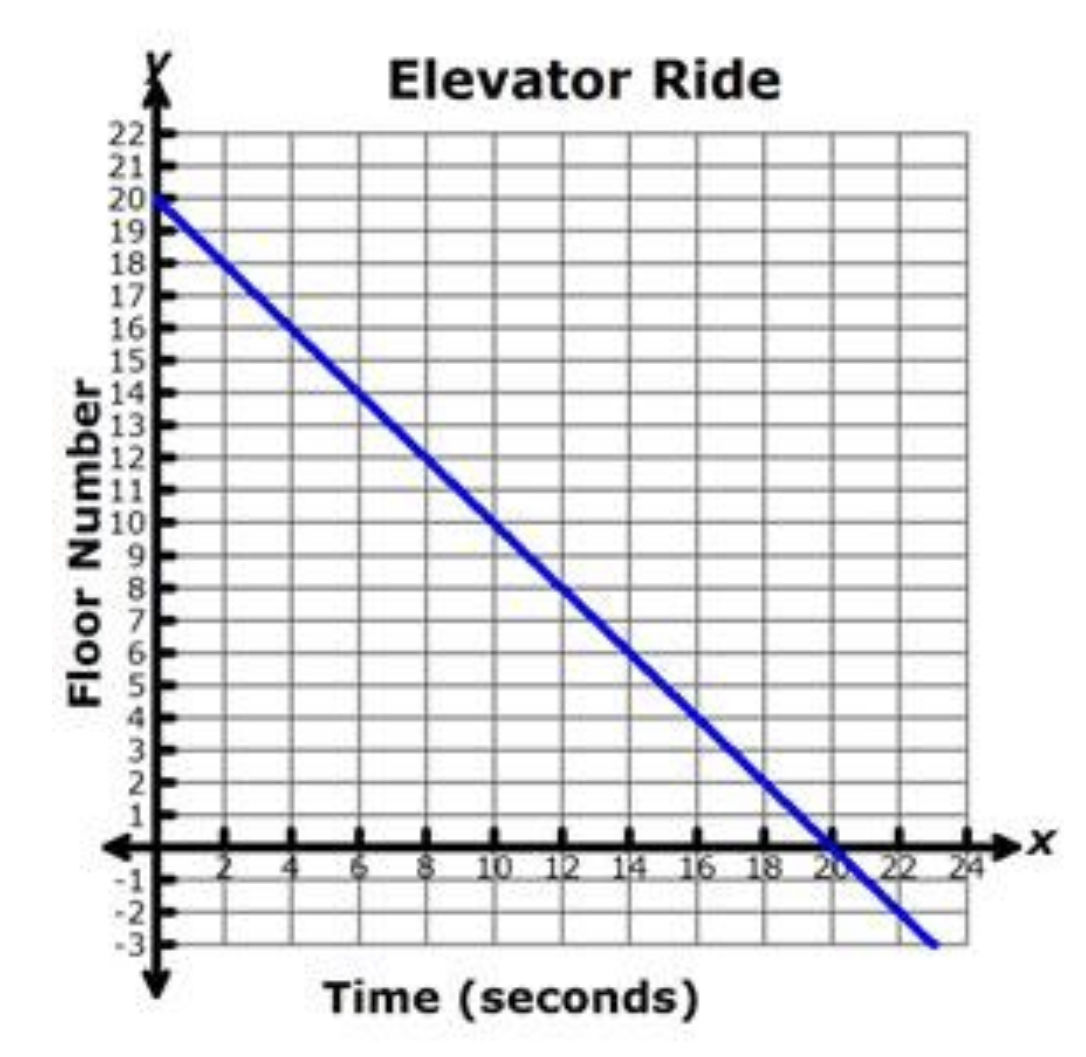
The time it takes the elevator to reach the ground.
The floor number at 0 seconds.
20 floors.
The floor number.
Give this quiz to my class
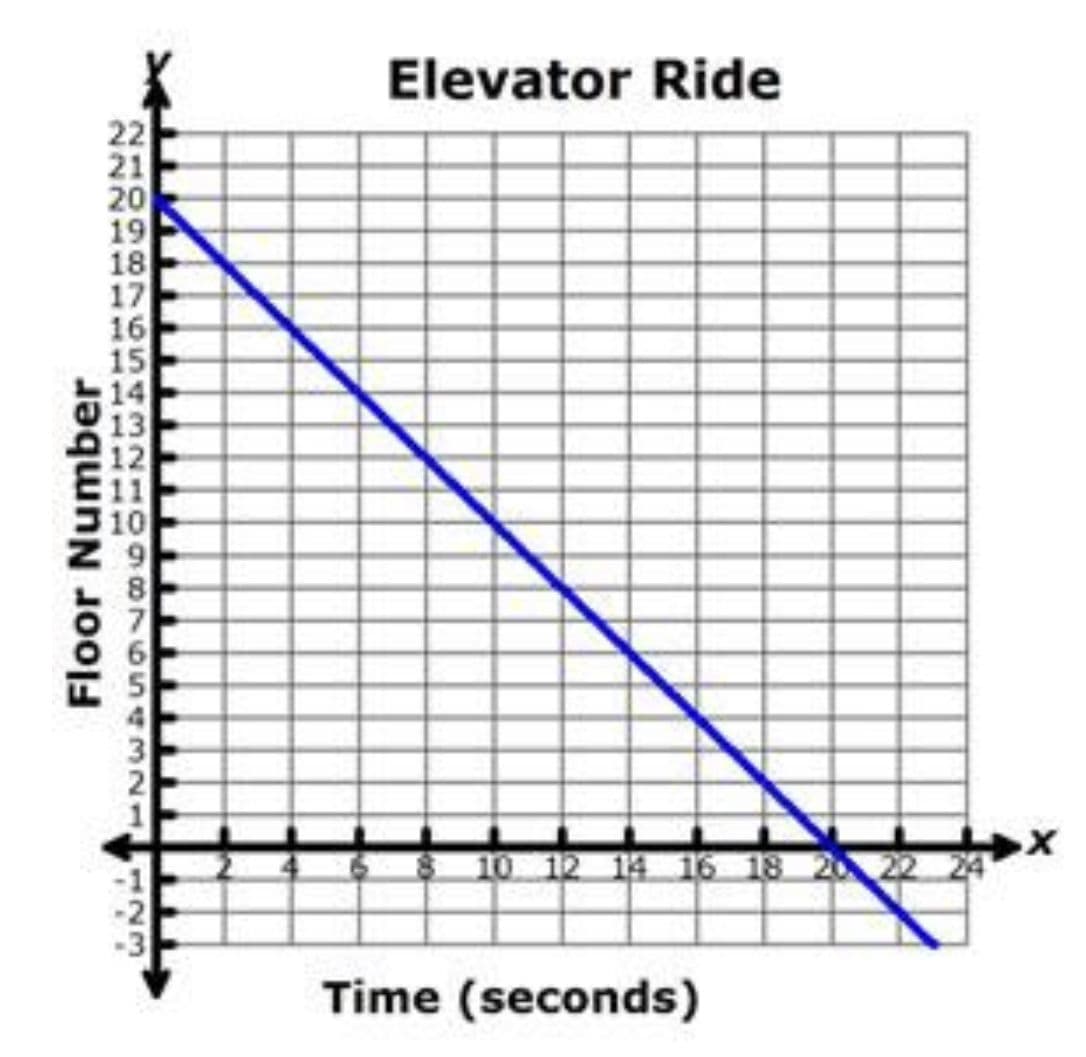
Interpret the y-intercept for this graph.
 GRADE 4 Module 6 Lesson 3. Interpret Remainders This PowerPoint file contains instructional aids for teachers who have purchased Into Math. It is intended to be projected to students and used in conjunction with the Student Edition and manipulatives as needed. These slides can be used to move the conversation forward in the classroom, but they should not serve as a replacement for student-centered, collaborative conversations in which students have the space they need to find an entry point, construct meaning, and build understanding. About the Slide Presentation Presenter View: Use the Presenter view to see notes while presenting. Customization: Add or delete content or notes to get the best learning experience for your classroom. 1 Problem of the Day. Which equations can be used to solve the following problem? Rita makes 40 bracelets and gives an equal number to 8 friends, including Veronica. Veronica gives 2 of the bracelets that she received to her sister. How many bracelets does Veronica have left? A. 40 – 8 = 32 32 ÷ 2 = 16 B. 40 ÷ 8 = 5 5 + 2 = 7 C. 8 + 2 = 10 40 ÷ 10 = 4 D. 40 ÷ 8 = 5 5 – 2 = 3 2 I Can. I Can solve a division problem and interpret the remainder in the context of the problem. 3 Spark Your Learning. Aiden is building solar toy cars in his science club. The cars collect and use energy from the sun for power. Aiden buys 18 wheels. Each car needs 4 wheels. How many cars can Aiden build? Show your thinking. 4 Turn and Talk. What is the remainder in this problem? What does the remainder mean? Professional Development note: Use the Professional Learning Cards to provide language routines that may help students access the meaning of the problem. 5 Build Understanding • Task 1 ACTIVITY. There are 57 students going to the science museum. Each van can take 5 students. How many vans are needed to take all the students? Use a visual model to show how the students are divided into groups of 5. 6 Turn and Talk. How can you use the whole-number quotient and remainder to answer these questions? How many vans will be full? How many students will ride in the van that is not full? Professional Development note: Use the Professional Learning Cards to provide language routines that may help students access the meaning of the problem. 7 Step It Out • Task 2 ACTIVITY.. Amanda has 73 inches of wire for a science experiment. She needs to cut all the wire into 8 identical pieces. How many inches long will each piece be? 8 Turn and Talk. Why is this problem a good situation to write the remainder as a fraction? Professional Development note: Use the Professional Learning Cards to provide language routines that may help students access the meaning of the problem. 9 Check Understanding. 1. Maya needs 44 batteries for smoke alarms. The batteries come in packs of 6. How many packs does Maya need to buy? For 44 ÷ 6, the whole-number quotient is ____ and the remainder is ____. Maya needs to buy ____ packs. Circle how you interpreted the remainder to solve the problem. 10 I Can Scale. 4 I can explain how to solve a division problem and interpret the remainder in the context of the problem. 3 I can solve a division problem and interpret the remainder in the context of the problem. 2 I can solve a division problem and identify the whole-number quotient and the remainder. 1 I can solve a division problem with a remainder. 11 Exit Ticket. Mr. Jenkins’ class is giving speeches during a 46-minute class. Each student will be able to talk for 4 minutes. How many students can give speeches? Justify your answer.In this video we take a look at the 0:02 fetch to code 0:03 execute cycle including its effect on 0:06 the various registers we've previously 0:12 [Music] 0:14 discussed a computer is defined Definition 0:17 as an electronic device that takes an 0:20 input 0:22 processes data 0:25 and delivers output 0:29 in this simple example you can see we're 0:31 taking the input 5 0:35 we're multiplying it by 2 that's our 0:37 process 0:39 and we're outputting 10. 0:44 but this could be way more complex for 0:46 example of a game console 0:48 the input could be the buttons you press 0:50 on a controller 0:53 the processes would then be carried out 0:55 by the console itself 0:59 and the output would be some form of 1:01 update to a monitor 1:02 and sound out for a speaker possibly 1:04 vibration feedback through the 1:06 controller 1:10 to process data a computer follows a set 1:13 of instructions 1:14 known as a computer program 1:18 if we take the lid off a typical desktop 1:20 computer we can identify 1:22 two critical components the memory 1:26 that stores the program and the central 1:29 processing unit or processor 1:31 which is under this large fan and 1:33 carries out the instructions 1:37 a computer carries out its function by 1:40 fetching 1:41 instructions decoding them and then 1:43 executing them 1:44 in a continuous repetitive cycle 1:46 billions of times a second 1:48 let's look at each of these stages in a 1:50 little more detail Fetch 1:53 so let's start with the fetch stage the 1:55 very first thing that happens 1:57 is the program counter is checked as it 2:00 holds the address 2:01 of the next instruction to be executed 2:07 the address stored is then copied into 2:09 the memory address register 2:14 the address is then sent along the 2:16 address bus to main memory 2:18 where it waits to receive a signal from 2:21 the control 2:22 bus so it knows what to do 2:27 as we want to read the data that's 2:29 stored in memory address 2:30 0 0 0 0 the control unit sends 2:34 a read signal along the control bus to 2:36 main memory 2:41 now main memory knows the data needs to 2:44 be read 2:45 the content stored in memory address 000 2:49 can be sent along the data bus to the 2:51 memory data register 2:56 now as we're currently in the process of 2:58 fetching an instruction 3:00 the data received by the memory data 3:03 register gets copied 3:04 into the current instruction register 3:11 the instruction effectively has now been 3:14 fetched from memory 3:16 just before we proceed to the decode 3:18 phase we now 3:19 increment the program counter so that 3:22 the address it contains 3:24 points to the address of the next 3:26 instruction which will need to be 3:30 executed 3:32 the instruction now being held in the 3:33 current instruction register 3:35 is ready to be decoded 3:39 now as we mentioned in the previous 3:41 video the instruction is made up of two 3:43 parts 3:44 we have the op code that's what it is we 3:47 need to do 3:50 and we have the operand what are we 3:53 going to do it to 3:55 now the operand could contain the actual 3:57 data 3:58 or indeed it could contain an address of 4:01 where the data is to be found 4:06 by decoding this instruction we can see 4:08 the operation we need 4:10 is a load operation so we need to load 4:14 the contents of memory location0101 4:18 into the cpus accumulator 4:25 in the exam a simple model will be used 4:27 to describe the 4:29 structure of any given instruction 4:32 you're not going to be expected to 4:34 define how an opcode is made up 4:36 but simply to interpret opcodes in the 4:39 given context of an exam 4:40 question in the example here 4:44 you can see there's a total of 16 4:46 different opcodes available 4:48 and this is because we're using four 4:50 bits for our representation 4:56 so now we've fetched the instruction and 4:59 we've decoded it so we know what we need 5:00 to do 5:01 we're finally ready to execute it 5:05 so we now send address 0101 5:08 to the memory dress register 5:13 now we're in the memory address register 5:15 we can finally send the address 5:18 down the address bus to main memory 5:24 this time we want to read the data 5:26 that's stored in memory 5:28 and so the control unit again sends a 5:30 read signal along the control bus 5:36 so main memories now receive an address 5:38 and a read signal 5:40 so the content stored at memory location 5:43 0101 5:44 can now be sent along the data bus back 5:46 to the cpu 5:47 and into the memory data register 5:54 finally the contents of the memory data 5:56 register are copied to the accumulator 5:59 and this is one of a number of general 6:00 purpose registers found in the cpu 6:04 this first instruction is now complete Branching 6:11 so what does this program actually do 6:14 you should be able to work it through 6:16 carefully and figure it out 6:19 we're now pointing instructions zero 6:21 zero zero one in the program counter 6:23 and we're ready to fetch the second 6:25 instruction 6:27 at the end of this video we're gonna 6:29 provide you with the answer 6:34 so let's talk a second about programs 6:37 that branch 6:40 on the left here we have a very simple 6:42 piece of pseudo code 6:44 line zero says first execute this line 6:46 of code 6:47 line 1 now execute this line and then 6:50 line 2 says 6:52 if the age is greater than 18 then 6:56 we're going to execute lines 3 and 4 6:58 otherwise 6:59 we're going to execute lines six and 7:02 seven 7:03 so this program doesn't necessarily 7:05 follow strictly in sequence from line 7:07 zero through to seven there's a chance 7:10 here the program may branch and jump 7:14 around 7:16 so we're going to pretend that this 7:17 program has been loaded into memory 7:20 each line of code on the left here has 7:23 ended up 7:24 as a location in memory now this is not 7:27 strictly how this would happen in this 7:28 one-to-one way 7:29 but for the purpose of example it's 7:31 absolutely fine 7:35 so the program counter starts by 7:37 pointing to memory address zero 7:39 and we fetch the first instruction 7:41 decode it and execute it 7:44 it then updates and tells us the next 7:47 instruction 7:48 is zero zero zero one because remember 7:50 the program counter is being incremented 7:52 so we fetch it decode it and we execute 7:55 line one of our program 7:59 we then fetch line two which in binary 8:01 is one 8:02 zero 8:06 now at this point depending on what 8:10 happens during the execution 8:11 of line two the program may be required 8:15 to fetch line three from memory or 8:18 line five from memory 8:25 so let's look at how this actually works 8:27 because we've said the program counter 8:28 simply gets incremented 8:31 well in the current instruction register 8:33 we have an instruction with the op code 8:36 0 1 1 0. 8:41 now when we look this up in the decode 8:43 unit we discover that this 8:45 code means branch always 8:51 this replaces the value held in the 8:54 program counter 8:56 with the contents of the operand that's 8:58 the second part of the instruction 9:01 from the current instruction register so 9:03 this case 9:04 one zero zero one 9:09 now when the next fetch cycle begins the 9:12 program counter is obviously checked 9:14 and as its contents have been previously 9:16 updated to a new memory location 9:19 and not simply incremented the program 9:22 effectively is able to jump 9:24 around memory 9:28 so having watched this video you should 9:30 be able to answer the following key 9:32 question 9:33 how does a cpu work 9:39 okay so let's um answer the question we 9:41 posed 9:42 earlier what did that program actually 9:48 do 9:50 so this is the first fetch to code 9:53 execute cycle 9:55 and this is the one that we ran through 9:57 in detail earlier 9:58 it effectively loaded the contents of 10:01 the memory 10:02 stored at location location0101 10:05 into the accumulator in other words 10:08 the dna number 3 is moved 10:11 from memory into the cpu 10:18 we then proceed onto the second fetch 10:20 decode execute cycle 10:23 now this one adds the contents of memory 10:27 located at 0 1 1 0 10:30 to the current contents of the 10:32 accumulator 10:34 so in other words the dna number one 10:38 because that's what's stored at address 10:40 zero one one zero 10:43 is added to the number three that was in 10:45 the accumulator 10:46 the results are stored back over the 10:48 accumulator 10:49 so effectively we've done three plus one 10:53 equals four 10:58 the third fetch to code execute cycle 11:00 stores the contents which are in the 11:02 accumulator 11:03 into memory location zero one one one 11:07 and that's because the op code the first 11:09 part of this current instruction 11:10 zero zero one one is the command to 11:13 store when we look it up in the decoder 11:15 unit 11:16 so in other words the result of the 11:17 previous calculation three plus one 11:19 equals four 11:20 is now written back into main memory 11:28 the fourth fetch decode execute cycle 11:30 outputs the contents of the accumulator 11:33 remember they were copied into main 11:34 memory but they're still held in the 11:35 accumulator 11:37 so in this simple abstraction the number 11:40 four is now 11:41 output to the user so they can see the 11:43 result of the calculation 11:49 the fifth and final fetch code execute 11:51 cycle 11:52 brings a halt to the current program 11:58 so this very simple program which has 12:01 five 12:02 fetch decode execute cycles has 12:04 performed the calculation 12:06 three plus one is then stored the result 12:09 in main memory 12:10 and displayed the result four to the 12:12 user 12:13 and in a high-level language this may 12:15 look something very similar to the 12:17 following two lines of code 12:20 sum variable equals num1 plus num2 12:24 print sum to the user 12:27 so you can start to get an appreciation 12:29 here of how the high level code you 12:32 write actually ends up being fetched 12:34 decoded 12:35 and executed inside a processor 12:38 of course your processor is doing 12:40 billions and billions of these 12:42 operations a second 12:43 which when you think about it is really 12:45 very impressive 12:52 [Music] 13:03 you. make 10 questions for a standerd of a levelQ1. A teacher designs a lesson where students compute real-life percentages such as discounts and savings. 👉 A student calculates 15% of 200 to determine savings in a purchase. What is the correct result? A. 20 B. 25 C. 30 D. 35 Q2. In a classroom activity, learners compare numbers to find the highest common factor for grouping materials evenly. 👉 What is the GCF of 24 and 36? A. 6 B. 8 C. 12 D. 18 📘 FRACTIONS, DECIMALS, AND POWERS Q3. A learner converts fractions into percentages for data interpretation. 👉 What is 3/4 expressed as a percentage? A. 50% B. 60% C. 75% D. 80% Q4. A student models exponential growth using repeated multiplication. 👉 What is the value of 252^525? A. 25 B. 30 C. 32 D. 64 📘 ALGEBRA (EQUATIONS AND EXPRESSIONS) Q5. A teacher guides students to solve equations that represent real-life situations. 👉 Solve: 2x+8=202x + 8 = 202x+8=20 A. x = 4 B. x = 6 C. x = 8 D. x = 10 Q6. Students simplify expressions to understand relationships between quantities. 👉 Simplify: 3(x+4)−2x3(x + 4) - 2x3(x+4)−2x A. x + 12 B. x + 4 C. 5x + 4 D. 5x + 12 📘 FUNCTIONS AND GRAPHING Q7. A student analyzes a linear equation to determine its rate of change. 👉 What is the slope of y=3x−5y = 3x - 5y=3x−5? A. -5 B. -3 C. 3 D. 5 Q8. A learner evaluates functions to predict outcomes. 👉 If f(x)=2x+3f(x) = 2x + 3f(x)=2x+3, what is f(4)f(4)f(4)? A. 7 B. 9 C. 11 D. 14 📘 GEOMETRY Q9. Students explore geometric shapes and their properties through visual models. 👉 What is the sum of interior angles of a triangle? A. 90° B. 180° C. 270° D. 360° Q10. A student calculates the area of a classroom table with dimensions 8 cm by 5 cm. 👉 What is the area? A. 26 sq cm B. 30 sq cm C. 40 sq cm D. 48 sq cm 📘 MEASUREMENT AND FIGURES Q11. A learner determines the volume of a cube used in a science experiment. 👉 What is the volume of a cube with side 4 cm? A. 16 cubic cm B. 32 cubic cm C. 48 cubic cm D. 64 cubic cm Q12. Students identify shapes used in design projects. 👉 How many sides does a hexagon have? A. 5 B. 6 C. 7 D. 8 📘 STATISTICS AND PROBABILITY Q13. A teacher helps students interpret data sets using measures of central tendency. 👉 What is the mean of 4, 6, 8, 10, 12? A. 6 B. 8 C. 10 D. 12 Q14. A class experiment involves flipping a fair coin. 👉 What is the probability of getting heads? A. 1/4 B. 1/3 C. 1/2 D. 2/3 📘 WORD PROBLEMS (APPLICATION) Q15. A car travels 180 km in 3 hours during a learning task on speed. 👉 What is its average speed? A. 45 km/h B. 60 km/h C. 75 km/h D. 90 km/h Q16. Students analyze work efficiency in a project. 👉 If 5 workers complete a task in 12 days, how long will 10 workers take? A. 3 days B. 6 days C. 8 days D. 12 days Q17. A student solves a problem involving ratios in a classroom population. 👉 If the ratio of boys to girls is 3:2 and there are 30 students, how many boys are there? A. 12 B. 15 C. 18 D. 20 Q18. A learner determines the duration of a scheduled trip. 👉 A journey starts at 8:30 AM and ends at 11:15 AM. How long is the trip? A. 2 hrs 15 mins B. 2 hrs 30 mins C. 2 hrs 45 mins D. 3 hrs 15 mins Q19. A student computes simple interest for financial literacy. 👉 What is the simple interest on ₱1000 at 5% for 2 years? A. ₱50 B. ₱75 C. ₱100 D. ₱150 Q20. A learner solves a perimeter problem involving a rectangle. 👉 A rectangle has a length of 12 cm and perimeter of 34 cm. What is the width? A. 5 cm B. 7 cm C. 10 cm D. 11 cm ✅ ANSWER KEY (BASED ON YOUR REVIEWER) (All verified from your uploaded file) [ilide.info...002acd4e5a | PDF] QAnswer1C2C3C4C5B6A7C8C9B10C11D12B13B14C15B16B17C18C19C20A1.1 Implement the business plan; 1.2 Operate the business; 1.3 Sell the product/service to potential customers; 1.4 Identify the reasons for keeping business records; 1.5 Perform key bookkeeping tasks; 1.6 Interpret financial statements (balance sheet, income statement, cash flow projections, and summary of sales and cash receipts); 1.7 Prepare an income statement and a balance sheet; 1.8 Identify where there is a profit or loss for a business; and 1.9 Generate an overall report on the activity. entrepreneurship grade 12SC.7.N.1.1 Define a problem from the seventh grade curriculum, use appropriate reference materials to support scientific understanding, plan and carry out scientific investigation of various types, such as systematic observations or experiments, identify variables, collect and organize data, interpret data in charts, tables, and graphics, analyze information, make predictions, and defend conclusions. AA-SC.7.N.1.1 (H) Define a problem from the seventh grade curriculum, use appropriate reference materials to support scientific understanding, plan and carry out scientific investigation of various types, such as systematic observations or experiments, identify variables, collect and organize data, interpret data in charts, tables, and graphics, analyze information, make predictions, and defend conclusions.PB-SC.8.N.1.1 (H) – Define a problem from the curriculum using appropriate reference materials to support scientific understanding; plan and carry out scientific investigations of various types, such as systematic observations or experiments; identify variables; collect and organize data; interpret data in charts, tables, and graphics; analyze information; make predictions; and defend conclusions.AA-SC.6.N.1.1 (H) – Define a problem from the curriculum using appropriate reference materials to support scientific understanding; plan and carry out scientific investigations of various types, such as systematic observations or experiments; identify variables; collect and organize data; interpret data in charts, tables, and graphics; analyze information; make predictions; and defend conclusions.