use models and diagrams to explain the Pythagorean theorem
Track each student's skills and progress in your Mastery dashboards
Give this quiz to my class
Q 1/10
Score 0
Which model would best represent the Pythagorean theorem?
30
Q 2/10
Score 0
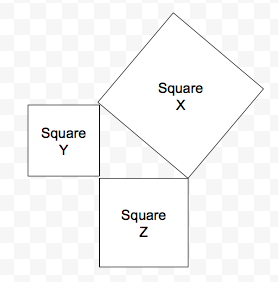
The diagram shows three squares that are joined at vertices to for a right triangle. Which statement is true?
30
The sum of the areas of Square Z and Square Y is greater than the area of Square X.
The sum of the areas of Square Z and Square Y is equal to Square X.
The sum of the areas of Square Z and Square Z is less than Square Y.
The sum of the areas of Square X and Square Y is equal to Square Z.
10 questions
Q.
Which model would best represent the Pythagorean theorem?
1
30 sec
8.6.C: Expressions, Equations and Relationships
Q.
The diagram shows three squares that are joined at vertices to for a right triangle. Which statement is true?
2
30 sec
8.6.C: Expressions, Equations and Relationships
Q.
The diagram shows three square that are joined at vertices to form a right triangle. Which statement is true?
3
30 sec
8.6.C: Expressions, Equations and Relationships
Q.
A right triangle is shown below. Based on the diagram, what is the length of one side of Square F?
4
30 sec
8.6.C: Expressions, Equations and Relationships
Q.
A right triangle is show below. Based on the diagram, what is the length of one side of Square X?
5
30 sec
8.6.C: Expressions, Equations and Relationships
Q.
When three squares are joined at their vertices to form a right triangle, the combined area of the two smaller squares is the small as the area of the largest square. Which three squares support this statement?
6
30 sec
8.6.C: Expressions, Equations and Relationships
Q.
When three squares are joined at their vertices to form a right triangle, the combined area of the two smaller squares is the same as the area of the largest square.
7
30 sec
8.6.C: Expressions, Equations and Relationships
Q.
Sally is creating a model to explain the Pythagorean theorem. Her incomplete model is shown. Which of the following best describes the missing part of Sally's model?