Loading...


1-15 PISA questions
Quiz by Rovejane Selvano
Tag the questions with any skills you have. Your dashboard will track each student's mastery of each skill.
Biodiversity Text 1
Read the following newspaper article and answerthe questions which follow.
BIODIVERSITY IS THE KEY TO MANAGINGENVIRONMENT
An ecosystem that retains a high biodiversity (that is, a wide varietyof living things)is much more likely to adapt to human-caused environment change than is one that has little.
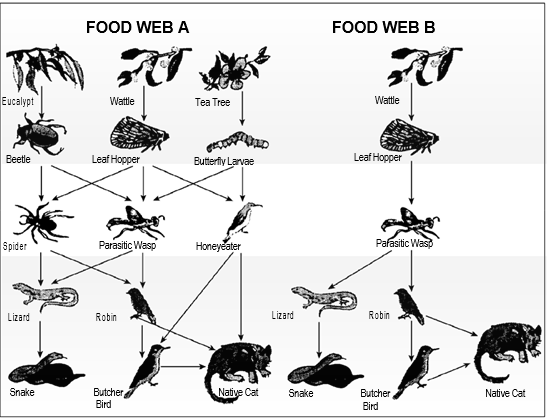
Considerthe two food webs shown in the diagram. The arrows pointfrom the
9 organism that gets eaten to the one that eats it. These food webs are highly simplified comparedwith food webs in real ecosystems, but they still illustrate a key difference between more diverse and less diverseecosystems.
Food web B represents a situation with very low biodiversity, where at some levels the food path involves only a singletype of organism. Food web A represents
10 a more diverse ecosystem with, as a result, many more alternative feeding pathways.
Generally, loss of biodiversity shouldbe regarded seriously, not only because the organisms that have becomeextinct represent a big loss for both ethicaland utilitarian (useful benefit) reasons,but also becausethe organisms that remain have become more vulnerable (exposed) to extinction in the future.
Question3: BIODIVERSITY S126Q03
In lines 9 and 10 it is stated that “Food web A represents a more diverseecosystem with, as a result, many more alternative feeding pathways.”
Look at FOOD WEB A. Only two animals in this food web have three direct (immediate) food sources.Which two animals are they?
A Native Cat and Parasitic Wasp B Native Cat and ButcherBird
C Parasitic Wasp and Leaf Hopper D Parasitic Wasp and Spider
E Native Cat and Honeyeater
E Native Cat and Honeyeater
D Parasitic Wasp and Spider
B Native Cat and ButcherBird
C Parasitic Wasp and Leaf Hopper
A Native Cat and Parasitic Wasp
Biodiversity Text 1
Read the following newspaper article and answerthe questions which follow.
BIODIVERSITY IS THE KEY TO MANAGINGENVIRONMENT
An ecosystem that retains a high biodiversity (that is, a wide varietyof living things)is much more likely to adapt to human-caused environment change than is one that has little.
Considerthe two food webs shown in the diagram. The arrows pointfrom the
9 organism that gets eaten to the one that eats it. These food webs are highly simplified comparedwith food webs in real ecosystems, but they still illustrate a key difference between more diverse and less diverseecosystems.
Food web B represents a situation with very low biodiversity, where at some levels the food path involves only a singletype of organism. Food web A represents
10 a more diverse ecosystem with, as a result, many more alternative feeding pathways.
Generally, loss of biodiversity shouldbe regarded seriously, not only because the organisms that have becomeextinct represent a big loss for both ethicaland utilitarian (useful benefit) reasons,but also becausethe organisms that remain have become more vulnerable (exposed) to extinction in the future.
Question3: BIODIVERSITY S126Q03
In lines 9 and 10 it is stated that “Food web A represents a more diverseecosystem with, as a result, many more alternative feeding pathways.”
Look at FOOD WEB A. Only two animals in this food web have three direct (immediate) food sources.Which two animals are they?
A Native Cat and Parasitic Wasp B Native Cat and ButcherBird
C Parasitic Wasp and Leaf Hopper D Parasitic Wasp and Spider
E Native Cat and Honeyeater

Question4: BIODIVERSITY S126Q04
Food webs A and B are in different locations. Imagine if Leaf Hoppersdied out in both locations. Which one of these is the best prediction and explanation for the effect this would have on the food webs?
3. Question 1: BUSES S127Q01
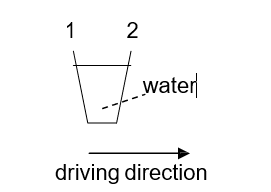
A bus is drivingalong a straight stretchof road. The bus driver,named Ray, has a cup of water restingon the dashboard:
SuddenlyRay has to slam on the brakes.
What is most likely to happen to the waterin the cup?
4. Question 4: BUSES S127Q04- 0 1 8 9
Ray’s bus is, like most buses,powered by a petrolengine. These buses contribute to environmental pollution.
Some cities have trolley buses: they are powered by an electricengine. The voltage needed for such an electricengine is providedby overhead lines (like electric trains). The electricity is suppliedby a power station using fossil fuels.
Supporters for the use of trolleybuses in a city say that these buses don’t contribute to environmental pollution.
Are these supporters right? Explain your answer. ....................................................
...................................................................................................................................
...................................................................................................................................
...................................................................................................................................
S128: Cloning
Readthe newspaper articleand answer the questions that follow.
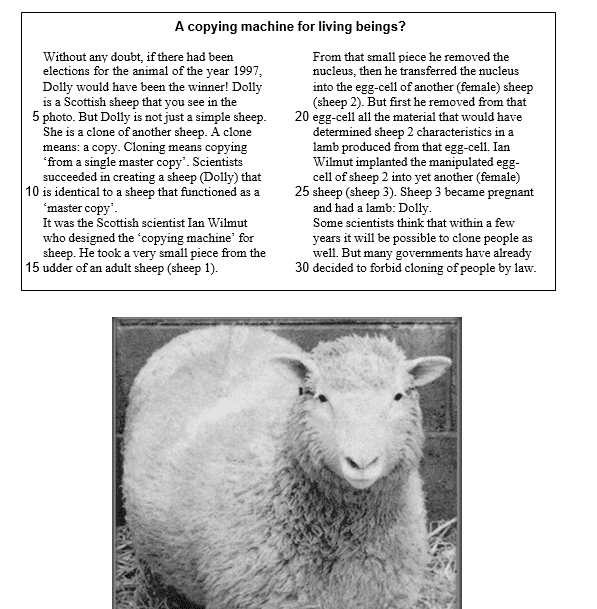
5. Which sheep is Dolly identical to?
Question2: CLONING S128Q02
In line 14 the part of the udder that was used is described as “a very small piece”. From the article text you can work out what is meant by “a very small piece”.
That “very small piece”is
Question3: CLONING S128Q03
In the last sentence of the article it is statedthat many governments have already decided to forbidcloning of people by law.
Two possible reasons for this decisionare mentioned below. Are these reasonsscientific reasons?
Circleeither “Yes” or “No” for each.
