Loading...

Customize this quiz to suit your class
Instantly translate to 100+ languages
Tag the questions with any skills you have. Your dashboard will track each student's mastery of each skill.
Give this quiz to my class
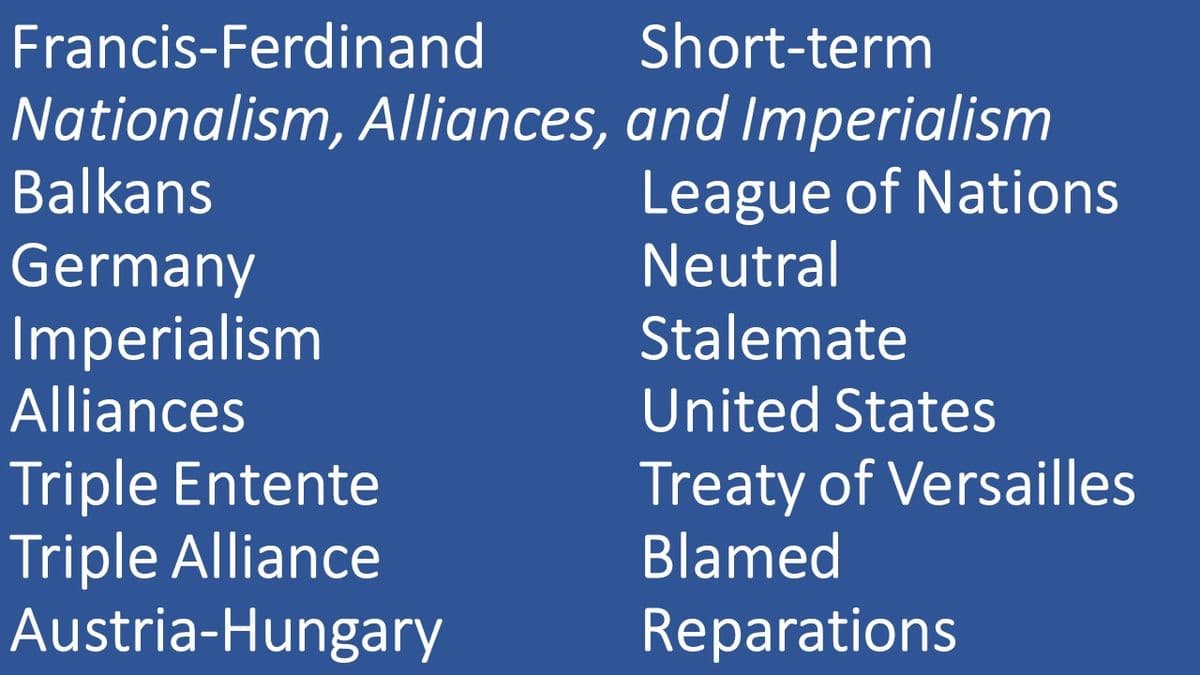
The assassination of ____ was a cause of the outbreak of World War I.
The assassination of Franz Ferdinand was a _ cause for the war.
The assassination of ____ was a cause of the outbreak of World War I.
The assassination of Franz Ferdinand was a _ cause for the war.
_were long-term causes of World War I.
The _, a region in southeastern Europe, had especially strong nationalist feelings.
_wanted to increase its influence at France's expense.
_ is the policy of empire building.
_ was the way that the European countries tried to keep the peace.
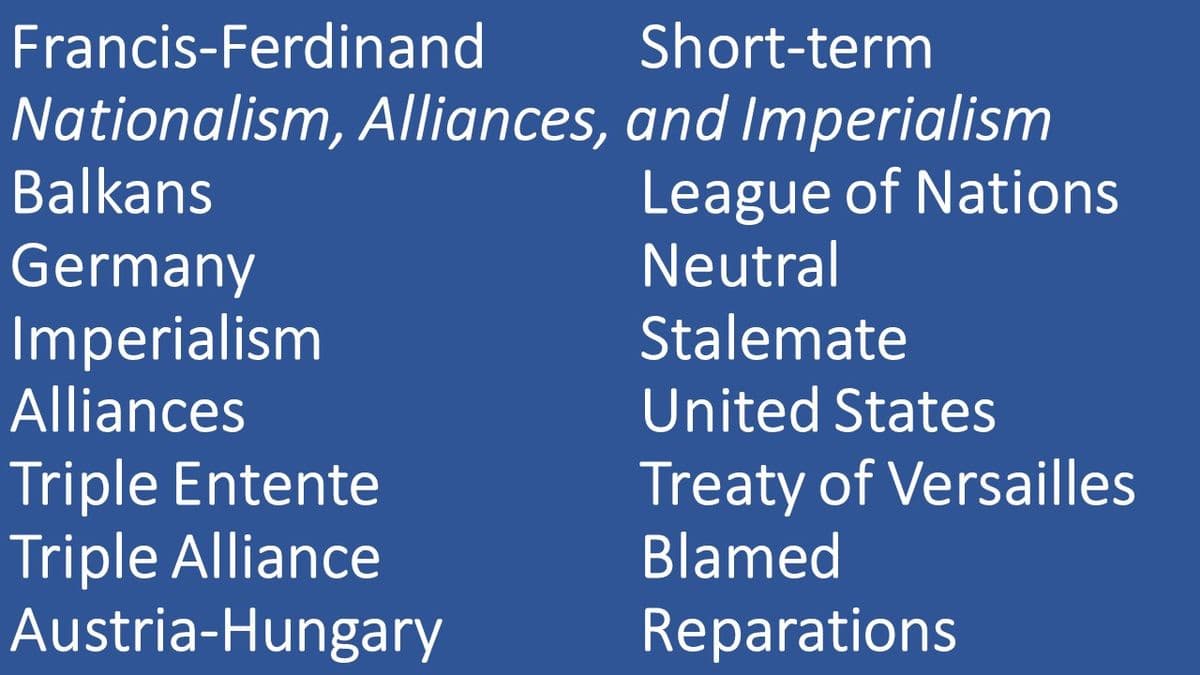
_ was an alliance between France, Great Britain, and Russia.
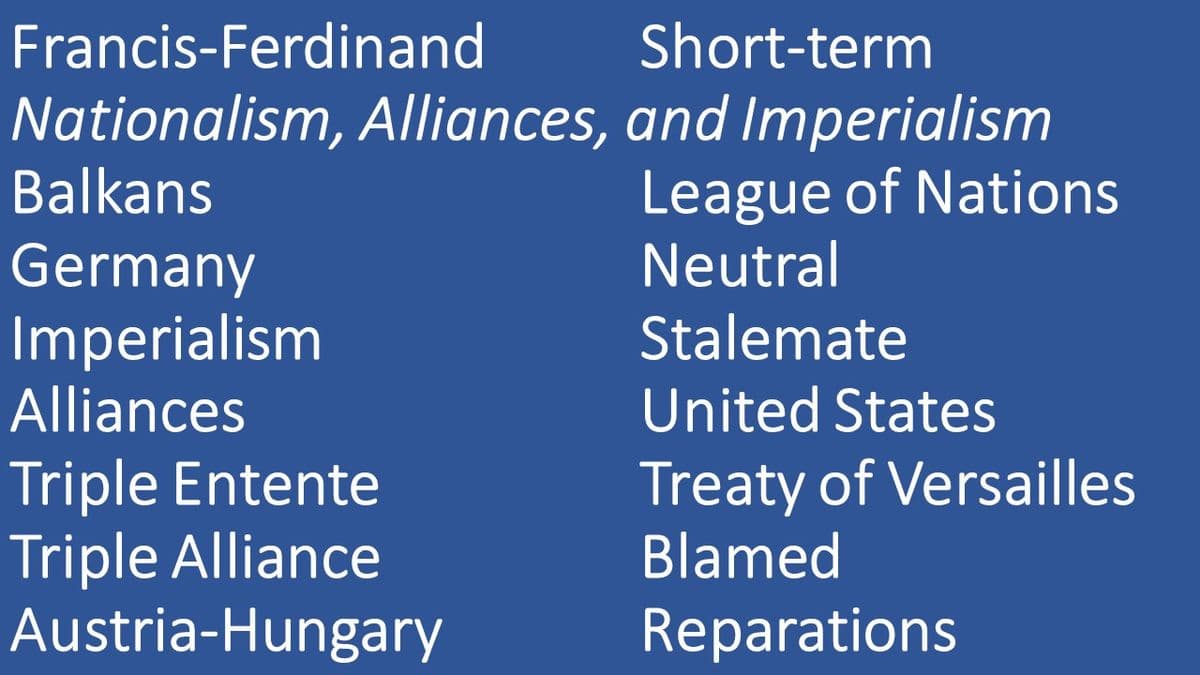
_ was an alliance that included Germany, Austria-Hungary, and Italy.
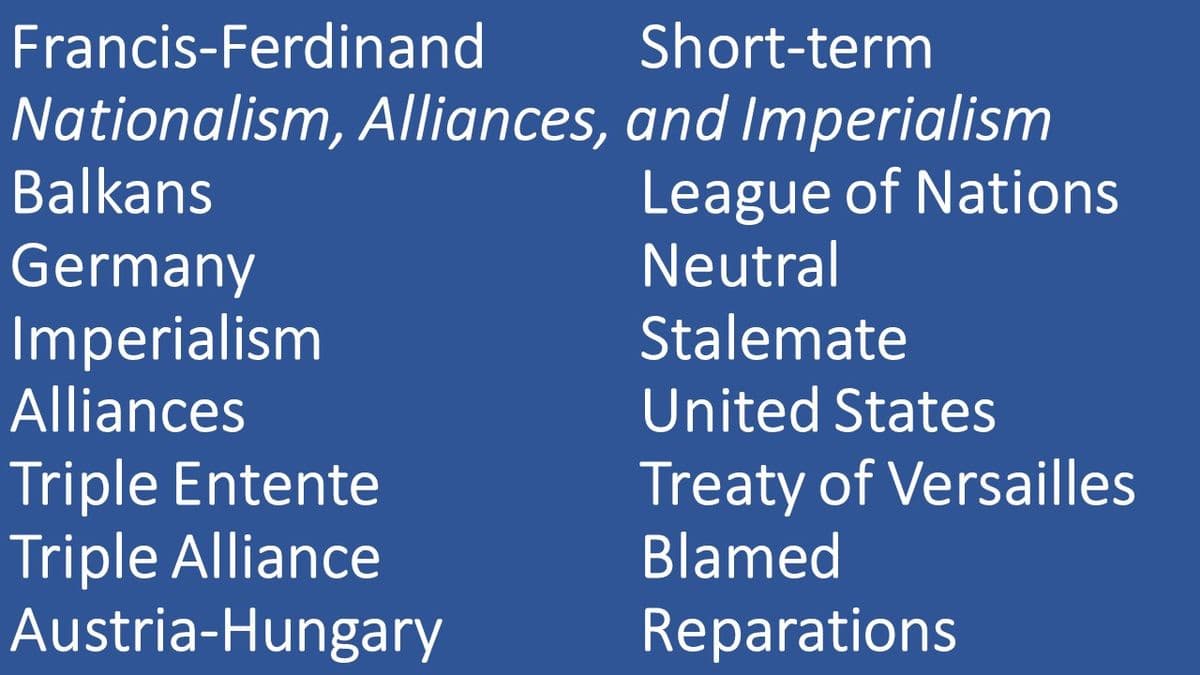
_ was the first country to declare war in World War I.
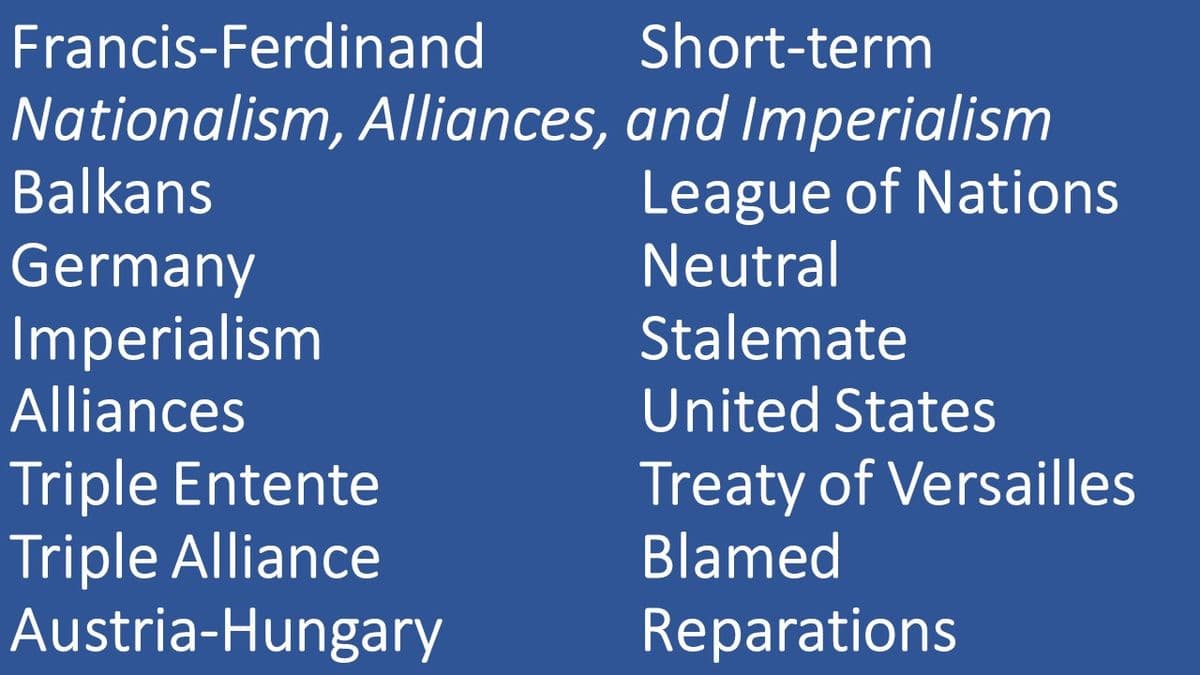
_ means to not take sides in a war.
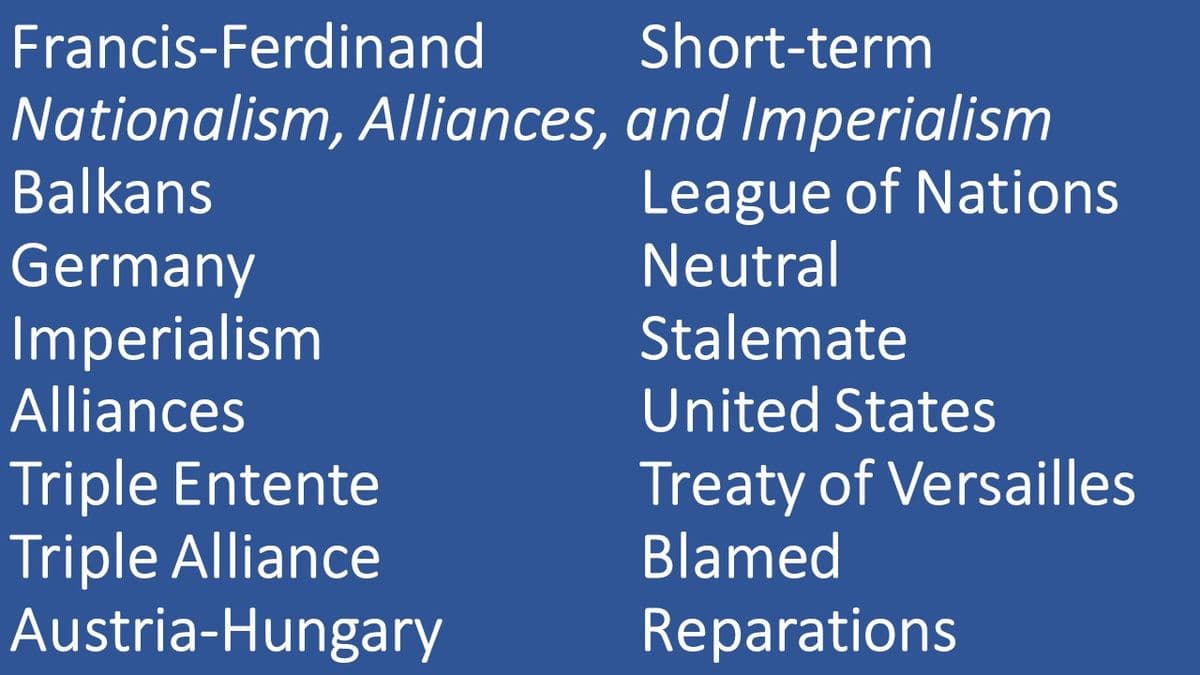
How would you describe the early years of the war?
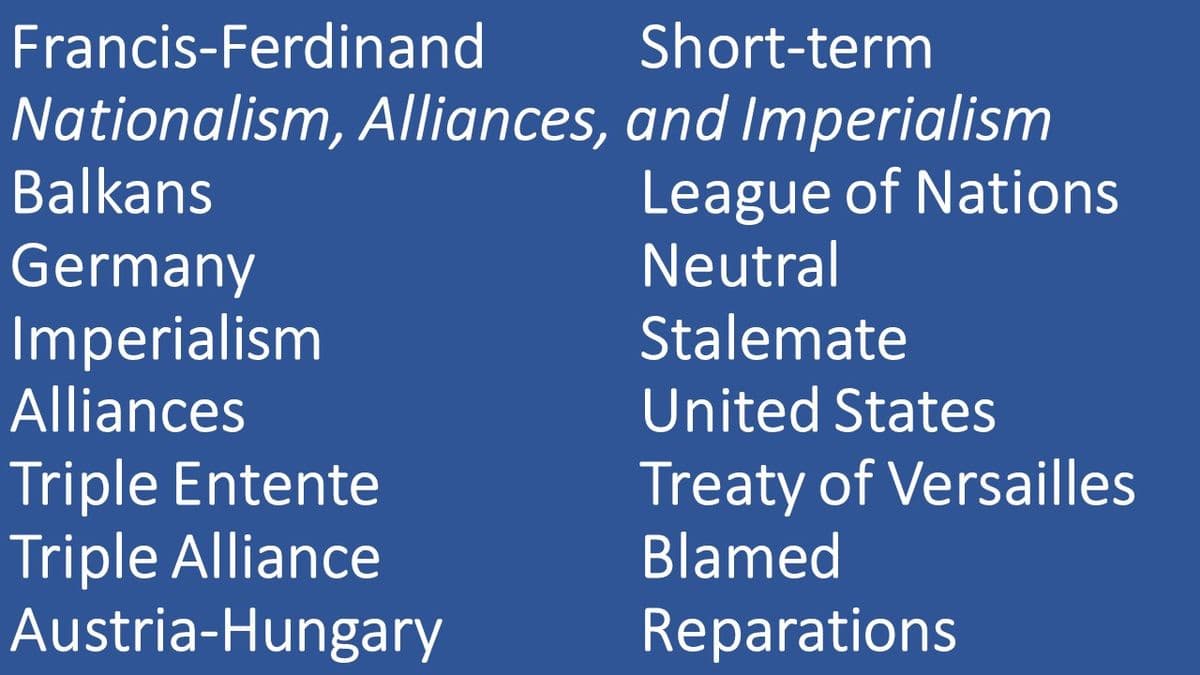
The _was brought into the war and helped turn the tide
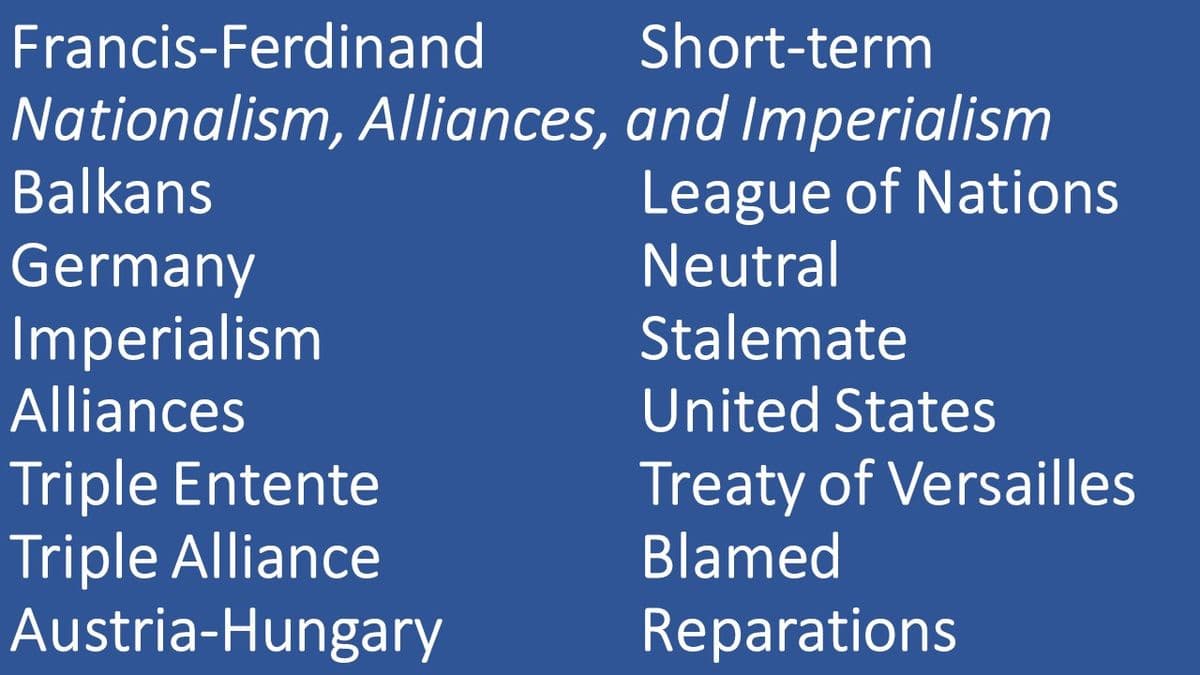
_ was the treaty that ended World War I.
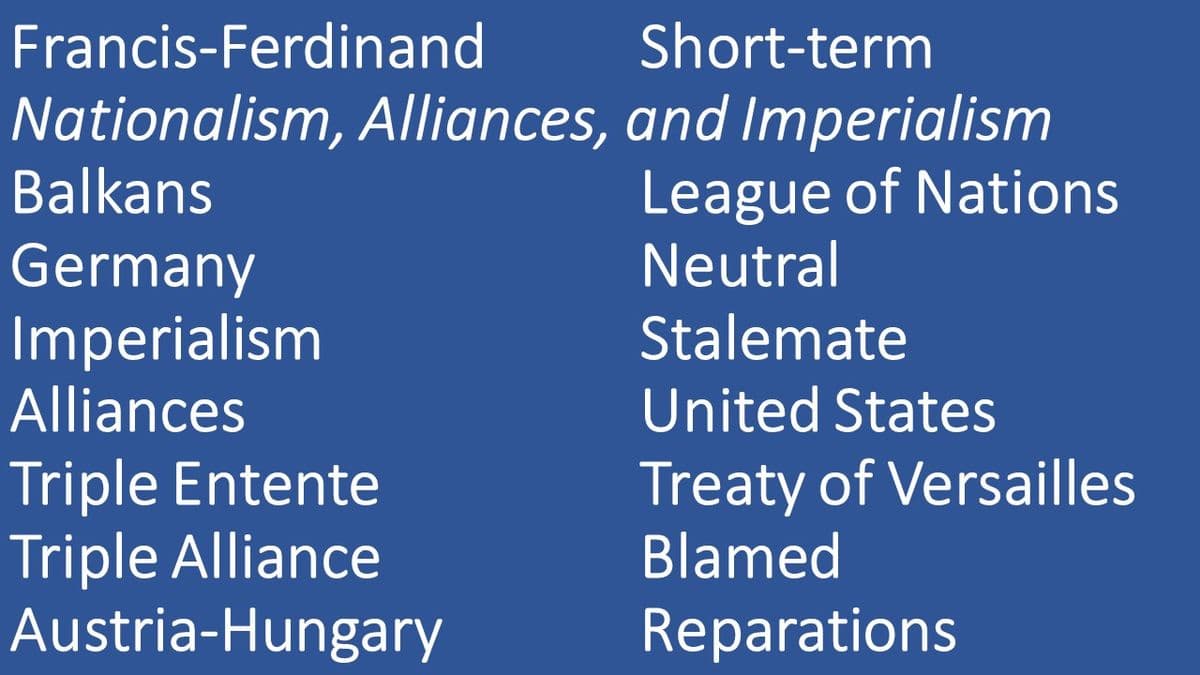
Germany was _ for the war.
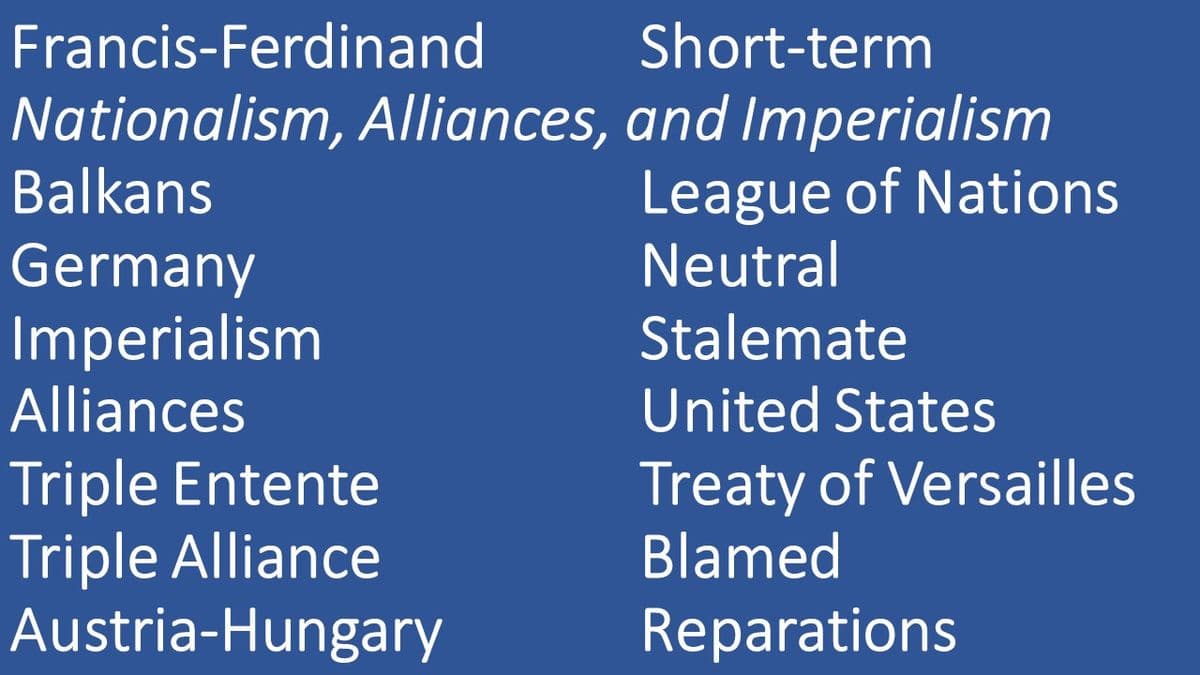
__ are payments made for harm done to other countries.

_ was an attempt to solve world disputes as part of the Treaty of Versailles.
 Ancient India Review QuizLesson 1: Continental Drift Theory and the Evidences that support the Theory Continental drift describes one of the earliest ways geologists thought continents moved over time. Today, the theory of continental drift has been replaced by the science of plate tectonics. The theory of continental drift is most associated with the scientist Alfred Wegener. In the early 20th century, Wegener published a paper explaining his theory that the continental landmasses were “drifting” across the Earth, sometimes plowing through oceans and into each other. He called this movement continental drift. Pangaea Wegener was convinced that all of Earth’s continents were once part of an enormous, single landmass called Pangaea. Wegener, trained as an astronomer, used biology, botany, and geology describe Pangaea and continental drift. For example, fossils of the ancient reptile mesosaurus are only found in southern Africa and South America. Mesosaurus, a freshwater reptile only one meter (3.3 feet) long, could not have swum the Atlantic Ocean. The presence of mesosaurus suggests a single habitat with many lakes and rivers. Wegener also studied plant fossils from the frigid Arctic Archipelago of Svalbard, Norway. These plants were not the hardy specimens adapted to survive in the Arctic climate. These fossils were of tropical plants, which are adapted to a much warmer, more humid environment. The presence of these fossils suggests Svalbard once had a tropical climate. Finally, Wegener studied the stratigraphy of different rocks and mountain ranges. The east coast of South America and the west coast of Africa seem to fit together like pieces of a jigsaw puzzle, and Wegener discovered their rock layers “fit” just as clearly. South America and Africa were not the only continents with similar geology. Wegener discovered that the Appalachian Mountains of the eastern United States, for instance, were geologically related to the Caledonian Mountains of Scotland. Pangaea existed about 240 million years ago. By about 200 million years ago, this supercontinent began breaking up. Over millions of years, Pangaea separated into pieces that moved away from one another. These pieces slowly assumed their positions as the continent we recognize today. Today, scientists think that several supercontinents like Pangaea have formed and broken up over the course of the Earth’s lifespan. These include Pannotia, which formed about 600 million years ago, and Rodinia, which existed more than a billion years ago. Tectonic Activity Scientists did not accept Wegener’s theory of continental drift. One of the elements lacking in the theory was the mechanism for how it works—why did the continents drift and what patterns did they follow? Wegener suggested that perhaps the rotation of the Earth caused the continents to shift towards and apart from each other. (It doesn't.) Today, we know that the continents rest on massive slabs of rock called tectonic plates. The plates are always moving and interacting in a process called plate tectonics. The continents are still moving today. Some of the most dynamic sites of tectonic activity are seafloor spreading zones and giant rift valleys. In the process of seafloor spreading, molten rock rises from within the Earth and adds new seafloor (oceanic crust) to the edges of the old. Seafloor spreading is most dynamic along giant underwater mountain ranges known as mid-ocean ridges. As the seafloor grows wider, the continents on opposite sides of the ridge move away from each other. The North American and Eurasian tectonic plates, for example, are separated by the Mid-Atlantic Ridge. The two continents are moving away from each other at the rate of about 2.5 centimeters (1 inch) per year. Rift valleys are sites where a continental landmass is ripping itself apart. Africa, for example, will eventually split along the Great Rift Valley system. What is now a single continent will emerge as two—one on the African plate and the other on the smaller Somali plate. The new Somali continent will be mostly oceanic, with the Horn of Africa and Madagascar its largest landmasses. The processes of seafloor spreading, rift valley formation, and subduction (where heavier tectonic plates sink beneath lighter ones) were not well-established until the 1960s. These processes were the main geologic forces behind what Wegener recognized as continental drift.Question 1 Category: Current Events Question: What was the primary demand of the Kenyan Gen Z protesters featured in the BBC documentary Unmasked: The Truth Behind the Gen Z Protests? Options: A) Free education B) Repeal of the Finance Bill 2024 C) Climate change action D) New elections Correct Answer: B) Repeal of the Finance Bill 2024 Explanation: The BBC documentary highlights that Kenyan youth protested to demand the repeal of the Finance Bill 2024, which proposed tax hikes raising $2.7 billion. Question 2 Category: Science Question: Which gas, discovered on the sun before Earth, is the second most abundant element in the universe? Options: A) Hydrogen B) Oxygen C) Helium D) Nitrogen Correct Answer: C) Helium Explanation: Helium was first detected in the sun’s spectrum in 1868 and is the second most abundant element after hydrogen in the universe. Question 3 Category: Current Events Question: Which Kenyan city was the epicenter of the Gen Z protests covered in the BBC documentary Unmasked: The Truth Behind the Gen Z Protests? Options: A) Mombasa B) Nairobi C) Kisumu D) Eldoret Correct Answer: B) Nairobi Explanation: Nairobi, Kenya’s capital, was the main hub for the #OccupyParliament protests, with significant events like the Parliament breach occurring there, as shown in the documentary. Question 4 Category: History Question: Which empire, known for its vast trade networks, was centered in modern-day Turkey and lasted until the early 20th century? Options: A) Roman Empire B) Ottoman Empire C) Mongol Empire D) Byzantine Empire Correct Answer: B) Ottoman Empire Explanation: The Ottoman Empire, spanning over 600 years until 1922, was a major trade and cultural power centered in modern-day Turkey. Question 5 Category: Current Events Question: According to the BBC documentary, what technology helped document evidence of police brutality during the Kenyan Gen Z protests? Options: A) Drones B) Smartphone videos C) Facial recognition software D) Satellite tracking Correct Answer: B) Smartphone videos Explanation: The documentary used smartphone videos from protesters and bystanders, analyzed via open-source data, to document police brutality during the 2024 protests. Question 6 Category: Geography Question: What is the smallest country in the world by land area? Options: A) Monaco B) Vatican City C) San Marino D) Liechtenstein Correct Answer: B) Vatican City Explanation: Vatican City, with an area of about 44 hectares, is the smallest sovereign state in the world by land area. Question 7 Category: Current Events Question: What hashtag became synonymous with the Kenyan Gen Z protests, as featured in the BBC documentary Unmasked: The Truth Behind the Gen Z Protests? Options: A) #KenyaRising B) #OccupyParliament C) #TaxRevolt D) #GenZFight Correct Answer: B) #OccupyParliament Explanation: The #OccupyParliament hashtag was widely used by protesters to rally against the Finance Bill 2024, as documented by the BBC. Question 8 Category: Entertainment Question: Which actor starred as the lead in the 2023 film Barbie and also played a role in La La Land? Options: A) Emma Stone B) Margot Robbie C) Zendaya D) Saoirse Ronan Correct Answer: B) Margot Robbie Explanation: Margot Robbie starred as Barbie in the 2023 film and played a supporting role in La La Land (2016). Question 9 Category: Sports Question: Which sport is played at the Wimbledon Championships? Options: A) Cricket B) Rugby C) Tennis D) Golf Correct Answer: C) Tennis Explanation: Wimbledon, held annually in London, is the oldest and one of the most prestigious tennis tournaments in the world. Question 10 Category: Technology Question: In web development, what does the acronym “CSS” stand for? Options: A) Computer Style System B) Cascading Style Sheets C) Creative Script Syntax D) Centralized Style Standard Correct Answer: B) Cascading Style Sheets Explanation: CSS (Cascading Style Sheets) is used to style and format the appearance of web pages written in HTML.History of policing Pre-confederation Mostly informal policing by community residents First police officers Quebec city, mid 17th century Upper Canada, early 19th century Mandate Police conflicts between ethinc groups and employes/labours Maintain moral standards (drunkenness, alcoholism) Apprehend criminals Provincal Police Force Response to disorder resulting form gold strikes in 19th century Replaced by RCMP during 20th century Currently, Ontario,Quebec and parts of Newfoundland have their own provincal police force History of RCMP North-Wesr Mounted Police Founded in 1873 Maintain law and order Ensure orderly settlement in prairies Many problems: desertion, resignation and improper conduct Replaced by Royal Canadain Mounted Police Police Today About 70,000 police officers across Canada 199 police officers per 100,000 population Lower than Scotland (337), England(244), U.S (238) NUmber increased over past decade NUmber of female officers increased 1 out of 5 officers is a women Contemporary Policing Structure of policing Four levels Federal, Provincial, municipal, and First nations Also public transportation police (railway, airport, and transit) Some municipalities have own forces E.g, Peel, Toronoto Others use provincial force detachments or RCMP detachments Royal Candanin Mounted Police Governed by Royal Canadian Mounted Pollcei Act (1985) Broad Range of policing activities, including federal policing and international peacekeppiong Contract Policing Provincial, territorial and municipal level Concerns about local oversight and accountability In but not of communities-difficult to ensure that RCMp detachments are responsive to communities Provincial Police Three forces Ontario Provincial Police Surete du Quebec (SQ) Royal Newfoundland Constabulary (RNC) Other provinces contractually use the RCMP Responsibilities Police rural areas and areas outside municipalities Enforce provincial laws and Criminal Code Regional Police Amalgamated Forces E.g Peel region police and Halton Regional Police Force Provide Police Services to over Half of Ontarians Advantages Cheaper, more servies Disadvantages To centralized, not in touch with community Municipal Police Responsibilites Enforce Criminal Code, Provincal Statues, municipal by laws, some federal statues (e.g drugs) Largest number of officers of any level My be contracted to RCMP or Provincal force Costs are paid by the municipality First Nations Type of policing is negotiated by First Nations Commnity Autonomous reserve based First Nations Officers from RCMP or OPP Responsibilites Enforce Criminal Code, federal and provicanl statues, band bylaws Accountability Reserve based police commission or band council Private Security Services Two main types 1. Private Security Firms 2. Company based, in house security officers No more legal authority than ordinary citizens But can arrest and detain people who commit crimes on private property In Canada, Private security officers outnumber police officer by four to one Parapolice Extension of activities Lack of systems of oversight like transitional police Police Work POlicing The activities of any indivual or organization acting legally on behalf of public or private organizations or persons to maintain security or social order Pluralization of Policing The sharing between public and private security Legislative Framework Carry out tasks within a number of legislative frameworks, define role, powers/responsibilites Canadian charter of rights and freedoms- most impactful on power/actvites of police Provincial and municipal legislation - Status such as motor vehicle administration acts, highway traffic acts, liquor acts and provincial/musincpal police acts Democracy Governance Categories of Policing Recruitment and Training of police officers Police recruitment Recruiting Visible Minorites and Aboriginal People Special initvates and programs for youth, women and visible minorities PEACE (Police Ethnic and Cultureal Exchange) OPPBound (particpate in variety of activate with officer) Toronto POlice recruitment of Somali Officers Edmonton police uniforms that include a hijab Police Training Residential/non-residential academies, centralized and decentralized Physical and academic instruction, socilization into the police occupation Operational field traiing Hands-on application of principles learned in the academy Mentoship form senior officer Working Personality of Police officers Challenges of Police Work Work Enviroment Long hours and shift work Exposure to stressors, especially in high demand environments PTSD and burnout Work Organiztion Harassment of female officers Cumbersome of system of internal redress Summary A number of misconceptions arounds police work, including th emotion that most police work involves crime control A variety of influences on the roles and activities of the police Four levels of policing: federal, provincial, mnicipal and First Nations, each with different responsibilities WHAT IS SCIENCE? - is a way in which answers related to NATURAL events are proposed. - a way in which people can learn and UNDERSTAND events in the NATURAL WORLD - based on OBSERVABLE EVENTS - a study of the NATURAL WORLD - a method of DISCOVERY and UNDERSTANDING by using a PROBLEM-SOLVING process called the?? - A systematic body of knowledge based on observation and experimentation. FOUR COMMON CHARACTERISTICS OF SCIENCE: 1. It focuses on the NATURAL WORLD. 2. Goes through experiment. 3. Relies on evidence. 4. Passes through the scientific community. WHAT IS TECHNOLOGY? Brian Arthur (2009) defined technology as: 1. a means to fulfill a human purpose 2. assemblage of practices and components 3. a collection of devices and engineering practices available to a culture. SOCIETY ST (Science Technology) would not exist without society. WHAT IS STS? Science and Technology and Society (STS) is the study of how society, politics and culture affect scientific research and technological innovation and how these, in turn affects society, politics and culture. EVENTS IN THE HISTORY OF SCIENCE AND TECHNOLOGY THAT TRANSFORMED THE SOCIETY (IN THE WORLD) ANCIENT PERIOD 3500 BC. - 500 AD EUROPE - use of fire by Homo Erectus CA 750,000 - Stone Headed Spears CA 45,000 - Wooden bow and arrow CA 20,000 - The Minoans build palaces in Crete CA 2,000 THE AMERICAS - The Folsom people living on eastern side of the Rocky Mountain developed sophisticated tools CA 8,000. - Pottery is made in South America CA 6,000 - Olmec sculpture carves figurines and giant human heads. CA 1200 ASIA AND OCEANA - Earliest known clay pots are made in Japan CA 11,000. - Bronze is first made in Thailand CA 4000 - A lunar calendar is developed in China CA 2950 - Chinese doctors begin using acupuncture CA 2500 - The Hindu calendar of 360 days was introduced in India CA 1000 AFRICA AND MIDDLE EAST - Homo erectus uses stone tools CA 1000000 - CA 15000 in Africa, bone harpoons are used for fishing. - Clay tokens are used for record keeping in Mesopotamia CA 7500 - Mesopotamian mathematicians discover the Pythagorean Theorem MEDIEVAL PERIOD CA 500 -1500 - Dark ages because few written records and evidences remained - Scholastic tradition was established by Charlemagne - Vertical windmills, spectacles, mechanical clock, water mills, gothic style were invented - Johannes Gutenberg invented the printing press RENAISSANCE PERIOD 14TH – 17TH CENTURY - Rebirth of revival - Printing with movable type allowed Bible, secular books made in large amount - Nicolas Copernicus presented a heliocentric theory - Galileo Galilei invented telescope INDUSTRIAL REVOLUTION 18TH CENTURY - Skilled workers were set aside because of the machines - Iron production, steam engine and textile flourished - Scottish James Watt improved steam engine Robert Fulton (steam boat) - The following were invented: Light bulb, telephone, first steam powered locomotive 19TH CENTURY - Age of machine and tools - Herman Helmholtz (law of conservation of energy) - James Clark Maxwell (light as electro-magnetic wave) - Henry Becquerel (radioactivity) - Marie and Pierre Curie (radium) - Hans Christian Oersted (electric current near the magnet) - Michael Faraday (magnet produces electricity) - Atomic Theory proposed by John Dalton - Electron discovered by JJ. Thomson - Telegraph developed by Samuel Morse 20TH CENTURY - Communication, transportation, military research were developed - Personal computer was created - Intel developed microprocessor - Apple was introduced by Steve Jobs and Steve Wozniak - Internet was created (ARPANET) - Henry Ford's mass production of cars - Artificial Intelligence was invented SCIENCE, TECHNOLOGY AND SOCIETY (PHILIPPINE HISTORY) Stone Age - Archeological findings show that modern man from Asian mainland first came over land on across narrow channels to live in Batangas and Palawan about 48,000 B.C. - Subsequently they formed settlement in Sulu, Davao, Zamboanga, Samar, Negros, Batangas, Laguna, Rizal, Bulacan and Cagayan. Inventions - They made simple tools and weapons of stone flakes and later developed method of sawing and polishing stones around 40,000 B.C. - By around 3,000 B.C. they were producing adzes ornaments of seashells and pottery. Pottery flourished for the next 2,000 years until they imported Chinese porcelain. Soon they learned to produce copper, bronze, iron, and gold metal tools and ornaments. Iron Age - The Iron Age lasted from the third century B.C. to 11th century A.D. During this period Filipinos were engaged in extraction smelting and refining of iron from ores, until the importation of cast iron from Sarawak and later from China. INVENTIONS AND DISCOVERIES - They learn to weave cotton, make glass ornaments, and cultivate lowland rice and dike fields of terraced fields utilizing spring water in mountain regions. - They also learned to build boats for trading purposes. - Spanish chronicles noted refined plank built warships called caracoa suited for interisland trade raids 10TH CENTURY A.D. - Filipinos from the Butuan were trading with Champa (Vietnam) and those from Ma-I (Mindoro) with China as noted in Chinese records containing several references to the Philippines. These archaeological findings indicated that regular trade relations between the Philippines, China and Vietnam had been well established from the 10th century to the 15th century A.D. TRADING - The People of Ma-I and San-Hsu (Palawan) traded bee wax, cotton, pearls, coconut heart mats, tortoise shell and medicinal betel nuts, panie cloth for porcelain, leads fishnets sinker, colored glass beads, iron pots, iron needles and tin. SOME PRESPANISH FILIPINO SCIENCE AND TECHNOLOGY - Curative values of plants extract use as medicine - Alphabet (Alibata) - Counting Methods - Weights - Measuring system (isang gatang) - Calendar based on the periods of moon - Banaue Rice Terraces SPANISH REGIME Religion the Catholic Church - The latter part of the 16th Century Development of schools: - Colegio de San Ildefonso-Cebu-1595 - Colegio de San Ignacio-Manila-1595 - Colegio De Nuestra Senora del Rosario-Manila 1597 - Colegio De San Jose-Manila-1601 Colegio De San Ildefonso De Cebu - In 1863 the colonial authorities issued a royal degree to reform the existing educational system. In 1871 the school of medicine and pharmacy were opened to UST, after 15 years it had granted the degree Of Licenciado En Medicina to 62 graduates. Medicine - Development of hospitals San Juan Lazaro hospital the oldest in the far east was founded in 1578. Roads and Bridges Among other Spanish contributions: - Arithmetic - Algebra - Geometry - Trigonometry - Physics - Hydrography - Meteorology - Navigation - Pilotage American Period and Post Commonwealth Era - BUREAU OF GOVERNMENT LABORATORIES (1901) - BUREAU OF SCIENCE (1905) - INSTITUTE OF SCIENCE (1946) RA 2067 OTHERWISE KNOWN AS THE “SCIENCE ACT OF 1958”. - This was enacted to integrate, coordinate, and intensify scientific and technological research and development and to foster invention including allocation of funds and other purposes. NATIONAL RESEARCH COUNCIL WAS ESTABLISHED ON DECEMBER 8, 1933. - Its Mandate (Nrcp) Promotes And Supports Fundamental Or Basic Research For The Continuing Total Improvement Of The Research Capability Of Individual Scientists Or Group Of Scientists; Provides Advice On Problems And Issues Of National Interest; Promotes Scientific And Technological Culture To All Sectors Of Society; And Fosters Linkages With Local And International Scientific Organizations For Enhanced Cooperation In The Development And Sharing Of Information NATIONAL RESEARCH COUNCIL WAS ESTABLISHED IN DECEMBER 8, 1933. - Its Mandate (NRCP) promotes and supports fundamental or basic research for the continuing total improvement of the research capability of individual scientists or group of scientists; provides advice on problems and issues of national interest; promotes scientific and technological culture to all sectors of society; and fosters linkages with local and international scientific organizations for enhanced cooperation in the development and sharing of information. It was during the American Period when Science was inclined towards: - Agriculture - Food Processing - Forestry - Medicine - Pharmacy - NursingCan you make a multiple choice of test questions regarding this information given which is Curriculum from Different Points of View There are many definitions of curriculum. Because of this, the concept of curriculum is sometimes characterized as fragmentary, elusive and confusing. However, the numerous definitions indicate dynamism that connotes diverse interpretations of what curriculum is all about. The definitions are influenced by models of thought, pedagogies, political as well as cultural experiences. Let us study some of these definitions. 1. Traditional Points of View of Curriculum In early years of the 20th century, the traditional concepts held of the “curriculum is that it is a body of subjects or subject matter prepaid by the teachers for the student’s to learn”. It was synonymous to the “course of study” and “syllabus” Robert M. Hutchins views curriculum as “permanent studies” where the rules of grammar, reading, rhetoric and logic and mathematics for basic education are emphasized. Basic education should emphasize the 3 Rs and college education should be grounded on liberal education. On the other, Arthur Bestor as an essentialist, believes that the mission of the school should be intellectual training, hence curriculum should focus on the fundamental intellectual disciplines of grammar, literature and writing. It should also include mathematics, science, history and foreign language. The definition leads us to the view of Joseph Schwab that discipline is the sole source of curriculum. Thus in our education system, curriculum is divided into chunks of knowledge we call subject areas in basic education such as English, Mathematics, Science, Social Studies and others. In college, discipline may include humanities, sciences, language and many more. To Phoenix, curriculum should consist entirely of knowledge which comes from various disciplines. Academic discipline became the view of what curriculum is after the cold war and the race to space. Joseph Schwab, a leading curriculum theorist coined the term discipline as a ruling doctrine for curriculum development. Curriculum should consist only of knowledge which comes from disciplines which is the sole source. Thus curriculum can be viewed as a field of study. It is made up of its foundations (philosophical, historical, psychological and social foundations); domains of knowledge as well as its research theories and principles. Curriculum is taken as scholarly and theoretical. It is concerned with broad historical, philosophical and social issues and academics. Most of the traditional ideas view curriculum as written documents or a plan of action in accomplishing goals. 2. Progressive Points of View of Curriculum On the other hand, to a progressivist, a listing of school subjects, syllabi, course of study, and a list of courses or specific discipline do not make a curriculum. These can only be called curriculum if the written materials are actualized by the learner. Broadly speaking, curriculum is defined as the total learning experiences of the individual. This definition is anchored on John Dewey’s definition of experience and education. He believed that reflective thinking is a means that unifies curricular elements. Thought is not derived from action but tested by application. Caswell and Campbell viewed curriculum as “all experiences children have under the guidance of teachers”. This definition is shared by Smith, Stanley and Shores when they defined “curriculum as a sequence of potential experiences set up in the schools for the purpose of disciplining children and youth in group ways of thinking and acting”. Marsh and Willis on the other hand view curriculum as all the “experiences in the classroom which are planned and enacted by the teacher, and also learned by the students”. Points of View on Curriculum Development From the various definitions and concepts presented, it is clear that curriculum is a dynamic process. Development connotes changes which are systematic. A change for the better means any alteration, modification or improvement of existing condition. To produce positive changes, development should be purposeful, planned and progressive. This is how curriculum evolves. Let us look at the two models of curriculum development and concepts of Ralph Tyler and Hilda Taba. Ralph Tyler Model: Four Basic Principles. This is also popularly known as Tyler’s Rationale. He posited four fundamental questions or principles in examining any curriculum in schools. These four fundamental principles are as follows: 1. What educational purposes should the school seek to attain? 2. What educational experiences can be provided that are likely to attain these purposes? 3. How can these educational experiences be effectively organized? 4. How can we determine whether these purposes are being attained or not? In summary, Tyler’s Model show that in curriculum development, the following considerations should be made: (1) Purpose of the school, (2) Educational experiences related to the purposes, (3) Organization of the experiences, and (4) Evaluation of the experiences. On the other hand, Hilda Taba improved on Tyler’s Rationale by making a linear model. She believed that teachers who teach or implement the curriculum should participate in developing it. Her advocacy was commonly called the grassroots approach. She presented seven major steps to her model where teachers could have a major input. These steps are as follows: 1. Diagnosis of learner’s needs and expectations of the larger society. 2. Formulation of learning objectives. 3. Selection of learning content. 4. Organization of learning content. 5. Selection of learning experiences. 6. Organization of learning activities. 7. Determination of what to evaluate and the means of doing it. Thus as you look into curriculum models, the three interacting processes in curriculum development are planning, implementing and evaluating. Types of Curriculum Operating in Schools From the various concepts given, Allan Glatthorn(2000) describes seven types of curriculum operating in the schools. These are (1) Recommended curriculum- proposed by scholars and professional organizations. (2) Written Curriculum- appears in school, district, division or country documents. (3) Taught Curriculum- what teacher’s implement or deliver in the classrooms and schools. (4) Supported Curriculum- resources-textbooks, computers, audio- visual materials which support and help in the implementation of the curriculum. (5) Assessed Curriculum- that which is tested and evaluated. (6) Learned Curriculum- which the students actually learn and what is measured and (7) Hidden Curriculum- the unintended curriculum. 1. Recommended Curriculum- Most of the school curricula are recommended. The curriculum may come from a national agency like the Department of Education, Commission on Higher Education (CHED), Department of Science and Technology (DOST) or any professional organization who has stake in education. For example the Philippine Association for Teacher Education (PAFTE) or the Biology Teacher Association (BIOTA) may recommend a curriculum to be implemented in the elementary or secondary education. 2. Written Curriculum- This includes documents, course of study or syllabi handed down to the schools, districts, division, departments or colleges for implementation. Most of the written curricula are made by curriculum experts with participation of teachers. These were pilot-tested or tried out in sample schools or population. Example of this is the Basic Education Curriculum (BEC). Another example is the written lesson plan of each classroom teacher made up of objectives and planned activities of the teacher. 3. Taught Curriculum- The different planned activities which are put into action in the classroom compose the taught curriculum. These are varied activities that are implemented in order to arrive at the objectives or purposes of the written curriculum. These are used by the learners with the guidance of teachers. Taught curriculum varies according to the learning styles of students and the teaching styles of teachers. 4. Supported Curriculum- In order to have a successful teaching, other than the teacher, there must be materials which should support or help in the implementation of a written curriculum. These refer to the support curriculum that includes material resources such as textbooks, computers, audio-visual materials, laboratory equipment, playgrounds, zoos and other facilities. Support curriculum should enable each learner to achieve real and lifelong learning. 5. Assessed Curriculum- This refers to a tested or evaluated curriculum. At the duration and end of the teaching episodes, series of evaluations are being done by the teachers to determine the extent of teaching or to tell if the students are progressing. This refers to the assessed curriculum. Assessment tools like pencil-and-paper tests, authentic instruments like portfolio are being utilized. 6. Learned Curriculum- This refers the learning outcomes achieved by the students. Learning outcomes are indicated by the results of the tests and changes in behavior which can either be cognitive, affective or psychomotor. 7. Hidden Curriculum- This is the unintended curriculum which is not deliberately planned but may modify behavior or influenced learning outcomes. There are lots of hidden curricula that transpire in the schools. Peer influence, school environment, physical condition, teacher-learner interaction, mood of the teachers and many other factors made up the hidden curriculum.1.21+2 ?