Feel free to use or edit a copy
includes Teacher and Student dashboards
Measures 1 skill from
Measures 1 skill from
Track each student's skills and progress in your Mastery dashboards
With a free account, teachers can
- edit the questions
- save a copy for later
- start a class game
- automatically assign follow-up activities based on students’ scores
- assign as homework
- share a link with colleagues
- print as a bubble sheet
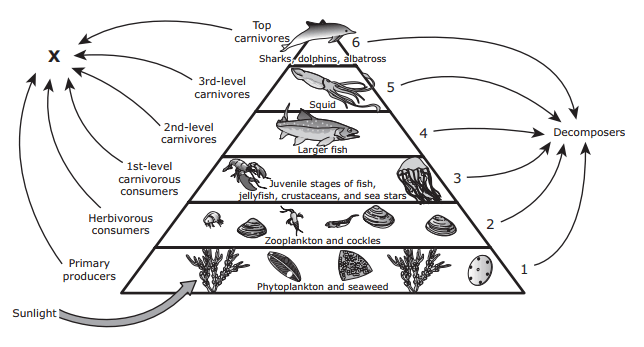
- Q 1/12Score 0Which of the following are missing from the food web shown above?29OmnivoresPredatorsDecomposersProducers

12 questions
Show answers
- Q1Which of the following are missing from the food web shown above?OmnivoresPredatorsDecomposersProducers60sBIOL.12c
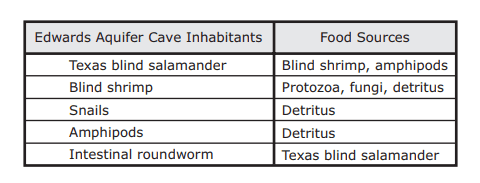
- Q2The Texas blind salamander (Eurycea rathbuni) lives in the Edwards Aquifer region around San Marcos. Along with other species the salamander lives in total darkness in the underground crevices and caves of the aquifer region. The table lists some of the organisms that live in this environment and their food sources. In an energy pyramid for these aquifer cave dwellers, which of the following would be placed at the bottom?ProtozoaBlind shrimpSnailsTexas blind salamanders60sBIOL.12c
- Q3A marine ecosystem is represented below. What is lost to the environment at each of the trophic levels of this ecosystem?Food sourcesHeatLiving space for the organismsNutrients from the soil60sBIOL.12c
- Q4A terrestrial food web is shown below. Which of the following lists only organisms that are secondary consumers in this food web?Predaceous insects, toads, spiders, and foxesInsectivorous birds, seed-eating birds, owls, and hawksSpiders, foxes, owls, hawks, and snakesMice, rabbits, herbivorous insects, and squirrels60sBIOL.12c
- Q5The food web shows the flow of energy through a sagebrush-steppe ecosystem. Which of these organisms are in a trophic level that receives a larger percentage of the energy captured by the producers than the percentage received at the bats' trophic level?Mountain lionsGround squirrelsSnakesHawks60sBIOL.12c
- Q6A student is asked to draw a food web in which the same organism is a primary consumer as well as a secondary consumer. How should the organism be represented in the food web?The organism must have an arrow pointing from it to a secondary consumer and another arrow pointing to it from the top predatorThe organism must have an arrow pointing from it to a primary consumer and another arrow pointing away from it to a decomposerThe organism must have an arrow pointing from it to a tertiary consumer and another arrow pointing from it to a decomposerThe organism must have an arrow pointing to it from a producer and another arrow pointing to it from a primary consumer60sBIOL.12c
- Q7The amount of energy the producers in this energy pyramid provide the primary consumers is 54,000 joules. From this amount, 540 joules are provided to the tertiary consumers. Based on this model, how much of the energy was provided to secondary consumers?54 J5,400 J53,460 J540 J60sBIOL.12c
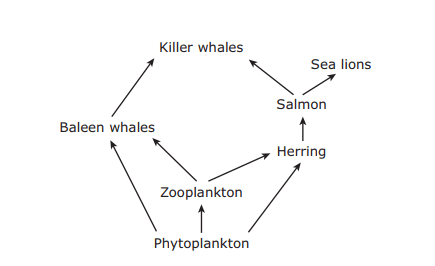
- Q8Part of a hydrothermal vent food web is represented in the diagram. Which organisms are both secondary and tertiary consumers in this food web?Chemosynthetic bacteria and amphipodsRatfish and octopusesZooplankton and musselsGalatheid crabs and zoarcid fish60sBIOL.12c
- Q9The energy pyramid below shows the energy made available by producers. Based on the energy flow between trophic levels in an energy pyramid, how much energy would be expected to be found at the secondary consumer level in this pyramid?1,000 joules50 joules100 joules500 joules60sBIOL.12c
- Q10The diagram shows a partial East Texas food web. Which table correctly classifies these organisms?60sBIOL.12c
- Q11The table lists some organisms found in a swamp ecosystem and their sources of energy. When constructing an energy pyramid of the swamp ecosystem, which of these would be placed at the top of the pyramid?Grass carpAmerican alligatorGreat blue heronEastern mud turtle60sBIOL.12c
- Q12A partial meadow food web is shown. Based on this food web, which organisms are direct sources of energy for secondary consumers?Aphid Bird RabbitLadybug Fox DragonflyFrog Butterfly BerriesMouse Snake Hawk60sBIOL.12c