Demonstrate an understanding of the origins and purposes of government, law, and the American political system. - Explain the viewpoints of the Federalists and the Anti-Federalists regarding the ratification of the Constitution and inclusion of a bill of rights.
Demonstrate an understanding of the principles, functions, and organization of government. - Differentiate between local, state, and federal governments' obligations and services.
Track each student's skills and progress in your Mastery dashboards
Give this quiz to my class
Q 1/20
Score 0
What was the Anti-Federalists’ greatest concern about ratifying the U.S. Constitution?
30
The lack of legislative veto power.
The lack of a bill of rights.
The lack of a strong military.
The lack of a federal court system.
Q 2/20
Score 0
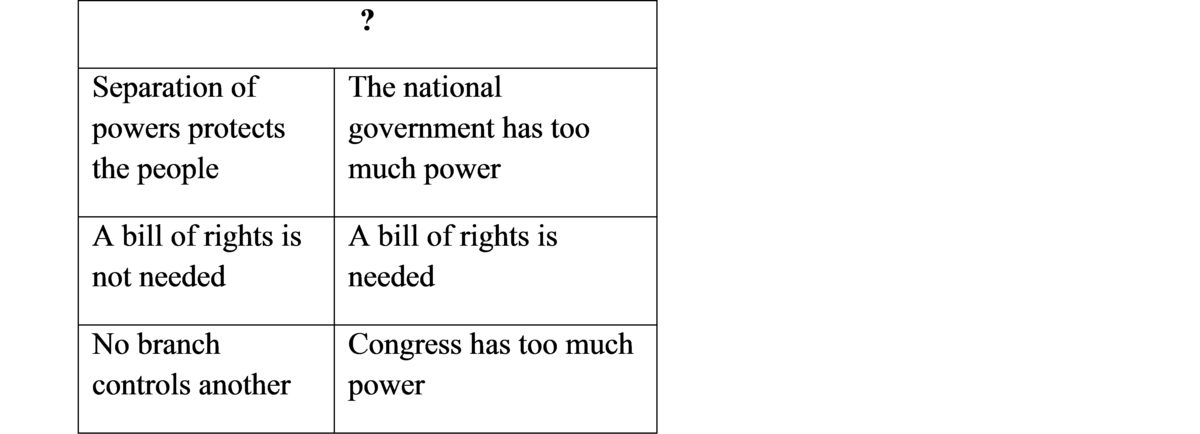
This table shows views about government. What title completes the table?
30
New Jersey Plan and Virginia Plan
Federalists and Anti-Federalists
Patriots and Loyalists
Articles of Confederation and U.S. Constitution
20 questions
Q.
What was the Anti-Federalists’ greatest concern about ratifying the U.S. Constitution?
1
30 sec
SS.7.C.1.8
Q.
This table shows views about government. What title completes the table?
2
30 sec
SS.7.C.1.8
Q.
Why does the U.S. Supreme Court continue to debate states’ rights?
3
30 sec
SS.7.C.3.14
Q.
This statement appeared in a 1787 essay by James Winthrop. What does this statement reflect?
4
30 sec
SS.7.C.1.8
Q.
This passage was written by James Madison in 1787.
Source: Federalist Paper #10
Based on this passage, what change in modern political society would Madison support?
5
30 sec
SS.7.C.1.8
Q.
Which documents addressed concerns about a bill of rights not being included in the U.S. Constitution?
6
30 sec
SS.7.C.1.8
Q.
Below is a passage from Anti-Federalist Paper #84 written by Brutus. Based on the passage, why did the Anti-Federalists support the inclusion of a bill of rights?
7
30 sec
SS.7.C.1.8
Q.
Which document is a group of 85 letters supporting the Constitution, and written in the 1780s by James Madison, Alexander Hamilton, and John Jay?
8
30 sec
SS.7.C.1.8
Q.
Which group of Founding Fathers supported ratification of the US Constitution, a strong central government, and no added bill of rights?
9
30 sec
SS.7.C.1.8
Q.
Which group of Founding Fathers opposed ratification of the US Constitution, supported strong state governments, and an added bill of rights?
10
30 sec
SS.7.C.1.8
Q.
Which system of government divides powers between the central and state governments?
11
30 sec
SS.7.C.3.14
Q.
Which system of government gives power to independent states that are loosely organized?
12
30 sec
SS.7.C.3.14
Q.
Which system of government gives all power to a strong central government and leader, with states having no power?
13
30 sec
SS.7.C.3.14
Q.
Which constitutional provision forbids conflict between state and federal laws?
14
30 sec
SS.7.C.3.14
Q.
Which describes concurrent powers?
15
30 sec
SS.7.C.3.14
Q.
What is the name for powers set aside specifically in the Constitution for the national government?
16
30 sec
SS.7.C.3.14
Q.
How does federalism limit the power of the national government?
17
30 sec
SS.7.C.3.14
Q.
Which amendment to the US Constitution states that all powers not given to the national government are reserved for the states and the people?
18
30 sec
SS.7.C.3.14
Q.
What is the name for powers that are not granted to the federal government but belong to the states and the people, according to the 10th amendment?
19
30 sec
SS.7.C.3.14
Q.
What system of government was established by the US Constitution after a debate by the Federalists and Anti-Federalists?