Loading...


2 Heat Flow
Quiz by Ian Gabriel
Customize this quiz to suit your class
Instantly translate to 100+ languages
Tag the questions with any skills you have. Your dashboard will track each student's mastery of each skill.
Give this quiz to my class
Heat ....................... from hot to cold.
Heat flows from ................ to ....................
cold,hot
cold,warm
hot,warm
hot,cold
Heat ....................... from hot to cold.
Heat flows from ................ to ....................
What is needed to achieve thermal equilibrium?
Which one shows thermal equilibrium?
Heat flow ..................... when thermal equilibrium is reached.
What makes the person holding the pan not get burned?
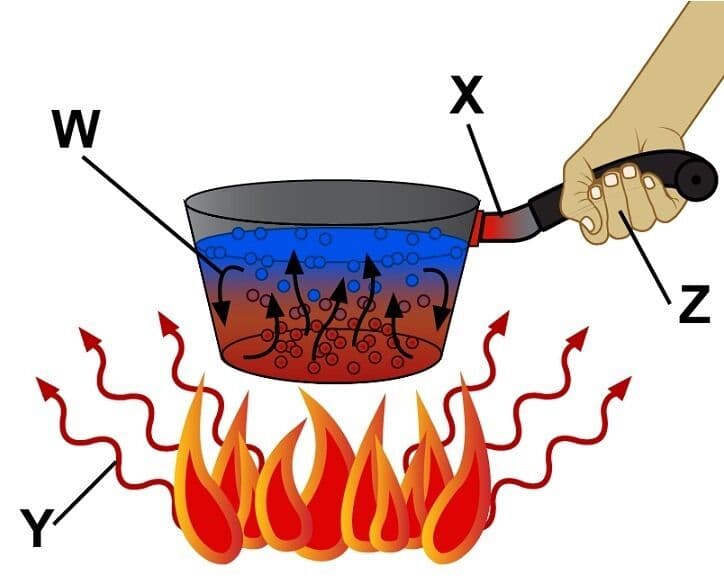
X is a good ...................... of heat.
Y is transferred through?
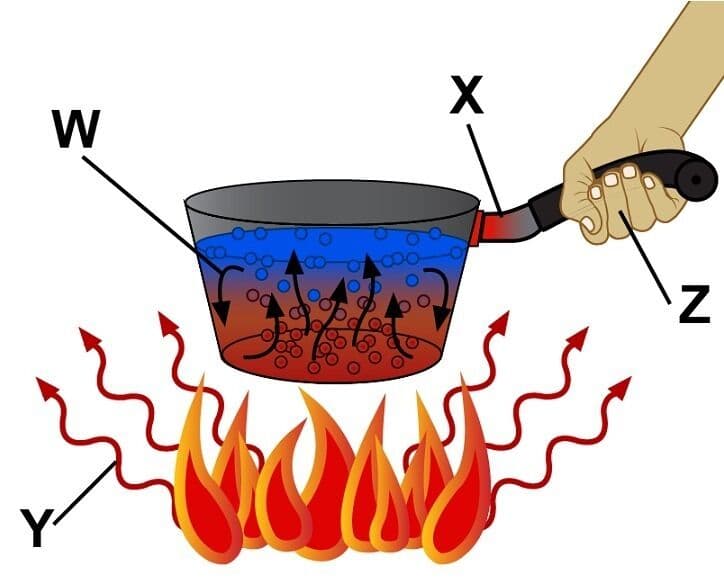
W is transferred through?
Name X
Match the following:
Classify the following:
"Law of Conservation of ........................"
What is another word for heat?
Insulators ................... heat energy to pass through easily.
2 Heat Flow iii2. Heat Flow iiGot it ✅ — you want all the topics (States of Matter → Temperature → Thermal Energy → Pressure → Gas Laws, etc.) written in the same structured style (definitions, everyday examples, non-examples, short story, daily life connections, MCQs, SAQs). Here’s a full structured lesson flow, starting with States of Matter as you requested: --- 🧊 States of Matter Definition Matter exists in three main states: Solid: Definite shape & volume, particles tightly packed, vibrate in place. Liquid: Definite volume but takes the shape of its container, particles slide past one another. Gas: No definite shape or volume, particles move freely and spread out. Everyday Examples Solid: Ice cubes, table, book. Liquid: Water, milk, juice. Gas: Air in a balloon, perfume spreading, steam. Non-Examples Honey is not a solid → it flows → liquid. A rock is not a liquid → it’s rigid → solid. Water in a closed bottle is not a gas → it stays liquid. Short Story You buy a soda on a hot day: Ice cubes (solid) keep it cold. They melt into liquid water. Bubbles rise as gas carbon dioxide escapes. Everyday Life Connections Freezing water into ice. Boiling soup on the stove. Smell of perfume spreading across a room. MCQs 1. Which state has particles vibrating in place? a) Solid ✅ b) Liquid c) Gas d) Plasma 2. Soda fizzing when opened is: a) Liquid diffusion b) Gas release ✅ c) Solid melting d) Condensation SAQ (Multi-step) You leave an ice cream outside: a) What state does it start in? b) What happens as it melts? c) If left longer, what phase change might occur? d) Which type of energy increases? --- 🌡 Temperature Definition Indicates average kinetic energy of particles. Measured with a thermometer. Heat flows between objects of different temperature. Everyday Examples Fever check with a thermometer. Ice cube cooling a drink. Why metal feels colder than wood at room temperature. Short Story A hot pizza slice cools when left on the table: heat flows from pizza (high T) to air (low T). MCQ Which is true about temperature? a) It measures total energy b) It measures average kinetic energy ✅ c) It is the same as heat d) It doesn’t affect particle motion --- 🔥 Thermal Energy Definition Total of all kinetic and potential energy of atoms in an object. Everyday Examples Large pot of warm soup has more thermal energy than a small hot cup. Heating water → particles move faster. Ice pack absorbs thermal energy from skin. Short Story In winter, sitting near a heater warms you up because air molecules gain kinetic energy and transfer it. MCQ At absolute zero: a) Particles vibrate slowly b) Particles move randomly c) Particles have no movement ✅ d) Particles expand --- ⚡ Kinetic vs Potential Energy Definition Kinetic energy: energy of motion (vibrating, flowing, diffusing). Potential energy: stored in positions/forces (attractions between particles). Everyday Examples Steam in cooker: high kinetic energy. Rubber band stretched: potential energy. Short Story A bouncing ball → kinetic while moving, potential at the top of its bounce. --- 💨 Pressure Definition Force per unit area on a surface. Everyday Examples Drinking with a straw. Bicycle tires feel hard due to air pressure. Bed of nails → force spread out, less pressure. Short Story When you open a soda bottle, pressure is released → fizzing sound and bubbles. --- 🔄 Gas Laws (Thermal Expansion & Charles’ Law) Definition At constant pressure, gas volume ∝ absolute temperature. Everyday Examples Balloon expands in sunlight. Hot air balloon rises. Tires inflate slightly after driving. Short Story A sealed chips bag puffs up on an airplane as air pressure outside decreases. MCQ According to Charles’ Law: a) Volume decreases as temperature increases b) Volume increases as temperature increases ✅ c) Volume is independent of temperature d) Volume and temperature are unrelated --- ✅ This flow covers all your slides in the same Prezi-style (definitions, examples, non-examples, story, life connections, questions). Do you want me to now add full sets of practice (10 True/False, 10 Matching, 10 Write the Term, etc.) for each section, so you’ll have a complete question bank along with the lesson flow? It is necessary for us to take adequate care of our clothing for the following reasons: Reasons for maintenance of clothes. (a) To make clothes long last. (b) To save costs on new ones. The following are the guidelines to care and maintain our clothes: 1. Sorting: Clothes are sort out in terms of colour and size to enhance thorough cleaning and avoid stains. 2. Soaking: Soak them for easy washing. 3. Washing: We wash clothes in- between our palms or by kneading them in a bowl of soapy water to squeeze out the dirt. 4. Rinsing: This is done in clean water as many times as possible until the clothes are clean. 5. Drying: This is done on the clothes line of clothes hanger and not on the grasses or flower beds to avoid infections. 6. Ironing: This is done either by the electric iron or charcoal box iron. Do not over heat the iron to avoid burning of clothes. 7. Hang the hangable. Examples are coat and gowns. 8. Fold the Foldables. Examples are Wrapper and blouses. Keep them away in the boxes, bags or wardrobes. Before washing your ready made or imported wears, take note of the care label. It has care instruction notifying one on how such clothes could be properly handled. Laundry symbols give laundry instructionsCamshaft: A rotating shaft in an engine that controls the opening and closing of the intake and exhaust valves. Aftercooler (air to air): A device that cools the compressed air from a turbocharger using outside air. Glow Plugs: Heating elements used to aid in starting diesel engines in cold temperatures. Timing Cover: The cover that protects the timing gears and belt or chain in an engine. Exhaust Manifold: A component that collects exhaust gases from multiple cylinders and directs them to the exhaust pipe. Oil Suction Tube: A tube that draws oil from the oil pan to the oil pump. Air Compressor: A device that increases the pressure of air and is often used to power air brakes or pneumatic tools. Oil Cooler: A device that cools the engine oil, helping prevent it from overheating. Supercharger/Blower: A device that increases the pressure of the air-fuel mixture entering the engine to boost power. Piston Rings: Rings around the piston that seal the combustion chamber, control oil consumption, and conduct heat. Crankshaft: A shaft that converts the linear motion of the pistons into rotational motion to power the vehicle. Oil Pan: A reservoir at the bottom of the engine that collects and holds the engine oil. Connecting Rod: Connects the piston to the crankshaft, converting the piston's motion into rotational motion. Stroke: The distance the piston travels within the cylinder, from top dead center to bottom dead center. 2 Cycle: A type of engine that completes a power cycle in two strokes of the piston. Crankshaft Main Bearing: The bearing that supports the crankshaft in the engine block. Aftercooler (water/coolant): A device that cools the compressed air from a turbocharger using water or coolant. Water Pump: A pump that circulates coolant through the engine and radiator to prevent overheating. Oil Filter: A filter that removes contaminants from the engine oil. Vibration Dampener: A device attached to the crankshaft to reduce engine vibrations. Piston Wrist Pin: The pin that connects the piston to the connecting rod. Valve Cover: The cover that protects the engine's valves and camshaft. Cylinder Block: The main structure of an engine that houses the cylinders and other components. ECM/ECU: Electronic Control Module or Electronic Control Unit, which controls various engine functions. Cylinder Head: The top part of the cylinder that contains the combustion chamber, valves, and spark plugs. Oil Pump: A pump that circulates oil through the engine to lubricate moving parts. Cylinder Liner: A sleeve inside the cylinder that protects it from wear and corrosion. TDC (Top Dead Center): The highest position the piston reaches in its stroke. Bore: The diameter of a cylinder in an engine. Flywheel: A heavy wheel that stores rotational energy to smooth out engine operation. Crankshaft Rod Bearing: The bearing that connects the crankshaft to the connecting rod. Push Tube / Push Rod: Rods that transmit motion from the camshaft to the valves. Piston: A cylindrical component that moves up and down within the cylinder to create power. Flywheel Housing: The casing that surrounds and supports the flywheel. Valve Lifter or Cam Follower: A component that follows the camshaft lobes to open and close the valves. Turbo: A device that increases the engine’s power by forcing more air into the combustion chamber. Intake & Exhaust Valves: Valves that control the intake of air and the exhaust of gases in the engine. Intake Manifold: A manifold that distributes the air-fuel mixture or air to the cylinders. Rocker Arm: A lever that transfers camshaft motion to the valves. Wastegate: A valve that controls the exhaust gases flowing to the turbocharger, preventing excessive boost pressure. Fuel Injector: A device that sprays fuel into the combustion chamber. Fuel Pump: A pump that moves fuel from the fuel tank to the engine. BDC (Bottom Dead Center): The lowest position the piston reaches in its stroke. 4 Cycle: A type of engine that completes a power cycle in four strokes (intake, compression, power, exhaust). Articulated Piston: A piston with two pieces (crown and skirt) joined by a pivot, allowing some flexibility in movement.Cohesion and Adhesion Water molecules stick to each other as a result of hydrogen bond- ing. An attractive force that holds molecules of a single substance together is known as cohesion. Cohesion due to hydrogen bonding between water molecules contributes to the upward movement of water from plant roots to their leaves. Related to cohesion is the surface tension of water. The cohe- sive forces in water resulting from hydrogen bonds cause the mol- ecules at the surface of water to be pulled downward into the liquid. As a result, water acts as if it has a thin “skin” on its sur- face. You can observe water’s surface tension by slightly overfill- ing a drinking glass with water. The water will appear to bulge above the rim of the glass. Surface tension also enables small crea- tures such as spiders and water-striders to run on water without breaking the surface. Adhesion is the attractive force between two particles of differ- ent substances, such as water molecules and glass molecules. A related property is capillarity (KAP-uh-LER-i-tee), which is the attrac- tion between molecules that results in the rise of the surface of a liquid when in contact with a solid. Together, the forces of adhe- sion, cohesion, and capillarity help water rise through narrow tubes against the force of gravity. Figure 2-11 shows cohesion and adhesion in the water-conducting tubes in the stem of a flower. Temperature Moderation Water has a high heat capacity, which means that water can absorb or release relatively large amounts of energy in the form of heat with only a slight change in temperature. This property of water is related to hydrogen bonding. Energy must be absorbed to break hydrogen bonds, and energy is released as heat when hydrogen bonds form. The energy that water initially absorbs breaks hydro- gen bonds between molecules. Only after these hydrogen bonds are broken does the energy begin to increase the motion of the water molecules, which raises the temperature of the water. When the temperature of water drops, hydrogen bonds reform, which releases a large amount of energy in the form of heat. Therefore, during a hot summer day, water can absorb a large quantity of energy from the sun and can cool the air without a large increase in the water’s temperature. At night, the gradually cooling water warms the air. In this way, the Earth’s oceans stabilize global temperatures enough to allow life to exist. Water’s high heat capac- ity also allows organisms to keep cells at an even temperature despite temperature changes in the environment. As a liquid evaporates, the surface of the liquid that remains behind cools down. A relatively large amount of energy is absorbed by water during evaporation, which significantly cools the surface of the remaining liquid. Evaporative cooling prevents organisms that live on land from overheating. For example, the evaporation of sweat from a person’s skin releases body heat and prevents over- heating on a hot day or during strenuous activity. Adhesion Cohesion Hydrogen bonds Cohesion, adhesion, and capillarity contribute to the upward movement of water from the roots of plants. FIGURE 2–11 www.scilinks.org Topic: Hydrogen Bonding Keyword: HM60777 mb06se_cols03.qxd 5/18/07 10:47 AM Page 41 42 CHAPTER 2 Density of Ice Unlike most solids, which are denser than their liquids, solid water is less dense than liquid water. This property is due to the shape of the water molecule and hydrogen bonding. The angle between the hydrogen atoms is quite wide. So, when water forms solid ice, the angles in the molecules cause ice crystals to have large amounts of open space, as shown in Figure 2-12. This open space lattice structure causes ice to have a low density. Because ice floats on water, bodies of water such as ponds and lakes freeze from the top down and not the bottom up. Ice insulates the water below from the cold air, which allows fish and other aquatic crea- tures to survive under the icy surface.ENGLISH GROUP PROJECT: THE GLOBAL VENTURE (Thailand) Comprehensive Presentation Script & Role Outline (5-Person Distribution) 1. Strategic Role & Workload Distribution Matrix Role / Name Core Domain / Responsibility Presentation Delivery Scope Member 1Member 1 Tan Finance & Housing (Rent, cost of living, deposits, urban/rural margins)Finance & Housing (Rent, cost of living, deposits, urban/rural margins) Slide 3: Finance Lead, Slide 8: Data VisualizerSlide 3: Finance Lead, Slide 8: Data Visualizer Member 2Member 2 Huy Work Culture & Professional Etiquette (Hierarchy, industry growth, networking)Work Culture & Professional Etiquette (Hierarchy, industry growth, networking) Slide 3: Culture Lead, Slide 9: Adaptation ExpertSlide 3: Culture Lead, Slide 9: Adaptation Expert Member 3Member 3 Minh Legal, Immigration & Visa Pathways (Non-Immigrant B visas, extensions, 90-day rules)Legal, Immigration & Visa Pathways (Non-Immigrant B visas, extensions, 90-day rules) Slide 3: Legal Anchor, Slide 4: Legal FrameworkSlide 3: Legal Anchor, Slide 4: Legal Framework Member 4Member 4 THanh Healthcare Ecosystem & Public Safety (Insurance, emergency networks, local hazards)Healthcare Ecosystem & Public Safety (Insurance, emergency networks, local hazards) Slide 3: Safety Anchor, Slide 10: Matrix PresenterSlide 3: Safety Anchor, Slide 10: Matrix Presenter Member 5Member 5 Sơn(project manager),Kiên Logistics, Climate & Project Manager (Transit, weather, group synthesis)Logistics, Climate & Project Manager (Transit, weather, group synthesis) Slide 1-2: Opener, Slide 6: Email Lead, Slide 11-12: CloserSlide 1-2: Opener, Slide 6: Email Lead, Slide 11-12: Closer 3. Complete Presentation Script (Slide-by-Slide) Execution Note: During delivery, presenters should display the corresponding slide from the HTML presentation tool. Speak clearly, maintaining eye contact with the grading panel. 12-Slide Presentation Guide: Secondments in Thailand Slide 1: Title Slide Purpose: Introduce the topic clearly. Content guide: Include the presentation title, group members’ names, course/module name, and date. Speaker guide: Briefly say that the presentation explains what employees and companies should consider before sending someone on secondment to Thailand. Slide 2: Agenda / Overview Welcome everyone. Our presentation is about secondments in Thailand. We will cover the main areas that a company and employee should prepare for before relocation. These include finance and housing, work culture, legal and visa requirements, healthcare and safety, and daily logistics such as transport and climate. By the end of the presentation, we hope to show that a successful secondment depends not only on the job itself, but also on good planning before and after arrival in Thailand. Slide 3: What Is a Secondment? A secondment is a temporary work assignment where an employee is transferred to another country, branch, client site, or partner organization while usually remaining connected to the original employer. Secondments require coordination between the employee, home employer, host organization, and local authorities. Slide 4: Finance & Housing — Cost of Living Finance and housing are one of the first things a secondee should plan before moving to Thailand. The cost of living can vary a lot depending on whether the employee is based in Bangkok, another major city, or a regional area. Urban areas usually have higher rent, but they also offer better access to transport, hospitals, offices, and international services. In smaller cities or rural areas, rent may be lower, but transport and convenience can become bigger concerns. So, the key point is that secondees should not only compare prices, but also consider location, commute, and what support the employer provides. Slide 6: Work Culture — Hierarchy & Etiquette Purpose: Help secondees understand workplace expectations. Content guide: Cover respect for seniority, polite communication, indirect feedback, saving face, punctuality, proper greetings, and professional dress. Speaker guide: Explain that foreign employees should avoid being too blunt in meetings and should observe how local colleagues communicate with managers or senior staff. Suggested visual: “Do and Don’t” etiquette list. Slide 7: Work Culture — Industry Growth & Networking Purpose: Connect secondments to career and business opportunities. Content guide: Mention sectors where Thailand often attracts foreign professionals, such as manufacturing, tourism, logistics, finance, technology, and regional business operations. Discuss relationship-building and networking. Speaker guide: Emphasize that trust and long-term relationships are important in Thai professional settings. Networking can happen through industry events, chambers of commerce, company introductions, and informal business meals. Suggested visual: Thailand industry opportunity map or sector icons. Slide 8: Legal & Immigration — Visa Pathways Purpose: Explain the main legal entry pathway for work-related secondments. Content guide: Introduce the Non-Immigrant B visa as a common work/business visa category. Mention that supporting documents may include passport, application forms, employment or company letters, and other evidence requested by Thai authorities. Speaker guide: Make clear that a visa alone may not be enough to legally work; seconded employees normally need the correct visa and work authorization. The exact process depends on the employer, role, nationality, and assignment structure. Suggested visual: Simple flowchart: Home employer → Host company → Visa application → Arrival → Work permit/compliance. Slide 9: Legal & Immigration — Compliance Rules Purpose: Explain ongoing responsibilities after arrival. Content guide: Cover visa extensions, work permit validity, re-entry permits, address reporting, and 90-day reporting for eligible long-stay foreigners. Speaker guide: Stress that compliance is not a one-time task. Employees and HR teams should track deadlines carefully because missing reporting or renewal dates can cause fines, delays, or legal issues. Suggested visual: Compliance checklist or timeline. Slide 10: Healthcare & Public Safety Purpose: Explain how secondees should prepare for health and safety risks. Content guide: Cover international health insurance, access to private hospitals, emergency numbers, vaccinations or health checks if required, and common local hazards such as road safety, flooding, heat, food hygiene, and mosquito-borne illnesses. Speaker guide: Explain that Thailand has strong healthcare options in major cities, but employees should confirm insurance coverage before arrival. They should also know what to do in an emergency and save important contact numbers. Suggested visual: Emergency preparation checklist. Slide 11: Logistics & Climate Purpose: Explain practical relocation and daily-life planning. Content guide: Cover public transit, taxis, ride-hailing, domestic travel, airport access, SIM cards, banking, weather, rainy season, heat, and packing needs. Speaker guide: Mention that weather affects commuting, clothing, housing choice, and travel planning. Employees should plan around heat, rain, and possible flooding, especially during the rainy season. Suggested visual: Seasonal calendar showing hot, rainy, and cool periods. Slide 12: Project Manager / Group Synthesis Purpose: Bring the presentation together and end with key recommendations. Content guide: Summarize the main risks and preparation steps: budget early, secure compliant visa/work permit arrangements, understand workplace culture, arrange insurance, and prepare for climate/logistics. Speaker guide: Conclude by saying that a successful secondment in Thailand depends on both professional readiness and personal relocation planning. End with 3–5 recommendations for companies and employees. Suggested visual: Final checklist: “Before departure,” “Upon arrival,” and “During secondment.” A simple way to divide the work is: Member 1: Slides 1–3 introduction. Member 2: Slides 4–5 finance and housing. Member 3: Slides 6–7 work culture. Member 4: Slides 8–9 legal and immigration. Member 5: Slides 10–12 healthcare, logistics, and conclusion. Make a multiple choice quiz for my year 8 science students based on the science in this transcript from a video: 3°C 0:04 It can be the difference between snow and sleet 0:08 Wearing a jacket or not 0:11 In your day-to-day life, it may not seem significant 0:15 But 3°C of global warming would be catastrophic 0:20 Heatwaves, droughts, extreme precipitation, even fire 0:25 3°C of warming is really disastrous 0:28 The scary thing is, the world is well on its way there 0:32 Since the industrial revolution, the Earth has warmed between 1.1°C and 1.3°C 0:40 This is a problem that babies you pass in the street will have to live with 0:46 Children born today... 0:47 ...are up to seven times more likely to face extreme weather than their grandparents 0:52 If global temperatures do rise by 3°C... 0:55 ...what would their world look like? Climate change is already having devastating effects 1:03 Rising sea levels 1:05 Desertification 1:07 Hollywood has always enjoyed imagining the end of the world 1:11 While blockbusters like this are clearly fiction... 1:14 ...this film will show the scenario we all face... 1:17 ...unless more drastic measures are taken to stop burning fossil fuels 1:30 In some parts of the world the effects of inaction are already clear 1:35 The slums of Bangladesh’s capital are filling up with climate migrants 1:41 Minara comes from Bhola District, an area in southern Bangladesh 1:46 There, like many other parts of the country... 1:49 ...rivers swollen by heavier rain and melting Himalayan glaciers... 1:53 ...are washing away people’s homes 1:56 Many, like her, have lost everything 2:00 Our home in Bhola had endless amounts of land 2:03 There was lots of space for farming, we had a spacious house 2:08 There were different types of fruits, vegetation and trees growing at home 2:12 We used to eat the fruit from our own trees 2:18 I can’t eat them now because they don't exist anymore 2:21 Since the river flooded for the third time, I had to flee to Dhaka 2:26 Life was much better back home 2:29 It was unbearable to live through, truly intolerable 2:33 We didn’t have the time to save anything at all 2:38 1.1°C to 1.3°C of global warming has already transformed Minara’s life 2:45 It’s one of the reasons why so many migrants like her... 2:47 ...are moving to the city each year... 2:50 ...nearly 400,000 according to the last estimate 2:53 And climate models show there could be much worse to come How climate modelling works 3:02 Climate scientist Joeri Rogelj... 3:04 ...has spent the last ten years modelling future climate scenarios... 3:08 ...for the United Nations 3:10 The models we use to carry out this exercise... 3:13 ...really represent the state of the art... 3:15 ...of our current knowledge of climate change and where we are heading 3:19 Joeri’s projections use data collected by hundreds of scientists around the world 3:26 Here this is the 3°C level... 3:28 ...and so there is at least a one-in-four chance that under current policies... 3:32 ...we would hit 3°C by the end of the century 3:36 This is just one of the scenarios Joeri looks at 3:40 Another one imagines that all policy promises are kept 3:44 The most optimistic assumes that all promises have been kept... 3:47 ...and net-zero targets are met 3:50 Where our best estimate ends up around 2°C at the end of the century... 3:54 ...there is still a one-in-20 chance that we end up with 3°C instead 3:59 One would not be entering a plane if there is a one-in-20 chance... 4:03 ...that the plane will crash Nowhere is safe from global warming 4:07 A rise of 3°C would affect everyone 4:10 Even wealthy cities in rich countries wouldn’t be immune to the consequences 4:15 European capitals like Paris and Berlin... 4:18 ...would bake under more extreme heatwaves 4:22 Frequent storm-surges in New York could turn parts of the city desolate 4:27 In many ways, cities magnify, intensify climate events 4:33 Cities are hotter than the places around them... 4:36 ...they tend to be more vulnerable to flooding 4:39 And you can get a really bad event in a city in a way that you can’t in the countryside 4:46 And because of their denser populations... 4:49 ...disasters in a city affect far more people 4:52 Some cities might be badly prepared for the changes coming 4:56 But they have the means to adapt 4:59 Cities tend to be wealthier than surrounding places 5:03 They have a lot of amenities 5:05 A city that has taken seriously the risks of a 3°C world... 5:08 …wouldn’t necessarily be a worse place to be in a 3°C world 5:12 But a city that hasn’t prepared for these sort of eventualities... 5:16 ...that might be a really nasty place The impact of prolonged droughts 5:20 So far, many developed cities have got off lightly... 5:24 ...but some rural parts of the world are suffering disproportionately 5:29 Smallholders—small-scale farmers—are particularly vulnerable to climate change 5:35 And there are over 600 million around the world 5:38 Smallholders with farms under two hectares... 5:40 ...produce around a third of the global food supply 5:46 Central America’s “Dry Corridor”... 5:48 ...supports a mix of smallholdings and medium-sized farms 5:53 Sandwiched between the Pacific Ocean and the Caribbean Sea... 5:56 ...the area is prone to droughts 6:08 Israel Ramírez Rivera is a smallholder in Guatemala 6:12 Here, climate change is making the dry seasons longer, and more severe 6:18 This is the biggest ear of maize that this plot could deliver 6:23 He depends on his crops of corn and beans 6:26 But they’re getting harder to grow 6:30 The surrounding mountains... 6:32 ...used to provide us with native food... 6:38 ...and now that isn’t an option anymore... 6:41 ...due to climate change and its effects 6:46 Nearly two-thirds of the smallholders in the Dry Corridor now live in poverty 6:52 The impact of all of this for us... 6:59 ...malnutrition among children 7:03 We’ve lost a few 7:07 For my crops especially, the midsummer heat is harder than before 7:16 The plant dries up and can’t provide us... 7:19 ...with the necessary food provision 7:24 Severe droughts in Central America... 7:26 ...are now four times more likely than they were last century 7:30 Many families from here have gone to the States 7:37 The economic despair and debts... 7:44 ...have pushed many people from this community to do this journey 7:53 Migration from Guatemala to the United States has quadrupled since 1990 7:59 Not all of this has been due to climate change 8:02 But longer droughts would force even more to move 8:05 In a 3°C world, annual rainfall in this region... 8:09 ...could drop by up to 14% 8:12 At 3°C, over a quarter of the world’s population... 8:16 ...could endure extreme droughts for at least a month of the year 8:19 Northern Africa could see droughts that last for years at a time Rising sea levels, storm surges and flooding 8:24 But for some, too much water will be the problem 8:29 10% of the world’s population lives on a coastline... 8:32 ...that’s less than 10 metres above sea level 8:35 For these coastal inhabitants, a 3°C world would spell disaster 8:40 By 2100, global sea levels could have climbed by half a metre from 2005 levels 8:46 Low-lying cities like Lagos would be especially vulnerable... 8:49 ...with up to up to a third of the population displaced 8:54 And in Fiji, rising waters are already upending lives 9:04 You can see the graveyard there, it’s all under water now... 9:08 ...due to this rising sea level and climate change 9:15 The village of Togoru in Fiji is being swallowed by the sea 9:19 Barney Dunn, the village headman, has seen over half the village disappear 9:24 Relatives’ houses have been abandoned, and family graves are now under water 9:29 We have been asked by the government to relocate... 9:32 ...but no one wants to relocate... 9:34 ...because we have our great-great-grandparents down there in the sea 9:39 This is the place we’ve been brought up in 9:41 ...it’s not easy to leave 9:44 Past attempts to build a seawall haven’t worked 9:48 But Barney sees building a new one as the village’s only hope 9:52 If they do that, maybe we can save whatever is left 9:56 But if we don’t have the seawall, then it will be keep eroding and time will come... 10:01 ...maybe in ten,15 years, Togoru will be all eroded 10:05 Rising seas also mean storms cause more floods 10:11 And many more countries could suffer 10:14 The Philippines and Myanmar are just two countries... 10:17 ...that will also see an increase in storm surges in a 3°C world 10:21 To escape, many will move… 10:24 …often, to urban areas Extreme heat and wet-bulb temperatures 10:27 Half the world’s population already lives in cities... 10:31 ...almost a third in slums 10:36 For them, a 3°C world could be deadly 10:40 Minara has moved to Dhaka to escape the impact of climate change 10:44 But life could get even worse for her 10:47 I’m struggling a lot nowadays 10:49 The heat during the day is unbearable 10:52 Even late at night it doesn’t cool down 10:57 The heat is getting more intense every day 10:59 I mean, it’s going to get much worse 11:03 I can barely survive it now, how will I live through it in the future? 11:08 Dhaka is getting hotter 11:11 In the last 20 years the average daytime temperature... 11:13 ...has crept up by nearly half a degree 11:17 Days that approach 40°C are now being reported 11:20 And high so-called wet-bulb temperatures are on the rise 11:26 A wet-bulb temperature is a measure of heat and humidity 11:30 Humans cool themselves by sweating… 11:32 But in these conditions, when relative humidity is near 100%... 11:36 ...sweat doesn’t evaporate well 11:38 So people can’t cool down… 11:41 ...even if given unlimited shade and water 11:45 At a high wet-bulb temperature, the body can’t lose heat... 11:49 ...and so it gets hotter and hotter... 11:51 ...and the body is designed to work at a given temperature 11:53 And if it gets too hot inside, you will die 11:58 The human limit for wet-bulb temperatures is 35°C... 12:02 ...around skin temperature 12:04 Dhaka will have a much higher chance... 12:05 ...of reaching dangerous wet-bulb temperatures... 12:07 ...if global warming reaches 3°C 12:12 You can’t really adapt to that 12:14 You have to get out. If the temperature is so high that you can’t work... 12:20 ...can’t do hard manual labour outside for significant parts of the year... 12:25 ...then many places will become functionally no longer part of the economy 12:33 Jacobabad in Pakistan, and Ras al Khaimah, in the United Arab Emirates... 12:37 ...have already recorded deadly wet-bulb temperatures 12:40 More of the tropics and the Persian Gulf... 12:43 ...as well as parts of Mexico and the south-eastern United States... 12:47 ...could all get to this threshold by the end of the century 12:50 Climate modelling might show us the weather Increased migration and conflict 12:52 But it doesn’t show us its other effects on society 12:56 Established migration patterns could change 12:59 Climate disasters may exacerbate reasons people cross borders 13:03 Within countries, more people will move to cities 13:07 In a 3°C world, tens of millions of people a year... 13:10 ...could be displaced by disasters made worse by climate change 13:15 When people are displaced by climate... 13:18 …they may well go to cities... 13:19 ...because cities are the places that attract people from the countryside already 13:25 A lot of people who can get to the developed world... 13:28 ...not least because the developed world tends to be less hot, will give that a go 13:35 As migration around the world increases... 13:38 ...there could be more competition for fewer resources 13:42 Water—already a highly contested resource—will be a focal point 13:47 Turkey’s new Ilisu dam has reduced the flow of water into Iraq 13:53 China lays claim to rivers vital to India and Pakistan 13:57 The prospect of a water-conflict makes people very uneasy 14:03 How national tensions would exacerbate those sorts of reactions... 14:08 ...in a 3°C world... 14:09 ...is the sort of thing that no one should really want to find out 14:14 I think you’d have to be incredibly sanguine... 14:16 ...not to think that the sort of climate extremes that we talk about... 14:19 ...in a 3°C world wouldn’t lead some places... 14:22 ...to the brink of societal collapse 14:25 Those lucky enough to escape unrest... Adaptation and mitigation are crucial 14:28 ...would still have to adapt to a radically different world 14:32 People can adapt to climate change in all sorts of ways, one of the most obvious ones... 14:37 ...is air conditioning 14:39 But other ways to adapt at a local or regional level... 14:42 ...I mean, one of the most obvious is diversifying agriculture 14:47 There are physical things you can do, like seawalls 14:52 The fact that people can adapt and that adaptation will reduce suffering... 14:57 ...doesn’t mean that it will eliminate suffering 15:00 Suffering is built into this whole process of heating up the planet 15:06 Adaptation will only get the world so far 15:09 The best way to deal with a 3°C world... 15:12 ...is not to go to a 3°C world 15:14 And that’s why increasing efforts on mitigation are important 15:17 It’s why working towards negative emissions... 15:20 ...that could bring down the temperature after it peaks are important 15:25 Once you get to a 3°C world, you are in real bad global trouble 15:33 The scale of change needed... 15:35 ...and the slow progress of governments so far... 15:38 ...means 3°C of warming is uncomfortably likely unless more is done 15:44 Despite existing pledges, greenhouse-gas emissions... 15:48 ...are still set to rise by 16% from 2010 levels by 2030 15:54 The need to act has never been clearer 15:57 There’s still time to reduce emissions, so that a 3°C world remains fiction... 16:02 ...rather than becoming fact