Loading...

3RD QUARTER-PRETEST_GRADE8
Quiz by Ana Rose Delima
Track each student's skills and progress in your Mastery dashboards
Which is TRUE about the forces of attraction between the particles of the three states of matter?
Which of the following is NOT true about matter?
When two or more substances are combined so each substance can be separated by physical means, the result is a(n) _____.
A small amount of salt was poured into water and stirred thoroughly to mix it evenly in water. What do you call the resulting liquid?
Which of the following best explains why you can compress a gas easily, but liquid?
Which of the following would NOT be classified as matter?
When a material is heated, its ________________move further apart.
What similarities do you observe from the given sample? Carbon, Gold, Mercury, and Oxygen?
This state of matter has a definite volume and takes the shape of a container.
What would 354 mL written on the label of a leading evaporated milk be classified as?
Which of the following is NOT true about physical change?
Which of the following is NOT a physical change?
Which term refers to the process by which water changes from liquid to gas?
Dew forms in the morning on leaves and grass because the warmer air deposits water molecules on the cold leaves. What phase change is described in this situation?
Which is evidence of chemical change?
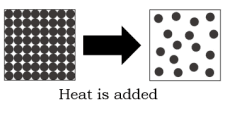
What phase change is illustrated in the given figure?
A student mixed two clear liquids together. After a few minutes, a white powdery solid was seen and settled at the bottom of the test tube. What conclusion can be made based on the observations cited?
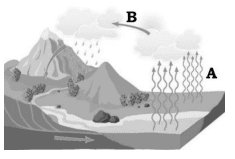
Refer to the figure below. What phase changes are illustrated in A and B?
What happens to the particles of a substance after undergoing a chemical change?
The term Solidification is other term for what phase change?
What is the best example for a heterogenous mixture?
Which of the following is the smallest particle of an atom?
What is the charge of an electron?
Which subatomic particle has a positive charge?
_______________was the first and English chemist who proposed the modern atomic theory.
The atomic mass of an element is equal to the number of protons and number of___________.
The experimentation with the cathode ray that led to the discovery of __________.
__________________,a Scottish physicist who explained the behavior of positively charged particles being depleted from a gold foil experiment, In which, total number of protons is equal to the atomic number of an element.
An atom that contains 12 protons and 12 neutrons in its nucleus has an atomic mass of ______.
Cations are positive ions (+ ion), it can loss one or more electrons number of protons >number of electrons. Which is an example of a cation?
Anions are negative ions (- ion), it can gain one or more electrons number of protons< number of electrons. Which is an example of a Anion?
Using the given diagram Identify the parts of an Atom.
What represent the positive charge of an atom?
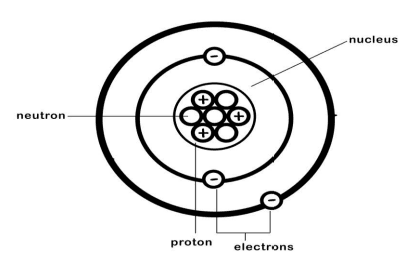
Using the given diagram Identify the parts of an Atom.
What represent the negative charge of an atom?
Using the given diagram Identify the parts of an Atom.
Where does the Neutron and Proton located based on the given diagram?
The word Aufbau means “building up” in German. Which of the following describes the Aufbau principle?
How many electrons are there in an s-orbital?
Which of the following describes the systematic arrangement of elements based on their atomic numbers and unique chemical and physical properties?
Which of the following refers to the 7 horizontal rows in the periodic table?
Which pertains to the 18 vertical columns in the periodic table?
Metallic property is the tendency of an atom to lose electrons. Which of the following is a metal?
