Analyze causes of the American Revolution, including the Proclamation of 1763, the Intolerable Acts, the Stamp Act, mercantilism, lack of representation in Parliament, and British economic policies following the French and Indian War.
Explain the issues surrounding important events of the American Revolution, including declaring independence; fighting the battles of Lexington and Concord, Saratoga, and Yorktown; enduring the winter at Valley Forge signing the Treaty of Paris of 1783.
Identify colonial grievances listed in the Declaration of Independence and explain how those grievances were addressed in the U.S. Constitution and the Bill of Rights.
Track each student's skills and progress in your Mastery dashboards
Give this quiz to my class
Q 1/14
Score 0
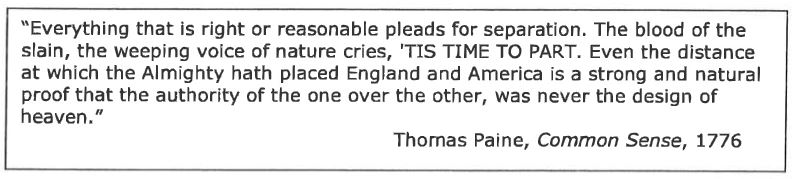
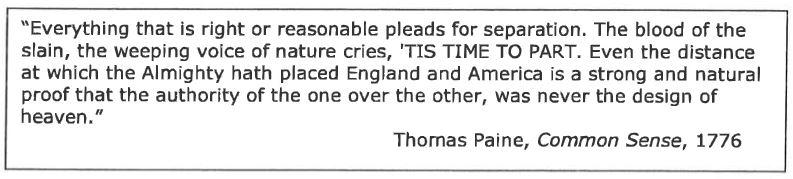
Which answer best explains the impact Thomas Paine's Common Sense had on the American colonists? (8.4A)
30
It demonstrated that King George and Parliament were making laws that were hurting the colonists.
It informed the colonists that the King had no intention of allowing them to be independent.
It taught them that England and America relied heavily on each other for trade.
It encouraged many colonists to seek their freedom from Great Britain.
Q 2/14
Score 0
The tax laws imposed on the colonists by the British government were viewed as unfair and created support for declaring independence because-- (8.4A)
30
Parliament passed the laws to deregulate the trade of imports
colonists were taxed without direct representation in Parliament
British merchants were taxed at a higher rate than colonial merchants
the laws only applied to those foreign subjects of the British crown
14 questions
Q.
Which answer best explains the impact Thomas Paine's Common Sense had on the American colonists? (8.4A)
1
30 sec
113.20.4.A
Q.
The tax laws imposed on the colonists by the British government were viewed as unfair and created support for declaring independence because-- (8.4A)
2
30 sec
113.20.4.A
Q.
The events in the chart directly led to the-- (8.4A)
3
30 sec
113.20.4.A
Q.
An important effect of Common Sense was that it persuaded many-- (8.4A)
4
30 sec
113.20.4.A
Q.
The events in the table led to the-- (8.4C)
5
30 sec
113.20.4.C
Q.
According to the Declaration of Independence, the American colonists had the right to break away from England because the British government had-- (8.4C)
6
30 sec
113.20.4.C
Q.
This section of the U.S. Constitution below was included to address which grievance from the Declaration of Independence? (8.15C)
7
30 sec
113.20.15.C
Q.
Which addition to the U.S. Constitution best reflects this grievance? (8.15C)
8
30 sec
113.20.15.C
Q.
This section of the U.S. Constitution was included to address which grievance from the Declaration of Independence? (8.15C)
9
30 sec
113.20.15.C
Q.
In what way does the Declaration of Independence explain and defend the colonists' right to revolt against Great Britain? (8.15C)
10
30 sec
113.20.15.C
Q.
The Declaration of Independence states that the British government had failed to-- (8.15C)
11
30 sec
113.20.15.C
Q.
The Royal Proclamation of 1763 by King George III limited the colonists in what way? (8.15C)
12
30 sec
113.20.15.C
Q.
Which of the following best describes a basic premise of the Declaration of Independence? (8.15C)
13
30 sec
113.20.15.C
Q.
According to the Declaration of Independence, which of the following are inalienable rights?