
5.3 The first political parties
Quiz by Catherine Chesser
Feel free to use or edit a copy
includes Teacher and Student dashboards
Measures 1 skill from
Track each student's skills and progress in your Mastery dashboards
- edit the questions
- save a copy for later
- start a class game
- automatically assign follow-up activities based on students’ scores
- assign as homework
- share a link with colleagues
- print as a bubble sheet
- Q1
Why did many farmers, artisans, and former Anti-Federalists support the Democratic-Republican party?
The Democratic-Republicans favored states' rights and the rights of the common man
The Democratic Republicans supported the use of tariffs
The Democratic-Republicans favored the expansion of a strong national government
The Democratic-Republicans supported strict restrictions on immigration
30s113.20.5.C - Q2
Which pai contributed to the development of political parties in the United States?
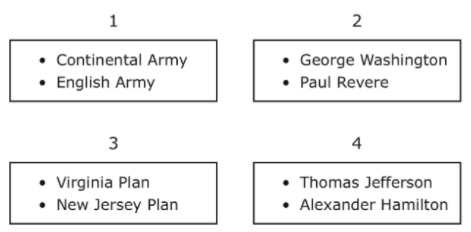
1
2
3
4
30s113.20.5.C - Q3
The organization of the first U.S. political parties resulted in large part from disagreements over which issue?
The purchase of the Louisiana Territory from France
The attack on the Port of Tripoli in North Africa
The establishment of the First Bank of the United States
The election of George Washington to a second term as president
30s113.20.5.C - Q4
The first political parties in the United States formed mainly in response to disagreements over-
taxation without representation
the extent of federal power
territorial expansion to the west
the doctrine of judicial review
30s113.20.5.C - Q5
Disgareements between these two cabinet members led to-
the establishment of the first U.S. political parties
the creation of reservations for American Indians
a struggle to ratify the Bill of Rights
the establishment of the first U.S. political parties
30s113.20.5.C - Q6
The Federalists and Democratic Republicans emerged as separate political parties as the result of disagreement over-
whether to approve the Declaration of Independence
how the nation should develop economically
how the nation should admit new states
whether to enforce the Monroe Doctrine
30s113.20.5.C