classify matter based on physical properties, including mass, magnetism, physical state (solid, liquid, and gas), relative density (sinking and floating), solubility in water, and the ability to conduct or insulate thermal energy or electric energy
Track each student's skills and progress in your Mastery dashboards
Give this quiz to my class
Q 1/19
Score 0
Which of these is the best conductor of electricity?
60
Copper penny
Plastic tubing
Cotton string
Glass rod
Q 2/19
Score 0
A teacher mixes a white powder into a beaker of water. The powder cannot be seen in the water. The teacher then heats the mixture until the water evaporates and the powder can be seen again. Which property of the powder is the teacher demonstrating?
60
Mass
Density
Solubility
Conductivity
19 questions
Q.
Which of these is the best conductor of electricity?
1
60 sec
5.5.A: Matter and Energy
Q.
A teacher mixes a white powder into a beaker of water. The powder cannot be seen in the water. The teacher then heats the mixture until the water evaporates and the powder can be seen again. Which property of the powder is the teacher demonstrating?
2
60 sec
5.5.A: Matter and Energy
Q.
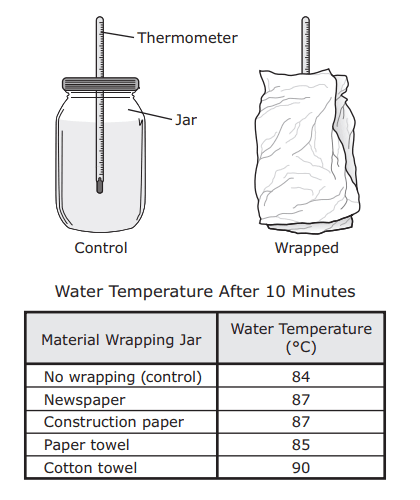
A teacher sets up an experiment using five jars like the ones shown below. The teacher keeps one jar unwrapped as the control. The other four jars are wrapped with equal thicknesses of four different materials. The jars are each filled with an equal amount of water that is 92°C. Students observe and record the water temperature in each jar after 10 minutes. The results are shown in the table below. Which property of the materials wrapping the jars are the students most likely investigating?
3
60 sec
5.5.A: Matter and Energy
Q.
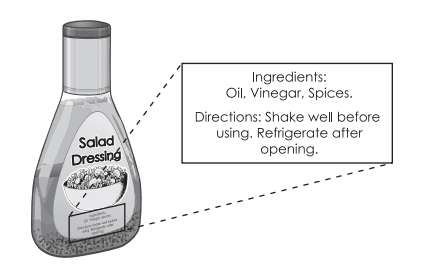
A student reads the label on the bottle of salad dressing shown below. Why would the student shake the salad dressing well before using it?
4
60 sec
5.5.A: Matter and Energy
Q.
Which of these is not soluble in water?
5
60 sec
5.5.A: Matter and Energy
Q.
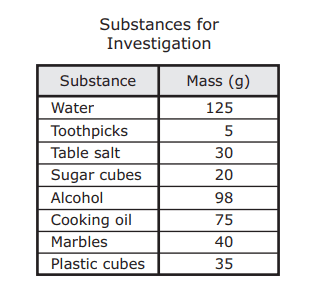
A student measures the mass of several substances and records the results in the table below. What is the difference in grams between the total mass of the liquid substances and the total mass of the solid substances used in the investigation? Be sure to use the correct place value.
6
60 sec
5.5.A: Matter and Energy
Q.
A teacher wears protective gloves to lift a metal pan filled with boiling water from a hot plate. Why are the protective gloves necessary?
7
60 sec
5.5.A: Matter and Energy
Q.
Objects that blow into a swimming pool or that are dropped into the pool by swimmers need to be removed. These objects include foam cups, keys, and coins. Which of the following explains a useful method for removing some of these objects?
8
60 sec
5.5.A: Matter and Energy
Q.
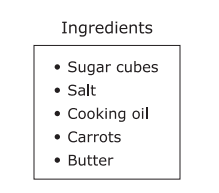
A cook uses the ingredients listed below to prepare a meal. Which table correctly shows the physical properties of these ingredients when placed in hot water?
9
60 sec
5.5.A: Matter and Energy
Q.
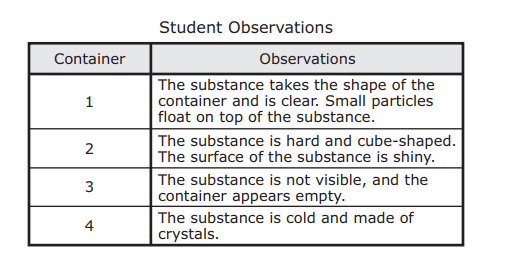
A teacher gives a student four clear sealed containers. Each container holds a different substance. The student records some observations about the substance in each container.
Based on these observations, which container most likely holds only gas?
10
60 sec
5.5.A: Matter and Energy
Q.
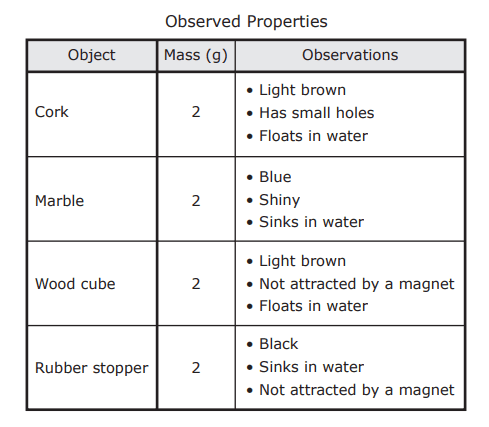
Some students investigate the properties of four objects using a hand lens, a magnet, and a beaker containing water. Their observations are recorded in the table. Which statement identifies a property that could be used to classify these objects into two different groups?
11
60 sec
5.5.A: Matter and Energy
Q.
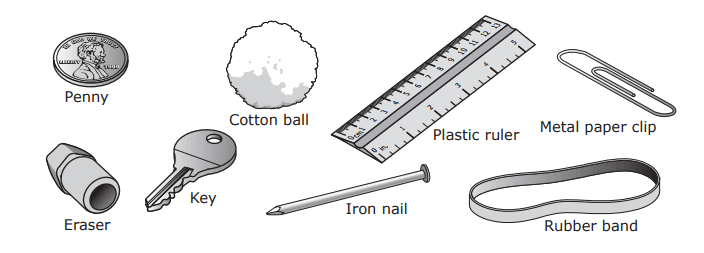
A student classifies the objects shown based on their physical properties. Which property cannot be used to classify these objects into more than one group?
12
60 sec
5.5.A: Matter and Energy
Q.
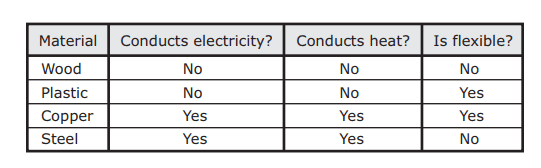
A science class tested three properties of different materials. The results are shown in the table below. Based on the table, which material would be best to use to insulate electrical wires?
13
60 sec
5.5.A: Matter and Energy
Q.
Two wires carrying electricity can create a spark if they come too close together. This spark can start a fire. Wires carrying electricity are usually covered with plastic to keep them from starting a fire. Why does the plastic keep the electricity from starting a fire?
14
60 sec
5.5.A: Matter and Energy
Q.
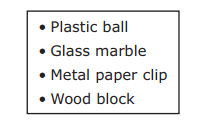
A student puts four objects in a bucket filled with water. The objects are listed below. Which two objects are most likely less dense than the water?
15
60 sec
5.5.A: Matter and Energy
Q.
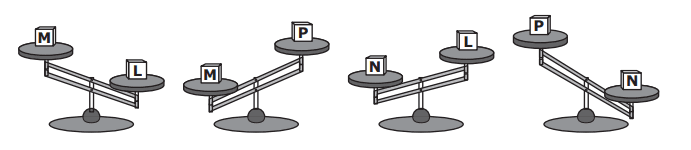
A student was asked to compare the masses of four blocks that were all the same size but made of different materials. The student used a balance to compare the masses of two blocks at a time. The student repeated this process three more times with different pairs of blocks and recorded observations. Which list shows the blocks in order from least to greatest mass?
16
60 sec
5.5.A: Matter and Energy
Q.
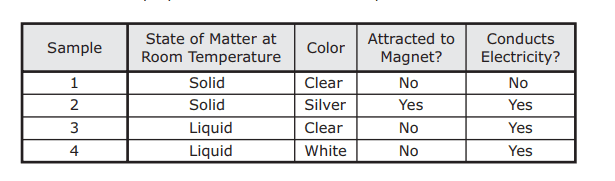
The table lists some properties of four different samples of matter. Which two samples could be glass and saltwater?
17
60 sec
5.5.A: Matter and Energy
Q.
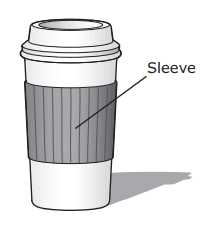
A student is asked to design a sleeve for a cup that will insulate thermal energy and not feel hot to the touch when the cup is filled with hot liquid.The student has four materials to choose from. Which of these materials is least useful as an insulator?
18
60 sec
5.5.A: Matter and Energy
Q.
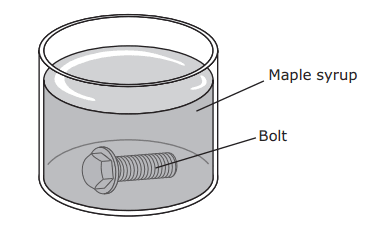
For an investigation a teacher dropped a bolt into a container of maple syrup and asked students to remove it without touching the syrup. The students first tried to use a strong magnet to remove the bolt, but it remained on the bottom of the container. They finally poured the syrup into another container to get the bolt out. Which of these best describes some of the bolt’s physical properties?