Tag the questions with any skills you have. Your dashboard will track each student's mastery of each skill.
Give this quiz to my class
Q 1/4
Score 0
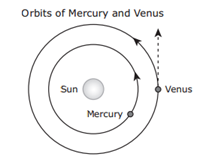
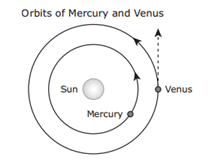
The diagram models Mercury and Venus orbiting the sun. What force causes Venus to travel along a curved path instead of moving in a straight line as indicated by the dashed line in the diagram?
30
Gravitational attraction between the sun and Venus
Electromagnetic attraction between the sun and Venus
Gravitational attraction between Mercury and Venus
Electromagnetic attraction between Mercury and Venus
Q 2/4
Score 0
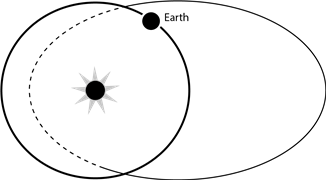
Astronomers track asteroids as they move throughout our solar system. An asteroids path is illustrated below. What force is most responsible for the path this asteroid follows?
30
Centripetal force that governs objects will move in circular patterns
Gravitational pull from the sun
Newton’s 1st law of motion that says objects want to travel in a straight line
Gravitational pull from the center of the Milky Way galaxy
4 questions
Q.
The diagram models Mercury and Venus orbiting the sun. What force causes Venus to travel along a curved path instead of moving in a straight line as indicated by the dashed line in the diagram?
1
30 sec
Q.
Astronomers track asteroids as they move throughout our solar system. An asteroids path is illustrated below. What force is most responsible for the path this asteroid follows?
2
30 sec
Q.
Two identically sized and shaped balls are dropped from a height of 50 feet. The first ball has a mass of 15 kg, and the second ball has a mass of 45 kg. Which statement describes the effect of dropping both balls at the same time?
3
30 sec
Q.
The existence of the force of gravity explains why the Moon —