Tag the questions with any skills you have. Your dashboard will track each student's mastery of each skill.
Give this quiz to my class
Q 1/45
Score 0
Match the layer of the earth to its description.
30
Users link answers
Q 2/45
Score 0
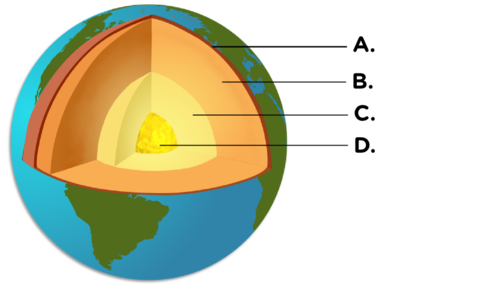
Match the layer of the earth to the letter marking it on the diagram.
30
Users link answers
45 questions
Q.
Match the layer of the earth to its description.
1
30 sec
Q.
Match the layer of the earth to the letter marking it on the diagram.
2
30 sec
Q.
The breaking down of rocks and other materials on the Earth's surface.
3
30 sec
Q.
The process that breaks down rock through chemical changes
4
30 sec
Q.
the mechanical breakdown of rocks and minerals
5
30 sec
Q.
Large areas of solid rock that make up the crust and float around on the mantle
6
30 sec
Q.
the underwater mountain ranges that occur where pieces of the earth's crust are moving away from each other
7
30 sec
Q.
sudden movements of Earth's crust followed by a series of shocks
8
30 sec
Q.
a weak earthquake that is a slight vibration and usually is accompanied by a low rumbling sound
9
30 sec
Q.
smaller quakes produced after a major quake caused by rocks shifting to new positions
10
30 sec
Q.
The study of earthquakes
11
30 sec
Q.
A scientist who studies earthquakes
12
30 sec
Q.
when earthquakes happen and the rock bends but does not break
13
30 sec
Q.
When earthquakes happen and the rock bends and breaks
14
30 sec
Q.
a break at the boundary of two moving masses of rock
15
30 sec
Q.
the point underground where an earthquake begins
16
30 sec
Q.
the point on the Earth's surface directly above the focus of an earthquake
17
30 sec
Q.
the strength of an earthquake
18
30 sec
Q.
the most famous scale used to measure earthquake strength
19
30 sec
Q.
the numerous regions of the earth where most of the world's earthquakes occur
20
30 sec
Q.
the most active seismic belt
21
30 sec
Q.
a vent that allows molten rock and hot gases to escape from within the earth
22
30 sec
Q.
Molten rock beneath the earth's surface
23
30 sec
Q.
the pocket deep in the ground beneath a volcano where magma collects
24
30 sec
Q.
The opening through which molten rock and gas leave a volcano
25
30 sec
Q.
Magma that reaches Earth's surface
26
30 sec
Q.
Nickname for the chain of volcanoes that lines the Pacific Rim and corresponds to the Circum-Pacific belt
27
30 sec
Q.
a vent in a volcanic area from which fumes or gases escape
28
30 sec
Q.
Any rock fragments and particles ejected by a volcanic eruption.
29
30 sec
Q.
the smallest form of tephra
30
30 sec
Q.
large tephra
31
30 sec
Q.
the largest form of tephra
32
30 sec
Q.
Pieces of tephra that are smaller than bombs or blocks, but larger than volcanic ash
33
30 sec
Q.
a broad, domed volcano with gently sloping sides
34
30 sec
Q.
A bowl-shaped area that forms around a volcano's central opening
35
30 sec
Q.
second tallest volcanoes that are made up of ash and cinder
36
30 sec
Q.
Tall cone shaped volcano that shares the characteristics of both the shield and the cinder cone volcano
37
30 sec
Q.
a huge bowl-shaped depression formed when an empty magma chamber collapses after a volcanic eruption
38
30 sec
Q.
example of a caldera
39
30 sec
Q.
a volcano that is erupting or has shown signs of erupting in the near future
40
30 sec
Q.
A volcano that has not erupted for a long time, but may erupt again one day.
41
30 sec
Q.
A volcano that has not erupted for thousands of years and probably will not erupt again
42
30 sec
Q.
A eruption that produces a large amount of fluid lava like a fountain
43
30 sec
Q.
A volcano that erupts often; they are noisy but mild as gas bubbles up from the magma and flings globs into the air forming volcanic bombs where they harden
44
30 sec
Q.
come from volcanoes that have lain dormant for a long period of time