Tag the questions with any skills you have. Your dashboard will track each student's mastery of each skill.
Give this quiz to my class
Q 1/25
Score 0
Which best contrasts a bacterium and a virus? (correctly describes both)
30
A bacterium does not live in living things, whereas a virus does.
A bacterium can reproduce, whereas a virus will not reproduce
A bacterium is a one-celled living organism, whereas a virus is a nonliving organism.
Q 2/25
Score 0
Diseases that can be transmitted between organisms are
30
infectious
congenital
inherited
environmental
25 questions
Q.
Which best contrasts a bacterium and a virus? (correctly describes both)
1
30 sec
Q.
Diseases that can be transmitted between organisms are
2
30 sec
Q.
For which disease would a doctor most likely prescribe an antibiotic?
3
30 sec
Q.
Which contagion is correctly matched to the disease it causes?
4
30 sec
Q.
The overuse of antibiotics has most likely resulted in the development of resistant strains of which organisms?
5
30 sec
Q.
Alan noticed that his foot itched between his toes after coming home from the gym. He now believes he may have contracted athlete’s foot. What type of pathogen most likely caused this possible infection of his foot?
6
30 sec
Q.
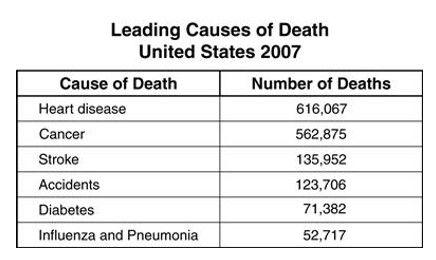
The table shows leading causes of death in the United States. Which of the causes can be categorized as an infectious disease?
7
30 sec
Q.
Plasmodium is a protozoan (protist) that carries malaria. Which organism is known to carry this protozoan?
8
30 sec
Q.
Ten people became sick with the flu after attending a school dance. What is the scenario that could best explain how the people got sick?
9
30 sec
Q.
Lyme disease is spread by ticks and people affected with Lyme disease often exhibit a rash and symptoms similar to the flu. Which is the cause of Lyme disease?
10
30 sec
Q.
Given favorable conditions, which disease-causing agent could quickly multiply into colonies of billions of cells in the space of a drop of water?
11
30 sec
Q.
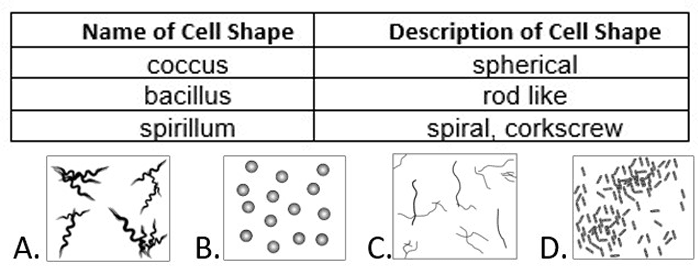
Which best represents bacterial cells belonging to the bacillus group?
12
30 sec
Q.
Which best explains why a person can get the flu multiple times?
13
30 sec
Q.
Which is the smallest pathogen?
14
30 sec
Q.
Which best explains how a nonliving virus is able to reproduce?
15
30 sec
Q.
The Black Plague killed about 100 million people in the fourteenth century. The bacteria that caused the plague was carried by fleas on rats and traveled great distances. Which would have most directly limited the spread of the disease?
16
30 sec
Q.
Scientists are trying to prevent an epidemic of a highly contagious disease. What information should the scientists study first?
17
30 sec
Q.
Which is an example of an epidemic?
18
30 sec
Q.
Which will most likely occur when the quality of sanitation in an area improves?
19
30 sec
Q.
Which situation would most favor the spread of infectious disease?
20
30 sec
Q.
Which has made the possibility of an epidemic becoming a pandemic much more likely in the 20th century?
21
30 sec
Q.
A mosquito can spread the West Nile Virus but remains unaffected by the disease. Which best describes the mosquito?
22
30 sec
Q.
Which best compares an epidemic and a pandemic?
23
30 sec
Q.
Which best distinguishes an infectious disease from a noninfectious disease?
24
30 sec
Q.
Which most likely spreads diseases such as rabies or Lyme disease?