placeholder image to represent content

8th Grade - Semester 1 A

Quiz by Oksana Tariche

Our brand new solo games combine with your quiz, on the same screen

Correct quiz answers unlock more play!

New Quizalize solo game modes
30 questions
Show answers
  • Q1
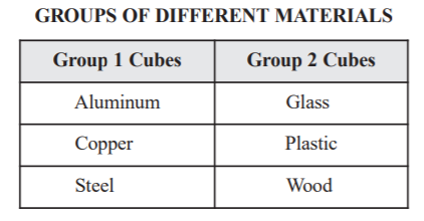
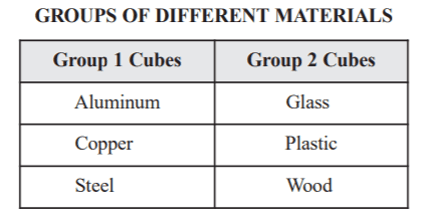
    Matthew has six cubes of different materials. Each cube has a mass of 10 grams (g). Matthew sorts the cubes into two groups using one physical property. Which physical property did Matthew most likely use to sort the cubes into two groups?
    Question Image
    Density
    Electrical conductivity
    Magnetism
    Melting point
    120s
  • Q2
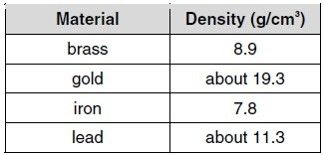
    Density is the ratio of mass to volume. Troy listed the density of four metals at 20 °C. If Troy has a 4-cm cube of each of these metals, which cube will have the greatest mass?
    Question Image
    Iron
    Lead
    Gold
    Brass
    120s
  • Q3
    A piece of titanium has a mass of 18 grams. Using a graduated cylinder partly filled with water, a scientist found that the titanium displaced 4 milliliters of water. What is the density of titanium?
    Question Image
    4.5 g/cm 3
    324 g/cm 3
    18 g/cm 3
    0.22 g/cm 3
    120s
  • Q4
    Emma constructed a simple motor. When connected correctly, the coil of copper wire spins. Which of the following best describes the energy transformation that takes place between the paper clips and the spinning coil?
    Question Image
    Mechanical energy transforms into electrical energy
    Electrical energy transforms into mechanical energy.
    Mechanical energy transforms into chemical energy
    Chemical energy transforms into electrical energy.
    120s
  • Q5
    On a sunny day, Heidi and some of her classmates are playing kickball during PE. She kicks the ball past second base, and it rolls uphill to a stop. She runs to first base, but before she gets any farther, the bell rings and everyone has to go back inside. Which of these is an example of kinetic energy changing to potential energy?
    The players running from base to base
    The ball rolling uphill to a stop
    The sun warming the playground
    The bell ringing inside the school
    120s
  • Q6
    These two beakers contain the same liquid substance at the same temperature. How does the thermal energy of the liquid in the larger beaker compare to the thermal energy of the liquid in the smaller beaker?
    Question Image
    The liquid in the larger beaker has more thermal energy than the liquid in the smaller beaker.
    The liquid in the larger beaker has less thermal energy than the liquid in the smaller beaker.
    The exact volume of liquid in each beaker must be known to compare the thermal energy of the liquids.
    The liquid in the larger beaker has the same amount of thermal energy as the liquid in the smaller beaker.
    120s
  • Q7
    Kito puts his spoon into a helping of fresh, hot, mashed potatoes as shown in the figure below. Which process takes place when the two objects come together?
    Question Image
    The average temperature of the spoon does not change.
    The thermal energy of both the mashed potatoes and the spoon increases as energy in the form of heat is transferred between them.
    The temperature of the spoon increases, but its thermal energy does not change.
    Energy in the form of heat is transferred from the warmer mashed potatoes to the cooler spoon
    120s
  • Q8
    Which of these choices best describes the temperature of a substance?
    The average kinetic energy of the particles that make up a substance
    The sum of the kinetic energy of all of the particles of a substance
    The total kinetic and potential energies of the particles of a substance
    The difference between the kinetic energy and potential energy of a substance
    120s
  • Q9
    Which of these choices best describes the thermal energy of a substance?
    The total kinetic and potential energies of the particles of a substance
    The sum of the kinetic energy of all of the particles of a substance
    The difference between the kinetic energy and potential energy of a substance
    The average kinetic energy of the particles that make up a substance
    120s
  • Q10
    An example of kinetic energy continuously being changed to potential energy and back again might be _______.
    A girl swinging on a swing
    A plate sitting on the edge of a table
    A train moving down a track
    Electric charges moving in a straight path
    120s
  • Q11
    The illustration below shows the locations of a rock as it rolls down a slope. Which location shows the rock with the greatest kinetic energy?
    Question Image
    1
    4
    2
    3
    120s
  • Q12
    The illustration below shows the locations of a rock as it rolls down a slope. Which location shows the rock with the greatest potential energy?
    Question Image
    2
    1
    4
    3
    120s
  • Q13
    Which is the BEST example of something that has kinetic energy?
    A rock sitting at the top of a steep hill
    A tennis ball rolling across the court
    A picture hanging on the wall
    A piece of wood before it is burned
    120s
  • Q14
    At which labeled point does the diver have the LEAST potential energy?
    Question Image
    3
    1
    4
    2
    120s
  • Q15
    Ashton warms a pure, solid substance. He graphs the changes in temperature over time as shown in the figure below. What is happening as he warms the substance?
    Question Image
    The speed of the molecules is not changing.
    The molecules speed up and then decrease their speed.
    The molecules are moving more slowly.
    The molecules are moving more rapidly.
    120s

Teachers give this quiz to your class