Loading...

America's FIRST Government
Quiz by Natalie Thompson
Customize this quiz to suit your class
Instantly translate to 100+ languages
Tag the questions with any skills you have. Your dashboard will track each student's mastery of each skill.
Give this quiz to my class
A constitution is a...
a call for independence
an essay written to convince others
a legislature with two parts
written plan for government
This word describes a legislature consisting of two parts, or houses.
Supremacy Clause
ratify
bicameral
ordinance
A constitution is a...
This word describes a legislature consisting of two parts, or houses.
These are the first ten amendments to the Constitution..
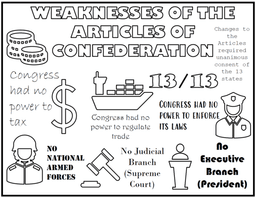
This was America's first plan for government; it didn't last because it was WEAK!
This term means to vote approval of a law or amendment.
This term is another name for a law, usually used by a city or county
This was a law passed under the Articles of Confederation in 1785 that set up a plan for surveying/measuring new western lands in Michigan and Ohio.
This law, passed under the Articles in 1787, established a procedure for the admission of new states to the Union (country).
This uprising of Massachusetts farmers, who did not want to lose their farms because of debt they owed, sparked concern from many leaders about the weaknesses of the national government under the Articles of Confederation.
This meeting of state delegates in 1787 in Philadelphia was called to fix the Articles of Confederation. Delegates to this meeting instead designed a new plan for a stronger national government.
This Enlightenment thinker argued for separation of powers.
This was a series of essays written in support of the Constitution. The writers were James Madison, Alexander Hamilton, and John Jay, who were all Federalists.
These people supported the Constitution with its stronger national government.
These people were opposed/against the ratification of the Constitution and supported a weaker national government but stronger state powers.
James Madison created this proposal at the Constitutional Convention to create a stronger national government that share powers with states. It called for a bicameral Congress with both houses determined by state population. It called for 3 branches of government, with a president and Supreme Court. Larger states favored this plan.
William Patterson created this proposal to create a government that allows states to retain their sovereignty (power) and keeping a weak central government. It called for a unicameral Congress with each state getting one vote. The executive branch would be led by a committee without a single leader.
Compromise made by the Constitutional Convention in which states would have equal representation in one house of the legislature and representation based on population in the other house.
Who demanded a Bill of Rights be added to the Constitution?
This agreement at the Constitutional Convention was over concern on how to count the enslaved population in the southern colonies. This new plan stated that 3/5 of the slave population be counted for the purpose of deciding a state's population and how many delegates each state would have in Congress
This was the name of the legislative body formed by the Articles of Confederation.
This branch of government carries out laws; includes the president, vice president, and cabinet.
This branch of government makes the laws (the U.S. Congress)
This branch of government interprets the laws and decides if laws are carried out fairly (the U.S. Supreme Court)
This sentence in the U.S. Constitution states that laws made by the federal government are superior to state law.
This is the system of government (created by the U.S. Constitution) that allows for the national and state governments to share powers (such as making laws or collecting taxes)
What was the ORIGINAL purpose of the Constitutional Convention?
This SYSTEM of government gives individual states more power than the national government
Which was a WEAKNESS of the Articles of Confederation?
Which is TRUE about America's government under the Articles of Confederation?
Who was the leader at the Constitutional Convention?
 John Adams the first Vice President and second President of the United States James Armistead black slave who served in the colonial army as a spy General Edward Braddock commander of all British forces in North America during the French and Indian War Nathan Hale "I only regret that I have but one life to lose for my country." Patrick Henry Virginian who said, "Give me liberty, or give me death!" New York City our nation's first capital Battle of Bunker Hill the first major battle in the War for Independence judicial the branch of government that interprets the law executive the branch of government that enforces the law legislative the branch of government that makes the law Articles of Confederation the first plan of government that the United States had agreed upon Bill of Rights lists the rights or freedoms the Constitution gives to Americans; written in the form of ten amendments Constitution of the U.S. plan of government our country still follows today Declaration of Independence document written by Jefferson declaring the independence of the colonies from England First Amendment gives Americans the following freedoms: religion, speech, press, and assembly Treaty of Paris document signed by England giving up the American colonies and making them officially free and independent Inauguration Day The day the President takes his oath of office Valley Forge Washington's army spent the harsh winter of 1777-1778 Second Continental Congress The decision to organize the Continental Army was made at the ??? in 1775. constitutional republic The form of government in which the people and their elected representatives are limited by a constitution patriots Those who wanted America to be free from Britain's controlLa Isla de Pascua This 64-square mile island off Chile’s west coast goes by many names. Its English name is Easter Island, marking the day in 1722 when it was discovered by a European. In Spanish, it is called Isla de Pascua. The Rapa Nui, its first inhabitants, called it “The Navel of the World.” Experts do not agree on the history of Easter Island. It is unclear where the first people came from or when they arrived. Many people believe they came from neighboring Polynesia around AD 300. This culture built 900 enormous stone statues for which the island is famous. The statues are known as moai. Most of the moai are made of volcanic tuff. Tuff is a soft rock made from the ash that is forced out during a volcanic eruption. It is easier to carve than hard stones like marble, but it is not ideal for carving small details. The moai are considered megaliths (large stones that form prehistoric monuments). They stand up to 33 feet high when on their ceremonial platform (the average height is about 13 feet), and they weigh up to 82 tons. They usually have a trunk (body), inset arms, and an exaggerated head with angular edges. The head of each moai takes up about one-third of the total figure. It all shows that the people who created them could engineer monumental structures. Many moai stand with their backs to the sea. They watch the island like protective markers. Some low-relief carvings of religious deities were added to the backs of the moai at a later date. Experts are still trying to understand how they were carved and moved, and what they might mean. Chile took control of the island in 1888. At that time, its population was less than 200. The government used it for grazing livestock. Today, the mystery of Easter Island makes it a popular tourist spot. Valparaíso Valparaíso is a colorful blend of old and new traditions in Chile. This port city is an interesting example of daily life in Chile. Before the Panama Canal was opened in 1914, all ships traveling east to west had to pass all the way around South America. Valparaíso was ideally positioned as a stopping point in the Southern Pacific. Valparaíso has a long history of playing host to a large array of cultures and ideas. The city was known around the world as a place that embraced learning and new ideas. Pablo Neruda had a home in Valparaíso in the 1920s. After the Panama Canal was completed, shipping traffic declined significantly. Valparaíso was forgotten and fell upon hard times. In the 1990s, the government of Chile made an effort to revitalize the colorful port. Today it is a UNESCO (United Nations Educational, Scientific and Cultural Organization) World Heritage site. True to its history of embracing learning, it is also home to four universities. Tourists can visit the first stock exchange in Latin America. Valparaíso also has Chile’s first public library. Visitors stroll through cobblestone streets in the historic district. Here they can also view the city’s iconic colorful buildings. At night, music and street performers liven the experience. Try It Yourself Two Spanish words comprise the name of this city. Val means valley. Paraiso means paradise. The name Valparaíso means Paradise Valley. Can you recognize descriptive Spanish words in other Spanish place names? Start with names of places around you. Las Comidas Tradicionales To Chileans, nothing says home like pastel de choclo, a type of casserole made of beef and corn. The body of the casserole is flavorful. It contains beef, onions, raisins, and roasted chicken. It is topped off with a layer of creamed corn and then baked. Baking it brings out the sweetness in the corn, adding a contrast to the savory meat. The preferred type of corn is called choclo. This variety is grown in rugged conditions in the Andes. The kernels are large and hearty compared to other varieties. Another favorite dish in Chile is a type of meat stew called cazuela. Originally a native dish, it is now known as comfort food in Chile. Pork, beef, lamb, or chicken still on the bone is boiled in a traditional clay pot. To that, corn, potatoes, and other local vegetables are added. It is seasoned with onion and garlic. Pablo Rogat/Shutterstock When Chileans think about dessert, manjar is the first ingredient on their minds. It is a caramel sauce made from cooking milk, sugar, and vanilla. It is found in many desserts. It is used as filling in cakes, pies, and cookies. It is refrigerated to make puddings and custards. People even use it to sweeten their coffee.To the Lakota, and other indigenous people on North America's Great Plains, the bison was an essential part of their culture ( expressed in the quote on the previous page). The bison provided meat for nutrition, a hide for clothing and shelter, bones for tools, and fat for soap. The bison was also central to their religious beliefs. So, when European settlers hunted the bison nearly to extinction, Lakota culture suffered. Culture is central to a society and the identity of its people, as well as its continued existence. Therefore, geographers study culture as a way to understand similarities and differences among societies across the world, and in some cases, to help preserve these societies. Analyzing Culture All of a group's learned behaviors, actions, beliefs, and objects are a part of culture. It is a visible force seen in a group's actions, possessions, and influence on the landscape. For example, in a large city you can see people working in offices, factories, and stores, and living in high-rise apartments or suburban homes. You might observe them attending movies, concerts, or sporting events. Culture is also an invisible force guiding people through shared belief systems, customs, and traditions. Culture is learned, in that it develops through experiences, and not merely transmitted through genetics. For example, many people in the United States have developed a strong sense of competitiveness in school and business, and believe that hard work is a key to success. These types of elements, visible and invisible, are cultural traits. A series of interrelated traits make up a cultural complex, such as the process of steps and acceptable behaviors related to greeting a person in different cultures. A single cultural artifact, such as an automobile, may represent many different values, beliefs, behaviors and traditions and be representative of a cultural complex. Since culture is learned there are many ways that one generation passes its culture to the next. Children and adults learn traits three ways: • imitation, as when learning a language by repeating sounds or behaviors from a person or television • informal instruction, as when a parent reminds a child to say "please" • formal instruction, as when students learn history in school 132 HUMAN GEOGRAPHY: AP" EDITION CULTURAL COMPLEX OF THE AUTOMOBILE The automobile provides much more than just transportation, as it reflects many values that are central to American culture. Origins of Culture The area in which a unique culture or a specific trait develops is a culture hearth. Classical Greece was a culture hearth for democracy more than 2,000 years ago. New York City was a culture hearth for rap music in the 1970s. Geographers study how cultures develop in hearths and diffuse-or spread-to other places. Geographers also study taboos, behaviors heavily discouraged by a culture. For example, many cultures have taboos against eating certain foods, such as pork or insects. What is considered taboo changes over time. In the United States, marriages between Protestants and Catholics were once taboo, but they are not widely opposed now. Traditional, Folk, and Indigenous Cultures With the beginning of the Industrial Revolution in the late 18th century, modern transportation and communication connected people as never before and led to extensive cultural mixing, especially as cities have grown. The world prior to this time was very different; however, remnants of the past are still evident in our modern cultures. Traditional, folk, and indigenous cultures share some important characteristics and are often grouped together, but they do have some subtle differences. Traditional Culture Recently, the meanings of traditional, folk, and indigenous culture have begun to merge, causing geographers to debate when each should be used. Increasingly, the term traditional culture is used to encompass all three cultural designations. All three types share the function of passing down long-held beliefs, values, and practices and are generally resistant to rapid changes in their culture. Folk Culture The beliefs and practices of small, homogenous groups of people, often living in rural areas that are relatively isolated and slow to change, are known as folk cultures. Like all cultures, they demonstrate the diverse ways that people have adapted to a physical environment. For example, people around the world learned to make shelters out of available resources, whether 3.1: INTRODUCTION TO CULTURE 133 it was snow or mud bricks or wood. However, people used similar resources such as wood differently. In Scandinavia, people used trees to build cabins. In the American Midwest, people processed trees into boards, built a frame, and attached the boards to it. Many traits of folk culture continue today. Corn was first grown in Mexico around 10,000 years ago, and it is still grown there today. While many elements of folk culture exist side by side with modern culture, there are people whose societies have changed little, if at all, from long ago. These people practice traditional cultures, those which have not been affected by modern technology or influences. They often live in remote regions, such as some small tribes in the Amazon rainforest, and have scant knowledge of the outside world. As the lines continue blurring between cultural designations, the Amish of Pennsylvania are often referenced as both folk and traditional culture. Indigenous Culture When members of an ethnic group reside in their ancestral lands, and typically possess unique cultural traits, such as speaking their own exclusive language, they are considered an indigenous culture. Some indigenous peoples have been displaced from their native lands, but still practice their indigenous culture. Native Americans in the United States, such as the Navajo, have kept indigenous cultural practices. First Nations of Canada, such as the Inuit, have also retained their indigenous culture. Globalization and Popular Culture As a result of the Industrial Revolution, improvements in transportation and communication have shortened the time required for movement, trade, or other forms of interaction between two places. This development, known as space-time compression (see Topics 1.4 and 3.6), has accelerated culture change around the world. In 1817, a freight shipment from Cincinnati needed 52 days to reach New York City. By 1850, because of canals and railroads, it took half that long. And by 1852, it took only 7 days. Today, an airplane flight takes only a few hours, and digital information takes seconds or less. Similar change has occurred on the global scale. People travel freely across the world in a matter of hours, and communication has advanced to a point where people share information instantaneously across the globe. The increased global interaction has had a profound impact on cultures, from spreading English across the world to instant sharing of news, events and music. Globalization specifically refers to the increased integration of the world economy since the 1970s. The process of intensified interaction among peoples, governments, and companies of different countries around the globe has had profound impacts on culture. The culture of the United States is intertwined with globalization. Through the influence of its corporations, Hollywood movies, and government, the United States exerts widespread influence in other countries. But other countries also shape American culture. For example, in 2019, the National Basketball Association included players from 38 countries or territories. When cultural traits- such as clothing, music, movies, and types of 134 HUMAN GEOGRAPHY: AP. EDITION businesses-spread quickly over a large area and are adopted by various groups, they become part of popular culture. Elements of popular culture often begin in urban areas and diffuse quickly through globalization processes such as the media and Internet. These elements can quickly be adopted worldwide, making them part of global culture. People around the world follow European soccer, Indian Bollywood movies, and Japanese animation known as anime. With people in many nations wearing similar clothes, listening to similar music, and eating similar food, popular cultural traits often promote uniformity in beliefs, values, and the cultural landscape across many places The cultural landscape, also known as the built environment (see Topic 3.2), is the modification of the environment by a group and is a visible reflection of that group's cultural beliefs and values. Traditional Culture to Popular Culture Popular culture emphasizes trying what is new rather than preserving what is traditional. Many people, especially older generations or those who follow a folk culture, openly resist the adoption of popular cultural traits. They do this by preserving traditional languages, religions, values, and foods. While older generations often resist the adoption of popular culture, they seldom are successful in keeping their traditional cultures from changing, especially among the young people of their society. One clash between popular and traditional culture is occurring in Brazil. As the population expands to the interior of the rain forest, many indigenous cultures, like the Yanamamo tribe, have more contact with outside groups. Remaining isolated by the forest is becoming increasingly difficult as many young people from the indigenous cultures become exposed to popular culture and begin to integrate into the larger Brazilian society. As the young people leave their communities, they are more likely to accept popular culture at the expense of their indigenous cultural heritage, which threatens the very existence of their folk culture. Traditional culture typically exhibits horizontal diversity, meaning each traditional culture has its own customs and language that makes it distinct from other culture groups. Yet, people people within each group are usually homogeneous, or very similar to each other. By contrast, popular culture typically exhibits vertical diversity, meaning that modern urban societies are usually heterogeneous, or exhibiting differences, within the society and usually contain numerous multiethnic neighborhoods. However, on a global scale popular cultures are relatively similar with the same type of malls, shops, fast food, and clothing. Urban global culture centers are not identical, yet, global cities often do not have as much horizontal diversity across space as folk cultures. 3.1: INTRODUCTION TO CULTURE 135 COMPARING TRADITIONAL AND POPULAR CULTURE Trait Traditional Culture Popular or Global Culture Society • Rural and isolated location • Urban and connected location • Homogeneous and • Diverse and multiethnic indigenous population population • Most people speak an • Many people speak a global indigenous or ethnic local language such as English or language Arabic • Horizontal diversity • Vertical diversity Social • Emphasis on community and • Emphasis on individualism and Structure conformity making choices • Families live close to each • Dispersed families other • Weakly defined gender roles • Well-defined gender roles Diffusion • Relatively slow and limited • Relatively rapid and extensive • Primarily through relocation • Often hierarchical • Oral traditions and stories • Social media and mass media Buildings and • Materials produced locally, • Materials produced in distant Housing such as stone or grass factories, such as steel or glass • Built by community or owner • Built by a business • Similar style for community • Variety of architectural styles • Different between cultures • Similar between cities • Traditional architecture • Postmodern / contemporary architecture Food • Locally produced • Often imported • Choices limited by tradition • Wide range of choice • Prepared by the family or • Purchased in restaurants community Spatial Focus • Local and regional • National and global Artifacts, Mentifacts, and Sociofacts Whether a cultural attribute is considered traditional, folk, indigenous, or popular in nature, it is valuable to differentiate between elements of culture that can be seen and those that can not. There are artifacts that comprise the material culture, which consists of tangible things, or those that can be experienced by the senses. Art, clothing, food, music, sports, and housing types are all tangible elements of culture. Another element of the study of artifacts is understanding the techniques to use or build a specific artifact. Artifacts can be unique to a particular culture, or can be shared. For example, people of all cultures need to communicate through language, yet there are many groups that possess languages unique to their culture. The ability to read, write and understand the English language is an artifact of importance for much of popular global culture. 136 HUMAN GEOGRAPHY: AP" EDITION Mentifacts comprise a group's nonmaterial culture and consist ofintangible concepts, or those not having a physical presence. Beliefs, values, practices, and aesthetics (pleasing in appearance) determine what a cultural group views as acceptable and desirable. Mentifacts can also be unique or shared. People of many cultures possess an belief in one or many deities, and often the deities are unique to that culture. The belief in a god is a mentifact-the religious building or symbols are artifacts. Cultural groups also possess sociofacts, which are the ways people organize their society and relate to one another. Taken altogether, people tend to see the whole of their culture as greater than the sum of its individual parts. Sociofacts are embodied through families, governments, sports teams, religious organizations, education systems, and other social constructs. As with artifacts and mentifacts, sociofacts may also be unique or similar to other societies. Families are the foundations of most societies, yet what constitutes the structure of a family may vary widely between cultural groups. For example, Western cultures tend to view the nuclear family, consisting of the parents and their children as the basic family unit. By contrast, in many Western African cultures the norm is the extended family, consisting of several generations and other family members such as cousins living under one roof.If we look at the United States on a map today, it is very difficult to imagine that where we see borders, cities, and states, there once existed nothing but open land, uncharted mountain ranges, and miles of untouched wilderness. North America was a highly desired destination for exploration and settlement for Europeans. In the early 1500s, expeditions from Europe to North America were funded by Europe's kings and queens in hopes of expanding their territories across the world. The voyages were treacherous with unknown dangers and many attempts to settle in this new land were faced with failure. In the early 1600’s however, the settlers of Jamestown and Plymouth survived the harsh conditions and established the first two permanent English settlements in North America. Jamestown Colony in Virginia Jamestown was founded in 1607. Of course, its colonists did not know it would go on to become the the first permanent English settlement in the Americas. The settlement was located along the James River off Chesapeake Bay in modern-day Virginia. Life in Jamestown was very hard, and nearly 80% of the first settlers died in the first year due to disease and starvation. The region was warm and had fertile soil, making it a perfect place for growing crops, specifically tobacco. Sponsored by a joint stock company known as the Virginia Company of London, Jamestown was originally established as a profit-making enterprise. The first settlers looked for gold and other natural resources that could bring a profit to the company's investors. After several very difficult years, the colonists were eventually able to grow tobacco that was popular in England and it became a valuable cash crop. Jamestown's colonists were primarily all supporters of the Church of England and felt a strong connection to their homeland. Many, like John Smith, returned to England, or would move back and forth between the two locations. Being that Jamestown was founded by a corporation looking to make a profit, it began using enslaved labor in 1619. Indentured servants and enslaved Africans made up much of the workforce on the growing tobacco and cotton plantations. The system of using enslaved Africans for the profit of American plantations has been described as America's "original sin". About 400 miles to the north of Jamestown, a group of Pilgrims seeking religious freedom established Plymouth in 1620 as the second English colony in North America. Located in modern day Massachusetts, the colder climate and rocky soil made farming and agriculture more difficult. Instead of growing cash crops, settlers turned to lumber, shipbuilding, and fishing for trade. Unlike the settlers of Jamestown, the Pilgrims of Plymouth Colony were dissenters from the Church of England. They came to the New World so that they could freely practice their religion without fear of persecution. Although their reasons for settling were different, the settlements had many similar experiences. Jamestown and Plymouth both faced harsh and demanding climates and struggled with hunger, disease, and death. In their first years they had much difficulty establishing housing and finding a sustainable source of food. Plymouth Colony in New England While the settlers in Jamestown used the House of Burgesses as a legislative body for laws and decisions, the Pilgrims in Plymouth wrote and agreed to the Mayflower Compact as a set of rules for self-government. Both helped maintain the rule of law in new places far from the courts and tradition of England. Settlers of both colonies experienced complicated and, at times, violent relationships with local Native Americans that owned the land. While some American Indian groups offered help to the new settlers, oftentimes both sides needed to defend themselves from attacks. Nevertheless, the settlers of Jamestown and Plymouth persevered through these difficulties and maintained their establishments, providing inspiration for future colonies and settlers in search of a new life in the New World.Multiple choice quiz on this reading: By 1900, the United States had claimed its place as a world power through the Spanish-American War. As the new century began, the country governed subject territories in Puerto Rico, Hawaii, Guam, the Wake Islands, and the Philippines. U.S. troops also occupied Cuba. U.S. businesses reached beyond the country's borders. During the first decade of the new century, the Coca-Cola Company, Quaker Oats, AT&T, the Standard Oil Company, Du Pont, General Electric, and Ford Motor Company seized the opportunity for international sales. After finding international markets, they built factories abroad, taking advantage of lower labor costs in foreign countries. Then they asked for U.S. protection of their investments and interests. Foreign countries invested heavily in Central America. U.S. investors focused on banana plantations and mining, as well as railroads, with little money in government bonds. By 1913, U.S. investments in Central America totaled about $93 million. British investment in Central America peaked at about $115 million in 1913. About $75 million of that total represented railroad holdings, mostly in Costa Rica and Guatemala. The other $40 million was in government bonds, which were worth little or nothing. The Roosevelt Corollary to the Monroe Doctrine From its earliest days, the United States claimed a special interest in the Western Hemisphere. The Monroe Doctrine, issued in 1823, warned European powers to keep their hands off Latin America. In 1902, Britain, Germany, and Italy mounted a naval blockade of Venezuela. They wanted to force the government to repay its debts. All the countries involved eventually agreed to settle the matter by arbitration. The United States stood back and did nothing, but U.S. citizens were clearly uneasy with the appearance of European military forces in "their" hemisphere. In 1904, President Theodore Roosevelt issued a corollary to the Monroe Doctrine, saying that the United States would act as a police officer to keep order in the region. He intended both to keep European military forces out of the hemisphere and to protect U.S. and European investors, exerting whatever pressure or control on Latin American governments that might be necessary to these ends. In 1905, the Dominican Republic owed $40 million in debts to European lenders. In order to prevent the European nations from using military force to collect their debts, Roosevelt used U.S. power. The United States basically took over collection of Dominican customs taxes, declared that $20 million of the debt was unjustified, and began repayment of the rest. Building a Canal The United States needed a canal through Central America, in order to save shipping time and costs. Colombia had the best location for a canal, and the United States negotiated a deal. It would pay Colombia $10 million for a three-mile-wide strip of land and would make annual rental payments of $250,000 yearly, beginning in 1912. Colombia's Senate turned down the deal, and Roosevelt exploded in rage, calling its members "foolish and homicidal corruptionists." Roosevelt considered seizing the land for the canal by military force but soon found an easier way. The province of Panama seceded from Colombia. A U.S. gunship stood off shore, protecting the Panamanian rebels. They formed a new republic under the protection of the United States. The new country of Panama and the United States agreed on a canal treaty within days. The new treaty had similar terms except that the Canal Zone would be five miles wide, instead of three, and the United States would guarantee and maintain the independence of Panama. Revolutions While Roosevelt welcomed the revolution that separated Panama from Colombia, he opposed most other revolutionary activity. So did his successors in office, William Howard Taft and Woodrow Wilson. The U.S. presidents sent troops to put down revolutions in Nicaragua and Haiti, using U.S. military forces to set up new governments in those countries and maintaining military occupations for years. U.S. military interventions were frequent throughout the hemisphere. Dollar Diplomacy President Taft preferred using "dollar diplomacy" to control Latin American countries. In Honduras, for example, U.S.-based banana companies virtually ran the government. Taft supported expanded U.S. investment in South and Central American countries, the Caribbean, and the Far East. He ordered Secretary of State Philander Chase Knox to protect U.S. investments, sending in military troops if necessary. On the World Stage As a world power, the United States did not limit its involvement to the Western Hemisphere. In 1905, President Roosevelt brought Russia and Japan to the negotiating table to end their war over control of Korea and Manchuria. Roosevelt agreed to Japanese annexation of Korea in return for Japan giving up any claim to China, Hawaii, and the Philippines. Roosevelt won the Nobel Peace Prize for settling this dispute. In 1906, Roosevelt's negotiating powers were tested again. This time, he mediated a dispute between the Alliance powers—Germany, Austria-Hungary, and Italy—with the Entente—France, Russia, and Britain—over control of Morocco. The United States backed France and ended the dispute. No longer an upstart, the United States had taken its place as a world power alongside its former colonial ruler.Honduras is a Central American nation bordered by Nicaragua, Guatemala, and El Salvador. The Caribbean Sea forms its northern coastline. The Pacific Ocean borders a small southern strip of land. Almanaque Nombre oficial: República de Honduras Área total: 112.090 km2 Población: 9.038.741 Ciudad capital: Tegucigalpa Moneda: lempira Lenguas: español, dialectos amerindios Early History Explorer Christopher Columbus came to Honduras in 1502 on his fourth trip to the New World. As was the case in North America, Honduras, in Central America, had been home to many native indigenous groups including the Sumu and Lenca. Some estimates suggest an indigenous population of up to 2,000,000 before the Europeans arrived. Among these indigenous groups were the Maya. Their civilization spread from the Yucatán area of Mexico to Honduras’ ancient city of Copán. Spain’s conquest of Honduras began in 1525, but it was not easy. It took until 1539 to fully conquer it. There were conflicts with the native population, who were forced into labor. Many died from disease and abuse. Others were enslaved and sent to the Caribbean islands. In addition, there were pirate attacks and in-fighting among the Spaniards. Phawat/Shutterstock Gold and silver deposits were discovered in Honduras in the 1530s, attracting more settlers. By the mid-16th century, mining was an important industry, mainly in the towns of Gracias and Comayagua. More native labor was needed, taking its toll on the dwindling indigenous population. As a solution, enslaved Africans were introduced in the 1540s. This was well before 1619, when enslaved Africans first arrived in Jamestown in the American colonies. The 17th century was filled with conflicts, primarily between the Spanish and the British. Britain wanted to establish colonies on the Caribbean coast of Honduras. They eventually seized the coast with help from the native Sambo and Miskito peoples. However, Spain later regained control. Independence In the early 1800s in Honduras, resentment toward Spain grew. One reason was that Honduras was subject to more taxes to help pay for conflicts that were happening between Spain and France. Other Spanish colonies were also increasingly resentful toward Spain. In 1776 in North America, the 13 colonies banded together to declare their independence from Britain. Similarly, Honduras joined other Central American provinces. Together, they declared independence from Spain on September 15, 1821. Honduras briefly became a part of Mexico, but in 1823, it became independent from Mexico. It then joined the United Provinces of Central America. This included other former Spanish colonies: Costa Rica, El Salvador, Guatemala, and Nicaragua. But the federation did not last, partially due to divisions in political beliefs. In 1838, Honduras declared its independence from the federation. By the early 1900s, the United States had economic interests in Honduras. American fruit corporations like the Standard Fruit Company and United Fruit Company began investing in Honduras to export bananas. To protect American investments, the United States became more involved in Honduras’ political affairs. When Nicaragua appeared to threaten the stability in Honduras, US President Taft sent forces to Honduras to protect American interests. The Great Depression caused economic havoc in the United States and elsewhere. In Honduras, this meant economic problems and political turmoil. During this time, General Tiburcio Carías Andino was elected president, in 1932. He worked to strengthen the military and pay off Honduran debt. Yet he also worked to gather and maintain his own power. He changed the constitution so that he could extend his term in office as president until 1949. His advanced age and pressure from the United States forced him to allow free elections in 1948. General Francisco Morazán In 1823, Honduras joined the United Provinces of Central America. In 1830, Tegucigalpa-born General José Francisco Morazán was elected president of the federation. He remained president until just before the federation disbanded in 1840. aalezk/Shutterstock Morazán favored liberal policies and the reduced power of the church. Morazán was a self-educated man. He recognized the importance of education and the need for schools in Honduras. He believed that girls and boys should have an equal opportunity for education. During his presidency, he tried to make improvements in education. He opened schools that were free to attend. In addition to improving education, he established a system of trial by jury. It was based on the Livingston Code, created in Louisiana. This was a set of reforms to the system of legal punishment. Today, Honduras celebrates the Day of the Honduran Soldier on October 3, Morazán’s birthday. This holiday honors Morazán for his fight for democracy, liberalism, and the nation. Modern Honduras The last half of the 20th century was a political rollercoaster. There were various coups (government takeovers), conflicts, and changing leaders. Starting in 1963, Honduras was primarily led by military governments. This continued for almost 20 years. In 1969, Honduras fought a four-day war with El Salvador. The conflict was over immigration and the shared border. Though the war was brief, the two nations didn’t sign a peace treaty until 1980. With the election of president Roberto Suazo Córdova in 1981, Honduras returned to a civilian government. In the 1980s Honduras was tangled in conflicts of Nicaragua and El Salvador, partly because of the United States. Nicaraguan Contras, who wanted to overthrow the Sandinista government in Nicaragua, were using US-approved bases in Honduras. The United States was also running training camps in Honduras for Salvadoran forces facing their own civil war. This sparked anti-American protests and a desire to reduce the US presence in Honduras. Over the next few decades, Honduras continued to experience political instability. In 2009, President Manuel Zelaya was removed from power by a military coup. People were upset because he called for a referendum to change the constitution. The international community condemned this coup. As a result, Honduras cut diplomatic ties with several countries. In 2010, the United States recognized President Porfirio Lobo Sosa as a democratically elected leader. He was followed by Juan Orlando Hernández in 2014. However, protests in 2015 called for his resignation over claims of campaign fraud. In 2017, Orlando Hernández was re-elected in a disputed election.Contact with the Americas In 1001, Viking sailors led by Leif Erikson reached the eastern tip of North America. Archaeologists have found evidence of the Viking settlement of Vinland in present-day Newfoundland, Canada. The Vikings did not stay in Vinland long and no one is sure why they left. However, Viking stories describe fierce battles with Skraelings, the Viking name for the Inuit. Evidence suggests that Asians continued to cross the Bering Sea into North America after the last ice age ended. Some scholars believe that ancient seafarers from Polynesia may have traveled to the Americas using their knowledge of the stars and winds. Modern Polynesians have sailed canoes thousands of miles in this way. Still others think that fishing boats from China and Japan blew off course and landed on the western coast of North or South America. Perhaps such voyages occurred. If so, they were long forgotten. Before 1492, the peoples of Asia and Europe had no knowledge of the Americas and their remarkable civilizations. The Voyages of Columbus Portuguese sailors had pioneered new routes around Africa toward Asia in the late 1400s. Spain, too, wanted a share of the riches. King Ferdinand and Queen Isabella hoped to keep their rival, Portugal, from controlling trade with India, China, and Japan. They agreed to finance a voyage of exploration by Christopher Columbus. Columbus, an Italian sea captain, planned to reach the East Indies by sailing west across the Atlantic. Finding a sea route straight to Asia would give the Spanish direct access to the silks, spices, and precious metals of Asia. The spice trade was a major cause for European exploration and a reason the Spanish rulers supported Columbus’s voyage. They also wanted wealth from any source. “Get gold,” King Ferdinand said to Columbus. “Humanely if possible, but at all hazards—get gold.” Crossing the Atlantic In August 1492, Columbus set out with three ships and about 90 sailors. As captain, he commanded the largest vessel, the Santa María. The other ships were the Niña and the Pinta. After a brief stop at the Canary Islands, the little fleet continued west into unknown seas. Fair winds sped them along, but a month passed without the sight of land. Some sailors began to grumble. They had never been away from land for so long and feared being lost at sea. Still, Columbus sailed on. On October 7, sailors saw flocks of birds flying southwest. Columbus changed course to follow the birds. A few days later, crew members spotted tree branches and flowers floating in the water. At 2 a.m. on October 12, the lookout on the Pinta spotted white cliffs shining in the moonlight. “Tierra! Tierra!” he shouted. “Land! Land!” At dawn, Columbus rowed ashore and planted the banner of Spain. He was convinced that he had reached the East Indies in Asia. He called the people he found there “Indians.” In fact, he had reached islands off the coasts of North America and South America in the Caribbean Sea. These islands later became known as the West Indies. For three months, Columbus explored the West Indies. To his delight, he found signs of gold on the islands. Eager to report his success, he returned to Spain. Columbus Claims Lands for Spain In Spain, Columbus presented Queen Isabella and King Ferdinand with gifts of pink pearls and brilliantly colored parrots. Columbus brought with him many things that Europeans had never seen before: tobacco, pineapples, and hammocks used for sleeping. Columbus also described the “Indians” he had met, the Taino (ty noh). The Taino, he promised, could easily be converted to Christianity and could also be used as slaves. The Spanish monarchs were impressed. They gave Columbus the title Admiral of the Ocean Sea. They also agreed to finance future voyages. The promise of great wealth, and the chance to spread Christianity, gave them a reason to explore further. Columbus made three more voyages across the Atlantic. In 1493, he founded the first Spanish colony in the Americas, Santo Domingo, on an island he called Hispaniola (present-day Haiti and the Dominican Republic). A colony is an area settled and ruled by the government of a distant land. Columbus also explored present-day Cuba and Jamaica. He sailed along the coasts of Central America and northern South America. He claimed all of these lands for Queen Isabella of Spain. Columbus proved to be a better explorer than governor. During his third expedition, settlers on Hispaniola complained of his harsh rule. Queen Isabella appointed an investigator, who sent Columbus back to Spain in chains. In the end, the queen pardoned Columbus, but he never regained the honors he had won earlier. He died in 1506, still convinced that he had reached Asia. The Impact of Columbus’s Voyages Columbus has long been honored as the bold sea captain who “discovered America.” Today, we recognize that American Indians had discovered and settled these lands long before 1492. We also recognize that Columbus and the Europeans who followed him treated the ancient inhabitants of the Americas brutally. Still, Columbus’s voyages did change history. They marked the beginning of lasting contact among the peoples of Europe, Africa, and the Americas. For a great many American Indians, contact had tragic results. Columbus and those who followed were convinced that European culture was superior to that of the Indians. The Spanish claimed Taino lands and forced the Taino to work in gold mines, on ranches, or in Spanish households. Many Taino died from harsh conditions or European diseases. The Taino population was wiped out. Still, the voyages of Columbus signaled a turning point for the Americas. A turning point is a moment in history that marks a decisive change. Curious Europeans saw the new lands as a place where they could settle, trade, and grow rich. Spanish Exploration Continues After the voyages of Columbus, the Spanish explored and settled other Caribbean islands that Columbus had found. They sought gold, land for crops, people to enslave, and converts to Christianity for the Spanish crown. By 1511, they had conquered Puerto Rico, Jamaica, and Cuba. They also explored the eastern coasts of North America and South America in search of a western route to Asia. In 1513, Vasco Núñez de Balboa (bal boh uh) crossed the Isthmus of Panama. American Indians had told him that a large body of water lay to the west. With a party of Spanish soldiers and Indians, Balboa reached the Pacific Ocean and claimed the ocean for Spain. The Spanish had no idea how wide the Pacific was until a sea captain named Ferdinand Magellan (muh jel un) sailed across it. The expedition—made up of five ships and about 250 crew members—left Spain in 1519. Fifteen months later, it cut through the stormy southern tip of South America by way of what is now known as the Strait of Magellan and entered the Pacific Ocean. Crossing the vast Pacific, the sailors ran out of food: Primary Source “We remained 3 months and 20 days without taking in provisions or other refreshments and ate only old biscuit reduced to powder, full of grubs and stinking from the dirt which rats had made on it. We drank water that was yellow and stinking.” —Antonio Pigafetta, The Diary of Antonio Pigafetta Magellan himself was killed in a battle with the local people of the Philippine Islands off the coast of Asia. In 1522, only one ship and 18 sailors returned to Spain. They were the first people to circumnavigate, or sail completely around, the world. In doing so, they had found an all-water western route to Asia. Europeans became aware of the true size of the Earth. How Did the Columbian Exchange Affect the Rest of the World? The encounter between the peoples of the Eastern and Western Hemispheres sparked a global exchange of goods and ideas. Because it started with the voyages of Columbus, this transfer is known as the Columbian Exchange. The Columbian Exchange refers to a biological and cultural exchange of animals, plants, human populations, diseases, food, government, technology, the arts, and languages. The exchange went in both directions. Europeans learned much from American Indians. At the same time, Europeans contributed in many ways to the culture of the Americas. This exchange also brought about many modifications, or changes, to the physical environment of the Americas, with both positive and negative results. Changing Environments Europeans introduced domestic animals such as chickens from Europe and Africa. European pigs, cattle, and horses often escaped into the wild and multiplied rapidly. Forests and grasslands were converted to pastures. As horses spread through what would become the United States, Indians learned to ride them and used them to carry heavy loads. Plants from Europe and Africa changed the way American Indians lived. The first bananas came from the Canary Islands. By 1520, one Spaniard reported that banana trees had spread “so greatly that it is marvelous to see the great abundance of them.” Oranges, lemons, and figs were also new to the Americas. In North America, explorers also brought such plants as bluegrass, the daisy, and the dandelion. These plants spread quickly in American soil and modified American grasslands. Tragically, Europeans also brought new diseases, such as smallpox and influenza. American Indians had no resistance to these diseases. Historians estimate that within 75 years, diseases from Europe had killed almost 90 percent of the people in the Caribbean Islands and in Mexico. American Indian Influences on Europe, Africa and Asia American Indians introduced Europeans to valuable food crops such as corn, potatoes, sweet potatoes, beans, tomatoes, manioc, squash, peanuts, pineapples, and blueberries. Today, almost half the world’s food crops come from plants that were first grown in the Americas. Europeans carried the new foods with them as they sailed around the world. Everywhere, people’s diets changed and populations increased. In South Asia, people used American hot peppers and chilies to spice stews. Chinese peasants began growing corn and sweet potatoes. Italians made sauces from tomatoes. People in West Africa grew manioc and corn. European settlers often adopted American Indian skills. In the North, Indians showed Europeans how to use snowshoes and trap beavers and other fur-bearing animals. European explorers learned how to paddle Indian canoes. Some leaders studied American Indian political structures. In the 1700s, Benjamin Franklin admired the Iroquois League and urged American colonists to unite in a similar way. Positive and Negative Consequences Through the Columbian Exchange, Europeans and American Indians modified their environments and gained new resources and skills. At the same time, warfare and disease killed many on both sides. Europeans viewed expansion positively. They gained great wealth, explored trade routes, and spread Christianity. Yet their farming, mining, and diseases took a toll on the physical environment and left many American Indians dead. Despite these negatives, the Columbian Exchange shaped the modern world, including what would become the United States.WHAT IS SCIENCE? - is a way in which answers related to NATURAL events are proposed. - a way in which people can learn and UNDERSTAND events in the NATURAL WORLD - based on OBSERVABLE EVENTS - a study of the NATURAL WORLD - a method of DISCOVERY and UNDERSTANDING by using a PROBLEM-SOLVING process called the?? - A systematic body of knowledge based on observation and experimentation. FOUR COMMON CHARACTERISTICS OF SCIENCE: 1. It focuses on the NATURAL WORLD. 2. Goes through experiment. 3. Relies on evidence. 4. Passes through the scientific community. WHAT IS TECHNOLOGY? Brian Arthur (2009) defined technology as: 1. a means to fulfill a human purpose 2. assemblage of practices and components 3. a collection of devices and engineering practices available to a culture. SOCIETY ST (Science Technology) would not exist without society. WHAT IS STS? Science and Technology and Society (STS) is the study of how society, politics and culture affect scientific research and technological innovation and how these, in turn affects society, politics and culture. EVENTS IN THE HISTORY OF SCIENCE AND TECHNOLOGY THAT TRANSFORMED THE SOCIETY (IN THE WORLD) ANCIENT PERIOD 3500 BC. - 500 AD EUROPE - use of fire by Homo Erectus CA 750,000 - Stone Headed Spears CA 45,000 - Wooden bow and arrow CA 20,000 - The Minoans build palaces in Crete CA 2,000 THE AMERICAS - The Folsom people living on eastern side of the Rocky Mountain developed sophisticated tools CA 8,000. - Pottery is made in South America CA 6,000 - Olmec sculpture carves figurines and giant human heads. CA 1200 ASIA AND OCEANA - Earliest known clay pots are made in Japan CA 11,000. - Bronze is first made in Thailand CA 4000 - A lunar calendar is developed in China CA 2950 - Chinese doctors begin using acupuncture CA 2500 - The Hindu calendar of 360 days was introduced in India CA 1000 AFRICA AND MIDDLE EAST - Homo erectus uses stone tools CA 1000000 - CA 15000 in Africa, bone harpoons are used for fishing. - Clay tokens are used for record keeping in Mesopotamia CA 7500 - Mesopotamian mathematicians discover the Pythagorean Theorem MEDIEVAL PERIOD CA 500 -1500 - Dark ages because few written records and evidences remained - Scholastic tradition was established by Charlemagne - Vertical windmills, spectacles, mechanical clock, water mills, gothic style were invented - Johannes Gutenberg invented the printing press RENAISSANCE PERIOD 14TH – 17TH CENTURY - Rebirth of revival - Printing with movable type allowed Bible, secular books made in large amount - Nicolas Copernicus presented a heliocentric theory - Galileo Galilei invented telescope INDUSTRIAL REVOLUTION 18TH CENTURY - Skilled workers were set aside because of the machines - Iron production, steam engine and textile flourished - Scottish James Watt improved steam engine Robert Fulton (steam boat) - The following were invented: Light bulb, telephone, first steam powered locomotive 19TH CENTURY - Age of machine and tools - Herman Helmholtz (law of conservation of energy) - James Clark Maxwell (light as electro-magnetic wave) - Henry Becquerel (radioactivity) - Marie and Pierre Curie (radium) - Hans Christian Oersted (electric current near the magnet) - Michael Faraday (magnet produces electricity) - Atomic Theory proposed by John Dalton - Electron discovered by JJ. Thomson - Telegraph developed by Samuel Morse 20TH CENTURY - Communication, transportation, military research were developed - Personal computer was created - Intel developed microprocessor - Apple was introduced by Steve Jobs and Steve Wozniak - Internet was created (ARPANET) - Henry Ford's mass production of cars - Artificial Intelligence was invented SCIENCE, TECHNOLOGY AND SOCIETY (PHILIPPINE HISTORY) Stone Age - Archeological findings show that modern man from Asian mainland first came over land on across narrow channels to live in Batangas and Palawan about 48,000 B.C. - Subsequently they formed settlement in Sulu, Davao, Zamboanga, Samar, Negros, Batangas, Laguna, Rizal, Bulacan and Cagayan. Inventions - They made simple tools and weapons of stone flakes and later developed method of sawing and polishing stones around 40,000 B.C. - By around 3,000 B.C. they were producing adzes ornaments of seashells and pottery. Pottery flourished for the next 2,000 years until they imported Chinese porcelain. Soon they learned to produce copper, bronze, iron, and gold metal tools and ornaments. Iron Age - The Iron Age lasted from the third century B.C. to 11th century A.D. During this period Filipinos were engaged in extraction smelting and refining of iron from ores, until the importation of cast iron from Sarawak and later from China. INVENTIONS AND DISCOVERIES - They learn to weave cotton, make glass ornaments, and cultivate lowland rice and dike fields of terraced fields utilizing spring water in mountain regions. - They also learned to build boats for trading purposes. - Spanish chronicles noted refined plank built warships called caracoa suited for interisland trade raids 10TH CENTURY A.D. - Filipinos from the Butuan were trading with Champa (Vietnam) and those from Ma-I (Mindoro) with China as noted in Chinese records containing several references to the Philippines. These archaeological findings indicated that regular trade relations between the Philippines, China and Vietnam had been well established from the 10th century to the 15th century A.D. TRADING - The People of Ma-I and San-Hsu (Palawan) traded bee wax, cotton, pearls, coconut heart mats, tortoise shell and medicinal betel nuts, panie cloth for porcelain, leads fishnets sinker, colored glass beads, iron pots, iron needles and tin. SOME PRESPANISH FILIPINO SCIENCE AND TECHNOLOGY - Curative values of plants extract use as medicine - Alphabet (Alibata) - Counting Methods - Weights - Measuring system (isang gatang) - Calendar based on the periods of moon - Banaue Rice Terraces SPANISH REGIME Religion the Catholic Church - The latter part of the 16th Century Development of schools: - Colegio de San Ildefonso-Cebu-1595 - Colegio de San Ignacio-Manila-1595 - Colegio De Nuestra Senora del Rosario-Manila 1597 - Colegio De San Jose-Manila-1601 Colegio De San Ildefonso De Cebu - In 1863 the colonial authorities issued a royal degree to reform the existing educational system. In 1871 the school of medicine and pharmacy were opened to UST, after 15 years it had granted the degree Of Licenciado En Medicina to 62 graduates. Medicine - Development of hospitals San Juan Lazaro hospital the oldest in the far east was founded in 1578. Roads and Bridges Among other Spanish contributions: - Arithmetic - Algebra - Geometry - Trigonometry - Physics - Hydrography - Meteorology - Navigation - Pilotage American Period and Post Commonwealth Era - BUREAU OF GOVERNMENT LABORATORIES (1901) - BUREAU OF SCIENCE (1905) - INSTITUTE OF SCIENCE (1946) RA 2067 OTHERWISE KNOWN AS THE “SCIENCE ACT OF 1958”. - This was enacted to integrate, coordinate, and intensify scientific and technological research and development and to foster invention including allocation of funds and other purposes. NATIONAL RESEARCH COUNCIL WAS ESTABLISHED ON DECEMBER 8, 1933. - Its Mandate (Nrcp) Promotes And Supports Fundamental Or Basic Research For The Continuing Total Improvement Of The Research Capability Of Individual Scientists Or Group Of Scientists; Provides Advice On Problems And Issues Of National Interest; Promotes Scientific And Technological Culture To All Sectors Of Society; And Fosters Linkages With Local And International Scientific Organizations For Enhanced Cooperation In The Development And Sharing Of Information NATIONAL RESEARCH COUNCIL WAS ESTABLISHED IN DECEMBER 8, 1933. - Its Mandate (NRCP) promotes and supports fundamental or basic research for the continuing total improvement of the research capability of individual scientists or group of scientists; provides advice on problems and issues of national interest; promotes scientific and technological culture to all sectors of society; and fosters linkages with local and international scientific organizations for enhanced cooperation in the development and sharing of information. It was during the American Period when Science was inclined towards: - Agriculture - Food Processing - Forestry - Medicine - Pharmacy - Nursing