

Feel free to use or edit a copy
includes Teacher and Student dashboards
Measures 5 skills from
Measures 5 skills from
With a free account, teachers can
- edit the questions
- save a copy for later
- start a class game
- automatically assign follow-up activities based on students’ scores
- assign as homework
- share a link with colleagues
- print as a bubble sheet
- Q 1/15Score 029


15 questions
Show answers
- Q145s9.2.12.C
- Q2Which is the best definition of sunken relief?a carving in which main figures are lower than the backgroundan in-the-round carving of a figure against a sunken background.a carving in which the background is lower than the main figuresA carving that sinks and falls apart when you finish.45s9.2.12.F
- Q3The Egyptians used is to make paper, sandals, baskets, and boats.An animal found on a safari.A bag of flax seedA vegetable.Papyrus45s9.2.12.F
- Q4The object is the picture is call a what?Sarcophagus45s9.2.12.C
- Q5The name for Egyptian embalming.Mummificationlinen bandagesAnubisNatron45s9.2.12.F
- Q6Which statement best describes how Egyptian art and architecture reflect beliefs of the time?Egyptian architects designed buildings to focus on the important role artists and architects played in Egyptian civilization.Egyptian art and architecture commemorated Egyptian citizens and military heroes, reflecting the important role of the common man in society.Art and architecture featured Egyptian pharaohs, gods, and goddesses, showing the importance of religion in the lives of the people.45s9.2.12.I
- Q7Which is a convention that Egyptian artists used in wall paintings?They depicted body parts in their most recognizable position.They studied the human form in order to depict accurate proportion.They didn't make wall paintings.They carefully covered the outlines they drew by painting over them.45s9.2.12.G
- Q8Why were the pyramids built?Pyramids were tombs that were built for bodies of the pharaohs.45s9.2.12.D
- Q9While common folk were buried in simple sandpits, the tombs of Egyptian nobles and royalty were filled with treasures, including magnificent sculptures and wall paintings. Egyptians believed those works of art were necessary for the survival of the __—the immortal human life force.shishraboom-baka45s9.2.12.D
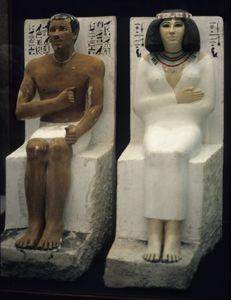
- Q10Prince Rahotep and Nofret are painted limestone sculptures that were found in a mastaba Opens in modal popup window at Meidum, Egypt. A mastaba is a ____________________________________-. There are several mastabas at the Meidum pyramid complex of Pharaoh Sneferu Opens in modal popup window , Rahotep's probable father.rectangular structure with sloping sides, built over a burial chambersquare structure with sloping sides, built over a burial chambertype of taco made with chickenmural built inside a burial chamber45s9.2.12.F
- Q11The statues of Prince Rahotep and his wife Nofret radiate _________- through their solemn, confident expressions and solid, compact forms. Their pose is frontal and symmetrical, and they sit rigidly upright.angerpessimismserenityelation45s9.2.12.D
- Q12What was the most important purpose of sculpture and wall paintings in Egyptian tombs?They protected and provided for the ka in the afterlife.They beautified the underground burial chamber.They showed the importance of ordinary citizens in society.45s9.2.12.D
- Q13Which statement is true about the Book of The Dead?It helped architects plan the designs of funerary temples.It told stories of the life and accomplishments of deceased pharaohs.It contains images and hieroglyphics instructing the ka in the underworld.45s9.2.12.D
- Q14What are two characteristics of figures in ancient Egyptian sculpture?perfect proportions, confident expressionscomplex poses, many detailsunpainted, made of bronze45s9.2.12.D
- Q15What is the most important day in Egypt?FridaysFather's DayMondaysMummy's Day45s

