AP US Gov't Exam 2 Review
Quiz by Joe Pilakowski
Feel free to use or edit a copy
includes Teacher and Student dashboards
Measure skillsfrom any curriculum
Measure skills
from any curriculum
Tag the questions with any skills you have. Your dashboard will track each student's mastery of each skill.
With a free account, teachers can
- edit the questions
- save a copy for later
- start a class game
- automatically assign follow-up activities based on students’ scores
- assign as homework
- share a link with colleagues
- print as a bubble sheet
25 questions
Show answers
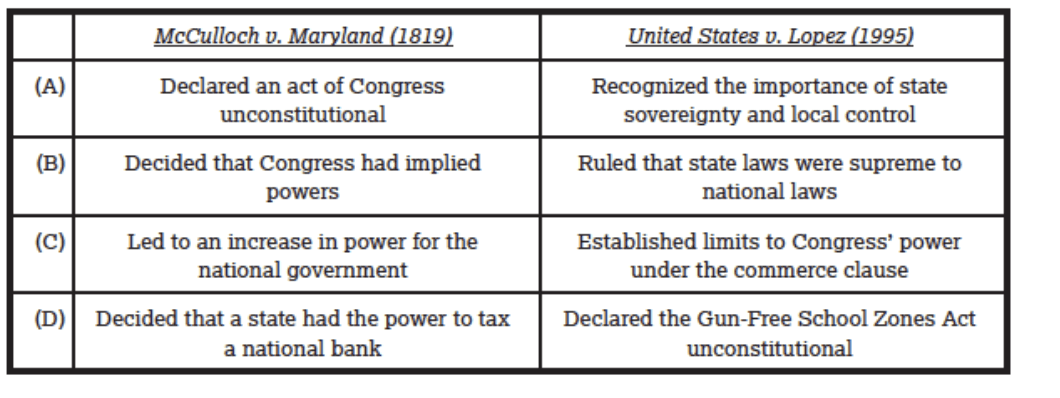
- Q1The McCulloch v. Maryland case exemplified____.the creation and use of implied powersjudicial review specified within the Constitutionthat the scope of the Necessary and Proper Clause created enumerated powersthe growing power of the state governments60s
- Q2Ultimate authority and trumping power is in the national government exemplifies ____.Authoritarian GovernmentPresidential GovernmentFederal GovernmentUnitary Government60s
- Q3Powers specifically expressed and granted to the national government by the Constitution are known as __________ Powers.EnumeratedConcurrentImpliedInferred60s
- Q4The Elastic Clause __________.expands the power of state governments and reduces the power of the national governmentmaintains the existing division of power between the national and state governments in the reserved powers it supportsties to the Necessary & Proper Clausecontains a list of prohibited powers60s
- Q5Powers not given to the Federal Government by the Constitution, are __________ as stated in the 10th Amendment.nonetheless retained by the federal governmentreserved to the statesknown as enumerated powerswithin the Necessary and Proper Clause60s
- Q6Which of the following would Anti-Federalists most likely support?Enumerated PowersImplied PowersThe 10th AmendmentSupremacy Clause60s
- Q7In Gibbons v. Ogden the Supreme Court __________.stated commerce cannot be said to transport of peopleruled that Congress could not regulate commercial activitiesstated that the power to regulate interstate commerce is impliedruled that commerce should be interpreted broadly60s
- Q8One of the earliest examples of Fiscal Federalism's categorical grants was ________.allowing states to borrow money at low interest rates to improve prisonstransferring much of its military power to state militiasproviding grants to the states to assist in the financing of state educationrequiring the states to lower the drinking age to 2160s
- Q9Categorical Grants __________.are preferable by the state governmentswere provided at their lowest levels during the Great Depressionhave been used to fund numerous programs by providing conditions that must be metare an example of dual federalism at work60s
- Q10The transfer of power FROM the national government TO state and local governments is known as __________.evolutionrestitutionretributiondevolution60s
- Q11A position that has been sought by liberals in regards to federalism has been to ____.utilize devolutionroll back the use of enumerated powersuse categorical grantsblock federal mandates60s
- Q12A position that has been sought by conservatives in regards to federalism has been to _________.increase the use of implied powersincrease the use of federal mandatesthe use of block grantsstop the use of devolution60s
- Q13If Texas enacted an immigration law claiming the legislation complemented existing federal law and it was challenged which clause would likely be used to say it was only federal power?Necessary and Proper ClauseSupremacy ClauseCommerce ClauseElastic Clause60s
- Q14Which of the following is a good example of concurrent powers?Power of control of educationPower to taxPower over elections and votingPower of interstate commerce60s
- Q15Which of the following statements best fits with Madison's view of factions in the The Federalist #10Factions are a negative creation that must be destroyed by government.Factions are inevitable, but okay.A consolidation of power in a few factions was good for the republic.A small nation and few factions is the goal of government.60s