placeholder image to represent content

APU1 - Vergil - 1.1-33 Comprehension Analysis

Quiz by Robynn Hecht

Our brand new solo games combine with your quiz, on the same screen

Correct quiz answers unlock more play!

New Quizalize solo game modes
49 questions
Show answers
  • Q1
    Which of the following is a traditional epic standard as seen in words like The Aeneid?
    integration of supernatural forces
    Mind control, telepathy, and telekinesis
    technological control
    protagonist as the narrator
    20s
  • Q2
    The epic The Aeneid was heavily influence by The Iliad and The Odyssey, which were both words attributed to the Greek poet
    Homer
    Aeschylus
    Aristotle
    Sappho
    20s
  • Q3
    Epics often show the use of vast settings throughout the entire story.
    False
    True
    20s
  • Q4
    A story that begins "in mediās rēs" starts
    a decade before the protagonist has been born.
    in the middle of the events of the narrative.
    in the middle of a dialogue.
    after the protagonist has been killed.
    20s
  • Q5
    What is the name of the muse called upon by Vergil for inspiration in the Aeneid?
    Thalia
    Calliope
    Erato
    Terpsichore
    20s
  • Q6
    Metonymy is
    the use of the parent's name to describe the child.
    the repetition of three words in successive clauses.
    the use of one word to stand in for the meaning of another.
    the repetition of sounds at the beginning of words.
    20s
  • Q7
    Anaphora is
    the use of the parent's name to describe the child.
    the repetition of a word in at least 3 successive clauses.
    the use of one word to stand in for the meaning of another.
    the repetition of sounds at the beginning of words.
    20s
  • Q8
    Patrynomic is
    the repetition of a word in at least successive clauses.
    the use of the parent's name to describe the child.
    the repetition of sounds at the beginning of words.
    the use of one word to stand in for the meaning of another.
    20s
  • Q9
    Alliteration is
    the use of the parent's name to describe the child.
    the use of one word to stand in for the meaning of another.
    the repetition of sounds at the beginning of words.
    the repetition of a word in at least successive clauses.
    20s
  • Q10
    Which of the following is a rhetorical question?
    Where did I place my keys?
    How do I get to Sesame Street?
    What's the time?
    How could you be so heartless?
    20s
  • Q11
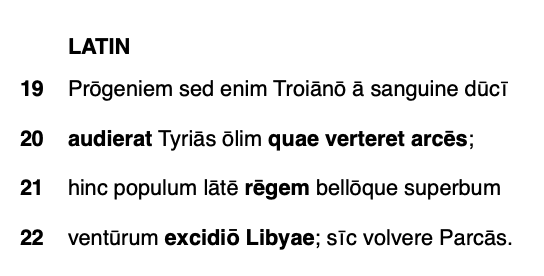
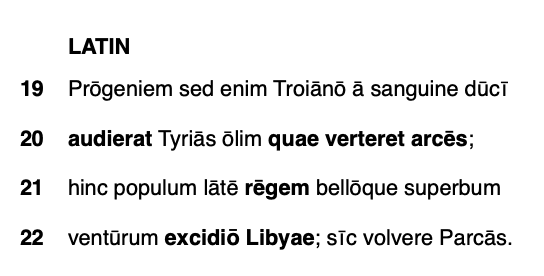
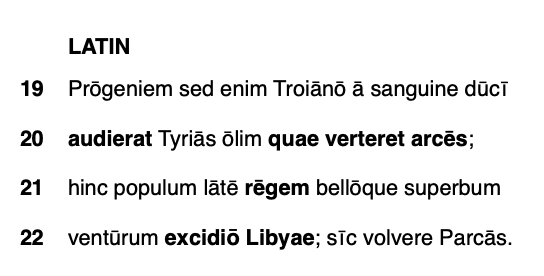
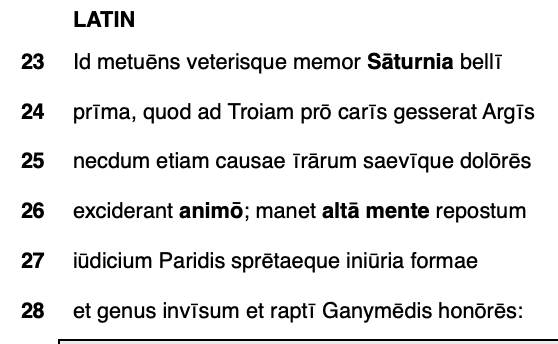
    The use of the patrynomic Saturnia is used to describe..... in the story.
    Paris
    Venus
    Minerva
    Juno
    20s
  • Q12
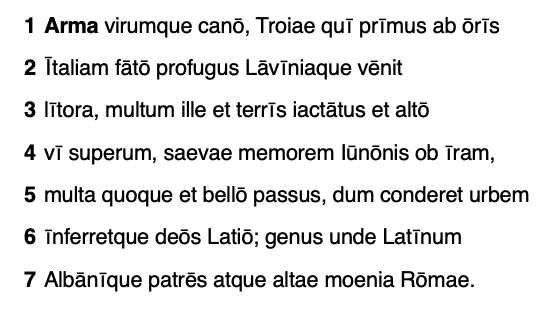
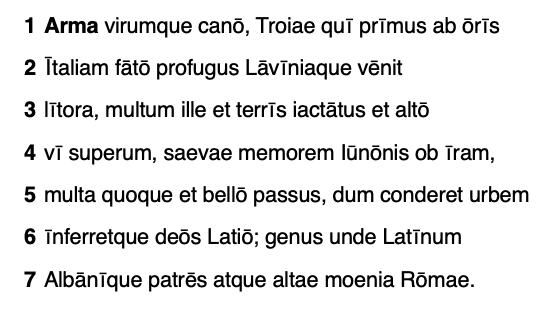
    What is the true form of the syncopated (shortened) word "superum" on line 4 ?
    Question Image
    superōs
    superīs
    superōrum
    superī
    20s
  • Q13
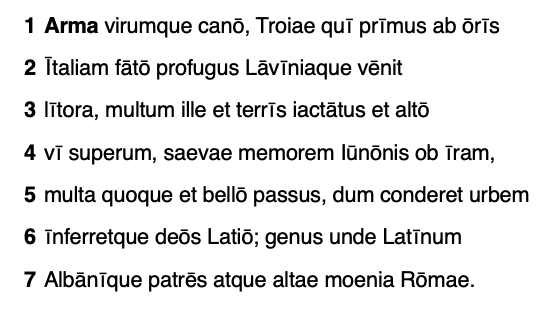
    What is the literary device used in line 1 "arma virumque canō"?
    Question Image
    metonymy (using one word to stand in to reference something greater/different)
    patrynomic (use of the father's name to identify a character)
    anastrophe (inversion of normal word order)
    alliteration (repetition of a consonant sound)
    20s
  • Q14
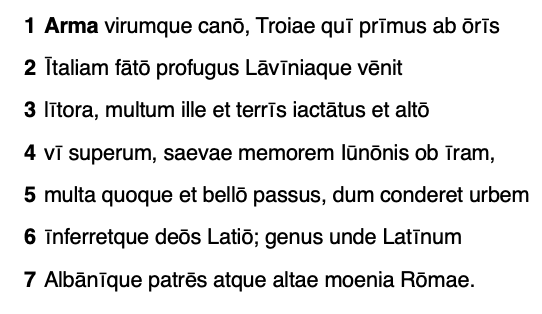
    What do we learn about Aeneas from lines 1-4?
    Question Image
    his actions were due to fate.
    he wrote Troy's fate.
    he tried to avert his fate to Italy.
    he fled to Italy, escaping his fate.
    20s
  • Q15
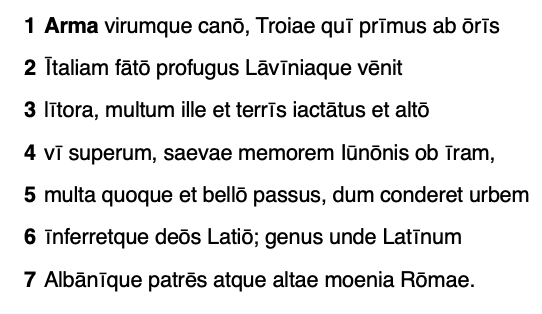
    According to lines 3-4, we learn that Aeneas' situation was
    Question Image
    due to the actions and the interference of the gods.
    equivalent to that of a god.
    a recreation of a story from his childhood.
    the origin of the first Mediterranean map.
    20s

Teachers give this quiz to your class