Tag the questions with any skills you have. Your dashboard will track each student's mastery of each skill.
Give this quiz to my class
Q 1/25
Score 0
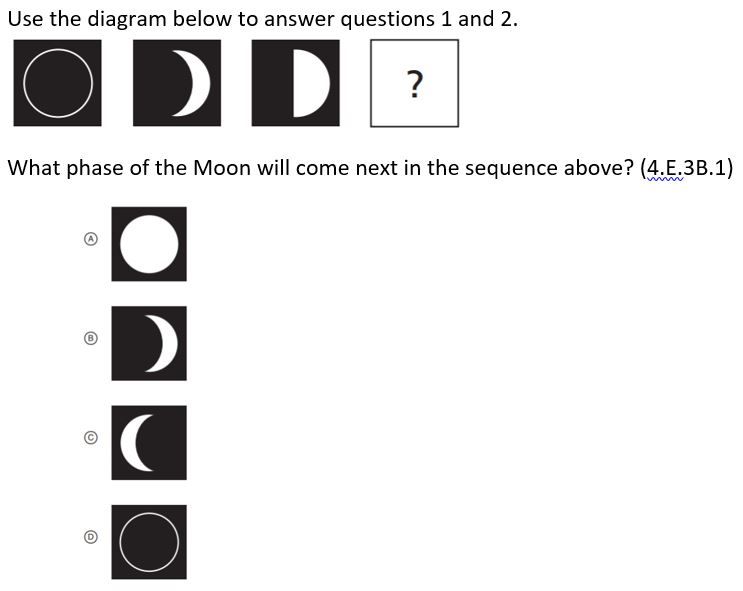
What phase of the Moon will come next in the sequence above? (4.E.3B.1)
120
C. Waning Crescent
D. New Moon
B. Waxing Crescent
A. Full Moon
Q 2/25
Score 0
Is the moon waxing or waning in the sequence? (4.E.3B.1)
120
The moon is waxing because the illuminated part is decreasing in size.
The moon is waxing because the illuminated part is increasing in size.
The moon is waning because the illuminated part is increasing in size.
The moon is waning because the illuminated part is decreasing in size.
25 questions
Q.
What phase of the Moon will come next in the sequence above? (4.E.3B.1)
1
120 sec
Q.
Is the moon waxing or waning in the sequence? (4.E.3B.1)
2
120 sec
Q.
What season is the Northern Hemisphere experiencing in this diagram? (4.E.3B.4)
3
120 sec
Q.
The picture shows a satellite view of Earth from directly above the North Pole during the summer. What time of day would it be in Alaska? (4.E.3B.2)
4
120 sec
Q.
Ping conducted an experiment with shadow sticks. The pictures below were drawn from his observations of the Sun’s movement across the sky. Which picture shows the time of the day when the Sun was highest in the sky? (4.E.3B.3)
5
120 sec
Q.
What does the tool pictured do? (4.E.3A.3)
6
120 sec
Q.
Which of the following describes the sun? (4.E.3A.1)
7
120 sec
Q.
Which is the best tool for observing distant objects such as planets? (4.E.3A.3)
8
120 sec
Q.
It is summer in South Carolina when the ____________________. (4.E.3B.4)
9
120 sec
Q.
At 6:00 p.m., you are facing the sunset. Which of the following describes your shadow? (4.3B.3)
10
120 sec
Q.
A student lists some properties of objects in the solar system. What are the objects described as X and Y? (3.E.3A.1)
11
120 sec
Q.
An astronomer is studying constellations. He reads that a constellation named Orion is best seen in the Northern Hemisphere during winter. What makes constellations visible during winter in the Northern Hemisphere but not during the summer? (4.E.3A.2)
12
120 sec
Q.
What is the name for one of the largest constellations best known as the "big dipper"? (4.E.3A.2)
13
120 sec
Q.
The diagram shows the sun, the Earth, and the moon in space. Which statement is correct about their revolutional relationships? (4.E.3A.1)
14
120 sec
Q.
Use the diagram to help answer the question.
Which of the following planets in the would be the hottest? (4.E.3A.1)
15
120 sec
Q.
Which of the planets is a gas planet and not a rocky planet like Earth? (4.E.3A.1)
16
120 sec
Q.
The diagram below shows the Sun and Earth. Letter X shows a location on the Earth’s surface. Location X is shown during the day.
Explain why it will be night at Location X in 12 hours. (3.E.3B.2)
17
120 sec
Q.
Which diagram best illustrates the order of the planets in the Solar System? (4.E.3A.1)
18
120 sec
Q.
Based on this diagram, what is the best explanation for why the size and shape of the shadows changed? (4.E.3B.3)
19
120 sec
Q.
What is the best conclusion that can be made by studying the diagram? (4.E.3B.4)
20
120 sec
Q.
The moon is the Earth's natural _________________. (4.E.3A.1)
21
120 sec
Q.
According the the table, which gas do all 4 gas giants have in common as part of its main surface composition? (4.E.3A.1)
22
120 sec
Q.
A student observed the stars in the night sky every hour. Which of these MOST likely describes what the student saw? (4.E.3A.2)
23
120 sec
Q.
About how long does it take the moon to orbit the Earth? (4.E.3B.1)
24
120 sec
Q.
Stella tells her teacher that we see the moon because it is a very bright planet. Which of the following statements would her teacher most likely say in response to Stella? (4.E.3B.1)