Loading...


Bacteria, Protists, and Fungi Practice
Quiz by Shannon Sarno
Customize this quiz to suit your class
Instantly translate to 100+ languages
Tag the questions with any skills you have. Your dashboard will track each student's mastery of each skill.
Give this quiz to my class
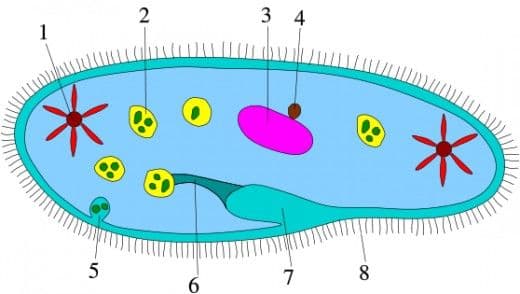 All animals, most protists, all fungi, and many bacteria are het- erotrophs. Unlike autotrophs, heterotrophs cannot manufacture their own food. Instead, they get energy by eating other organisms or organic wastes. Ecologically speaking, heterotrophs are consumers. They obtain energy by consuming organic molecules made by other organisms. Consumers can be grouped according to the type of food they eat. Herbivores eat producers. An antelope that eats grass is a herbivore. Carnivores eat other consumers. Lions, cobras, and praying mantises are examples of carnivores. Omnivores eat both producers and consumers. The grizzly bear, whose diet ranges from berries to salmon, is an omnivore. Detritivores (dee-TRIET-uh-VAWRZ) are consumers that feed on the “garbage” of an ecosystem. This waste, or detritus, includes organisms that have recently died, fallen leaves, and animal wastes. The vulture shown in Figure 18-8 is a detritivore. Many bacteria and fungi are detritivores that cause decay by breaking down complex molecules into simpler molecules. So, they are specifically called decomposers. Some of the molecules released during decay are absorbed by the decomposers, and some are returned to the soil or water. Decomposers make the nutrients that were contained in detritus available again to the autotrophs in the ecosystem. Thus, the process of decomposition recycles chemical nutrients. Copyright © by Holt, Rinehart and Winston. All rights reserved. 368 CHAPTER 18 ENERGY FLOW When one organism eats another, molecules are metabolized and energy is transferred. As a result, energy flows through an ecosystem, moving from producers to consumers. One way to follow the pattern of energy flow is to group organisms in an ecosystem based on how they obtain energy. An organism’s trophic (TRAHF-ik) level indicates the organism’s position in a sequence of energy transfers. For exam- ple, all producers belong to the first trophic level. Herbivores belong to the second trophic level, and the predators belong to the third level. Most terrestrial ecosystems have only three or four trophic lev- els, whereas marine ecosystems often have more. Food Chains and Food Webs A food chain is a single pathway of feeding relationships among organisms in an ecosystem that results in energy transfer. A food chain may begin with grass, which is a primary producer. The chain may continue with a consumer of grass seeds—a meadow mouse. Next, a carnivorous snake may kill and eat the mouse. A hawk then may eat the snake, as shown in Figure 18-9. The feeding relationships in an ecosystem are usually too com- plex to be represented by a single food chain. Many consumers eat more than one type of food. In addition, more than one species of consumer may feed on the same organism. Many food chains inter- link, and a diagram of the feeding relationships among all the organisms in an ecosystem would resemble a web, as shown in Figure 18-10. For this reason, the interrelated food chains in an ecosystem are called a food web.LESSON 3 Characteristics of Living Things Learning Objectives • Describe each characteristic of life • Relate each characteristic of life with how first forms of life evolved What sets living things apart from nonliving things? Organisms are equipped with different characteristics that allow them to grow, adapt, survive, and perpetuate. These include the ability to metabolize, respond to stimuli, interact, and reproduce, among others What are the characteristics of life? Try to look at your surroundings and identify the living things that you see. You have probably identified a lot. Many scientists believe that there are more than 10 million kinds of living things that exist on Earth today. But the question is, how can something be considered living? There are certain characteristics that all living things exhibit: the characteristics of life. Living things are made up of cells. They metabolize, grow and develop, respond to stimulus, adapt to their environment, and reproduce. Living Things Are Made up of Cells All living things are made up of cells. Cells are the basic building blocks of all living things. Each cell contains materials that carry out basic life processes such as respiration. In the 1600s, an argument against the theory of spontaneous generation was made. Italian physician and biologist Francesco Redi disproved the theory that all living things come from nonliving things. Cells have different properties and characteristics. The cell theory describes the properties of all cells. There are three tenets of the cell theory: 1. The cell is the basic unit of life. 2. All living things are composed of one or more cells. 3. All cells arise from preexisting cells. The discovery of the cell is largely attributed to Robert Hooke. Upon examining a piece of cork using a microscope that he built, Hooke observed tiny compartments that he called "cells" (from the Latin word cella, meaning "little room"). Matthias Schleiden suggested that all structural parts of plants are made up of cells. In 1839, Theodore Schwann stated that along with plants, all animals were composed of cells. From these conclusions about plants and animals, advancement on the study of animal parts and functions began. In 1855, Rudolf Virchow included the idea that all cells came from preexisting cells. Some living things are made up of only single cells. Single-celled or unicellular organisms include bacteria, some protists, and some fungi. Even though composed of single cells, these organisms carry out all the functions necessary for life. Most living things such as animals and plants, are multicellular organisms. They are composed of many cells, which are grouped together and perform specific tasks in the body. In different organisms, cells also vary in sizes, shapes, parts, and functions. There are two kinds of organisms according to their cell structure, the prokaryotes and eukaryotes (figure 5-3). Prokaryotes are single-celled organisms that lack a membrane-bound nucleus, mitochondria, and all other organelles. Its name comes from the Greek words pro, which means "before," and karyon, which means "nut or kernel." Eukaryotes are organisms with cells that contain membrane-bound nucleus and other membrane-bound organelles. The nucleus of a eukaryotic cell contains the genetic material (DNA), enclosed by a nuclear envelope. Other membrane-bound organelles are mitochondria, Golgi apparatus, and chloroplast found in photosynthetic organisms such as algae and plants. There are also unicellular eukaryotes known as protozoa. All other eukaryotes are multicellular organisms, such as plants, animals, and fungi. Living Things Metabolize Essential chemical reactions in life can be best described as building up (anabolism) and breaking down (catabolism) processes. In anabolism, the substances needed by organisms to grow, store energy, and repair tissues are synthesized. In contrast in catabolism, some complex substances are broken down, releasing the energy stored in their molecules. This happens in food digestion. This chemical building up and breaking down processes are collectively called metabolism. Metabolism, from the Greek word metabole meaning "change," is the sum total of all the life-sustaining chemical reactions in living things. It allows living things to grow, maintain their structures and functions, and respond to stimuli. Living Things Grow and Develop Growth and development are not new concepts to many. In all living things, growth involves the increase in one's size or height. However, growth is not just an increase in physical structure. It also involves complex changes in an organism. Growth and development occur rapidly from younger stages of life to maturity. In humans, animals, and plants, distinct changes brought by growth and development can be dearly identified. Microorganisms such as bacteria also undergo growth and development until they reach their maximum size and maturity. A life span is the average length of time a aving thing can live. Living things have different life spans. Humans have average life spectancy of 60 to 70 years, while some plants, such as the narra trees, can live for more than 100. Living Things Respond to Stimuli All living things respond to stimuli the environment. This responsiveness Increases survivability. Stimulus (plural: uli) is any signal or change in he environment of an organism that produces a response or reaction from that organism. Responses to stimuli depend on an organism's need. Responding to stimuli also maintains homeostasis in living things. Homeostasis is the internal balance of a body system. This balance is needed for the proper function and regulation of the living thing's body. For example, when a person is in a warmer environment, the body sweats, keeping the body maintain a temperature suited for the normal function of the body. Living Things Interact No living thing can live alone. Interaction among organisms is simultaneously happening on Earth. From the smallest microorganisms to the biggest organism, and from the North Pole to the South Pole of Earth, all are connected in one living system. An ecosystem is formed when a community of organisms interacts with another community and with their environment. Many processes and interactions, such as in a feeding relationship, life cycle, and the exchange of gases between plants and animals, occur in the ecosystem. These are some of the important processes needed to maintain life on Earth. Living Things Reproduce The ability of living things to produce offspring of their kind is called reproduction. Reproduction is not an individual organism's need, rather, it is for the species' perpetuation. In some cases, animals become extinct because of their inability to reproduce their kind. Higher forms of plants and animals reproduce through sexual reproduction. Sexual reproduction involves the union of sex cells or gametes-the egg cell from a female organism and the sperm cell from a male organism. This union gives rise to a new individual with characteristics or traits from both parents. Other simple organisms, such as bacteria and plants, can reproduce asexually. These organisms give rise to a new individual from their body. A bacterial cell divided in two through asexual reproduction gives rise to new bacteria, as shown in figure 5-5. A yeast can form buds that later on become separate individual. Plants grow new plants using their stem, leaf, and roots. Both sexual and asexual reproductions have important functions. In both cases, the genetic material (DNA) is passed on from one generation to the next, ensuring the survival of the species on Earth. 1. Bacteria copy their DNA by starting at any point on the circular chromosomes. 2. The two copies of DNA attach to the inside wall of the bacterial cell. 3. The cell starts to divide, forming a new membrane and cell wall. 4. The bacterial cell splits into two separate cells, each with their own DNA. Living Things Adapt and Evolve All living things can adapt to their environment. This adaptation is necessary for rvival. Adaptation depends on the need of an individual. A polar bear, for example, would not be able to survive in an extremely cold environment without its capacity adapt. Adaptation is any response or reaction toward a stimulus that helps in the survival of an organism. A seed-eating bird will eventually eat a worm when there are seeds to be found. This change in food choice is therefore its adapting mechanism. Prolonged adaptation to certain environments may lead to the gradual evolution of the succeeding generations. Evolution is the gradual change in organisms over a long period in response to changing environment. Living Things Are Organized Life on Earth exhibits organization. The atom is the smallest unit of matter, lowed by molecules, which are combinations of atoms. When these molecules are grouped together, they form a cell. The cell is the basic unit of life. In multicellular organisms, such as plants and animals, cells are grouped as tissues to perform specific Functions. Different tissues can be grouped further and form organs. Organs in animals include the heart, brain, and lungs, among others. The organs form organ systems that makes the function of the body more complex and efficient. Organ systems form the whole organism. All living things exhibit organization, whether they are unicellular or multicellular organisms.. Review Virus, Bacteria, Protist, and Fungi 1Escape from Unsuitable Conditions Some species can survive unfavorable environmental conditions by escaping from them temporarily. For example, desert animals usually hide underground or in the shade during the hottest part of the day. Many desert species are active at night, when temper- atures are much lower. A longer-term strategy is to enter a state of reduced activity, called dormancy, during periods of unfavorable conditions, such as winter or drought. Another strategy is to move to a more favorable habitat, called migration. An example of migration is the seasonal movements of birds, which spend spring and summer in cooler climates and migrate to warmer climates in the fall. THE NICHE Species do not use or occupy all parts of their habitat at once. The specific role, or way of life, of a species within its environment is its niche (NICH). The niche includes the range of conditions that the species can tolerate, the resources it uses, the methods by which it obtains resources, the number of offspring it has, its time of reproduction, and all other interactions with its environment. Parts of a lion’s niche are shown in Figure 18-6. Generalists are species with broad niches; they can tolerate a range of conditions and use a variety of resources. An example of a generalist is the Virginia opossum, found across much of the United States. The opossum feeds on almost anything, from eggs and dead animals to fruits and plants. In contrast, species that have narrow niches are called specialists. An example is the koala of Australia, which feeds only on the leaves of a few species of eucalyptus trees. Some species have more than one niche within a lifetime. For example, caterpillars eat the leaves of plants, but as adult butter- flies, they feed on nectar. Plants and animals are able to share the same habitats because they each have different niches. FIGURE 18-6 niche from the Old French nichier, meaning “to nest” Word Roots and Origins www.scilinks.org Topic: Niche/Habitats Keyword: HM61029 mb06se_iecs02.qxd 5/24/07 10:25 AM Page 365 366 CHAPTER 18 ENERGY TRANSFER All organisms need energy to carry out essential functions, such as growth, movement, maintenance and repair, and reproduction. In an ecosystem, energy flows from the sun to autotrophs, then to organisms that eat the autotrophs, and then to organisms that feed on other organisms. The amount of energy an ecosystem receives and the amount that is transferred from organism to organism affect the ecosystem’s structure. PRODUCERS Autotrophs, which include plants and some kinds of protists and bacteria, manufacture their own food. Because autotrophs cap- ture energy and use it to make organic molecules, they are called producers. Recall that organic molecules are molecules that con- tain carbon. Most producers are photosynthetic, so they use solar energy to power the production of food. However, some autotrophic bacteria do not use sunlight as an energy source. These bacteria carry out chemosynthesis (KEE-moh-SIN-thuh-sis), in which they use energy stored in inorganic molecules to produce carbohydrates. In terres- trial ecosystems, plants are usually the major producers. In aquatic ecosystems, photosynthetic protists and bacteria are usu-Cell Theory The microscopes we use today are far more complex than those used in the 1600s by Antony van Leeuwenhoek, a Dutch shopkeeper who had great skill in crafting lenses. Despite the limitations of his now-ancient lenses, van Leeuwenhoek observed the movements of protista (a type of single-celled organism) and sperm, which he collectively termed “animalcules. ” In a 1665 publication called Micrographia, experimental scientist Robert Hooke coined the term “cell” for the box-like structures he observed when viewing cork tissue through a lens. In the 1670s, van Leeuwenhoek discovered bacteria and protozoa. Later advances in lenses, microscope construction, and staining techniques enabled other scientists to see some components inside cells. image Figure 4.3.1 : Structure of an Animal Cell: The cell is the basic unit of life and the study of the cell led to the development of the cell theory. By the late 1830s, botanist Matthias Schleiden and zoologist Theodor Schwann were studying tissues and proposed the unified cell theory. The unified cell theory states that: all living things are composed of one or more cells; the cell is the basic unit of life; and new cells arise from existing cells. Rudolf Virchow later made important contributions to this theory. Schleiden and Schwann proposed spontaneous generation as the method for cell origination, but spontaneous generation (also called abiogenesis) was later disproven. Rudolf Virchow famously stated “Omnis cellula e cellula”… “All cells only arise from pre-existing cells. “The parts of the theory that did not have to do with the origin of cells, however, held up to scientific scrutiny and are widely agreed upon by the scientific community today. The generally accepted portions of the modern Cell Theory are as follows: The cell is the fundamental unit of structure and function in living things. All organisms are made up of one or more cells. Cells arise from other cells through cellular division. The expanded version of the cell theory can also include: Cells carry genetic material passed to daughter cells during cellular division All cells are essentially the same in chemical composition Energy flow (metabolism and biochemistry) occurs within cellsReview:Protist, Bacteria, &FungiSemana 1: Definir los conceptos básicos de taxonomía, clasificación y biodiversidad. Identificar las características fundamentales de los seres vivos. Semana 2: Clasificar los organismos en dominios (Bacteria, Archaea, Eukarya) según el tipo de células (procariota, eucariota). Reconocer las características distintivas de cada dominio. Semana 3: Explorar la clasificación de los reinos dentro del dominio Eukarya (Animalia, Plantae, Fungi, Protista). Identificar las características principales de cada reino. Semana 4: Adentrarse en la clasificación de los filos dentro de los reinos Animalia y Plantae. Reconocer ejemplos representativos de cada filo. Semana 5: Descubrir el concepto de especie y su importancia en la clasificación taxonómica. Aplicar criterios para identificar especies en diferentes entornos. Semana 6: Analizar los niveles de organización taxonómica (reino, filo, clase, orden, familia, género, especie). Utilizar claves taxonómicas simples para clasificar organismos. Semana 7: Reconocer la importancia de la clasificación taxonómica para el estudio de la biodiversidad. Explorar la diversidad de especies en diferentes ecosistemas. Semana 8: Analizar las relaciones de parentesco entre los organismos a través de árboles filogenéticos. Construir árboles filogenéticos sencillos para representar relaciones evolutivas.Semana 1: Definir los conceptos básicos de taxonomía, clasificación y biodiversidad. Identificar las características fundamentales de los seres vivos. Semana 2: Clasificar los organismos en dominios (Bacteria, Archaea, Eukarya) según el tipo de células (procariota, eucariota). Reconocer las características distintivas de cada dominio. Semana 3: Explorar la clasificación de los reinos dentro del dominio Eukarya (Animalia, Plantae, Fungi, Protista). Identificar las características principales de cada reino.