Tag the questions with any skills you have. Your dashboard will track each student's mastery of each skill.
Give this quiz to my class
Q 1/42
Score 0
The technique known as chromosome painting is the result of scientific research. Scientists use chromosome painting to mark the locations of genes on human chromosomes with fluorescent tags. It is also possible to apply this technique to the chromosomes of many different species. Chromosome painting allows for which of the following?
60
A comparison of the genomes of different species
The sequencing of proteins from many species
An increase in mutations in many species
The extraction of amino acids from different species
Q 2/42
Score 0
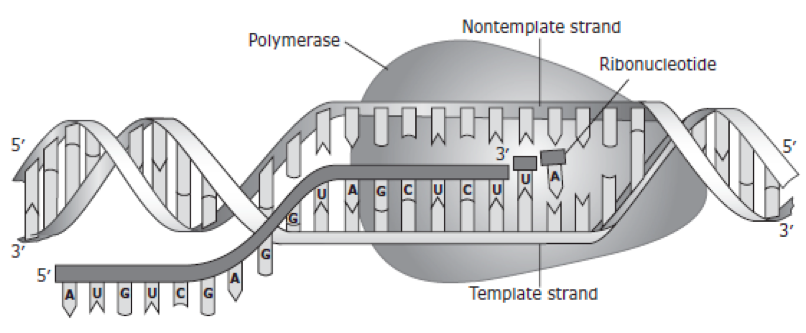
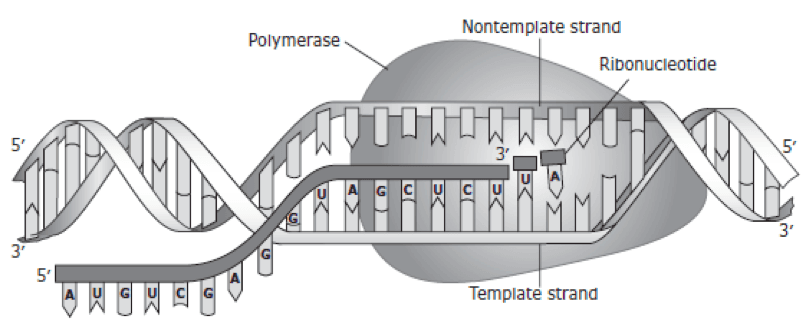
A section of a nucleic acid is shown in this diagram. The process represented in the diagram produces a molecule that is complementary to the template strand of DNA. What type of molecule is produced?
120
Polypeptide
Messenger RNA
New DNA
Carbohydrate
42 questions
Q.
The technique known as chromosome painting is the result of scientific research. Scientists use chromosome painting to mark the locations of genes on human chromosomes with fluorescent tags. It is also possible to apply this technique to the chromosomes of many different species. Chromosome painting allows for which of the following?
1
60 sec
Q.
A section of a nucleic acid is shown in this diagram. The process represented in the diagram produces a molecule that is complementary to the template strand of DNA. What type of molecule is produced?
2
120 sec
Q.
If several pea plants with the genotype TTYy are crossed with pea plants with the genotype Ttyy, what percentage of the offspring will be expected to have the TTYy allele combination?
3
120 sec
Q.
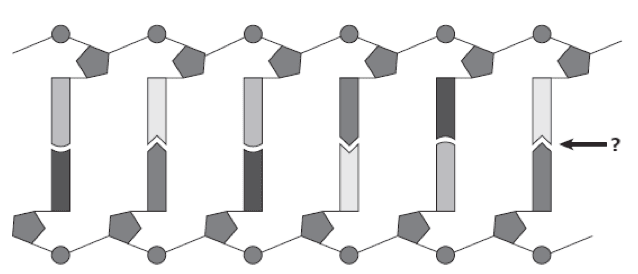
A model of a DNA molecule is shown here. The arrow indicates-
4
120 sec
Q.
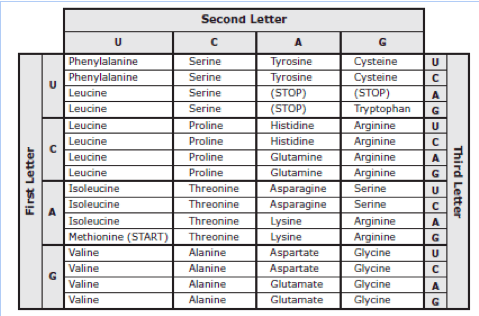
A codon chart is shown here Which of these changes to the DNA triple 3’GCT 5’ will affect the protein produced?
5
120 sec
Q.
Crossing-over between nonsister chromatids during meiosis is significant in heredity. This process most likely leads to an increase in which of the following?
6
60 sec
Q.
Characteristics such as a widow’s peak or attached earlobes are determined by the genetic code. Which components of DNA are referred to as the genetic code?
7
60 sec
Q.
In cocker spaniels the allele for a black coat color (B) is dominant over the allele for a brown coat color (b). If a brown cocker spaniel is crossed with a heterozygous black cocker spaniel, which of the following genotypic ratios can be expected?
8
120 sec
Q.
How does DNA in cells determine an organism’s complex traits?
9
60 sec
Q.
The fact that a strain of yeast with a certain defective gene can use the human version of the gene to repair itself is evidence that yeast and humans-
10
60 sec
Q.
A mutation that occurs in the gametes of an organism will most likely be transferred to which of the following?
11
60 sec
Q.
Early-onset Alzheimer’s disease affects people under the age of 65. Less than five percent of people who are diagnosed with Alzheimer’s disease have this type. Many cases of early-onset Alzheimer’s disease are inherited, a type known as familial Alzheimer’s disease (FAD). Which statement is best supported by this information?
12
60 sec
Q.
Sexual reproduction in animals depends on the production of gametes. Which of these processes produces gametes in animals?
13
60 sec
Q.
The sequence of nitrogenous bases in DNA varies widely. The sequence of the bases in DNA is most important for which of the following?
14
60 sec
Q.
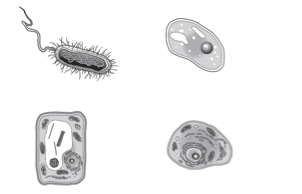
Four different types of cells are shown below. Which characteristic is shared by all four cells?
15
120 sec
Q.
In the 1860s Gregor Mendel performed numerous dihybrid crosses between pea plants. Dihybrid crosses involve the study of the inheritance patterns related to two different traits. In guinea pigs the allele for black fur (B) is dominant over the allele for brown fur (b), and the allele for short fur (F) is dominant over the allele for long fur (f). What percentage of the offspring from a BbFf x bbff cross would be expected to be heterozygous for both traits?
16
120 sec
Q.
In 1917 the biologist Thomas Hunt Morgan conducted studies in which he kept some caterpillars in the dark and placed some others under red, green, or blue lights. Exposure to red light produced butterflies with brightly colored wings. Exposure to green light resulted in dark-colored wings. Exposure to blue light or no light resulted in pale-colored wings. What was the most likely conclusion of Morgan’s research?
17
120 sec
Q.
The picture below shows a person’s karyotype. Which of the following can best be determined by examining this karyotype?
18
120 sec
Q.
Sickle-shaped red blood cells result from a mutation in the gene that codes for hemoglobin. This mutation results in sickle-cell anemia. A partial sequence of bases from a normal hemoglobin gene and a sequence that results in sickle-cell anemia are shown below. What type of mutation is depicted in this sequence?
19
120 sec
Q.
Tomato plants usually have hairy stems. Hairless stems are present in tomato plants that are homozygous recessive for this trait. If the stem characteristics are determined by a single gene, what is the expected outcome of crossing two tomato plants that are heterozygous for hairy stems?
20
120 sec
Q.
Which of the following polypeptides is coded for by the mRNA sequence 5’AUGGUUAAACGACAAUCC3’?
21
120 sec
Q.
In 1952 Rosalind Franklin took the x-ray photograph shown below, which gave the world its first look at DNA. By studying this photograph, scientists gained knowledge about the-
22
120 sec
Q.
A segment of DNA produces methionine, threonine, histidine, aspartate, and glycine when translated. A substitution mutation occurs and causes the synthesis of the segment as shown. Which is the new peptide chain when the new DNA segment is translated?
23
120 sec
Q.
Part of an important cellular process involving a DNA strand is modeled below. What is the purpose of this cellular process?
24
120 sec
Q.
Organisms can be classified based on homology, which is shared characteristics inherited from a common ancestor. In the past, homologies were based on studies of anatomical structures and patterns of embryonic development. In more recent years, the use of molecular biology techniques has allowed homologies to be compared at the level of nucleotide sequences. Nucleotide sequence comparisons are possible because all organisms share which of the following?
25
120 sec
Q.
A genome-wide association study involves searching the genomes of many people in order to find genetic variations associated with common diseases such as cancer, asthma, and diabetes. These studies are possible because of computer databases that allow researchers to compare the genomes of people who do not have a particular condition with the genomes of people who have the condition. In order to do this type of testing, researchers need blood samples or cheek swabs from people. Obtaining these samples is necessary because blood and cheek cells contain —
26
60 sec
Q.
A segment of DNA is represented in the illustration. How is information for a specific protein carried on the DNA molecule?
27
120 sec
Q.
Facial dimples and free earlobes are both considered dominant human traits. What are the expected phenotypes of the offspring of a female with dimples and free earlobes (DDFf) and a male with no dimples and attached earlobes (ddff)?
28
120 sec
Q.
At birth Himalayan rabbits are usually white over their entire bodies. But when parts of their bodies reach temperatures below 35°C, a pigment that causes these parts to turn black is produced. Which of the following is most likely the cause of this phenomenon?
29
60 sec
Q.
Human body cells each have 46 chromosomes in their nuclei. Meiosis is necessary in order to ensure that each gamete produced in the human body has —
30
60 sec
Q.
In the 1960s the molecular biologist George Streisinger developed the strand-slippage hypothesis. Streisinger noticed that mutations occurred in areas of DNA that contained many repeated sequences. When a strand-slippage error occurs, an insertion mutation can result. How does the insertion mutation affect the DNA?
31
60 sec
Q.
Normal fruit flies have brownish-yellow bodies, and this body color is dominant. A mutation in the gene for body color can produce flies with an ebony body color. A homozygous normal fruit fly (e+e+) is crossed with a homozygous ebony fruit fly (ee). What is the predicted outcome of this genetic cross?
32
60 sec
Q.
The four butterflies in the illustrations represent the offspring in the F1
generation. Which statement is best supported by the phenotypes of these offspring?
33
60 sec
Q.
The survival of a species depends on its ability to adapt to changes in the environment. A
species must be capable of surviving and reproducing despite changes to food sources,
climate, or threats from predators. Which statement correctly describes a way that mutations increase the likelihood that a species will survive in a changing environment?
34
60 sec
Q.
During meiosis, homologous chromosomes exchange genetic material. This exchange of
genetic material —
35
60 sec
Q.
The initial steps in gene expression are modeled below. Double-stranded DNA first unwinds
into two strands. Which process and product are represented in Diagram 2?
36
60 sec
Q.
Human bone, muscle, and nerve cells all contain the same number of chromosomes with the
same complement of genes. What enables these cells to perform specialized activities?
37
60 sec
Q.
Nitrogenous bases are located on both strands of the DNA double helix. What is the
significance of the nitrogenous bases?
38
60 sec
Q.
In the early 1980s scientists were able to produce two biomolecules by splicing a human gene into the bacterium E. coli to make recombinant human insulin and growth hormone. Which statement best explains why this experiment was successful?
39
60 sec
Q.
The table shows a DNA sequence and three types of mutations that can change the DNA
sequence. Which mutation will cause translation to stop?
40
60 sec
Q.
The photograph shows a laboratory investigator examining samples of DNA in a procedure
called PCR, or polymerase chain reaction. Using PCR, the investigator can create thousands or even millions of copies of a fragment of DNA for closer investigation. In which of these situations would PCR be most useful?
41
60 sec
Q.
Chickens can have different types of feathers. Frizzled feathers curl toward a chicken’s head.
Assume that feather type is determined by a single gene and that the allele for frizzled
feathers is dominant over the allele for straight feathers. In a cross between two chickens
with straight feathers, what percentage of the offspring can be expected to have frizzled
feathers?