Biomolecules and Enzymes ReTest
Quiz by Renee Delgado
High School
Biology(2017)(ARCHIVED)
Texas Essential Knowledge and Skills (TEKS)
Feel free to use or edit a copy
includes Teacher and Student dashboards
Measure skillsfrom any curriculum
Measure skills
from any curriculum
Tag the questions with any skills you have. Your dashboard will track each student's mastery of each skill.
With a free account, teachers can
- edit the questions
- save a copy for later
- start a class game
- automatically assign follow-up activities based on students’ scores
- assign as homework
- share a link with colleagues
- print as a bubble sheet


17 questions
Show answers
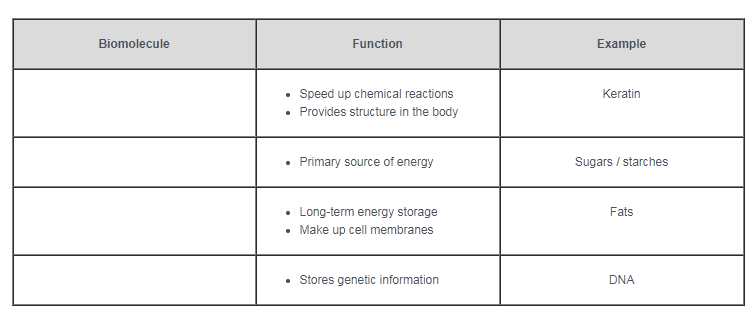
- Q1One function of the Lipids macromolecule is to store energy. Which other macromolecule also functions in providing energy?DNAProteinNucleic AcidCarbohydrates45s
- Q2Which of the following correctly orders the biomolecules starting from the top, that would complete the chart?Protein, Lipids, Carbohydrates, Nucleic AcidsLipids, Nucleic Acids, Protein, CarbohydratesProtein, Carbohydrates, Lipids, Nucleic AcidsNucleic Acids, Carbohydrates, lipids, Protein45s
- Q3What type of biomolecule is a major part of the cell membrane because it creates a thin hydrophobic layer that helps maintain selective permeability?ProteinsLipidsNucleic acidsCarbohydrates45s
- Q4The function of the nucleic acids contained in the body cells of an organism isdirecting the synthesis of proteins necessary for proper cell functionforming a variety of gametes that will pass on hereditary informationproducing the inorganic molecules needed for normal cell growthdisrupting meiosis and the synthesis of amino acids into a sequence45s
- Q5A substrate is a reactant that is affected by an enzyme. In order for an enzyme to be effective, it mustbind to a substrate, transform itself into more of the substrate, and release higher amounts of the substrate as a productbind to a substrate, transform itself and the substrate into products, and cause these products to dissolvebind to a substrate, transform the substrate into products, and release products into the substratebind to a substrate, transform the substrate into products, and release the products45s
- Q6What is the name of the structures labeled B, C, and D?productssubstratesubstrate complexenzyme45s
- Q7What is the name of the structure labeled A?enzyme complexenzymesubstrateproducts45s
- Q8What is the structure labeled E?enzymeproductsenzyme complexsubstrate45s
- Q9The diagram represents a section of a cell membrane. What does structure D represent?glucoseglycogena lipida protein45s
- Q10Sugars are also known aslipidsnucleic acidscarbohydratesproteins45s
- Q11Starches found in breads, pastas, and potatoes are known aslipidsproteinsnucleic acidscarbohydrates45s
- Q12The starch found in plants are used forwaste disposala store of auxillary glycogenenergy storagelong term energy storage45s
- Q13What are two types of carbohydrates found in living organisms?amino acids and alchoholsugars and starchesfats and lipidsfatty acids and glycerol45s
- Q14Carbon, hydrogen, oxygen, and nitrogen make up organic compounds such proteins, lipids, nucleic acids, andozonewatercarbohydratescarbon dioxide45s
- Q15If the amount of sustrate in a solution is used up, the enzymecan cause the reaction to occur exactly as it did beforeprevents a substrate from transforming into productscannot cause a reaction to occurtransforms into the substrate45s