Loading...

Capacitance and Capacitor
Quiz by Ymije Jee
Tag the questions with any skills you have. Your dashboard will track each student's mastery of each skill.
A parallel-plate capacitor has a capacitance of 20 µF. What potential difference across the plates is required to store 7.2 x 10⁻⁴ C on this capacitor?
Increasing the separation of the two charged parallel plates of a capacitor, which are disconnected from a battery, will produce what effect on the capacitor?
Three capacitors of 1.0 µF, 1.5 µF, and 2.0 µF are connected in series. Find the combined capacitance.
If three 4.0 µF capacitors are connected in parallel, what is the combined capacitance?
Two capacitors with capacitance's of 1.0 µF and 0.50 µF, respectively, are connected in series. The system is connected to a 100 V battery. What charge accumulates on the 1.0 µF capacitor?
Two capacitors with CA greater than CB and are connected in series with a battery. Which of the following is true?
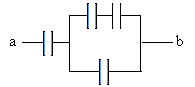
What is the equivalent capacitance between points a and b? All capacitors are 1.0 µF.
A 0.25 µF capacitor is connected to a 400-V battery. What potential energy is stored in the capacitor?
Inserting a dielectric material between two charged parallel conducting plates, originally separated by air and disconnected from a battery, will produce what effect on the capacitor?
The dielectric strength of Rutile is 6.0 x 10⁶ V/m, which corresponds to the maximum electric field that the dielectric can sustain before breakdown. What is the maximum charge that a 10 x 10 F capacitor with a 1.0-mm thickness of Rutile can hold?
A parallel-plate capacitor has dimensions 4.0 cm x 5.0 cm. The plates are separated by a 1.0 mm thickness of paper (dielectric constant k = 3.7). What is the charge that can be stored on this capacitor, when connected to a 1.5 V battery? (Ɛ0 = 8.85 x 10⁻¹² C2/Nm2)
Very large capacitors have been considered as a means for storing electrical energy. If we constructed a very large parallel-plate capacitor of plate area 1.0 m2 using paper (k = 3.7) of thickness 1.0 mm as a dielectric, how much electrical energy would it store at a plate voltage of 5 000 V?
The capacitance of a parallel-plate capacitor can be increased by:
What is the voltage across the plates of the capacitor if the capacitance is 10 uF and the Charge stored is 30 uC?
created out of two metal plates and an insulating material called a dielectric
In the capacitor, the dielectric can be made out of all sorts of ---------- materials and the plates are made of a -------------- material.
With respect to the capacitor, which relationship is true?
How is the capacitance (C) of a parallel-plate capacitor affected by the charge on the plates ?
How is the capacitance of a parallel-plate capacitor affected by the potential difference across the capacitor ?
How is the capacitance of a parallel-plate capacitor affected by the area of each plate?
