Loading...


Capital of France
Quiz by Aishah Muhammad
Customize this quiz to suit your class
Instantly translate to 100+ languages
Tag the questions with any skills you have. Your dashboard will track each student's mastery of each skill.
Give this quiz to my class
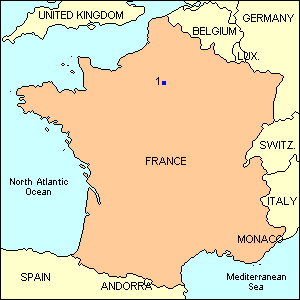 What is the Capital of FranceFrance Where Is It? France is a country in Europe. Other countries are to the east. To the south is Spain. The Atlantic Ocean is to the north and to the west. The United Kingdom is to the north. It is across a part of the Atlantic Ocean called the English Channel. Paris is the capital city of France. It is a very famous city. Millions of tourists visit Paris every year. More than ten million people live there. People. More than sixty-six million people live in France. Most people live and work in cities. Some have jobs helping tourists who visit France. Some people live in the countryside and grow food on farms. More than half of the land in France is used for farming. Most people in France speak French. Land. France has many different kinds of land. It has hills, forests, rivers, lakes, and beaches. Most of France is covered with low plains and hills. France also has five mountain ranges. They sit between France and other countries. The highest mountains are in the Alps. History. Long ago, France was called Gaul. Other countries took over Gaul many times. The Romans took it over first, and then the Franks took it from the Romans. France got its name from the Franks. For a long time, France was ruled by powerful kings. Then the French people fought against one king. This was called the French Revolution (1789–1799). Today, France is a democracy. Celebrations People in France celebrate the beginning of the revolution on July 14. They celebrate with fireworks and parades. Food. France is known for its food. One type of food is a long, thin loaf of bread. Many meals have more than one part. A meal may have soup, salad, a main course, and fruit for dessert. Conclusion France is a beautiful country with a long history. It has rolling hills, forests, and mountains. Its food is known around the world. What do you like most about France?Stages in the Sale of a Property Stage 1 – Getting to Instruction • Initial contact with the vendor: need to check the following: type of property, contact details of vendor, address of property/Eircode and purpose of the contact - sale or valuation? If a sale, does the vendor need a quick sale? Qualify the lead i.e. is the vendor buying another property? If an investment property, is the tenant in situ? Check if there is a folio number available and confirm the ownership of the property. Schedule the viewing. • Pre-viewing: Set up a file & record all info from initial contact on CRM system. Check the Property Price Register to help get a general idea of property valuation (subject to viewing, helps to display knowledge of area/market and set expectations for the vendor). Nature of property may affect pricing e.g. starter home vs. larger property with vendor seeking to downsize. Consideration for comparables may include similar/same location, size and condition of property, availability and type of parking, layout of property, plot size, orientation of garden, extensions undertaken etc. Nature of market conditions, state of wider economy, cost of capital and availability of credit may also be factors. • Appraisal/viewing: Bring an advertising pack/sales & marketing brochures. Walk through property with client, note nice features/selling points for the brochure, let the client talk about upgrades/specific features of the property. It is very important to listen to the vendor and build rapport. Confirm property details e.g. condition and layout, plot size, orientation of garden. Check for certificates of compliance for any extensions, planning permissions for conversions, right of way if applicable etc. Check if a BER available/provide details for approved assessors. Demonstrate your/the practice’s professional expertise, justify why you should get the instruction, discuss recent local sales and give your potential valuation. Discuss the sales fee, marketing fee and any additional charges e.g. professional photography, drone footage, virtual tours (walkthrough video, Matterport etc.) Ask how the vendor heard about you/your practice and why are they considering you for the sale. Where appropriate offer advice to help vendor increase potential sales price. (If possible, leave with signed Property Services Agreement/Letter of Engagement.) Thank you, send/email market appraisal, any queries/questions do get in touch and let the vendor know that we’ll be in touch in coming days. • Post appraisal – letter sent that pm/next morning with market appraisal; diary note to follow up. Check that market appraisal letter received and check for questions. If did not get sale, find out why not/debrief. If get the sale, email confirmation of instruction. Once PSRA sent and LOE returned signed = stage 2. Other details required – ID, proof of address, proof of ownership/title, solicitor details, BER certificate (refer to assessor if not available). All these should be uploaded to CRM. Stage 2 – Getting to ‘Sale Agreed’ Set up appointment to measure & photograph, note any special features e.g., upgraded kitchen, south-facing garden. Provide ideas for improving sales potential (declutter, painting, tidy garden etc. Check if has vendor potential buyers in mind already e.g., relations, friends, other parties interested. Seek vendor approval for photos/text of brochure. Check for access (tenants in situ/working from home etc) and confirm viewing times. If given a key for viewings – tag it! Check alarm codes & whether a sign is allowed on the property. Bring to market – upload to all websites e.g., daft/my home, in house websites and create window display. Match the property against your internal database of potential purchasers /CRM system. Set up appointments for viewings on CRM or arrange for open viewings. Confirm viewings with vendor & purchaser. Turn on lights, open windows, secure valuables, leave out brochures & business cards, bring viewings sheets to keep record of attendees. Introduce yourself and get attendee details. Let people view the property and address any questions. Point out key features. Record questions to be answered and any feedback from viewers. Ask are they selling property? Let viewers know of offers already received. Lock up/alarm property/close windows. Provide vendor with feedback on viewings - number of viewers / questions raised/overall reaction to property. Offers should be confirmed in writing & upload to on CRM/ offers will be input by bidders onto online bidding platforms ‘Proof of funds’ required for offers in some practices. Successful bidder will be chosen by vendor, who might want quick sale/no chain or prefer the highest bidder. Booking deposit will be sought from successful bidder. The amount varies by practice but must cover fees. Sales Advice Notice/letter should be sent to both solicitors (and may be cc’d to vendor/buyer or notify both that SAN have gone out). Booking deposit receipt should be issued. The BER certificate and report should go to the solicitor. Send requests for docs/info to successful bidder including steps they need to take to progress sale e.g., organise the bank valuation and/or schedule the survey. Once the deposit is paid the property is Sale Agreed, inform other bidders, and update all websites/sales board etc. Stage 3 – Getting to closing Access should be organised for the bank valuation/survey. Stay in touch with both solicitors ‘contract-chasing’ i.e., check when contracts are issued, signed and queries answered. Legal searches undertaken by the solicitors may include checking boundaries, land registry, title, rights of way, compliance certs etc. When contracts are signed 10% purchase price/booking deposit should be sent to the vendor’s solicitor. Once all queries satisfied = drawdown of mortgage/funding, house/life insurance in place. Title deeds will be requested once contract is signed. Decide final closing date. Check that the property taxes have been paid. Check that vendor has vacated the property. When vacant, conduct the final walkthrough and take final readings (MPRNs ). Check with solicitor if the drawn down funds h, and once received the solicitor gives authorisation to the estate agent to release the keys. The agent will do up invoice, send the balance of funds to solicitor and provide gift to purchaser. Finally remove sign, mark as sold on CRM, seek testimonials, upload to social media and close a/c on CRM Honduras is a Central American nation bordered by Nicaragua, Guatemala, and El Salvador. The Caribbean Sea forms its northern coastline. The Pacific Ocean borders a small southern strip of land. Almanaque Nombre oficial: República de Honduras Área total: 112.090 km2 Población: 9.038.741 Ciudad capital: Tegucigalpa Moneda: lempira Lenguas: español, dialectos amerindios Early History Explorer Christopher Columbus came to Honduras in 1502 on his fourth trip to the New World. As was the case in North America, Honduras, in Central America, had been home to many native indigenous groups including the Sumu and Lenca. Some estimates suggest an indigenous population of up to 2,000,000 before the Europeans arrived. Among these indigenous groups were the Maya. Their civilization spread from the Yucatán area of Mexico to Honduras’ ancient city of Copán. Spain’s conquest of Honduras began in 1525, but it was not easy. It took until 1539 to fully conquer it. There were conflicts with the native population, who were forced into labor. Many died from disease and abuse. Others were enslaved and sent to the Caribbean islands. In addition, there were pirate attacks and in-fighting among the Spaniards. Phawat/Shutterstock Gold and silver deposits were discovered in Honduras in the 1530s, attracting more settlers. By the mid-16th century, mining was an important industry, mainly in the towns of Gracias and Comayagua. More native labor was needed, taking its toll on the dwindling indigenous population. As a solution, enslaved Africans were introduced in the 1540s. This was well before 1619, when enslaved Africans first arrived in Jamestown in the American colonies. The 17th century was filled with conflicts, primarily between the Spanish and the British. Britain wanted to establish colonies on the Caribbean coast of Honduras. They eventually seized the coast with help from the native Sambo and Miskito peoples. However, Spain later regained control. Independence In the early 1800s in Honduras, resentment toward Spain grew. One reason was that Honduras was subject to more taxes to help pay for conflicts that were happening between Spain and France. Other Spanish colonies were also increasingly resentful toward Spain. In 1776 in North America, the 13 colonies banded together to declare their independence from Britain. Similarly, Honduras joined other Central American provinces. Together, they declared independence from Spain on September 15, 1821. Honduras briefly became a part of Mexico, but in 1823, it became independent from Mexico. It then joined the United Provinces of Central America. This included other former Spanish colonies: Costa Rica, El Salvador, Guatemala, and Nicaragua. But the federation did not last, partially due to divisions in political beliefs. In 1838, Honduras declared its independence from the federation. By the early 1900s, the United States had economic interests in Honduras. American fruit corporations like the Standard Fruit Company and United Fruit Company began investing in Honduras to export bananas. To protect American investments, the United States became more involved in Honduras’ political affairs. When Nicaragua appeared to threaten the stability in Honduras, US President Taft sent forces to Honduras to protect American interests. The Great Depression caused economic havoc in the United States and elsewhere. In Honduras, this meant economic problems and political turmoil. During this time, General Tiburcio Carías Andino was elected president, in 1932. He worked to strengthen the military and pay off Honduran debt. Yet he also worked to gather and maintain his own power. He changed the constitution so that he could extend his term in office as president until 1949. His advanced age and pressure from the United States forced him to allow free elections in 1948. General Francisco Morazán In 1823, Honduras joined the United Provinces of Central America. In 1830, Tegucigalpa-born General José Francisco Morazán was elected president of the federation. He remained president until just before the federation disbanded in 1840. aalezk/Shutterstock Morazán favored liberal policies and the reduced power of the church. Morazán was a self-educated man. He recognized the importance of education and the need for schools in Honduras. He believed that girls and boys should have an equal opportunity for education. During his presidency, he tried to make improvements in education. He opened schools that were free to attend. In addition to improving education, he established a system of trial by jury. It was based on the Livingston Code, created in Louisiana. This was a set of reforms to the system of legal punishment. Today, Honduras celebrates the Day of the Honduran Soldier on October 3, Morazán’s birthday. This holiday honors Morazán for his fight for democracy, liberalism, and the nation. Modern Honduras The last half of the 20th century was a political rollercoaster. There were various coups (government takeovers), conflicts, and changing leaders. Starting in 1963, Honduras was primarily led by military governments. This continued for almost 20 years. In 1969, Honduras fought a four-day war with El Salvador. The conflict was over immigration and the shared border. Though the war was brief, the two nations didn’t sign a peace treaty until 1980. With the election of president Roberto Suazo Córdova in 1981, Honduras returned to a civilian government. In the 1980s Honduras was tangled in conflicts of Nicaragua and El Salvador, partly because of the United States. Nicaraguan Contras, who wanted to overthrow the Sandinista government in Nicaragua, were using US-approved bases in Honduras. The United States was also running training camps in Honduras for Salvadoran forces facing their own civil war. This sparked anti-American protests and a desire to reduce the US presence in Honduras. Over the next few decades, Honduras continued to experience political instability. In 2009, President Manuel Zelaya was removed from power by a military coup. People were upset because he called for a referendum to change the constitution. The international community condemned this coup. As a result, Honduras cut diplomatic ties with several countries. In 2010, the United States recognized President Porfirio Lobo Sosa as a democratically elected leader. He was followed by Juan Orlando Hernández in 2014. However, protests in 2015 called for his resignation over claims of campaign fraud. In 2017, Orlando Hernández was re-elected in a disputed election.Regions of France Capitals and FactsCreate a matching exercise based on this listo Los Angeles: "City of Angels" o San Francisco: "The Golden City" o Austin: "The Live Music Capital of the World" o New York City: "The Big Apple" o Miami: "The Magic City" o Orlando: "The City Beautiful o Chicago: "The Windy City" o Las Vegas: "Sin City" o Denver: "The Mile High City" o Atlanta: "The ATL" or "Hotlanta" o Boston: "Beantown o Seattle: "The Emerald City"Buenos Aires is the capital of Argentina in South America. It’s a big and busy city with a population of almost 3 million people. And this is the world-famous Buenos Aires obelisk in the centre of the city. Just a few kilometres away from the obelisk is the home of the Menna family. Maria is fourteen years old and she’s in secondary school. She’s in the living room with her sister Sofia because they both really like computer games. They like board games too! Sofia is only nine and she’s at primary school but she’s really good at games! Sofia and Maria’s Mum is called Elena and their Dad is Alvaro. This is their house. There’s a dining room and kitchen and two bedrooms upstairs. This is Maria and Sofia’s bedroom! The family all live together in the centre of Buenos Aires. But their mum, Elena, isn’t from the city. Her parents - Sofia and Maria’s grandfather and grandmother - have got a house an hour away. It’s in a small city called Mercedes, about 100km west of Buenos Aires. It’s a big house with a dining room and a sitting room. It’s in the countryside and it’s got a beautiful garden. It’s nice and quiet here and it’s a great place to sit, eat and spend time as a family!Management and Globalization Global Management Why companies go global How companies for global Global Business environments Global Business Types of global business Pros and cons of global businesses Ethnic Challenges for global business Culture and Global Diversity Cultural intelligence Silent language of culture Tight and loose cultures Values and national cultures Global Management Learning Are management theories universal? Intercultural competencies Global learning goals Key concepts of the challenges of globalisation: Global economy Resources, markets and competition are worldwide in scope Internationalisation The process of increasing involvement in international operations Globalization/Deglobalization Glob- the growing interdependence among elements in the global economy The worldwide interdependence of resource flows, product markets and business competition World 3.0 Different views: World flat vs. round Distance is a metaphor that represents the degree of dissimilarities between countries Balancing cooperation in the global Global Management Global management - managing things in different countries Managing business and organizations with interests in more than one country What do we expect from global Managers Knowing how to adapt Knowing the language Global Manager Is culturally aware and informed on international affairs International Business Conducting for-profit transactions of goods and services across national boundaries International Motive Why do firms internatioalize their activities Cheaper labour Labour tax Natural resources Enrolments to do business Clientele Exclusive materials Personal benefits: Taxes Reasons why businesses go global Customers Suppluers Capital During (1993) - 4 motive 1. Market seeking 2. Efficiency Seeking 3. Resource seeking 4. Strategic Asset Seeking Cuervo Cazurra, Narula and un (2015) - 4 motive s Internationalization Motives A company may also explore the opportunities in different markets in order to take advantage and in some cases extend the product life cycle What is a Market Entry Strategy Involves the sale of goods or services to foreign markets but do not require expensive investments Franchising Exporting and importing Involve the sale of goods or services to foreign markets but do Types of market entry strategies Global sourcing Exporting Importing Licensing agreement Franchising Types of Foreign Direct Investment (FDI) strategies: Joint venture Strategic alliance Owned Subsidiary (sometimes called WOS) How to go abroad What conditions will affect the decisions of firms on how to internationalize their activities? During (1978)- Eclectic paradigm OLI model OLI- Ownership, Location and Internalization Advantages Ownership advantages Resources owned by the organization that can be transferred across locations include trademarks, production techniques and processes, managerial skills and other resources not available to the competitors Location Advantages Represent the implications of choosing to produce or to perform activities in a specific location (country or region) Internalization Advantages: The ability to internalize or to incorporate activities that add value to its business Evolution of Concepts- New Elements Although economic factors are certainly important to explain the formation, growth and expansion of firms within and across national borders, they are not sufficient to explain the additional complexity when a firm decides to expand its activities across national borders Economic factors Investigate the economic elements that affect the internationalization of firms Behavioural Elements Explaining the additional challenges (and perhaps opportunities) a firm faces in foreign host countries when compared to indigenous (local) firms Behavioural theories Johanson and Wiedersheim-Paul (1975) and Johanson and Vahlne (1977) Included the psychic Distance concept (beckerman,1956) to explain the internationalization behaviour of firms The Uppsala internationalization model Psychic distance is: the sum of factors preventing the flow of infomatio from and to the market Psychic Distance is a broad concept that includes several elements such as: language, culture, political systems, level of education, level of industrial development Firms behave in a “Risk Averse” manner It means that when the perceived risk goes down, the firm increase its commitment to the foreign market \ The Haier Group Data Strategy Big DATA and Small DATA The use of small data to satisfy individual customers’ needs, however, the book mentions a huge cultural shock at the plant in Camden, south caroline Ex: top down, hard hat colors and hierarchy Culutral Differnces can have a huge impact on the internationalization of firms Kogut and Singh (1988)- Cultural Distance Index First statsical study on the implication of ciltiral distance to the selection of entry mode When investigating in culturally distant countries, foreign firms can choose to partner with foreign firms in order to gain local knowledge and share the risk associated to the investment (higher commitment = higher risk) How Companies Go Global Global sourcing The process of purchasing materials or services around teh world for local use Exporting Selling locally made products in foreign markets Importing Buying foreign made products and selling them domestically Exports correspond to what percentage of Candain GDP What countries are the major trending partners of Canada Management and Globalization How Companies Go Global Licensing Agreement One firm pays a fee for rights to make or sell another company’s products What are the potential risks associated to licesning The case of new balance in China Franchising A fee is paid for the rights to use another firms name, branding and methods Insourcing Insourcing: refers to local job creation that results from foreign direct investment Types of insourcing Joint ventures: operate in a foreign country through co-ownership by foreign and local partners Strategic alliances: A partnership in which foreign and domestic firms share resources and knowledge for mutual gains Foreign subsidiaries: local operation completely owned by a foreign firm Criteria for choosing a joint venture partner: Familiarity with your firm’s major business String local workforce Values its customers Future expansion possibilities Strong local market for partner’s own products Good Profit potential Sound financial standing Global business environments Legal and poliical systems Trade agreements and trade barriers Regional economic alliances Legal and political systems Differing laws and practices regards Business ownership Negotiation and implementation of contracts Foreign currency exchange Protection of intellectual property rights Counterfeit merchandise Political risk Potential loss in value of foreign investment due to instability and political changes in the host country Political risk analysis (expertise/experience) Forecast political disruptions that threaten the value of a foreign investment Changes in the rules of the game Brexit US Trade Wars-mexico-China Other examples Bolivia, Venezuela, China De-globalization The process of weakening interdependence among nations Trade Agreements and trade Barriers World trade organization Most favourd nation status Tariffs Nontariss barriers (quotes, restrictions, etc.) Protectionism Regional Economic Alliances USMCA (replacment for the NAFTA-North American Free trade Agreement) EU- European Union APEC- Aisa Pacific Economic Copperation ASEAN - Association of Southeast Asian Nationas SADC - Southern Africa Development Community MERCOSUR- Chapter 5- Global Management and Cultural Diversity (part 2) Review Types of global business Global corporation MNE (multinational enterprise) or MNC (multinational corporation) with extensive business operations in more than one foreign country Transnational corporation A global corporation that operates worldwide on borderless basis Some host country complaints about MNCs Host Country companits about MNCs: Excessive profits Interference with local government Domination of local economy Interference with local government Hiring the best local talent Limited technology transfer Disrespect for local customers Examples - War in Ukraine Disruption in global -value chains and increased pressure and interference of MNCs with local government Fertilizer imports in Brazil (one of the major producers of agricultural commodities) We must consider the triple bottom line and the impact in society, the environment and the economy $2.5 billion invest in potash mine in Brazill What about Globalization gap Large multinationals adn industrilizednaitons gaining disporoportinonally form globalization Globalization gap: Large multinational and industrialized nations gaining disproportionally from Globalization Some MNC complaints about host countries MNC Complaints about host countries: Profiit limitations Laws and regulations Overpirce resources Exploitative rules Foreign exchange restriction Failure to uphold contracts Mutual benefits for host countries and multinational companies Mutual benefits for host country and global corporation of MNC: Shared growth opportunities Shared income opportunities Shared learning opportunities Share development opportunities Develop projects together What are some of the ethical challenges for global business Ethincal challenges for global business Child labour Employmnet of children for worl otherwise done by adults Sweatshops Employment of workers at very low wages for long hours in poor working conditions Ex: Nike bad labour prices Unsafe working conditions Corruption Illegal practices that further one’s business interests Corrupiotn of froeign public officials Act makes it illegal for Candain firms and their representatives to engage in corrupt practices overseas Bribes to foreign officials Excessive commissions Non-monetary gifts Sweatshops Conflict materials What is culture Culture : The shared set of beliefs, values, and patterns of behvaiourr common to a group of people Food preferences Values and traditions Language and beliefs Religion Art music Life style Hofstede defines culture as: “The collectiv programing of teh mind distinguishing the members of one group or category of people from others” What is culture shock Culture Shock: Confusion and discoumfert a person experiences in an unfaamiliar culture Stages to adjusting to a new culture Confusion Small vitorires The honeymoon Irritation and anger Reality Cultural Intelligence The ability to adapt and adjust to new cultures What is Ethnocentrism Tendency to consider one’s own culture as superior others Slinet languages of culture Contect Low context High context Space Proxemics Ex: personal space Time Monochronic Polychronic High and low contexts cultures Edward T.Hall (1959) Def: Part of a discourse that surround a word or passage and can throw on its meaning Low context cultures Emphizes communication via spoken or written words Countries like United States, Canada and Germany High context cultures Rely on nonverbal and situational cues as well as on spoken or written works Thailand Malaysia Time Monochronic cultures People tend to do one thing at a time Canda Polychronic cultures Time is used to accomplish many different things at once Egypt Space Proxemics Study of how people use space to communicate In North American people value “personal space’ Many Latin and Asian cultures expect much less personal space Tight and Loose Cultures Cultural tightness-looseness Tight = Strength of norms that govern social behvaviour Japan, Korea, Malaysia Loose = tolerance for any deviation from norms Australia, Brazil, Hungary Values and national cultures (Hofstede) Power distance Uncertainty avoidance Individalism-collectivism Masculinity-femininty Time Orientation Indulgence vs. Restraint Comparative management How management pratices systematically differ among countries and /or cultures Intercultural competencies Skills and personal characteristics that help us be successful in cross cultural situations Global Managers (know how to adapt) Need to successfully apply management functions across interantional boundaries Global Learning goals Not universal Engage critical thinking Look everywhere for new management ideas Always consider culture