Tag the questions with any skills you have. Your dashboard will track each student's mastery of each skill.
Give this quiz to my class
Q 1/61
Score 0
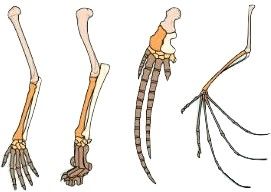
Do these common structures imply common ancestry?
20
No
Yes
Q 2/61
Score 0
A structure that seems to serve no purpose in an organism is called:
20
fossilized
homologous
vestigial
dichotomous
61 questions
Q.
Do these common structures imply common ancestry?
1
20 sec
Q.
A structure that seems to serve no purpose in an organism is called:
2
20 sec
Q.
In science, theories are:
3
30 sec
Q.
A group of mice becomes separated by the formation of a river. Over time, the northern mice became smaller and whiter, while the southern mice became larger and browner. This is an example of
4
30 sec
Q.
Any variation that can help an organism survive in its environment is called a(n):
5
30 sec
Q.
The strongest evidence for change over a long period of time comes from...
6
30 sec
Q.
Which of the following is NOT a component of the Theory of Evolution by Natural Selection?
7
45 sec
Q.
The finches on the Galapagos island were similar in form except for variations of their beaks. Darwin observed that these variations were useful for:
8
45 sec
Q.
In a certain population, disruptive selection is occurring. In this population, which is most likely to survive?
9
45 sec
Q.
This picture illustrates what type of selection?
10
45 sec
Q.
In a population of woolybeasts, individuals with long snouts tend to survive better on an island that has burrowing termites. Over time, the woolybeast population consists of individuals with extremely long snouts. This is an example of:
11
45 sec
Q.
Any characteristic that can help an organism survive and/or reproduce can be called a(n):
12
45 sec
Q.
Which of the following is NOT necessary for evolution to occur?
13
45 sec
Q.
What model of evolution suggests that species stay the same for a long period of time, then change abruptly due to mutations in key genes?
14
45 sec
Q.
Darwin concluded that a few finches migrated to the Galapagos from the mainland. These finches gave rise to the many species of finches on the islands today. This is an example of:
15
45 sec
Q.
Speciation occurs when
16
45 sec
Q.
Members of different species do not normally produce offspring due to
17
45 sec
Q.
Female guppies tend to choose brightly colored mates. Over time, the population of guppies becomes more colorful. This is an example of:
18
45 sec
Q.
What word does this image represent?
19
45 sec
Q.
What was the purpose of the Miller and Urey experiment?
20
45 sec
Q.
What gas was not included in the apparatus(picture) Miller and Urey created?
21
45 sec
Q.
What is it called when an isotope decays or dies by half its current weight after a specific amount of time?
22
45 sec
Q.
Why are half lives important?
23
45 sec
Q.
an isotope of cesium-137 has a half life of 30 years. If 10 g of cesium-137 decays over a period of 90 years, how many grams of cesium-137 remain?
24
120 sec
Q.
Actinium-226 has a half life of 29 hours. If 100 mg of actinium-226 decays over 58 hours, how many mg of actinium-226 would be left?
25
120 sec
Q.
The half life of isotope Z is 2 years. How many years would it take for a 4 g sample of Z to decay and have only .5 g of it remain?
26
120 sec
Q.
The half life of Po-218 is 3 minutes. How much of a 1000 g sample remains after 15 minutes?
27
120 sec
Q.
Suppose you have 10,000 g of Po-218 and it takes 30 minutes before you deliver it the lab. How many grams of Po-218 would be left when you reached the lab? (Po-218 half life is 3 minutes)
28
120 sec
Q.
Researchers have found fossils of Eocene horse species in Colorado. Deeper deposits contain smaller species, and more recent deposits contain larger species. How does this observation support the theory of evolution?
29
60 sec
Q.
Which of the following is the best modern definition of evolution?
30
60 sec
Q.
An earthquake decimates a ground-squirrel population. The surviving population happens to have broader stripes on average than the initial population. What is this an example of?
31
60 sec
Q.
Many crustaceans (e.g., lobsters, shrimp, and crayfish) use their tails to swim, but crabs have reduced tails that curl under their shells and are not used in swimming. This is an example of _________.
32
60 sec
Q.
Which of the following has the highest Darwinian fitness?
33
60 sec
Q.
A trait with a current functional role in the life of an organism that is maintained and evolved by means of natural selection best means__________.
34
60 sec
Q.
What word best describes what is happening in the image?
35
60 sec
Q.
The Galapagos finches are believed to have evolved from __________ mainland species.
36
60 sec
Q.
During their early stages of development, the embryos of reptiles, birds, and mammals look very similar. This suggests that reptiles, birds, and mammals
37
60 sec
Q.
If pollution is cleaned up and dark moths were easily noticed by predators, what should happen to the color of moths living in the woods?
38
60 sec
Q.
The fact that many forms of aquatic animals look alike even though they had diverse ancestors can be attributed to
39
60 sec
Q.
What types of events are typically seen in the fossil record?
40
60 sec
Q.
In relation to natural selection, evolution is the
41
60 sec
Q.
The occurrence of large or small beak sizes among finches in the absence of medium-sized beaks is an example of
42
60 sec
Q.
The random loss of alleles in a population is called
43
60 sec
Q.
A scientist measures the height in a population of children at the park and discovers that the most common height is 3 ft 2 in. . What would you expect the most common height(s) to be after 10 generations of stabilizing selection?
44
60 sec
Q.
A scientist measures the weight in a population of deer in Yellowstone National Park and discovers that the most common weight is 88 lbs. . What would you expect the most common weight to be after 10 generations of directional selection?
45
60 sec
Q.
A scientist measures the circumference of acorns in a population of oak trees and discovers that the most common circumference is 47 cm. What would you expect the most common circumference(s) to be after 10 generations of disruptive selection?
46
60 sec
Q.
A virus killed most of the seals in the North Sea (dropped the population from 8000 to 800). In an effort to help preserve the species, scientists caught 20 seals and used them to start a new population in the same region. Now this new generation of seals looks much different than the original population of 8000. What describes this change?
47
60 sec
Q.
Evolution by natural selection works best on a population having no variation.
48
45 sec
Q.
Which statement most accurately reflects what population geneticists refer to as "fitness"?
49
45 sec
Q.
Organisms that are least likely to experience extinction over the long term are most likely to be found in _______________.
50
45 sec
Q.
Which one of the following populations would most quickly lead to two groups with few shared traits?
51
45 sec
Q.
The effects of genetic drift are most apparent in small populations.
52
45 sec
Q.
Darwin explained his theory of evolution in a book called
53
45 sec
Q.
Structures that have the same evolutionary origin even though they may now have different structures or functions are said to be
54
45 sec
Q.
According to Darwin's theory of evolution
55
45 sec
Q.
Homologous structures in different species may serve different functions.
56
45 sec
Q.
Which of the following statements about species and speciation is true?
57
45 sec
Q.
Extinction can be viewed as the failure of a species to keep up with changing environmental conditions.
58
45 sec
Q.
What word best explains this image?
59
45 sec
Q.
What does a bell curve imply about a population of beetles?