Tag the questions with any skills you have. Your dashboard will track each student's mastery of each skill.
Give this quiz to my class
Q 1/70
Score 0
If an organism is unicellular and has free floating circular DNA and a plasma membrane. What is the most likely type of cell?
30
prokaryote
animal
virus
eukaryote
Q 2/70
Score 0
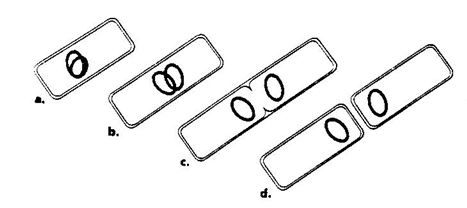
What is the image representing?
30
binary fission
sexual reproduction
conjugation
transformation
70 questions
Q.
If an organism is unicellular and has free floating circular DNA and a plasma membrane. What is the most likely type of cell?
1
30 sec
Q.
What is the image representing?
2
30 sec
Q.
Scientists think the first bacteria on Earth were
3
30 sec
Q.
As an endospore, a bacterium
4
30 sec
Q.
Bacteria do not have a nucleus which makes them prokaryotic cells.
5
45 sec
Q.
Nitrogen is important because all organisms need it to make
6
30 sec
Q.
Bacteria do not have cell walls.
7
45 sec
Q.
In what type of environmental conditions can bacteria be found?
8
30 sec
Q.
Bacteria are multicellular.
9
45 sec
Q.
Bacteria return nutrients to the environment by breaking down
10
45 sec
Q.
Bacteria are not used to make
11
45 sec
Q.
The bacteria in the image would best be described as a(an)
12
60 sec
Q.
Identify the Cell Wall in the image
13
60 sec
Q.
Bacteria reproduce through
14
60 sec
Q.
Type of bacteria which can tolerate harsh environments are known usualy as.
15
60 sec
Q.
The bacteria in the image would best be describes ad a(an)
16
60 sec
Q.
Which of the following statements regarding bacterial DNA is true
17
60 sec
Q.
If a bacteria stains pink in a gram stain it is said to be
18
60 sec
Q.
Identify the Pilli in the image
19
60 sec
Q.
Bacterial endospore formation usually occurs...
20
60 sec
Q.
Item A in the diagram refers to a(an)
21
60 sec
Q.
Item B refers to a(an)
22
60 sec
Q.
Item C refers to a(an)
23
60 sec
Q.
What does transformation involve in bacteria?
24
60 sec
Q.
Which of the following characteristics, structures, or processes is common to both bacteria and viruses?
25
60 sec
Q.
Flagella are long whip-like projections that is responsible for bacterial cell movement.
26
60 sec
Q.
The cell walls main purpose is to aid in protection and support of the cell.
27
60 sec
Q.
What are organisms that have a cell wall?
28
60 sec
Q.
Are prokaryote cells unicellular or multicellular?
29
60 sec
Q.
I am a cell that has a cell wall and ribosomes. I have cell membrane but my DNA is not in strands. I can be found by myself many times. What kind of cell am I?
30
60 sec
Q.
Which of the following is not one of the three domains?
31
60 sec
Q.
Because they are simple single cells, prokaryotes do not need energy.
32
60 sec
Q.
Pilli are used for movement and attachment to surfaces.
33
60 sec
Q.
Which one is an example of the positive things bacteria do for us?
34
60 sec
Q.
Prokaryotes contain membrane bound organelles and have a nucleus.
35
60 sec
Q.
Bacteria provide vital ecosystem services - they are important producers and are needed for the carbon and nitrogen cycles.
36
60 sec
Q.
Aerobic prokaryotes need oxygen.
37
60 sec
Q.
A common cold is cause by a ____________________.
38
60 sec
Q.
Prokaryotic DNA is usually one circular chromosome.
39
60 sec
Q.
The most common prokaryotic shapes are spheres, sprials, and rods
40
60 sec
Q.
Cyanobacteria contain the organelle chlorophyll which allows the bacterium to do photosynthesis.
41
60 sec
Q.
Since prokaryotes do not have organelles, they do not have ribosomes.
42
60 sec
Q.
The prokaryotic domains are
43
60 sec
Q.
Cyanobacteria
44
60 sec
Q.
Thermophiles
45
60 sec
Q.
Ways humans use bacteria include
46
60 sec
Q.
Prokaryotes reproduce through binary fission, a type of ____________ reproduction.
47
60 sec
Q.
The DNA of a prokaryotic cell is in the cytoplasm because the cell lacks a ____________.
48
60 sec
Q.
The term facultative anaerobe refers to an organism that
49
60 sec
Q.
The term obligate anaerobe refers to an organism that
50
60 sec
Q.
Bacteria and other eukayotes have what in common?
51
60 sec
Q.
Organisms that grow optimally at temperatures at 130 degree F or higher are called
52
60 sec
Q.
Most bacteria are ________ because they require a constant supply of oxygen
53
60 sec
Q.
Some bacteria are obligate anaerobes which means they do not like to live in oxygen.
54
60 sec
Q.
The earliest bacteria were ____________.
55
60 sec
Q.
Archaea include ____________.
56
60 sec
Q.
Bacteria require water to grow and divide.
57
60 sec
Q.
Facultative anaerobes can only grow in the presence of oxygen.
58
60 sec
Q.
Mutualistic bacteria are beneficial to humans or other organisms.
59
60 sec
Q.
Bacteria occur in which basic shape(s)?
60
60 sec
Q.
Some bacteria grow into clusters or chains.
61
60 sec
Q.
Binary fission is a form of ______ reproduction.
62
60 sec
Q.
Gram negative bacteria are typically more resistant to antibiotics because
63
60 sec
Q.
In binary fission, the chromosomes are __________.
64
60 sec
Q.
Endospores are formed by bacteria _______________.
65
60 sec
Q.
Endospores function to
66
60 sec
Q.
The capsule on the outside of a bacterium helps with movement by secreting a slime-like layer.
67
60 sec
Q.
A common cause of the common cold is the
68
60 sec
Q.
Where do chemoautotrophs get their energy?
69
60 sec
Q.
Gram positive bacteria stain ____________________ bacause of their lack of an extra cell wall.