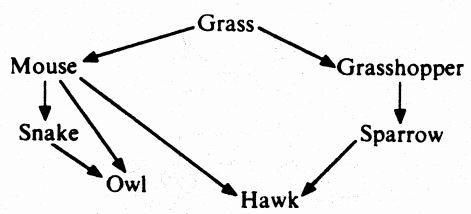
What term describes a level of organization that contains only type of one species?
1
30 sec
Q.
Which of the following is ordered correctly from largest to smallest?
2
30 sec
Q.
What term describes a consumer?
3
30 sec
Q.
What kind of organism provides the basis for an ecosystem's energy?
4
30 sec
Q.
An owl ate a snake, that ate a mouse, that ate some grass. Which organism is the producer?
5
30 sec
Q.
Which of the following that is an example of an abiotic factor?
6
30 sec
Q.
Carnivores might find which of the following tasty?
7
30 sec
Q.
All of the organisms living in the rain forest are called a _____________.
8
30 sec
Q.
Which of the following pizzas would an omnivore most likely order?
9
30 sec
Q.
All the chipmunks in an area is called a _____________.
10
30 sec
Q.
<p>Hawk ___________ rabbit ____________ Grass </p><p> Which direction do the arrows point in this food chain?</p>
11
30 sec
Q.
Which of the following is true about secondary consumers in an ecosystem?
12
30 sec
Q.
In the nitrogen cycle, the transformation of gaseous nitrogen into usable nitrogen
compounds is performed primarily by
13
30 sec
Q.
All of the following statements about the diagram are correct EXCEPT:
14
30 sec
Q.
The organic and inorganic materials in all the organisms in a forest will eventually return
to the environment by the action of
15
30 sec
Q.
Which of the following best explains why there are seldom more than five trophic levels in a food chain?
16
30 sec
Q.
Where does most of the energy in an ecosystem originate?
17
30 sec
Q.
Succession is a gradual process within an ecosystem in which some species replace
other species. When a forest fire destroys a certain area, regeneration occurs. This is an
example of
18
30 sec
Q.
The process by which some bacteria use nitrates for their own respiration and release nitrogen gas back into the atmosphere...
19
30 sec
Q.
A community of a pond, is made up of all the ________________________.
20
30 sec
Q.
A student is describing the temperature of soil in their research plot. What kind of factor is soil temperature?
21
30 sec
Q.
Which example shows organisms that all belong to the same species?
22
30 sec
Q.
A bird in a forest is considered a/an ______ factor. It is an environmental factor that is living.
23
30 sec
Q.
A group of different species that live in the same habitat and interact with each other and the abiotic factors around them is known as an ecosystem.
24
30 sec
Q.
A tropical rain forest is considered a ____________ because it is a large region characterized by a specific type of climate and certain types of plant and animal communities.
25
30 sec
Q.
Succession that begins with an abandoned field is an example of secondary succession.
26
30 sec
Q.
The final stable community in an ecological succession is called the
27
30 sec
Q.
The intermediate developmental stages in the ecological succession is called
28
30 sec
Q.
The first species to inhabit an area after a disturbance is a
29
30 sec
Q.
What happens after a disturbance where no soil is left behind?
30
30 sec
Q.
The type of succession that occurs after a volcanic eruption is... (FYI never supported life before)
31
30 sec
Q.
The type of succession that occurs after a wildfire is...
32
30 sec
Q.
A gradual change in an ecosystem after a disturbance is known as...
33
30 sec
Q.
What is the recycling of chemical elements throughout an ecosystem called?
34
30 sec
Q.
How do living things contribute to the water cycle?
35
30 sec
Q.
Which of the nutrient cycles requires the nutrient to be fixed before it can be used by producers and consumers?
36
30 sec
Q.
Choose the correct order of events in the nitrogen cycle.
37
30 sec
Q.
During ecological succession, when are pioneer species found?
38
30 sec
Q.
In which two ways can Nitrogen be fixed?
39
30 sec
Q.
Secondary consumers are also known as herbivores.
40
30 sec
Q.
Organisms such as green plants or algae that do photosynthesis are called __________________________.
41
30 sec
Q.
Terrestrial biomes are only on land.
42
30 sec
Q.
What is the name of a model that shows ALL the feeding relationships in an ecosystem?
43
30 sec
Q.
Any organism which must obtain its food from a source outside itself is a _____________.
44
30 sec
Q.
____________________________ are organisms that can produce their own food from inorganic substances like sunlight or chemical bonds.
45
30 sec
Q.
In the energy pyramid, which group forms the bottom and also has the largest number of organisms?
46
30 sec
Q.
Which of these describes the difference between an ecosystem and a community?
47
30 sec
Q.
During cellular respiration oxygen breaks down _________________ to release energy.
48
30 sec
Q.
Animals that get energy by eating the carcasses of other animals that have been killed by
predators or have died of natural causes are called
49
30 sec
Q.
What organisms are found in the climax community of an ecosystem?
50
30 sec
Q.
The aquatic biome only covers a small area of Earth.
51
30 sec
Q.
Examples of consumers include ____________.
52
30 sec
Q.
Decomposers break down detritus, which is organic matter.
53
30 sec
Q.
___________________ flows through an ecosystem and does NOT cycle.
54
30 sec
Q.
With every energy transformation, some energy is degraded into a less available form such as
55
30 sec
Q.
A ___________ indicates who eats whom in an ecosystem.
56
30 sec
Q.
What percent of energy is passed to the next trophic level?
57
30 sec
Q.
Why are there usually few organisms at the top of an energy pyramid?
58
30 sec
Q.
If producers receive 1,000 kcal of energy from the sun, what would the secondary consumers in that energy pyramid receive?
59
30 sec
Q.
Plants cannot incorporate nitrogen into organic compounds and therefore depend on ______ to make nitrogen available to them.
60
30 sec
Q.
Nitrogen fixation occurs when nitrogen is converted to a form plants can use and becomes part of the organic compounds.
61
30 sec
Q.
______ is the production of nitrates.
62
30 sec
Q.
Denitrification is the conversion of nitrate to ________.