Loading...


Chapter 1 - Chemistry, The Central Science
Quiz by Andre McBean
Tag the questions with any skills you have. Your dashboard will track each student's mastery of each skill.
What is matter?
Which of the following is a property of matter?
Which of the following is a correct definition of an element?
Why does matter come in so many shapes and sizes -- even though all matter is comprised of some combinations between only about 100 elements?
Are atoms and elements the same thing?
Which of the following options best describes the difference between atoms and molecules?
Which of the following is the difference between molecules and elements?
What are the three stages of matter?
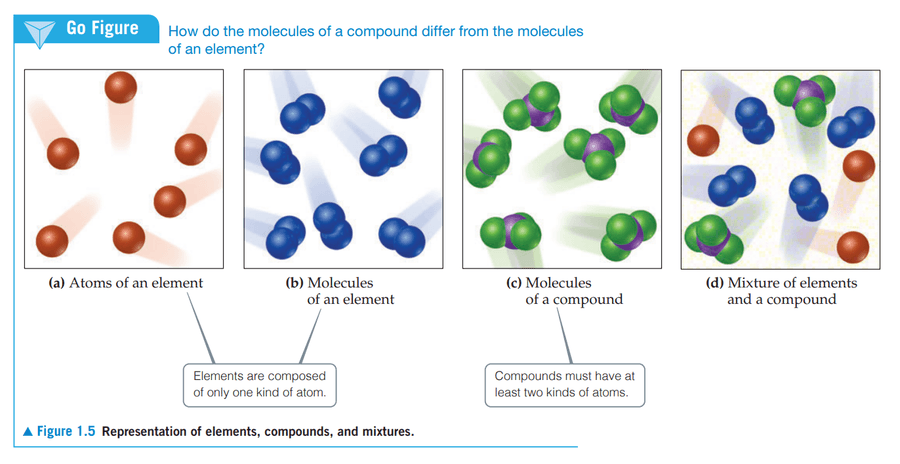
Which of the following is a compound?
Which of the following is the law of definite proportions?
Which of the following is a homogeneous mixture?
True or False: Substances can be classified as either pure substances, or a mixture?
TRUE or FALSE: Mixtures can only be homogeneous. They cannot be heterogeneous?
Which of the following is a physical property of matter?
Which of the following is a chemical property of matter?
"A" are properties of a substance the do not change regardless of whether you add more of that same substance. For instance, if you add more baking soda, the color will remain white. Therefore, color is a ____________. Whereas "B" are properties of a substance that are affected by the amount of the substance such as the case of its mass or volume. More of the substance directly impacts these properties. More, water means more volume. More baking soda means more weight.
Which of the following is a physical change?
Which of the following is a chemical change?
Which of the following is a sign of a chemical change?
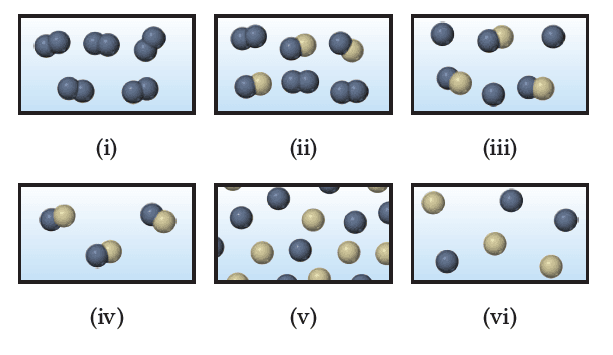
Appropriately label the following images:
The difference between filtration and distillation is that "A" is a "B" of two substances based on their "E". For example, sand can be separated from water by filtering the sand out with a filter paper. Whereas "C" is a "D" process such as boiling salt water. Due to the difference in "F" of the boiling point for salt vs water, the water will first evaporate into a gas, leaving behind the salt. If a condenser is added to create a closed system, then the evaporating water will be captured and become water again in a separate container.
TRUE or FALSE: Energy has mass and can therefore be held in our hands.
Complete the following sentence: Chromatography is a form of separation of mixtures based on their _____________________
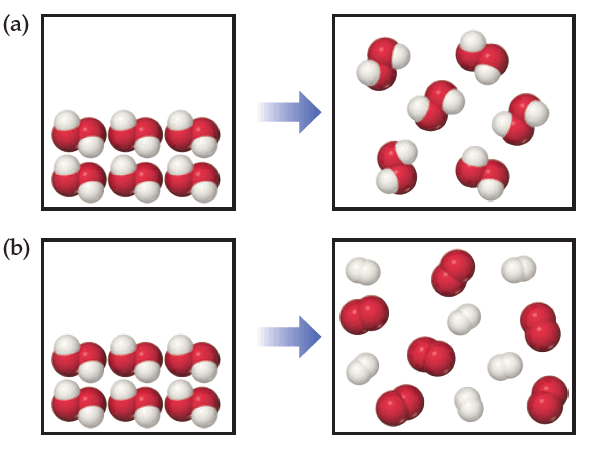
Which of the following diagrams represents a chemical change:
Match the following definitions to the corresponding terms:
What is the formula for work? (Hint: use the letter 'x' to represent multiplication. Be sure to capitalize appropriately.)
TRUE or FALSE: Kinetic energy is the energy of motion.
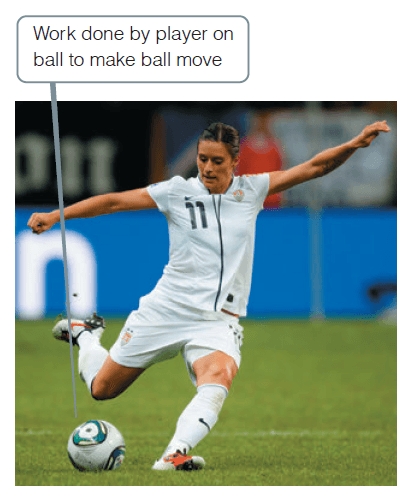
Kinetic energy can be calculated with the following formula: Ek = mv2
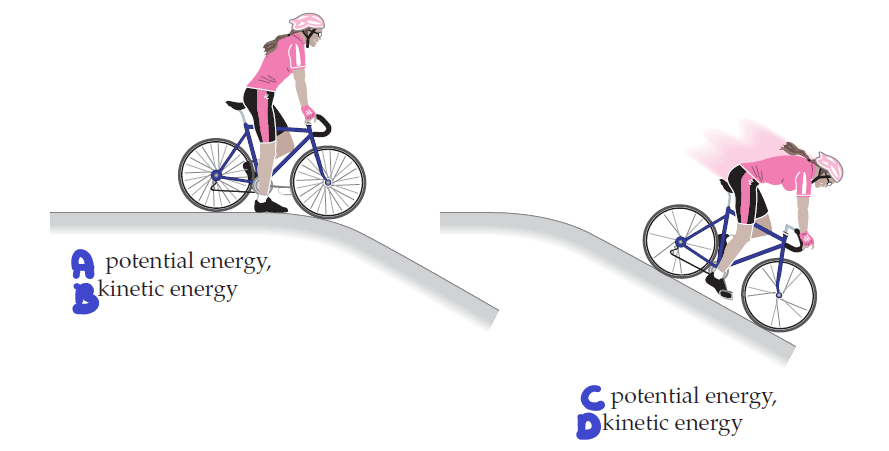
___________________ energy is, in essence, the “stored” energy that arises from the attractions and repulsions an object experiences in relation to other objects.
Match the letters to the corresponding energy experienced by the cyclist:
What is electrostatic potential energy?
The _____________ energy of a fuel is due to the potential energy stored in the arrangements of its atoms. _____________ energy is released when bonds between atoms are formed, and consumed when bonds between atoms are broken.
SI Base Units:
When nature behaves in a certain way over and over again, under all sorts of different conditions, we can summarize that behavior in a scientific law.
The order below defines the scientific method that is used to study all of science today:
Match the following prefixes with their corresponding meanings:
What is the name of the following unit? 10-3 meter
What SI unit of measurement is used to measure temperature?
What is the formula for Kelvin? (Hint: Use the symbol ` above the TAB on your keyboard in place of the degree symbol. Ex. `F, use spaces between each term such as `F = (`C × 9/5) + 32)).
A weather forecaster predicts the temperature will reach 31`C. What is this temperature in Kelvin? (Hint: Kelvin does not use the degree symbol. Always remember your units.)
What is the formula for density?
What is the SI unit for energy?
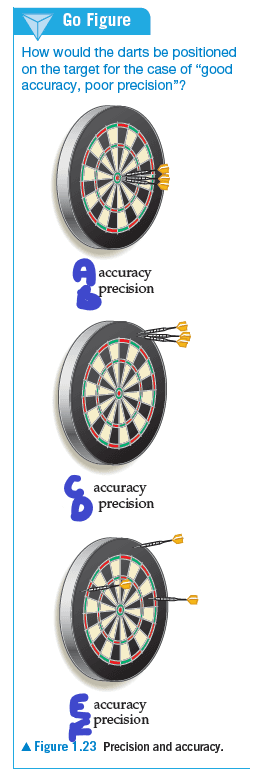
Accuracy is a measure of how closely individual measurements agree with one another. Precision refers to how closely individual measurements agree with the correct, or “true,” value.
Match the following precision or accuracy definitions:
How many significant figures are in the following number? 4.003
How many significant figures are in the following number? 6.023 x 10²³
How many significant figures are in the following number? 5000
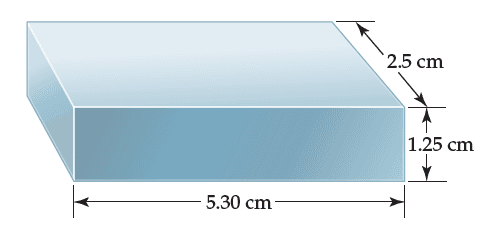
Volume = width x length x height
In chemistry, the most important thing to remember are your units of measurement. Without them, your answers will always be wrong. I certify that I will always remember to write in my units at all times throughout the entirety of the problem. I will do this for all of my chemistry classes.
Anyone who has travelled to another country and looked at the price of fuel there will experience the need to convert from one set of units to another. Most often, this conversion is between currencies but, in some cases, the standard volume may have different units—liters or gallons for example. The SI system of units provides a common ‘language’ in which to communicate measurement. ___________________ is the scientific and mathematical technique which is used to make these conversions on paper. It focuses on canceling out units rather than numbers in order to derive the desired unit of measurement.
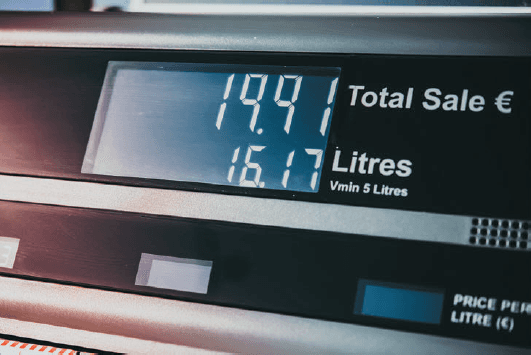
The key to dimensional analysis is using a conversion factor. This is a fraction which has the numerator being equal to the denominator, just in different units. For example, 2.54 cm is the same as 1 inch. Therefore, you can combine them and make it a fraction instead: 1in./2.54cm. This can now be used as a conversion factor for either cm, or inches. When using the conversion factor, the desired final unit must be the numerator. The beautiful part of conversion factors is they can be flipped as desired to eliminate the undesired units.

Sort each of the following measurements as either length, area, volume, mass, density, time or temperature:
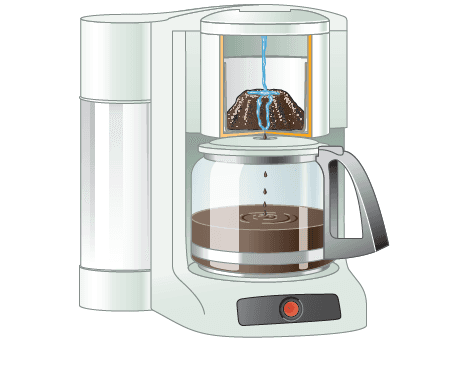
Is the separation method used in brewing a cup of coffee best described as distillation, filtration, or chromatography?
How many significant figures should be reported as the final volume after calculation?
Write the appropriate prefixes for the following measurement without exponents: ex. 7.29 x10⁶ g would be classified as 7.29 megagrams. (b) 6.1 x 10⁻¹² m =
Write the appropriate prefixes for the following measurement without exponents: ex. 7.29 x10⁶ g would be classified as 7.29 megagrams. (c) 1.828 x 10⁻³ s =
Write the appropriate prefixes for the following measurement without exponents: ex. 7.29 x10⁶ g would be classified as 7.29 Megagrams. (d) 3.523 x 10⁹ m =
Write the appropriate prefixes for the following measurement without exponents: ex. 7.29 x10⁶ g would be classified as 7.29 megagrams. (e) 9.62 x 10² m/s =
Write the appropriate prefixes for the following measurement without exponents: ex. 7.29 x10⁶ g would be classified as 7.29 megagrams. (b) 8.923 x 10⁻¹² kg =
Write the appropriate prefixes for the following measurement without exponents: ex. 7.29 x10⁶ g would be classified as 7.29 megagrams. (b) 3.552 x 10¹² L =
An exact number is a number that doesn't change with time. For example, 1kg of powder is an exact number because 1kg of powder will always be 1kg of powder. That said, classify the following as either exact-numbers of inexact-numbers:
To convert km/h to m/s, place the following dimensional analysis steps in the correct order:
The speed of light in a vacuum is 2.998 x 10⁸ m/s. Calculate its speed in miles per hour.
In March 1989, the Exxon Valdez ran aground and spilled 240,000 barrels of crude petroleum off the coast of Alaska. One barrel of petroleum is equal to 42 gal. How many liters of petroleum were spilled?
Type I agree to complete: I agree to always use my units in all of my calculations because I understand this is not a lesson in math but instead is a chemical science which are dependent on the units of measurement