


Chemical Change Review
Quiz by Robrion Sills
Feel free to use or edit a copy
includes Teacher and Student dashboards
Measure skillsfrom any curriculum
Tag the questions with any skills you have. Your dashboard will track each student's mastery of each skill.
- edit the questions
- save a copy for later
- start a class game
- automatically assign follow-up activities based on students’ scores
- assign as homework
- share a link with colleagues
- print as a bubble sheet
- Q 1/30Score 0
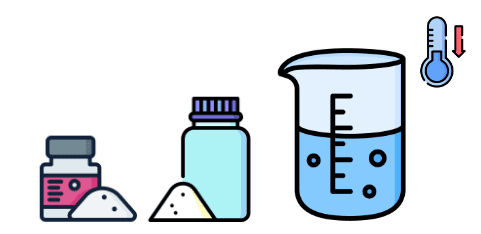
Two white powders are mixed and added to water in a beaker. The beaker immediately turns cold. A color change was not observed. Did a chemical change occur?
29No, because no gas formed.
Yes, because there was no color change.
No, because there was no color change.
Yes, because there was a change in temperature.


- Q1
Two white powders are mixed and added to water in a beaker. The beaker immediately turns cold. A color change was not observed. Did a chemical change occur?
No, because no gas formed.
Yes, because there was no color change.
No, because there was no color change.
Yes, because there was a change in temperature.
30s - Q2
What change shows a chemical change occurred?
change in temperature
gas formation
change in color
precipitate formation
30s - Q3
In an experiment, iron reacts with copper (II) sulfate to form copper and iron (II) sulfate, as shown. Which statement best describes what is occurring in the chemical reaction?
A change in state of matter is taking place in the reaction.
A change in chemical composition is taking place in the reaction.
A change in mass of the reactants is taking place in the reaction.
A change in volume of liquid is taking place in the reaction.
30s - Q4
Which would be considered evidence that a chemical change has occurred?
A different shape is formed.
A change of state occurs.
A change in size occurs.
A gas is produced.
30s - Q5
Which would be considered evidence that a chemical change has occurred?
A different shape is formed.
A change in size occurs.
A precipitate is formed.
A change of state occurs.
30s - Q6
A student observes two unknown substances labeled A and B. He combines the two unknown substances to make a substance labeled C. The table shows his observations. Which observation shows a chemical change occurred?
Substance C was a liquid.
Substance C was a gas.
Substance C was solid.
Substance C showed a change in temperature.
30s - Q7
Three reactions are observed in a lab, as shown. What is produced by the bubbles?
air
substance
precipitate
gas
30s - Q8
Three reactions are observed in a lab, as shown. The solid that is produced when the two liquids are mixed is what?
air
substance
gas
precipitate
30s - Q9
Use the model below and select the correct answer choice.
Two substances are being separated.
Two substances are being combined.
No new substance is formed.
No reaction is taking place.
30s - Q10
Use the model below and select the correct answer choice.
No reaction is taking place.
A new product is made.
No new substance is formed.
Two substances are being separated.
30s - Q11
A student leaves some nails outside in the backyard. After thirty days, the student observes that the nails have rusted. The pictures show the nails.
The student believes that a chemical change has occurred. Which best describes if the student is correct?
Yes, a chemical change occurred because a new substance was produced.
Yes, a chemical change occurred because the nails did not change state.
No, a physical change occurred because the nails maintained their shape.
No, a physical change occurred because the surface of the nails changed color.
30s - Q12
A student observes two unknown substances labeled A and B. He combines the two unknown substances to make a substance labeled C. The table shows his observations. Which observation shows a chemical change occurred?
Substance C was a gas.
Substance C was solid.
Substance C showed a change in odor or smell.
Substance C was a liquid.
30s - Q13
What does column A show?
Chemical reactions, because they form new substances
Both columns are physical reactions.
Physical reactions, because they create new forms of the same substance
Both columns are chemical reactions.
30s - Q14
What does column B show?
Chemical reactions, because they form new substances
Physical reactions, because they create new forms of the same substance
Both columns are physical reactions.
Both columns are chemical reactions.
30s - Q15
The picture below shows an experiment in which a student mixed two clear liquids together. The student can conclude that a chemical change occurred because —
a solid precipitate formed when the two liquids were mixed.
one substance was more dense than the other.
there was no change in mass during the experiment.
there was no temperature change during the experiment.
30s


