Tag the questions with any skills you have. Your dashboard will track each student's mastery of each skill.
Give this quiz to my class
Q 1/52
Score 0
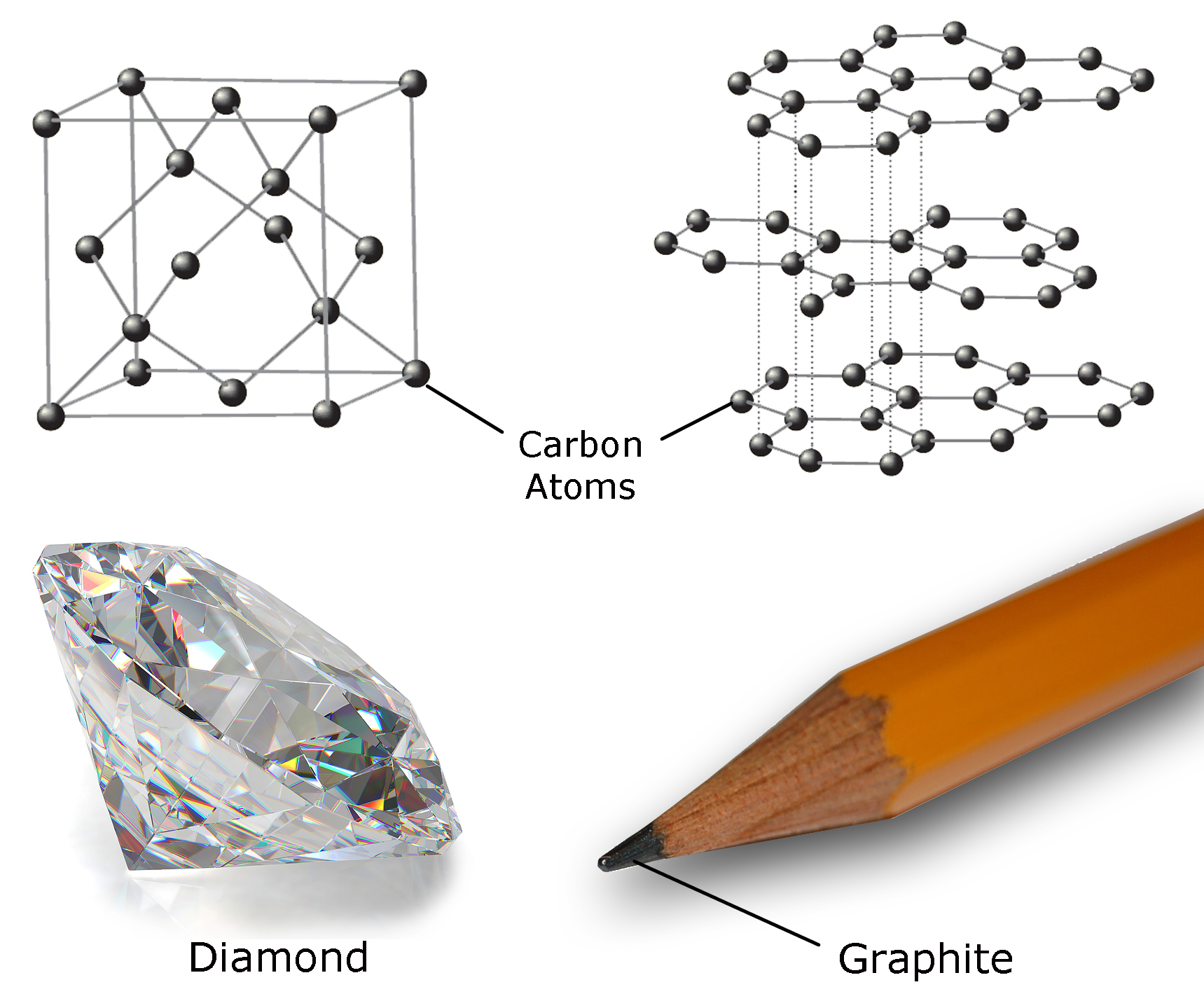
Graphite, charcoal, and diamonds are all forms of carbon. This demonstrates that different forms of one element can exist. These are called what?
30
corundums
isotopes
Allotropes
Q 2/52
Score 0
Green jello, plastic, stretchy polymers that have particles with little motion, keep their shape, and do not have regular patterns built into their molecules are called this?
30
crystaline solids
amorphous solids
liquids
52 questions
Q.
Graphite, charcoal, and diamonds are all forms of carbon. This demonstrates that different forms of one element can exist. These are called what?
1
30 sec
Q.
Green jello, plastic, stretchy polymers that have particles with little motion, keep their shape, and do not have regular patterns built into their molecules are called this?
2
30 sec
Q.
A temperature at which a liquid turns to gas or vapor is called what?
3
30 sec
Q.
This is a slow process, like a drying towel, that happens at the surface where a liquid turns to gas/vapor.
4
30 sec
Q.
This energy is a result of movement, not of just being higher up in the atmosphere.
5
30 sec
Q.
What is pushing on a liquid or solid by the gas form of that very substance at the boiling point.
6
30 sec
Q.
At this temperature, a solid becomes liquid.
7
30 sec
Q.
Dry ice (frozen carbon dioxide) absorbs heat and turns directly to a gas in a process called this.
8
30 sec
Q.
The process of a substance turning to a gas by boiling, evaporation, or sublimation is called this.
9
30 sec
Q.
This device measures atmospheric pressure.
10
30 sec
Q.
A solid that is called a crystal shows what kind of pattern in the molecules.
11
30 sec
Q.
What kind of solid is a snowflake, salt or a diamond?
12
30 sec
Q.
What is atmospheric pressure at sea level in SI units?
13
30 sec
Q.
List from fastest to slowest, the amount of movement because of the kinetic theory.
14
30 sec
Q.
What temperature does all particle motion stop?
15
30 sec
Q.
Why does pressure decrease when altitude increases?
16
30 sec
Q.
What kinds of collisions do gas particles have so no kinetic energy is lost?
17
30 sec
Q.
Newton's First law says that gas particles will travel in this path.
18
30 sec
Q.
What are these measuring, 1 atm, 760 mm Hg, 101.3 kPa?
19
30 sec
Q.
What is the point called that is the temperature at 1 atmosphere pressure?
20
30 sec
Q.
As temperature increases, kinetic theory says kinetic energy will do what?
21
30 sec
Q.
What is the smallest, most simple repeating pattern in a crystal lattice?
22
30 sec
Q.
What pattern do gas particles move at 1700 km/hr?
23
30 sec
Q.
Does kinetic theory work in a vacuum?
24
30 sec
Q.
What temperature is the pressure at STP 1 atmosphere?
25
30 sec
Q.
Which phase of matter has no defined shape, but a definite volme?
26
30 sec
Q.
Attractive forces keep this phase of matter held together?
27
30 sec
Q.
Evaporation is a slow process that changes the temperature by doing this?
28
30 sec
Q.
What is it called when two processes go back and forth?
29
30 sec
Q.
Gases and liquids and loose solid particles can flow and are the motion is also called this.
30
30 sec
Q.
An inverse relationship says that as one variable goes up, what happens?
31
30 sec
Q.
During a phase change, what happens to the temperature?
32
30 sec
Q.
Are the particles in a solid moving?
33
30 sec
Q.
Increasing vapor pressure will do what to the boiling point?
34
30 sec
Q.
Which has a higher melting point, ionic or covalent/molecular compounds?
35
30 sec
Q.
Which law is P1V1 = P2V2?
36
30 sec
Q.
Which law is this V1 / T1 = V2 / T2?
37
30 sec
Q.
Which law is this P1 / T1 = P2 / T2?
38
30 sec
Q.
Which law is this P1V1 / T1 = P2V2 / T2 ?
39
30 sec
Q.
Which law has all 4 variables in it?
40
30 sec
Q.
Which law is this PV = nRT?
41
30 sec
Q.
Why are gases easily compressed?
42
30 sec
Q.
On a hot day, once a raft is placed in a cold river, guides pump more air into the raft. Why do they add air?
43
30 sec
Q.
When a gas is compressed, if the pressure inside is higher than outside the container, what happens when the container opens?
44
30 sec
Q.
What are "ideal gases"?
45
30 sec
Q.
Can ideal gases really exist?
46
30 sec
Q.
Dalton's Law does not calculate pure gases, it calculates the contributions of what in the mixtures?
47
30 sec
Q.
At constant volume and temperature Dalton's pressure is calculated by doing what?
48
30 sec
Q.
Which direction do particles move during diffusion?
49
30 sec
Q.
What happens during effusion?
50
30 sec
Q.
What is the relationship that describes effusion rates?