recognize that chemical formulas are used to identify substances and determine the number of atoms of each element in chemical formulas containing subscripts
describe the structure of atoms, including the masses, electrical charges, and locations, of protons and neutrons in the nucleus and electrons in the electron cloud
interpret the arrangement of the Periodic Table, including groups and periods, to explain how properties are used to classify elements
Track each student's skills and progress in your Mastery dashboards
Give this quiz to my class
Q 1/28
Score 0
A student mixes two clear liquids. After a few minutes, a white powder can be seen settling at the bottom of the test tube. From these observations the student can conclude that the two clear liquids–
30
have been converted to the gaseous state.
have been stored too long and are no longer good.
were pure substances before they were mixed.
have combined to form a new substance.
Q 2/28
Score 0
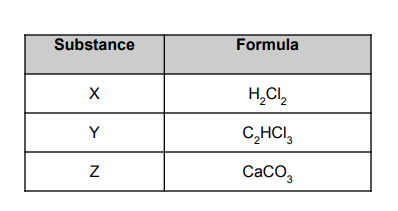
This table shows the chemical formulas for three substances that contain
some of the following elements: hydrogen (H), chlorine (Cl), carbon (C),
calcium (Ca), and oxygen (O). Which conclusion is supported by the information in the table?
30
Substance Y has more carbon atoms than substance Z.
Substance X has fewer atoms of hydrogen than substance Y.
Substance Z has fewer calcium atoms than substance X.
Substance X has more atoms of chlorine than substance Y.
28 questions
Q.
A student mixes two clear liquids. After a few minutes, a white powder can be seen settling at the bottom of the test tube. From these observations the student can conclude that the two clear liquids–
1
30 sec
8.5.E: Matter and Energy
Q.
This table shows the chemical formulas for three substances that contain
some of the following elements: hydrogen (H), chlorine (Cl), carbon (C),
calcium (Ca), and oxygen (O). Which conclusion is supported by the information in the table?
2
30 sec
8.5.D: Matter and Energy
Q.
Which of the following would indicate a new substance has been formed?
3
30 sec
8.5.E: Matter and Energy
Q.
The table lists the characteristics of four materials. Which sample is most likely classified as a metal?
4
30 sec
Q.
Based on the numbers of subatomic particles, which of the following atoms will have a positive charge?
5
30 sec
8.5.A: Matter and Energy
Q.
An atom of an element has 12 protons. How many electrons does the atom have if it has a charge of positive 2 (+2)?
6
30 sec
8.5.A: Matter and Energy
Q.
Which of the following is a property of nonmetals?
7
30 sec
Q.
A chart with the densities of four metals is shown. Students were given a sample of an unknown metal and told to determine its density. They measured its mass as 26.4 g and its volume as 3.0cm3. Use the chart to determine which metal the students were given.
8
30 sec
Q.
How many different elements are in 2NaCHONaC
9
30 sec
8.5.D: Matter and Energy
Q.
10
30 sec
8.5.D: Matter and Energy
Q.
An atom has 25 protons, 30 neutrons, and 25 electrons. What is the charge of the atom’s nucleus?
11
30 sec
8.5.A: Matter and Energy
Q.
The diagram shows an atom. How many protons are in the atom?
12
30 sec
8.5.B: Matter and Energy
Q.
A silver ring reacts with compounds containing sulfur in the air to form silver sulfide, a black substance that makes up the tarnish on the surface of silver objects. To remove the tarnish from the ring, students placed it in a pan lined with aluminum foil and added hot water. Baking soda was added to the hot water and stirred. Students made observations about the process. Which observation of this process provides evidence of a chemical reaction?
13
30 sec
8.5.E: Matter and Energy
Q.
What is the total number of protons, neutrons, and electrons in a cadmium, Cd, atom that has a mass number of 112?
14
30 sec
8.5.A: Matter and Energy
Q.
Which is NOT the correct formula to determine the number of neutrons in an atom?
15
30 sec
8.5.A: Matter and Energy
Q.
The pair of elements with the MOST similar chemical and physical properties are
16
30 sec
8.5.C: Matter and Energy
Q.
Coal contains carbon and other elements. Carbon dioxide forms when coal burns in the presence of oxygen. Which of these is the best evidence that a chemical reaction occurs when coal burns?
17
30 sec
8.5.E: Matter and Energy
Q.
Look at the model. How many valence electrons are in the atom shown?
18
30 sec
8.5.B: Matter and Energy
Q.
Very reactive metals
19
30 sec
8.5.C: Matter and Energy
Q.
elements that are generally gases or brittle dull-looking solids, they are poor conductors of heat and electricity
20
30 sec
8.5.C: Matter and Energy
Q.
Element R and Element Q have the same number of valence electrons. These elements both have similar chemical behavior, but Element R has fewer energy levels than Element Q. Which statement best describes the positions of the two elements in the periodic table?
21
30 sec
8.5.C: Matter and Energy
Q.
Inert gases (at room temp. and standard pressure); doesn't usually react with other elements, 8 valence electrons;
22
30 sec
8.5.C: Matter and Energy
Q.
Which two elements on the periodic table are in the same period?
23
30 sec
8.5.C: Matter and Energy
Q.
When trying to identify an unknown element, a scientist determines what other elements the unknown element reacts with chemically. Which property of the unknown element determines the other elements it reacts with?
24
30 sec
8.5.B: Matter and Energy
Q.
Which of the following is in the same period as phosphorus?
25
30 sec
8.5.C: Matter and Energy
Q.
Which of these formulas contain equal numbers of nitrogen atoms?
26
30 sec
8.5.D: Matter and Energy
Q.
The atoms of a certain element each contain 11 protons and 1 valence electron. Which statement correctly identifies this element and describes its chemical reactivity?
27
30 sec
8.5.B: Matter and Energy
Q.
Which statement correctly describes the location and charge of the electrons in an atom?