Loading...

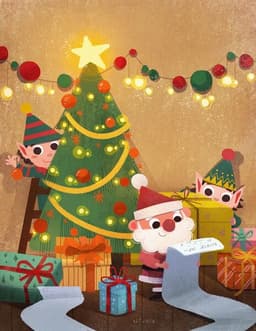
Christmas famous stories and songs
Quiz by Kultida Kodlakpet
Customize this quiz to suit your class
Instantly translate to 100+ languages
Tag the questions with any skills you have. Your dashboard will track each student's mastery of each skill.
Give this quiz to my class
Santa, ………… me if you're really there

to
tell
impart
say
Don't make ………… fall in love again

I
you
him
me
Santa, ………… me if you're really there

Don't make ………… fall in love again

If he won't be here next ………

'Cause I can't ………… it all away

……….. Christmas, I gave you my heart

I'll give it to someone …………

Santa Doesn't ………… you like I do
Kiss all your ………… away, babe
Or if it's true love that he thinks of
So next Christmas
I'm not all……………babe
Oh, I wanna have him beside me like oh-oh-ohOn the 25th by that …………..place, oh-oh-oh
Santa, tell me if you're very there Don't make me fall in love again
Thought we belong together
At least that's what you say
This year, to save me from dear I'll give it to someone special, oh, yeah
I no all of your favorite songsPick up each time you call
So why can't I be the one
I just want you to tell me that you feel the same
I don't think I'm gonna make it throughout the winter, babe
 Can you make me a 40 question quiz from the following information? he story of coffee has all the elements of a bestselling novel, such as chance happenings, luck, political intrigue, the high seas and great wealth. With research, you will find many stories and dates when this happened and dates when that happened. Often these stories and dates will conflict with each other. Whatever the history, coffee has become one of the most important trading commodities in the world. Being second only to oil and being one of the most popular beverages, behind tea, beer and of course, water. Coffee growing is a very labour-intensive operation and it provides important trading income for many nations and people throughout the world. The most famous story about the origin of coffee is the story of Kaldi a goat herder from Ethiopia. It is said he noticed that his goats became very active after eating the red berries of a certain plant. He tried a few himself and noticed the stimulating effect of the berries. It is then said that monks started drinking a beverage made from the berries to help stay awake for the prayers; this would have been around 1000 AD. Over the next few hundred years the Arab world started to use the berries as a beverage and coffee was born. In those early years, coffee was mostly confined to the Muslim world with the export of coffee plants and seeds banned. But coffee could not be hidden forever so eventually coffee was introduced to Constantinople and coffee houses were opened in 1475. European traders then brought coffee back to Europe by approximately 1600. At first, coffee was met with a hostile reaction, with some Christians calling it the ‘Devil’s Drink’ and asking Pope Vincent III to ban the beverage. He tried coffee and liked it so much that he is claimed to have said “This beverage is so delicious that it would be a sin to let only misbelievers drink it! Let’s defeat Satan by blessing this beverage, which contains nothing objectionable to a Christian!” Coffee shops sprung up in every city and became an important social and networking place to meet. This tradition continues today with the French word for coffee being ‘Café’. Coffee is said to have changed the social fabric of society by providing a popular non-alcoholic alternative to beer and wine. For the first time in recorded history people were not drunk all the time. Coffee today is grown and enjoyed worldwide and is one of the few crops that small farmers in third-world countries can profitably export. The coffee plant is a tree that is pruned to grow to a height of approximately three metres. This makes cultivating the beans easier as most of the beans are handpicked. The plant has white flowers similar to jasmine that grow in clusters and set to become red cherry-like fruit; beneath the red skin are two pips which are the coffee beans. Because the berries ripen at varying times the fruit must be handpicked to select only those beans ripe for harvest. This requires the picker to pick from the same plant many times and is very labour intensive. This is why coffee is grown in developing countries where labour is cheaper and foreign income is needed. Coffee plants grow best in a mountain tropical climate between the Tropic of Capricorn and the Tropic of Cancer. This mountainous land is another reason why machine picking is very difficult and hand picking is preferred. There are two main species of coffee grown today: Coffee Arabica. Coffee Robusta. Robusta grows at lower altitudes and produces a larger crop than Arabica; therefore, it is cheaper to produce Arabica is the most popular and generally considered to give superior flavour. Most Robusta is grown in Asia and Africa. About 75% of coffee grown is Arabica and 25% Robusta. Robusta is more often used as a blend with Arabica rather than a standalone coffee; used as a filler coffee in the production of instant or to add extra caffeine to an Arabica coffee for the European markets. Robusta is higher in caffeine than Arabica, but the flavour is not as palatable as the more popular Arabica bean. Coffee is produced in about 60 countries throughout the world but production is dominated by three countries producing approximately half the crop: Brazil, Vietnam and Colombia.Where Is It? Russia is a very big country. It is the largest country in the world almost twice as big as the United States. Russia is part of both Europe and Asia. Moscow is the capital of Russia. It is a big city in the European part of the country. More than twelve million people live there. The Russian president lives in a famous group of buildings in Moscow. People. Most people in Russia live and work in cities. The main language is Russian. In the country, jobs have to do with the land and the sea. For example, many people fish, mine oil and coal, and cut trees for wood. Sports such as soccer and ice hockey are popular in Russia. Russia is famous for music and a kind of dance show called ballet. Swan Lake is a famous Russian ballet. Land. The land in Russia is mainly low flatlands, high flatlands, and mountains. The deepest lake in the world, Lake Baikal, is in Russia. Russia has frozen flatlands in the north and wide grassy lands in the south. In between are huge forests. Russia is a cold country, and it is home to the coldest village in the world. But many places in Russia also have beautiful summers. History. In the past, czars, or emperors, ruled Russia. During that time, the peasants in Russia were unhappy. They didn't like the way the czars ruled the people. They fought in 1917 to change their country's ways. After the fight, Russia took control of a group of other nearby countries. Together they formed the Union of Soviet Socialist Republics (USSR). The USSR had many problems, so it broke up in 1991. Today, Russia has a president. Celebrations. Many people celebrate Christmas and Easter in Russia. On Easter, they eat cakes and paint hard-boiled eggs. Russian Easter egg Russians also have a holiday to celebrate the end of winter. For this holiday, people eat pancakes with butter. They also have fun with sleigh rides and snowball fights. Food. A popular soup in Russia is famous around the world. People make the soup from beets and other vegetables. Beets are red, so the soup also has a red color. Many Russians like a homemade drink. The drink has a sour flavor. Conclusion Russia is home to both crowded cities and wild forests. Russia has a long, rich history and many interesting things to do. The Russian people value the traditions of their beautiful homeland.Create multiple choice questions using the following information: In November, Mrs. Baker has Holling read The Tempest. Despite his preconceptions, Holling is captivated by all the "good stuff" in the play, especially the cussing, which he decides to learn by heart. He figures that Mrs. Baker could not have read the play herself; if she had, she certainly would not have let him have it. Holling is amazed when he discovers that his teacher not only has read the play, but she knows the bad parts as well. Mrs. Baker gives Holling a one-hundred-and-fifty question test on The Tempest, and assigns him to read the play again, telling him "there is a lot more to (it) than a list of colorful curses." The deadline set by Holling's classmates for him to bring them cream puffs arrives, but although Holling's father's company has won the Baker's Sporting Emporium contract, he refuses to extend an advance on his son's allowance. Desperate, Holling goes to Goldman's Best Bakery, offering to work for the money he lacks to buy the cream puffs. Coincidentally, Mr. Goldman, who is active in Long Island's Shakespeare Company, needs a boy to perform in their upcoming Extravaganza, and because of his work with Mrs. Baker, Holling fits the bill. Mr. Goldman gives Holling the required number of cream puffs in exchange, but sadly, while the students are at recess, Caliban and Sycorax, the escaped rats who inhabit the classroom walls and ceiling, come out and decimate the treats. Somehow, the disaster is blamed on Holling; he must clean up the mess, and his classmates decree that he still owes them cream puffs. The next Wednesday, Holling brings five cream puffs to school, which is all he can afford. In addition to facing his classmates' ire, he has to deal with the fact that, in the Shakespeare Company Holiday Extravaganza, he must play the part of Ariel, who is a fairy, and wear yellow tights with white feathers on an unmentionable part of his anatomy; "not a good thing for a boy from Camillo Junior High." To Holling's surprise, just when things are at their darkest, Mrs. Baker comes through for him, bringing cream puffs for the students on his behalf. That afternoon, Mrs. Baker and Holling discuss The Tempest, and whether or not Caliban, the "monster," deserves a happy ending. Holling argues that, as the antagonist, he does not, but Mrs. Baker muses whether Shakespeare might have shown, even in a monster, the capacity of humankind to use defeat to grow. Mrs. Bigio stumbles into the classroom at this point, emitting sounds of indescribable sadness; she has just learned that her husband has been killed in a futile reconnaissance mission in Vietnam. Two nights after his funeral, the Catholic Relief Agency, which houses Vietnamese refugees, including Holling's classmate Mai Thi, is the target of a hate crime. Holling reflects that Shakespeare, with his happy endings for nearly everyone in The Tempest, is wrong. He says, "sometimes, there isn't a Prospero to make everything fine...and...the quality of mercy is strained." In December, Camillo Junior High is awash in "signs of the season." Mrs. Baker, however, does not share the holiday spirit, but Holling is too absorbed with his problems with the Shakespeare Holiday Extravaganza to wonder why. As always, Holling seeks help from his family, but to no avail; his mother comments insipidly that his embarrassing costume is cute, his father tells him to wear it to please Mr. Goldman, who might one day need an architect, and his sister warns him that if news of his role gets to the high school, no one better find out they are related. The only thing that prevents December from being a total disaster is Mrs. Baker's announcement that Mickey Mantle will be signing autographs at the Baker Sporting Emporium. Unfortunately, Mrs. Baker also tells the class about Holling and the Shakespeare Extravaganza, and encourages the students to attend both events. Holling's classmates are intensely curious about his role as Ariel, whom he euphemistically describes as "a warrior." Mr. Goldman tells Mrs. Baker that Holling needs "some practice on interpretation", and she practices with him, playing the part of Prospero. Mrs. Baker is a terrific reader, and when she and Holling rehearse the part where Prospero releases Ariel from bondage, Holling is inspired, realizing what it means to be free "to create his own happy ending." On the night of the performance, Mrs. Baker, Mrs. Bigio, Danny Hupfer and his parents, Meryl Lee, and Mai Thi are in the audience to support Holling, unlike his own parents, who do not want to miss the Bing Crosby Christmas Special on television. Holling executes his part with such passion that his classmates are moved to tears, and do not even notice what he is wearing. When the show is over, Holling, finding the dressing room locked, rushes outside, still in costume, where his father is supposed to be waiting to take him to Baker's Sporting Emporium to see Mickey Mantle. Typically, his father is not there, and Holling, frantic, flags down a bus and begs the driver to take him to the Emporium. The driver takes pity on him and complies, getting him to the Emporium just in time, but when Holling approaches Mickey Mantle for an autograph, the famous player looks derisively at his costume and snaps rudely, "I don't sign baseballs for kids in yellow tights." Danny Hupfer witnesses this snub, and loyally returns his own autographed baseball to Mickey Mantle, saying, "I guess I don't need this after all." Holling and Danny leave together in silence, smarting because "when gods die, they die hard." During the days remaining until holiday break, Mrs. Bigio is especially cantankerous; her cafeteria cooking is unappetizing at best, and her comments to the students are impatient and unkind. Holling, remembering Mrs. Bigio's sadness when she received the news of her husband's death, does not complain, but he is bewildered at the sheer desolation he witnesses when Mrs. Bigio bitterly tells Mai Thi that she "shouldn't even be here...a queen in a refugee home while American boys are sitting in swamps on Christmas Day." After school on the last day before break, Mrs. Baker gives Holling, Danny Hupfer, and Doug Swieteck each a new baseball and mitt, and sends them to the gym, where, to their delight, they meet Joe Pepitone and Horace Clark in their Yankee uniforms, and receive tickets to Opening Day at the Stadium. Mrs. Baker's family knows what happened with Mickey Mantle, and wants to make it up to the boys. The next day, President Johnson declares a Christmas ceasefire in Vietnam, and the holiday season begins in earnest.The Civil Rights Movement in the United States was a pivotal period in history that aimed to secure equal rights and end segregation and discrimination against Black Americans. Let's explore some key aspects of this important movement: Which movement fought for equal rights for Black Americans? The Civil Rights Movement What was one of the main goals of the Civil Rights Movement? Ending racial segregation and discrimination Who was a prominent leader in the Civil Rights Movement known for his "I Have a Dream" speech? Martin Luther King Jr. Where did the famous bus boycott led by Rosa Parks take place? Montgomery, Alabama What event marked the beginning of the Civil Rights Movement? Rosa Parks' bus boycott Which organization was founded by Dr. Martin Luther King Jr. to fight against racial segregation and discrimination? SCLC (Southern Christian Leadership Conference) The Civil Rights Act of 1964 aimed to: End racial segregation What peaceful protest did Dr. Martin Luther King Jr. lead in Washington D.C.? March on Washington Which event led to the passage of the Voting Rights Act of 1965? Bloody Sunday in Selma Who was the first Black student to desegregate an all-white school in the South? Ruby Bridges What impact did the Civil Rights Act of 1964 have on U.S. society? Ended racial segregation in public places The Civil Rights Movement inspired other movements for equality, including the: Women's Rights Movement Which city was the location of a series of nonviolent protests led by Dr. King in 1963? Birmingham The Civil Rights Act of 1968 aimed to prevent: Discrimination in housing What was the purpose of the sit-in movement during the Civil Rights Movement? To protest against racial segregation Who inspired the Montgomery Bus Boycott by refusing to give up her seat to a white passenger? Rosa Parks What form of protest did students use during the Civil Rights Movement to challenge segregation at lunch counters? Sit-ins Which Supreme Court case declared state laws establishing separate public schools for Black and White students unconstitutional? Brown v. Board of Education In what state did the famous Selma to Montgomery March for voting rights take place in 1965? Alabama What strategy did Civil Rights activists use to draw attention to their cause, as exemplified by the Birmingham Campaign? Nonviolent direct actionChristmasChristmas!110.31.b.17.C Topic: Reading/Vocabulary Development