Tag the questions with any skills you have. Your dashboard will track each student's mastery of each skill.
Give this quiz to my class
Q 1/16
Score 0
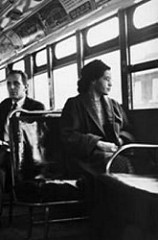
In 1955, after Rosa Parks was arrested for refusing to give up her seat on a city bus, Dr. Martin L. King led a boycott of city busses. After 11 months the Supreme Court ruled that segregation of public transportation was illegal.
30
Montgomery Bus Boycott, 1955
Q 2/16
Score 0
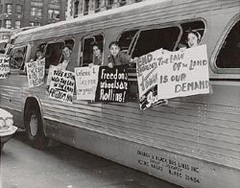
Group of civil rights workers who took bus trips through southern states in 1961 to protest illegal bus segregation
30
Freedom Riders, 1961
16 questions
Q.
In 1955, after Rosa Parks was arrested for refusing to give up her seat on a city bus, Dr. Martin L. King led a boycott of city busses. After 11 months the Supreme Court ruled that segregation of public transportation was illegal.
1
30 sec
Q.
Group of civil rights workers who took bus trips through southern states in 1961 to protest illegal bus segregation
2
30 sec
Q.
southern state laws designed to enforce segregation of blacks from whites (grandfather clause, poll tax, literacy tests, separate but equal, etc)
3
30 sec
Q.
Martin Luther King protest techniques that did not involve violence of any kind
4
30 sec
Q.
Statement in which the Supreme Court ruled that segregation of public facilities was legal.
5
30 sec
Q.
black students sat at white diner table
6
30 sec
Q.
U.S. Baptist minister and civil rights leader. A noted orator, he opposed discrimination against blacks by organizing nonviolent resistance and peaceful mass demonstrations. He was assassinated in Memphis, Tennessee. Nobel Peace Prize (1964)
7
30 sec
Q.
A speech given by Martin Luther King, Jr. at the demonstration of freedom in 1963 at the Lincoln Memorial. It was an event related to the civil rights movement of the 1960's to unify citizens in accepting diversity and eliminating discrimination against African-Americans
8
30 sec
Q.
Supreme Court ruling reversing the policy of segregation from Plessy v Ferguson, declaring that seperate can never be equal and a year later ordered the integration of all public schools with all deliberate speed
9
30 sec
Q.
August - 200,000 demonstrators converged on the Lincoln Memorial to hear Dr. King's speech and to celebrate Kennedy's support for the civil rights movement. (putting pressure on the federal government to pass civil rights legislation)
10
30 sec
Q.
A federal law that authorized federal action against segregation in public accommodations, public facilities, and employment.
11
30 sec
Q.
A law designed to help end formal and informal barriers to African American suffrage. Under the law, hundreds of thousands of African Americans were registered and the number of African American elected officials increased dramatically. Encouraged greater social equality and decreased the wealth and education gap
12
30 sec
Q.
protests by black college students, 1960-1961, who took seats at "whites only" lunch counters and refused to leave until served; in 1960 over 50,000 participated in sit-ins across the South. Their success prompted the formation of the Student Non-Violent Coordinating Committee.
13
30 sec
Q.
American civil rights lawyer, first black justice on the Supreme Court of the United States; an advocate for the rights of minorities and the poor.
14
30 sec
Q.
United States civil rights leader who refused to give up her seat on a bus to a white man in Montgomery (Alabama) and so triggered the national civil rights movement (born in 1913)
15
30 sec
Q.
1st group of black students who were able to attend an all white school in Little Rock, Arkansas because President Eisenhower used the military to enforce the Brown v. Board of Education decision.