Loading...

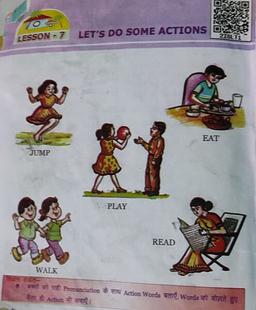
Class 1, Lesson 7, Let's Do Some Action
Quiz by Bindu Srivastava
Customize this quiz to suit your class
Instantly translate to 100+ languages
Tag the questions with any skills you have. Your dashboard will track each student's mastery of each skill.
Give this quiz to my class
इस Action को क्या कहते है?

Walking
Sleeping
Reading
Jumping
इस Action को क्या कहते है?

Eating
Talking
Walking
Reading
इस Action को क्या कहते है?

इस Action को क्या कहते है?

इस Action को क्या कहते है?

इस Action को क्या कहते है?

इस Action को क्या कहते है?

इस Action को क्या कहते है?

इस Action को क्या कहते है?

इस Action को क्या कहते है?

इस Action को क्या कहते है?

इस Action को क्या कहते है?

 Class 1, General EnglishVerbsSagutin ang mga tanongbasics of englishWord dictation. 10 class. Lesson 7. Game over. Word list (Part 1)RPMS Quiz: Quality vs. Efficiency 1. A teacher spends five hours creating a highly interactive digital game for a single 40-minute lesson. This is an example of prioritizing: • A) Quality over Efficiency • B) Efficiency over Quality • C) Administrative Competence • D) Resource Management • Hint: The focus is on high-level engagement, but the time investment is very high. 2. Which of the following best describes "Efficiency" in the context of the RPMS? • A) Submitting all MOVs and reports on or before the deadline with minimal errors. • B) Ensuring 100% of students pass the quarterly examination. • C) Creating the most aesthetically pleasing portfolio in the department. • D) Conducting home visits for every single student in a class of 50. • Hint: Look for the option that emphasizes timeliness and resource use. 3. Using a "template" or a "reusable slide deck" for lesson planning is a strategy to improve: • A) Efficiency • B) Instructional Diversity • C) Subject Matter Mastery • D) Classroom Discipline • Hint: Templates reduce the time spent on repetitive formatting. 4. If a teacher provides detailed, personalized feedback to every student but submits the grades two weeks late, they have achieved: • A) High Quality, Low Efficiency • B) Low Quality, High Efficiency • C) High Quality, High Efficiency • D) Low Quality, Low Efficiency • Hint: The work itself is excellent, but the timing is poor. 5. Which tool improves Efficiency without sacrificing the Quality of assessment data? • A) Automated Google Forms for multiple-choice quizzes. • B) Giving everyone a passing grade to save time on checking. • C) Writing long paragraphs of feedback on 200 paper-based essays. • D) Skipping assessments entirely to finish the syllabus faster. • Hint: Look for a balance where technology handles the "busy work." 6. When discussing Quality in your RPMS portfolio, which "Means of Verification" (MOV) is most appropriate? • A) Sample of student work with constructive teacher comments. • B) A logbook showing you arrived at school at 7:00 AM daily. • C) A certificate for attending a 1-hour webinar. • D) A photo of your organized teacher's cabinet. • Hint: Quality is evidenced by the impact on student learning. 7. The concept of "Doing the right things" (Effectiveness) represents: • A) Quality • B) Efficiency • C) Speed • D) Compliance • Hint: "Doing the right things" is about results; "Doing things right" is about process. 8. How does "Efficiency" help a teacher maintain "Quality" in the long run? • A) It prevents burnout by optimizing workload, leaving energy for creative teaching. • B) It allows the teacher to take more side jobs. • C) It ensures the teacher never has to talk to parents. • D) It proves that the teacher is smarter than their peers. • Hint: Consider the relationship between teacher well-being and performance. 9. If a teacher's RPMS rating for Quality is 5 (Outstanding) but Efficiency is 2 (Fair), what is the most likely reason? • A) The teacher produces excellent work but often misses deadlines. • B) The teacher is very fast but makes many mistakes in their reports. • C) The teacher is both slow and produces poor results. • D) The students are failing despite the teacher being very organized. • Hint: Check the gap between the high-standard output and the slow delivery. 10. What is the ultimate goal of balancing Quality and Efficiency in the PPST-RPMS? • A) To achieve sustainable professional excellence that benefits the learners. • B) To get a higher salary increase only. • C) To impress the School Head during the observation. • D) To finish the school year with the least amount of work possible. • Hint: It's about long-term growth for both teacher and student. ________________________________________ Answer Key: 1. A | 2. A | 3. A | 4. A | 5. A | 6. A | 7. A | 8. A | 9. A | 10. A ________________________________________1. Which factor is most crucial to verify first when selecting an ICT resource for instruction? A) Content alignment with the textbook B) Alignment with learning objectives C) The resource's popularity among peers D) Cost-effectiveness of the resource 2. When evaluating ICT resources, what is the purpose of checking cultural relevance? A) Ensuring it aligns with current trends B) Making sure it's accessible to all students C) Reflecting the diverse backgrounds of students D) Avoiding resources that are too complex 3. Which key aspect determines the accessibility of an ICT resource? A) How popular the resource is with students B) Its compatibility with existing technology C) Cost of using the resource D) Engagement levels it provides 4. In assessing content quality, why is accuracy important? A) To make resources easier to use B) To ensure alignment with curriculum standards C) To enhance visual appeal D) To provide a more engaging experience 5. Why is it essential for an ICT resource to offer interactivity? A) To improve download speeds B) To promote active learning and engagement C) To meet all technical requirements D) To minimize costs associated with the resource 6. What should be assessed regarding the usability of an ICT resource? A) How much it costs compared to other resources B) How easily students can navigate and use it C) How interactive it is D) Its level of engagement 7. Which of the following best describes the importance of feedback mechanisms in ICT resources? A) They reduce the need for grading B) They allow for automatic updates C) They provide immediate feedback to enhance learning D) They increase the cost-effectiveness of the resource 8. What is an advantage of resources that are scalable and flexible? A) They can adapt to different class sizes or teaching methods B) They are often free C) They do not require technical support D) They are easier to assess 9. Which tool would you use to gain structured feedback from students about an ICT resource? A) Rubrics B) Peer reviews C) Online review platforms D) Student feedback 10. When is a checklist most beneficial in evaluating an ICT resource? A) To provide structured guidelines for scoring B) For highlighting key features and requirements C) To measure student engagement D) To analyze technical support needs 11. Which of these tools helps teachers gather insights from colleagues on a resource's effectiveness? A) Online review platforms B) Student feedback C) Peer review D) Rubrics 12. In the planning stage, how can ICT benefit lesson development? A) By providing only audio resources B) By assisting in research for updated content C) By reducing the need for lesson objectives D) By limiting content access 13. During content delivery, how does ICT enhance the lesson experience? A) By allowing remote control of student devices B) By adding interactivity and visual elements C) By only focusing on text-based resources D) By limiting engagement 14. What is a key advantage of using ICT-based assessment tools? A) Reducing the need for reflection B) Tracking student progress and providing feedback C) Replacing lesson objectives D) Focusing solely on multiple-choice questions 15. Which ICT feature is most beneficial in the reflection stage of a lesson? A) Technical support options B) Feedback mechanisms for immediate assessment C) Tools for students to document learning, like online portfolios D) Interactive quizzes 16. How does ICT aid in skill development? A) By encouraging only memorization B) By fostering digital literacy and critical thinking C) By minimizing interactions with the teacher D) By restricting content variety 17. What does a cost-effective ICT resource entail? A) Being free of charge for all students B) Offering a good balance of educational value and cost C) Having the most features available D) Minimizing interactivity to reduce expenses 18. Why is teacher training crucial in ICT integration? A) To learn troubleshooting for technical issues B) To help only in the planning stage C) To reduce the need for ICT support D) To assess the cultural relevance of ICT tools 19. What challenge might schools face in accessing ICT resources? A) Lack of teacher motivation B) Availability of devices and internet connectivity C) High levels of student engagement D) Excessive interactivity 20. Why should teachers regularly evaluate the ICT resources they use? A) To determine if students enjoy using them B) To assess cost-effectiveness only C) To ensure resources remain effective and up-to-date D) To simplify lesson planningGRADE 4 Module 6 Lesson 3. Interpret Remainders This PowerPoint file contains instructional aids for teachers who have purchased Into Math. It is intended to be projected to students and used in conjunction with the Student Edition and manipulatives as needed. These slides can be used to move the conversation forward in the classroom, but they should not serve as a replacement for student-centered, collaborative conversations in which students have the space they need to find an entry point, construct meaning, and build understanding. About the Slide Presentation Presenter View: Use the Presenter view to see notes while presenting. Customization: Add or delete content or notes to get the best learning experience for your classroom. 1 Problem of the Day. Which equations can be used to solve the following problem? Rita makes 40 bracelets and gives an equal number to 8 friends, including Veronica. Veronica gives 2 of the bracelets that she received to her sister. How many bracelets does Veronica have left? A. 40 – 8 = 32 32 ÷ 2 = 16 B. 40 ÷ 8 = 5 5 + 2 = 7 C. 8 + 2 = 10 40 ÷ 10 = 4 D. 40 ÷ 8 = 5 5 – 2 = 3 2 I Can. I Can solve a division problem and interpret the remainder in the context of the problem. 3 Spark Your Learning. Aiden is building solar toy cars in his science club. The cars collect and use energy from the sun for power. Aiden buys 18 wheels. Each car needs 4 wheels. How many cars can Aiden build? Show your thinking. 4 Turn and Talk. What is the remainder in this problem? What does the remainder mean? Professional Development note: Use the Professional Learning Cards to provide language routines that may help students access the meaning of the problem. 5 Build Understanding • Task 1 ACTIVITY. There are 57 students going to the science museum. Each van can take 5 students. How many vans are needed to take all the students? Use a visual model to show how the students are divided into groups of 5. 6 Turn and Talk. How can you use the whole-number quotient and remainder to answer these questions? How many vans will be full? How many students will ride in the van that is not full? Professional Development note: Use the Professional Learning Cards to provide language routines that may help students access the meaning of the problem. 7 Step It Out • Task 2 ACTIVITY.. Amanda has 73 inches of wire for a science experiment. She needs to cut all the wire into 8 identical pieces. How many inches long will each piece be? 8 Turn and Talk. Why is this problem a good situation to write the remainder as a fraction? Professional Development note: Use the Professional Learning Cards to provide language routines that may help students access the meaning of the problem. 9 Check Understanding. 1. Maya needs 44 batteries for smoke alarms. The batteries come in packs of 6. How many packs does Maya need to buy? For 44 ÷ 6, the whole-number quotient is ____ and the remainder is ____. Maya needs to buy ____ packs. Circle how you interpreted the remainder to solve the problem. 10 I Can Scale. 4 I can explain how to solve a division problem and interpret the remainder in the context of the problem. 3 I can solve a division problem and interpret the remainder in the context of the problem. 2 I can solve a division problem and identify the whole-number quotient and the remainder. 1 I can solve a division problem with a remainder. 11 Exit Ticket. Mr. Jenkins’ class is giving speeches during a 46-minute class. Each student will be able to talk for 4 minutes. How many students can give speeches? Justify your answer.