Loading...


Class X Computer Application Test No 1
Quiz by Tamil selvi
Tag the questions with any skills you have. Your dashboard will track each student's mastery of each skill.
1) The wrapping up of data and functions into a single unit is called
Which of the loops will be executed at least once even if the condition is false?
If the function does not return any value, then what is the return type?
When will be the constructor created automatically?
The template or blue print used to create objects
_____________ function is used to find maximumof two numbers
Multiple branches are used by ____________statement
______________ keyword is used to return a valuefrom a function
Java constructor is like a method without_____________________
The parent class is also called as___________________
The default package used in java
The operator used to find remainder after dividing two numbers
Invoking a function means
The constructor with parameters is
A bundle of similar classes
A loop in java generally contains a loop counter
All user-defined functions cannot take parameters
Constructors are both user-defined and compiler created
The private members of the class can be used outside the class
Choose odd one out:
Choose Odd one out:
Choose Odd one out:
Choose the odd man out
Choose the odd man out
Predict the output
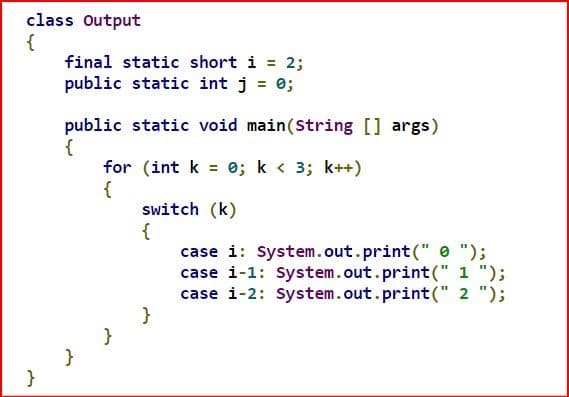
for(int i = 1; i<5; i++) {System.out.println(“Hello”)} How many times loop executed?
Predict the output: classB { int b; B( ) { b = 25;} void display(){ System.out.println ( b); }
class abc { int a,int b; void print ( ) { System.out.println("a = " + b);System.out.println("b = + a) } }when
the function is called with values a = 15, b = 16 what is the output?
int change (int p,int q) { p = p * q; return p;} What is the output of the above function if called change(10, 11) ?
In a certain school pass certificate is given to the students those who have scored40 percentage and above.
The following program is based on the specification given below., Fill in the blanks with appropriate Java statements.
class name: Result
Member variables
String name: To enter the name of a student
double per: To enter the percentage obtained by the student
String pc: To store the message
Member methods
void input() : To accept the detail
void passCertificate() : To check the percentage and award the pass certificate
void display() : To display the detail
void main(): To create an object of the class and invoke the member methods
(a)?
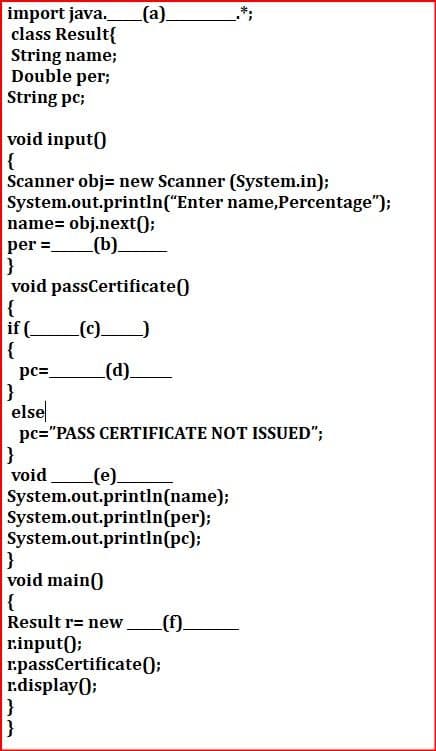
In a certain school pass certificate is given to the students those who have scored40 percentage and above.
The following program is based on the specification given below., Fill in the blanks with appropriate Java statements.
class name: Result
Member variables
String name: To enter the name of a student
double per: To enter the percentage obtained by the student
String pc: To store the message
Member methods
void input() : To accept the detail
void passCertificate() : To check the percentage and award the pass certificate
void display() : To display the detail
void main(): To create an object of the class and invoke the member methods
(b)?

In a certain school pass certificate is given to the students those who have scored40 percentage and above.
The following program is based on the specification given below., Fill in the blanks with appropriate Java statements.
class name: Result
Member variables
String name: To enter the name of a student
double per: To enter the percentage obtained by the student
String pc: To store the message
Member methods
void input() : To accept the detail
void passCertificate() : To check the percentage and award the pass certificate
void display() : To display the detail
void main(): To create an object of the class and invoke the member methods
(c)?
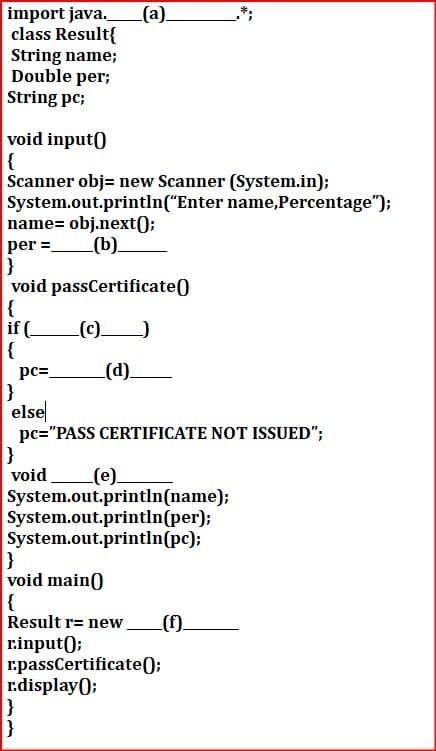
In a certain school pass certificate is given to the students those who have scored40 percentage and above.
The following program is based on the specification given below., Fill in the blanks with appropriate Java statements.
class name: Result
Member variables
String name: To enter the name of a student
double per: To enter the percentage obtained by the student
String pc: To store the message
Member methods
void input() : To accept the detail
void passCertificate() : To check the percentage and award the pass certificate
void display() : To display the detail
void main(): To create an object of the class and invoke the member methods
(d)?
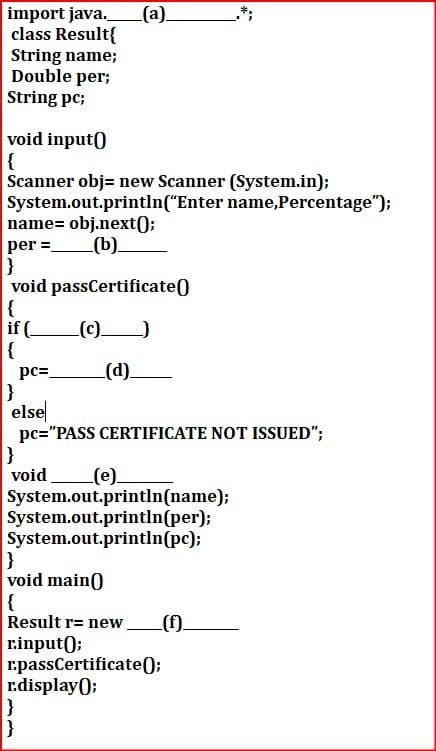
In a certain school pass certificate is given to the students those who have scored40 percentage and above.
The following program is based on the specification given below., Fill in the blanks with appropriate Java statements.
class name: Result
Member variables
String name:To enter the name of a student
double per: To enter the percentage obtained by thestudent
Stringpc: To store the message
Member methods
void input() : To accept the detail
void passCertificate() : To check the percentage and award the pass certificate
void display() : To display the detail
void main(): To create an object of the class and invoke the member methods
?(e)?
In a certain school pass certificate is given to the students those who have scored40 percentage and above.
The following program is based on the specification given below., Fill in the blanks with appropriate Java statements.
class name: Result
Member variables
String name: To enter the name of a student
double per: To enter the percentage obtained by thestudent
String pc: To store the message
Member methods
void input() : To accept the detail
void passCertificate(): To check the percentage and award the pass certificate
void display() : To display the detail
void main(): To create an object of the class and invoke the member methods
?(f)?

A Harshad number (or Niven number), is an integer (in base 10) that is divisible by the sum of its digits.
Let’s understand the concept of Harshad Number through the following examples:
The number 18 is a Harshad number in base 10, because the sum of the digits 1 and 8 is 9 (1 + 8 = 9), and 18 is divisible by 9 (since 18 % 9 = 0)
The number 1729 is a Harshad number in base 10, because the sum of the digits 1 ,7, 2 and 9 is 19 (1 + 7 + 2 + 9 = 19), and 1729 is divisible by 19 (1729 = 19 * 91)
The number 19 is not a Harshad number in base 10, because the sum of the digits 1 and 9 is 10 (1 + 9 = 10), and 19 is not divisible by 10 (since 19 % 10 = 9)
(a)?
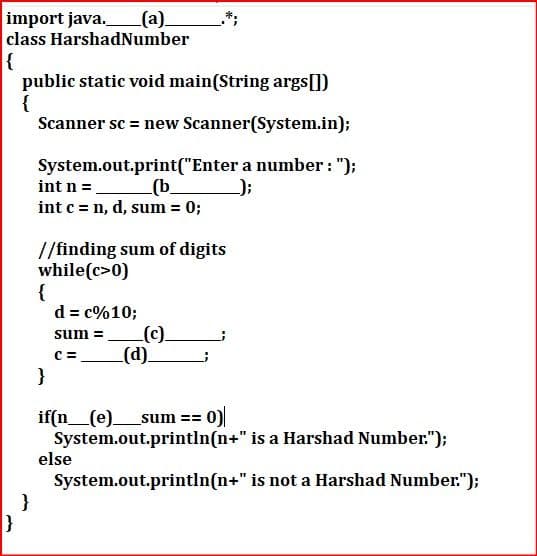
A Harshad number (or Niven number), is an integer (in base 10) that is divisible by the sum of its digits.
Let’s understand the concept of Harshad Number through the following examples:
The number 18 is a Harshad number in base 10, because the sum of the digits 1 and 8 is 9 (1 + 8 = 9), and 18 is divisible by 9 (since 18 % 9 = 0)
The number 1729 is a Harshad number in base 10, because the sum of the digits 1 ,7, 2 and 9 is 19 (1 + 7 + 2 + 9 = 19), and 1729 is divisible by 19 (1729 = 19 * 91)
The number 19 is not a Harshad number in base 10, because the sum of the digits 1 and 9 is 10 (1 + 9 = 10), and 19 is not divisible by 10 (since 19 % 10 = 9)
(b)?
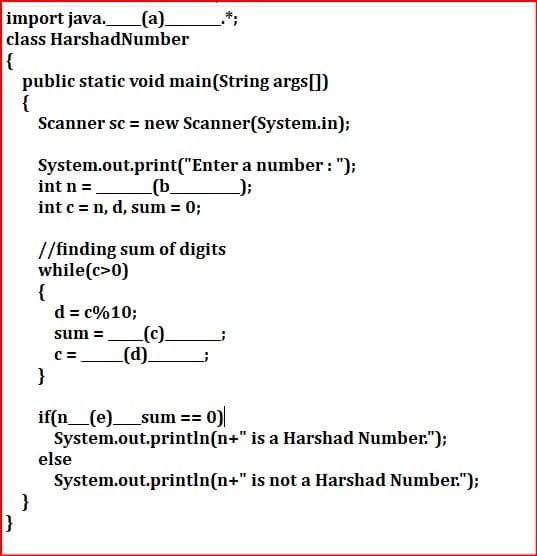
A Harshad number (or Niven number), is an integer (in base 10) that is divisible by the sum of its digits.
Let’s understand the concept of Harshad Number through the following examples:
The number 18 is a Harshad number in base 10, because the sum of the digits 1 and 8 is 9 (1 + 8 = 9), and 18 is divisible by 9 (since 18 % 9 = 0)
The number 1729 is a Harshad number in base 10, because the sum of the digits 1 ,7, 2 and 9 is 19 (1 + 7 + 2 + 9 = 19), and 1729 is divisible by 19 (1729 = 19 * 91)
The number 19 is not a Harshad number in base 10, because the sum of the digits 1 and 9 is 10 (1 + 9 = 10), and 19 is not divisible by 10 (since 19 % 10 = 9)
(c)?
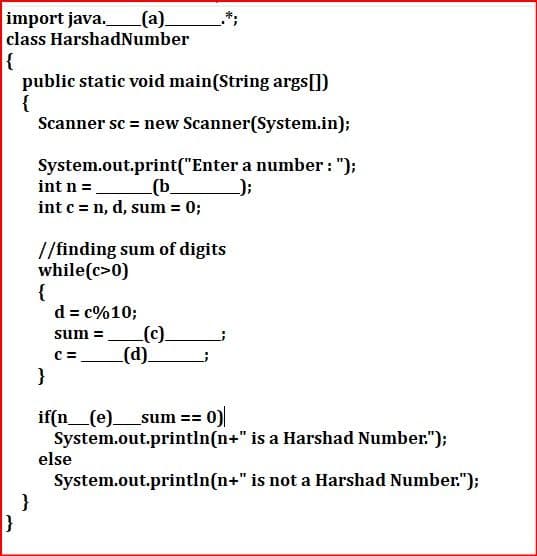
A Harshad number (or Niven number), is an integer (in base 10) that is divisible by the sum of its digits.
Let’s understand the concept of Harshad Number through the following examples:
The number 18 is a Harshad number in base 10, because the sum of the digits 1 and 8 is 9 (1 + 8 = 9), and 18 is divisible by 9 (since 18 % 9 = 0)
The number 1729 is a Harshad number in base 10, because the sum of the digits 1 ,7, 2 and 9 is 19 (1 + 7 + 2 + 9 = 19), and 1729 is divisible by 19 (1729 = 19 * 91)
The number 19 is not a Harshad number in base 10, because the sum of the digits 1 and 9 is 10 (1 + 9 = 10), and 19 is not divisible by 10 (since 19 % 10 = 9)
(d)?

A Harshad number (or Niven number), is an integer (in base 10) that is divisible by the sum of its digits.
Let’s understand the concept of Harshad Number through the following examples:
The number 18 is a Harshad number in base 10, because the sum of the digits 1 and 8 is 9 (1 + 8 = 9), and 18 is divisible by 9 (since 18 % 9 = 0)
The number 1729 is a Harshad number in base 10, because the sum of the digits 1 ,7, 2 and 9 is 19 (1 + 7 + 2 + 9 = 19), and 1729 is divisible by 19 (1729 = 19 * 91)
The number 19 is not a Harshad number in base 10, because the sum of the digits 1 and 9 is 10 (1 + 9 = 10), and 19 is not divisible by 10 (since 19 % 10 = 9)
(e)?
