Loading...


Cold Work Permit
Quiz by Dr. Mahes Ali Al Olaimat
Customize this quiz to suit your class
Instantly translate to 100+ languages
Tag the questions with any skills you have. Your dashboard will track each student's mastery of each skill.
Give this quiz to my class
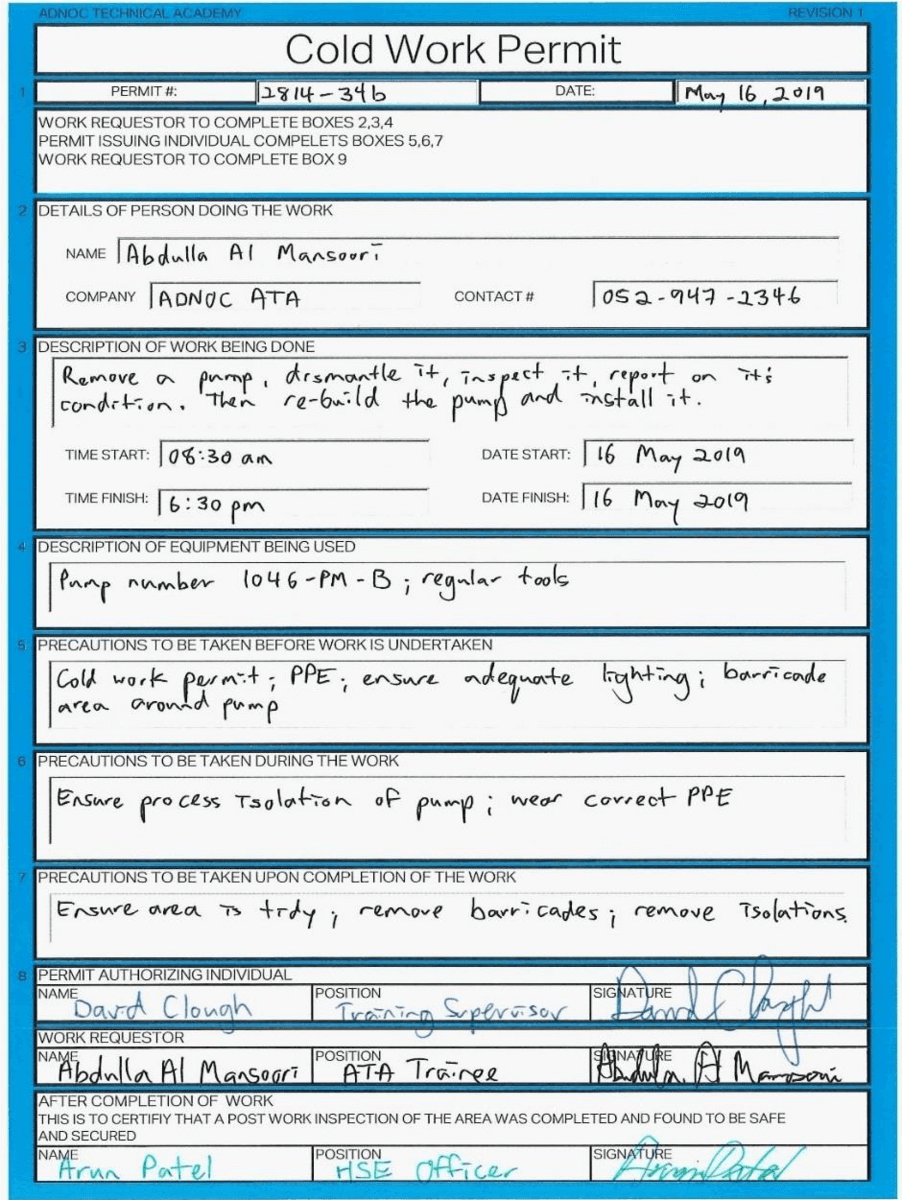
The permit number is ______.
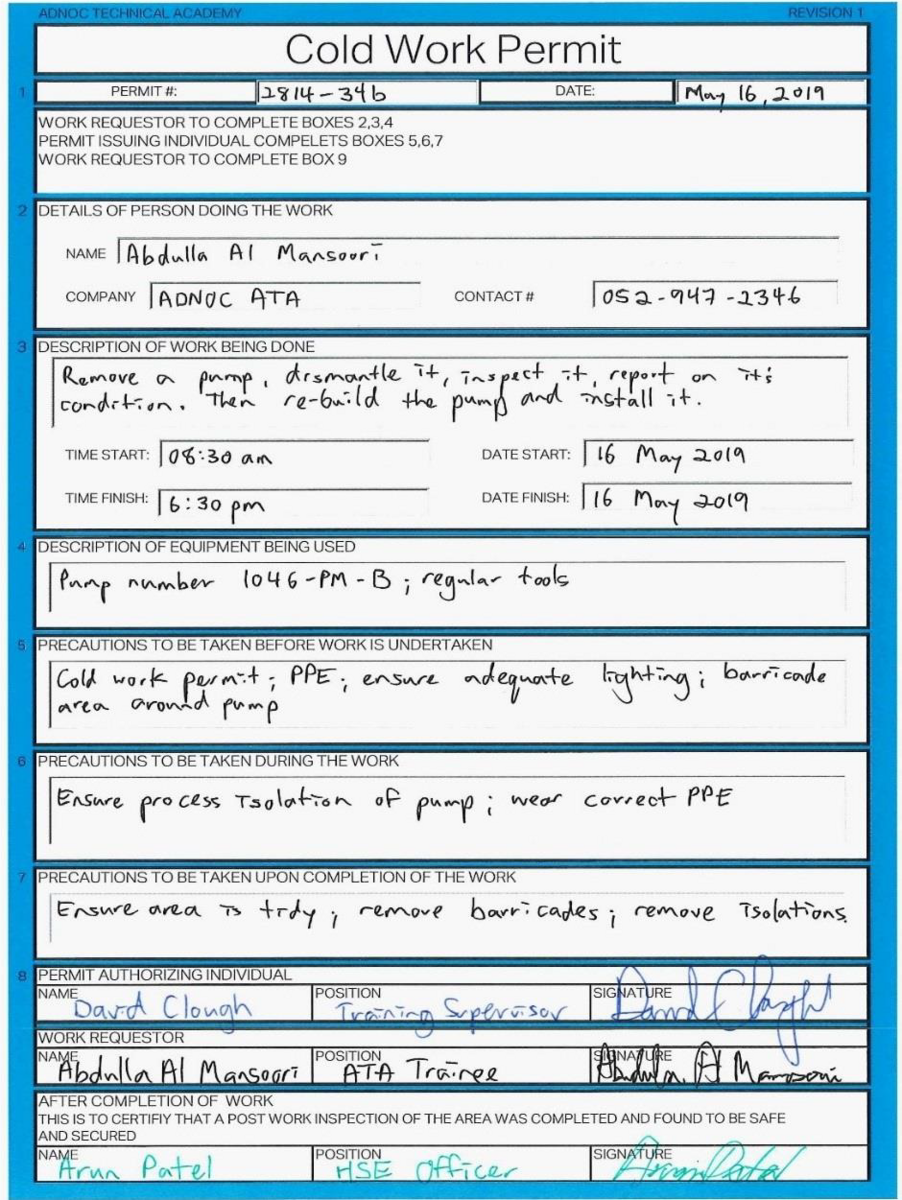
The date on the permit is ______.
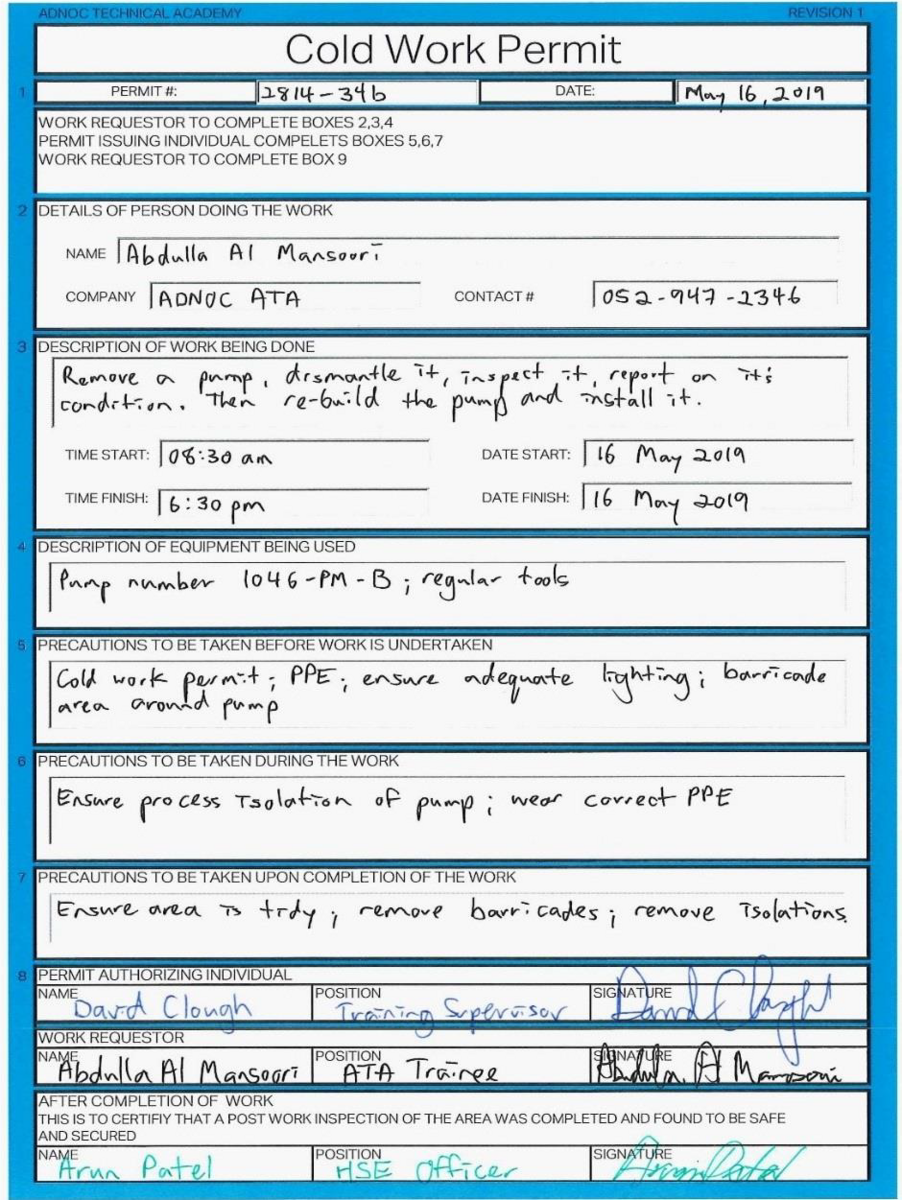
The permit number is ______.
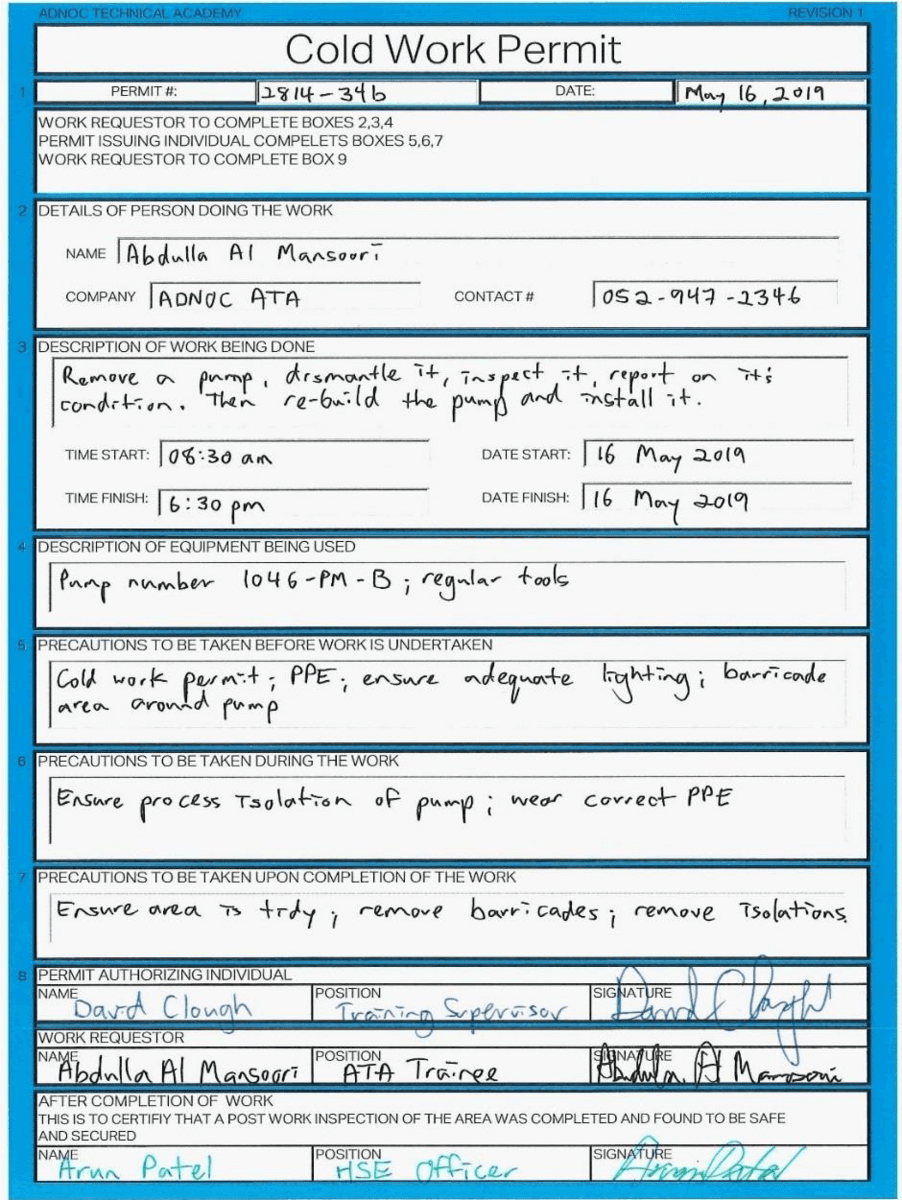
The date on the permit is ______.
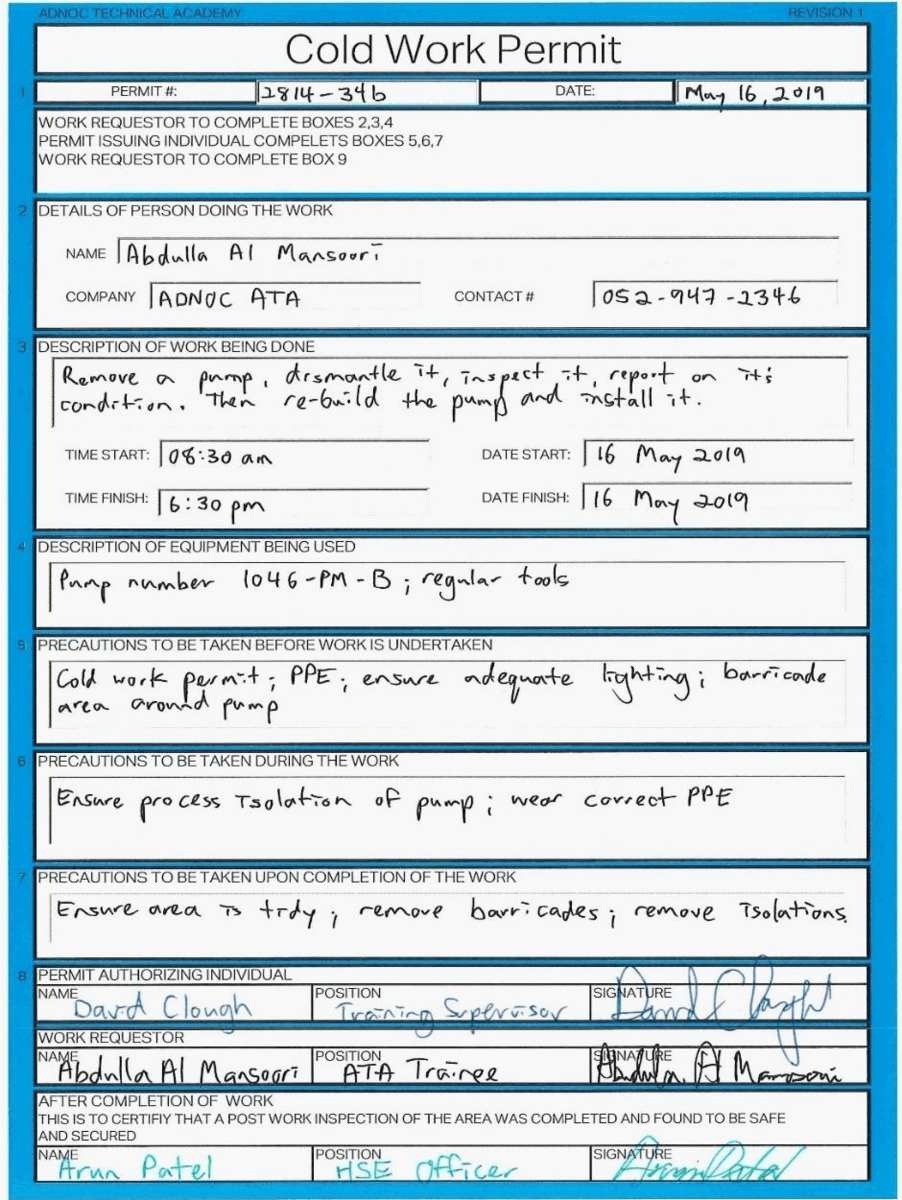
The name of the person doing the work is ______.
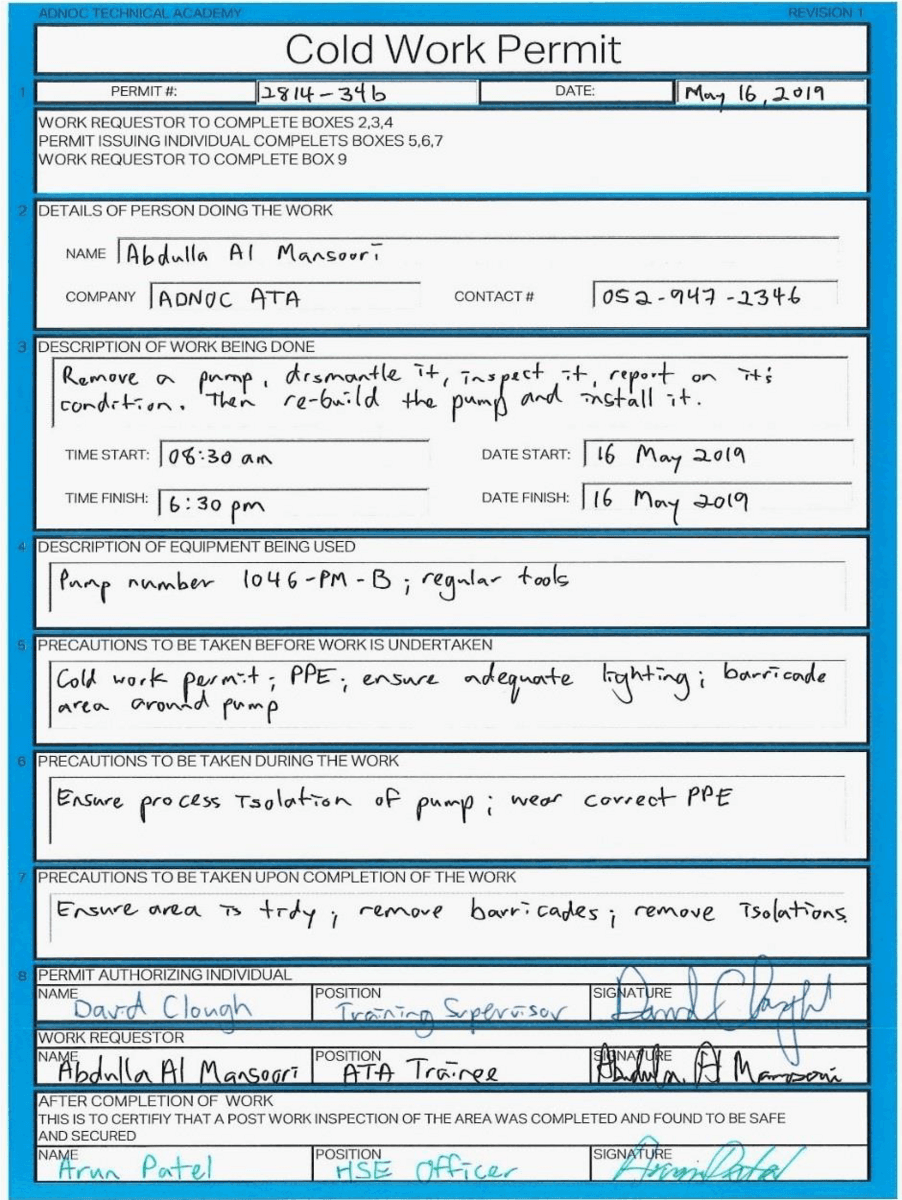
The company associated with the work is ______.
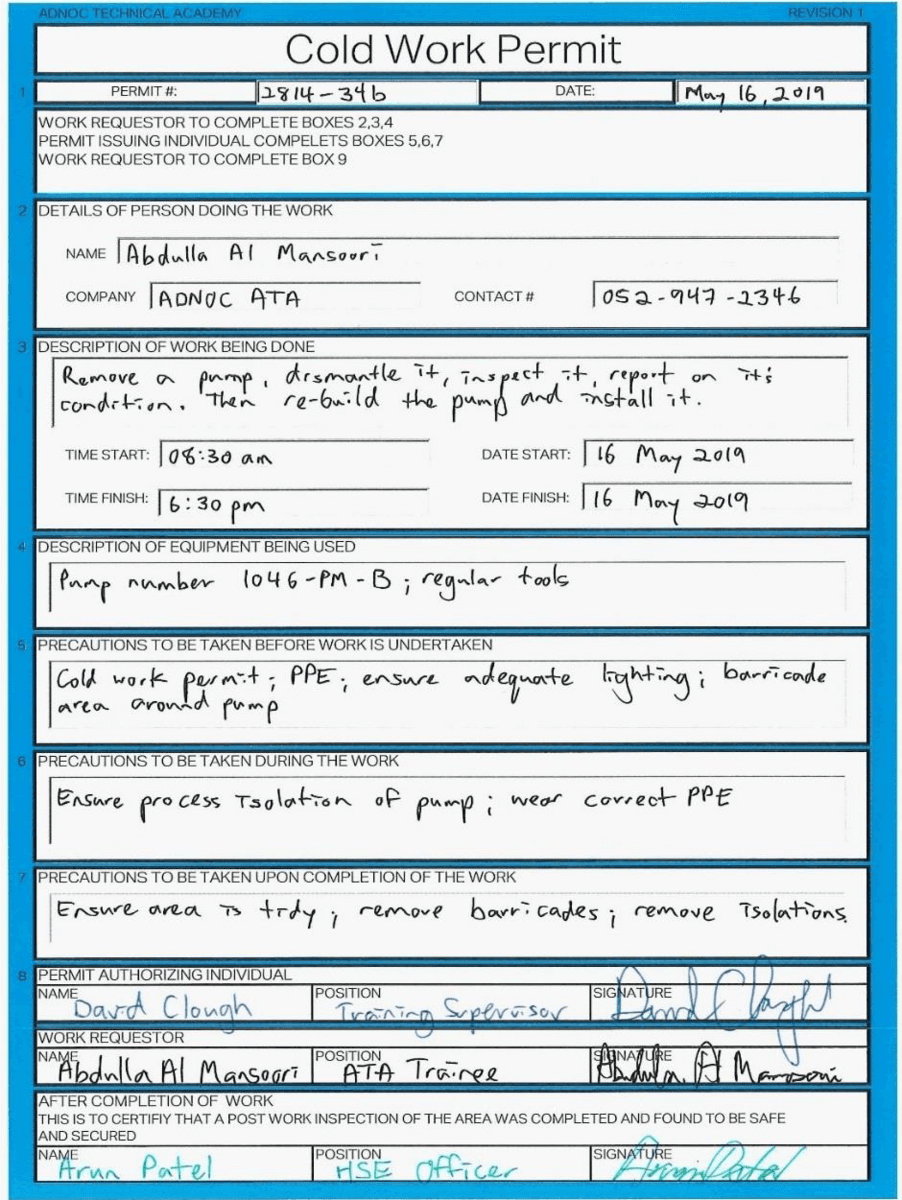
The contact number of the person doing the work is ______.
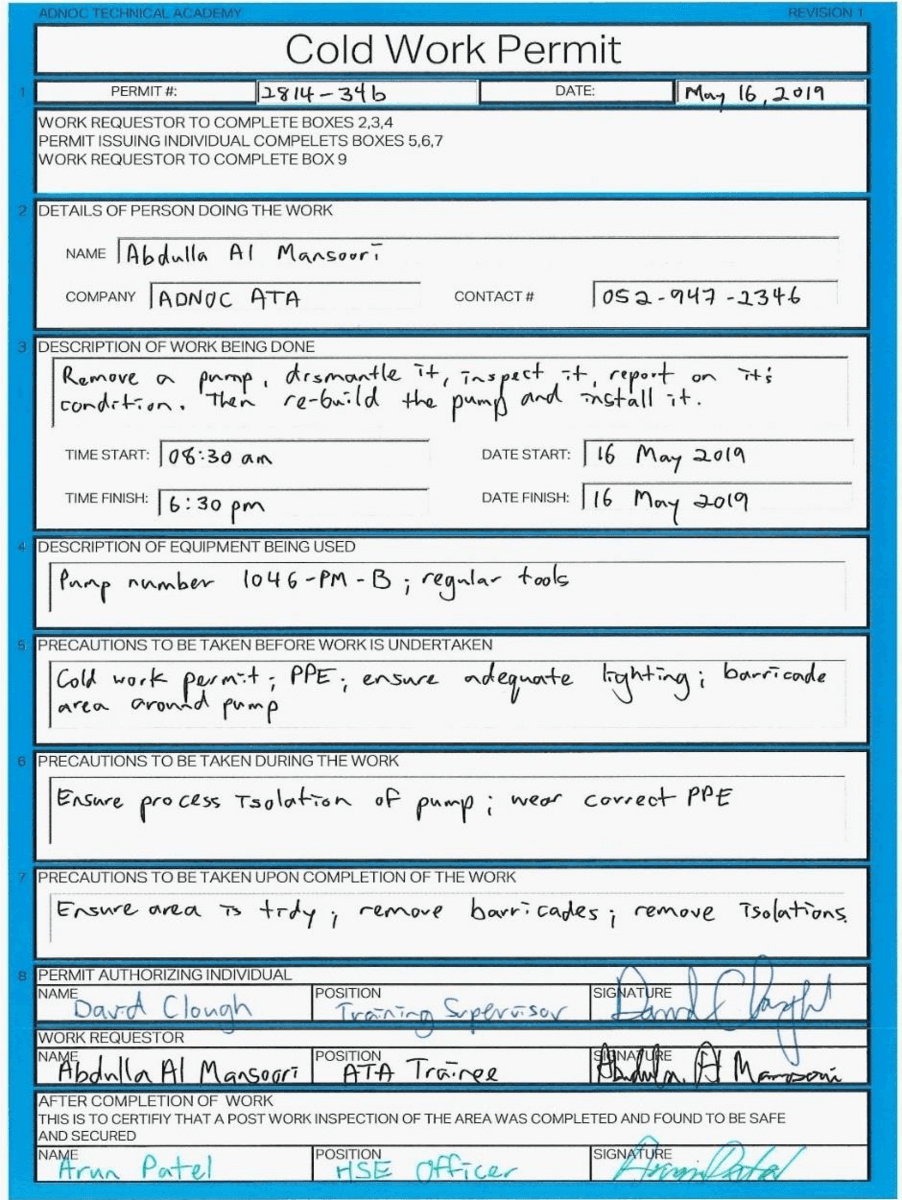
The description of the work being done includes removing and______ a pump, inspecting it, and reporting its condition.
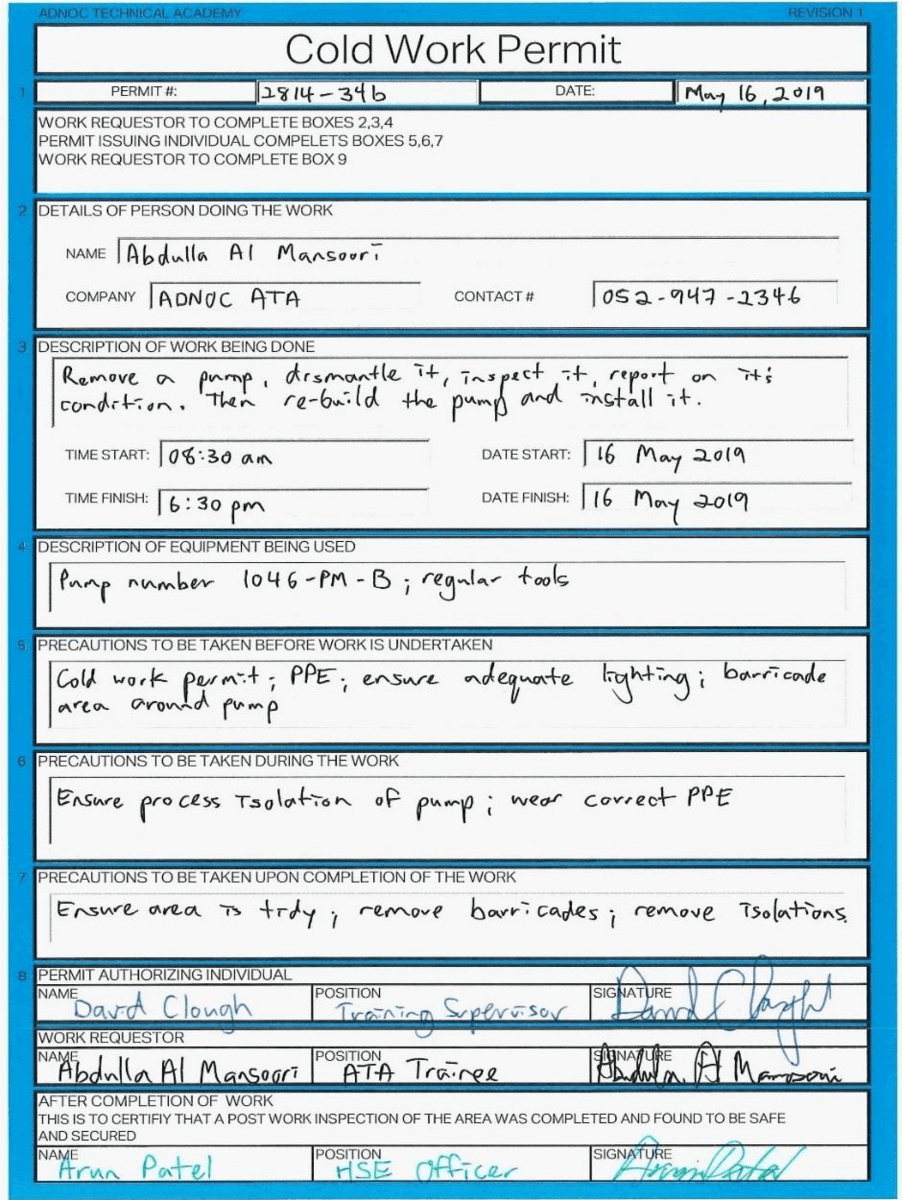
The work is scheduled to start at ______ and finish at ______ onMay 16, 2019.
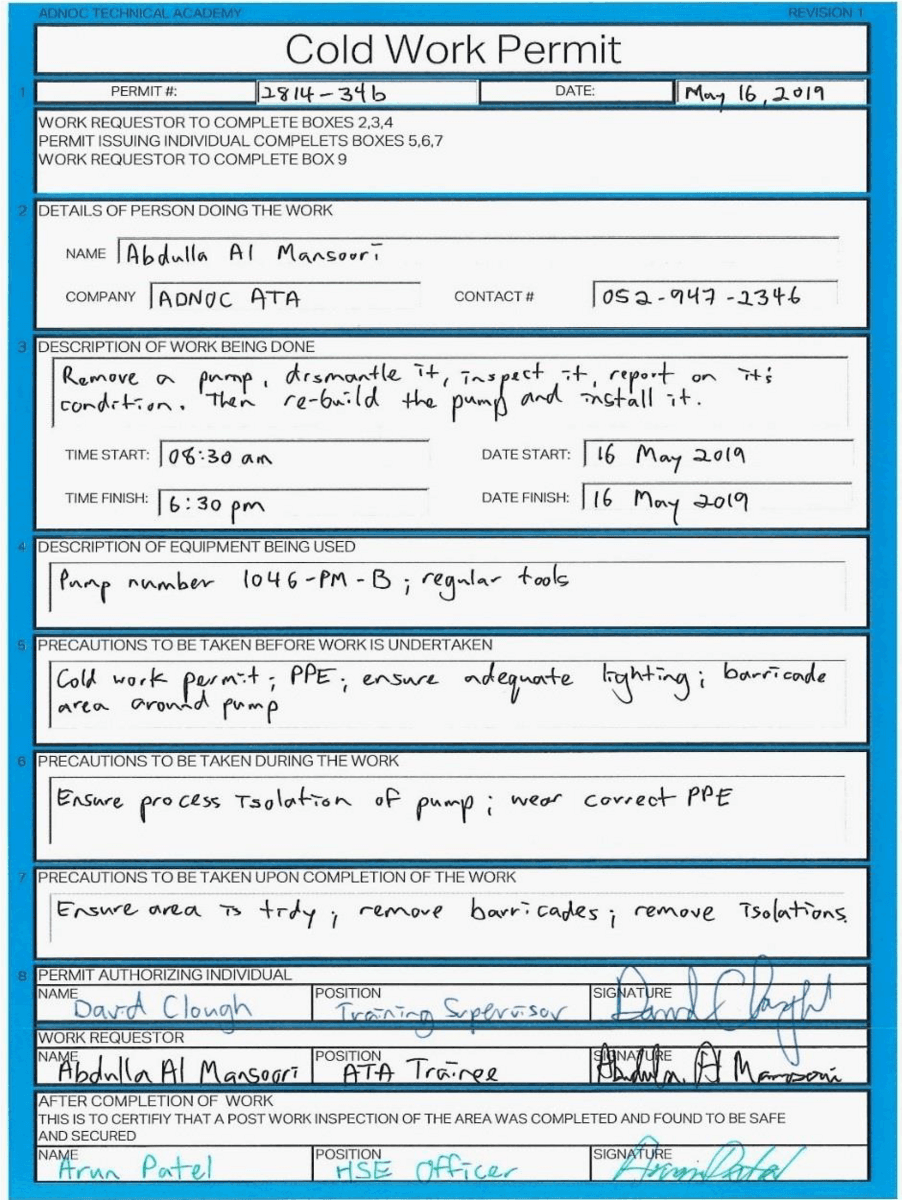
The pump number being used for the work is ______.
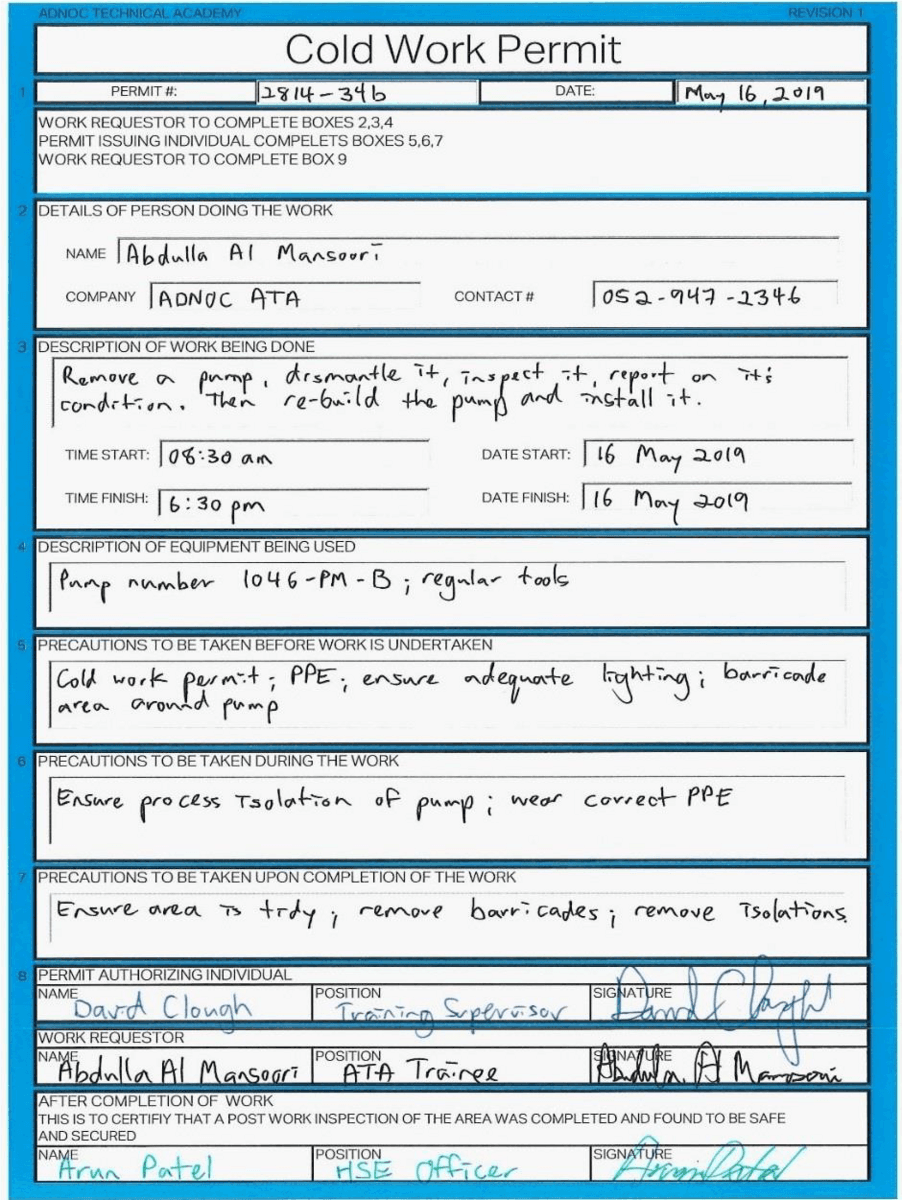
1. One of the precautions to be taken before the work is undertakenis to ensure adequate ______ around the pump.
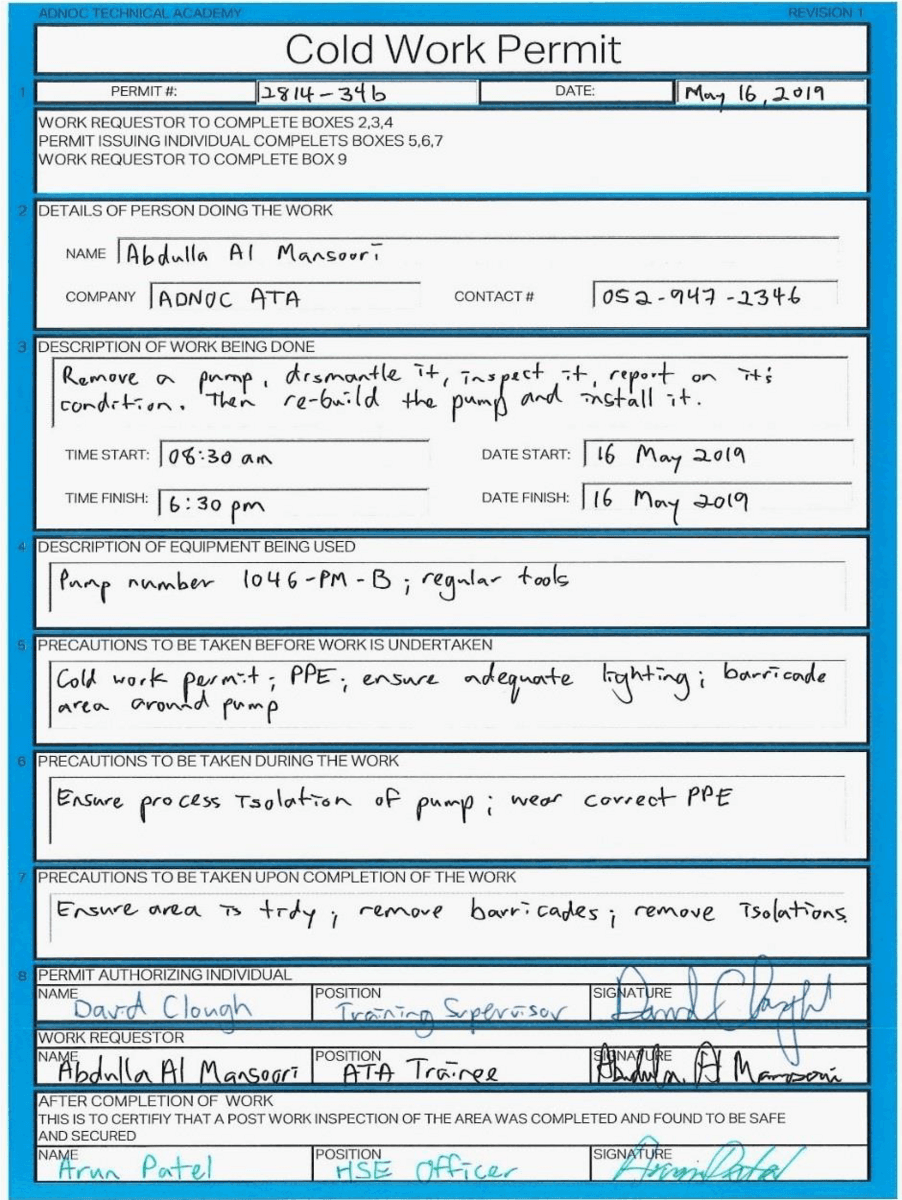
During the work, it is necessary to wear the correct ______.
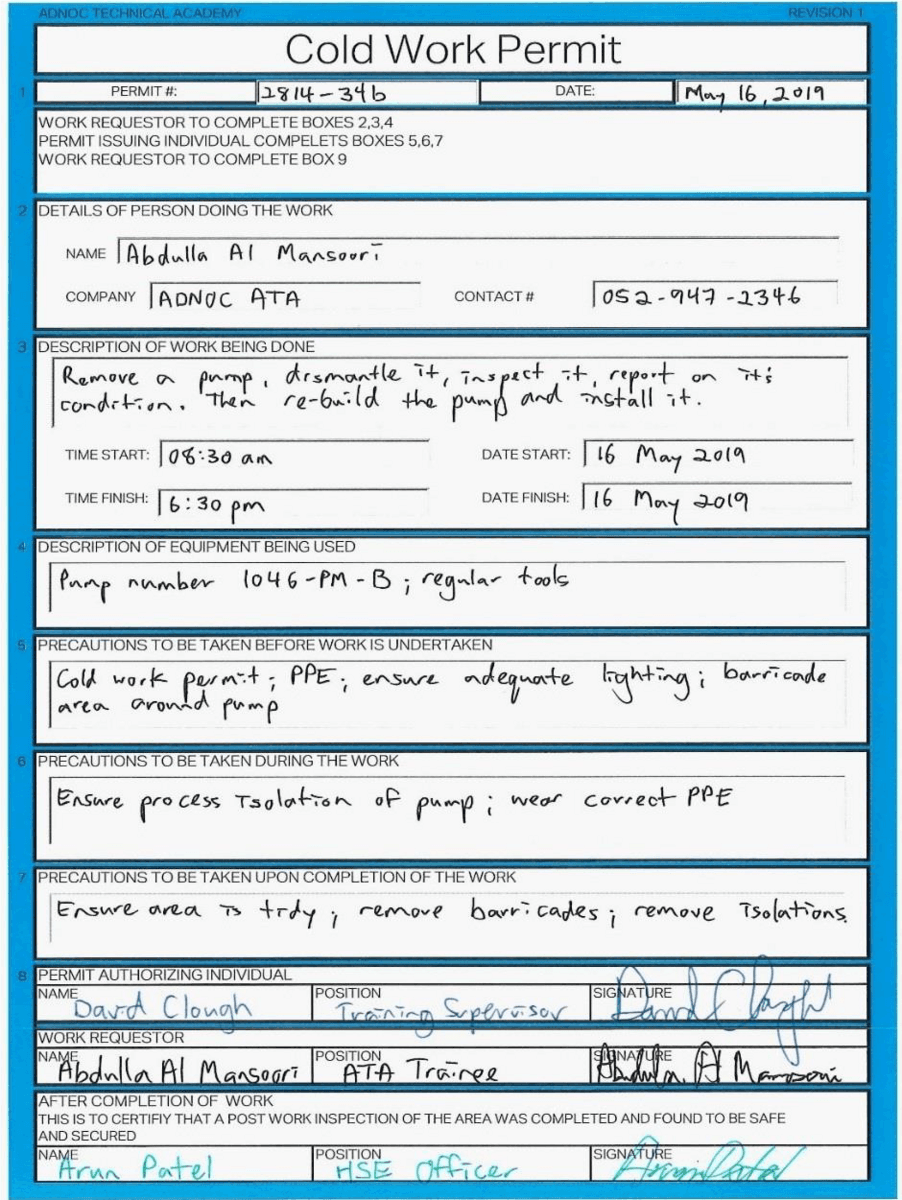
Upon completion of the work, the area should be ______ andbarricades should be removed.
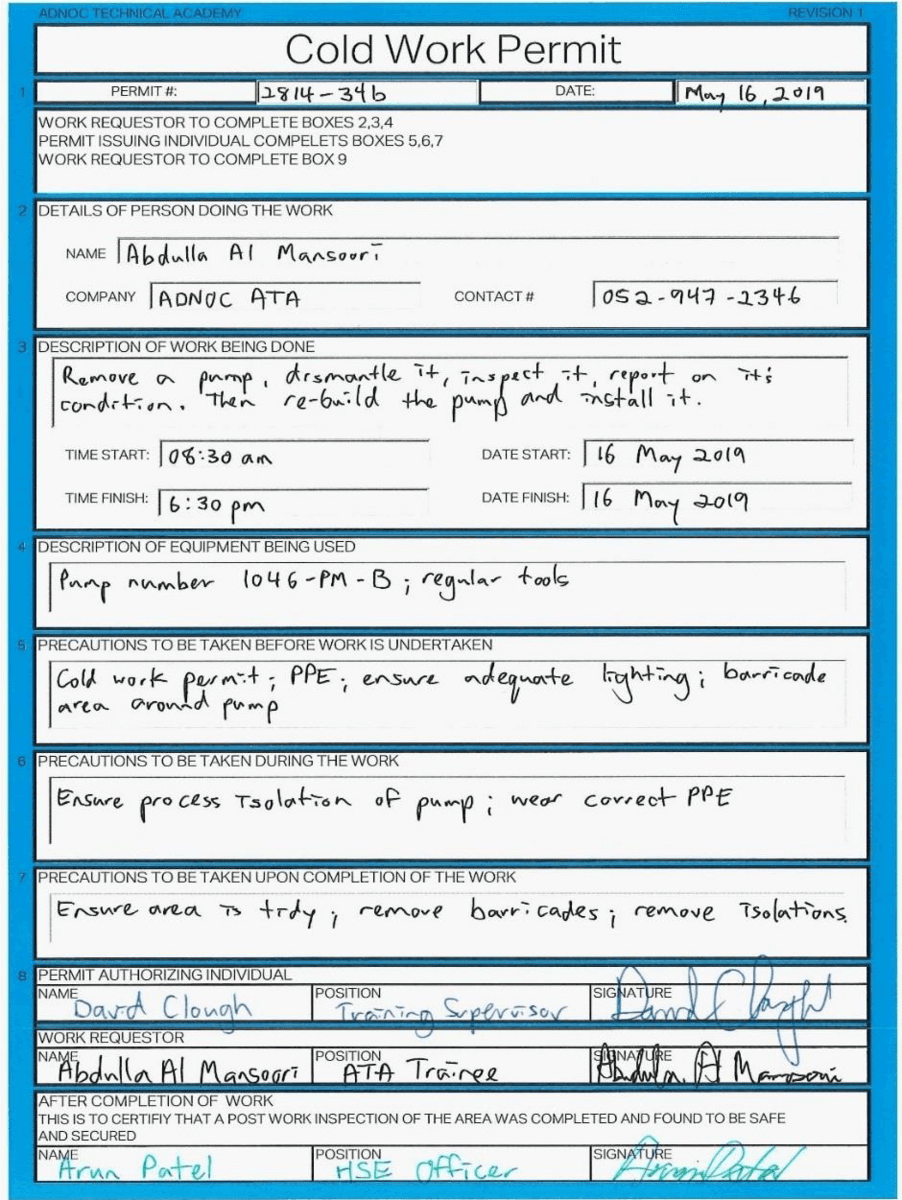
The permit authorizing individual is ______, with the positionof ______.
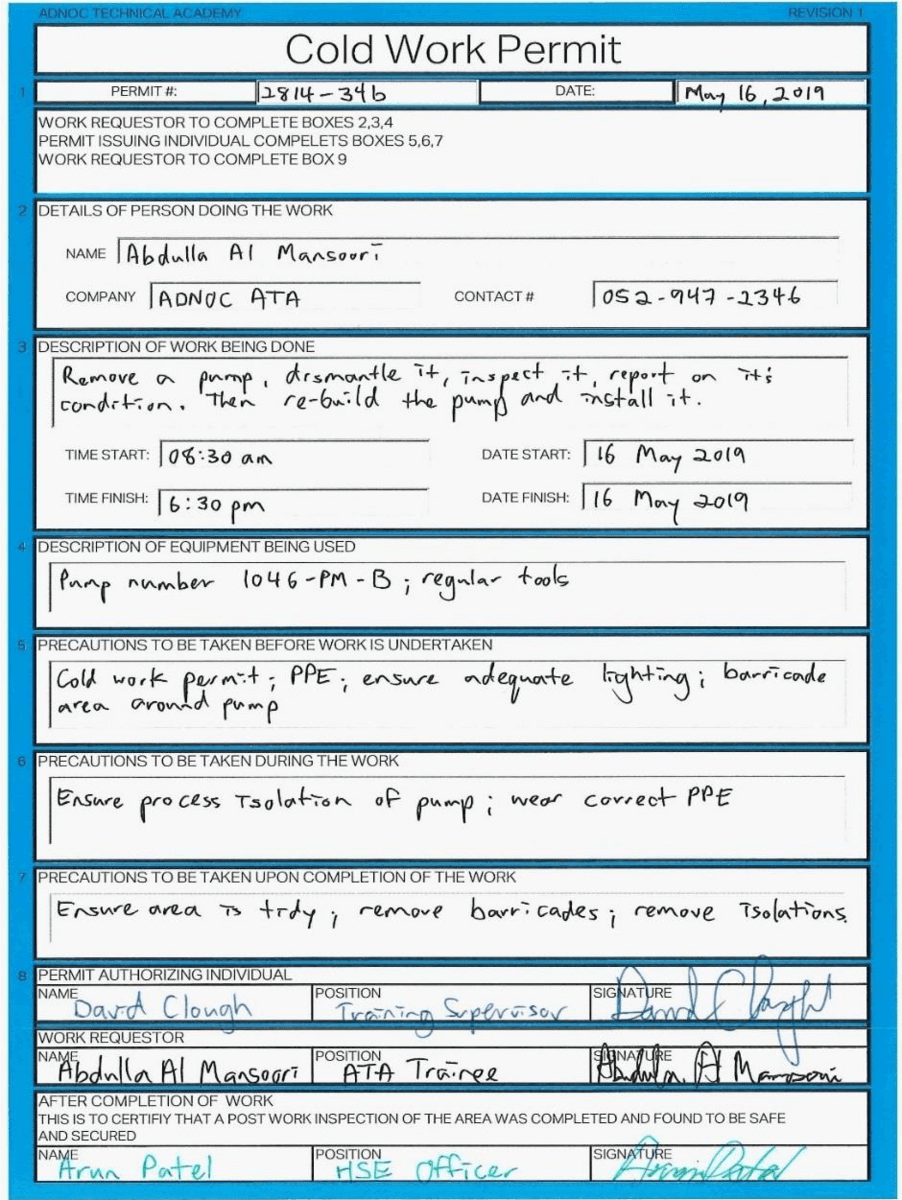
The HSE Officer who signed off after the completion of work is______.
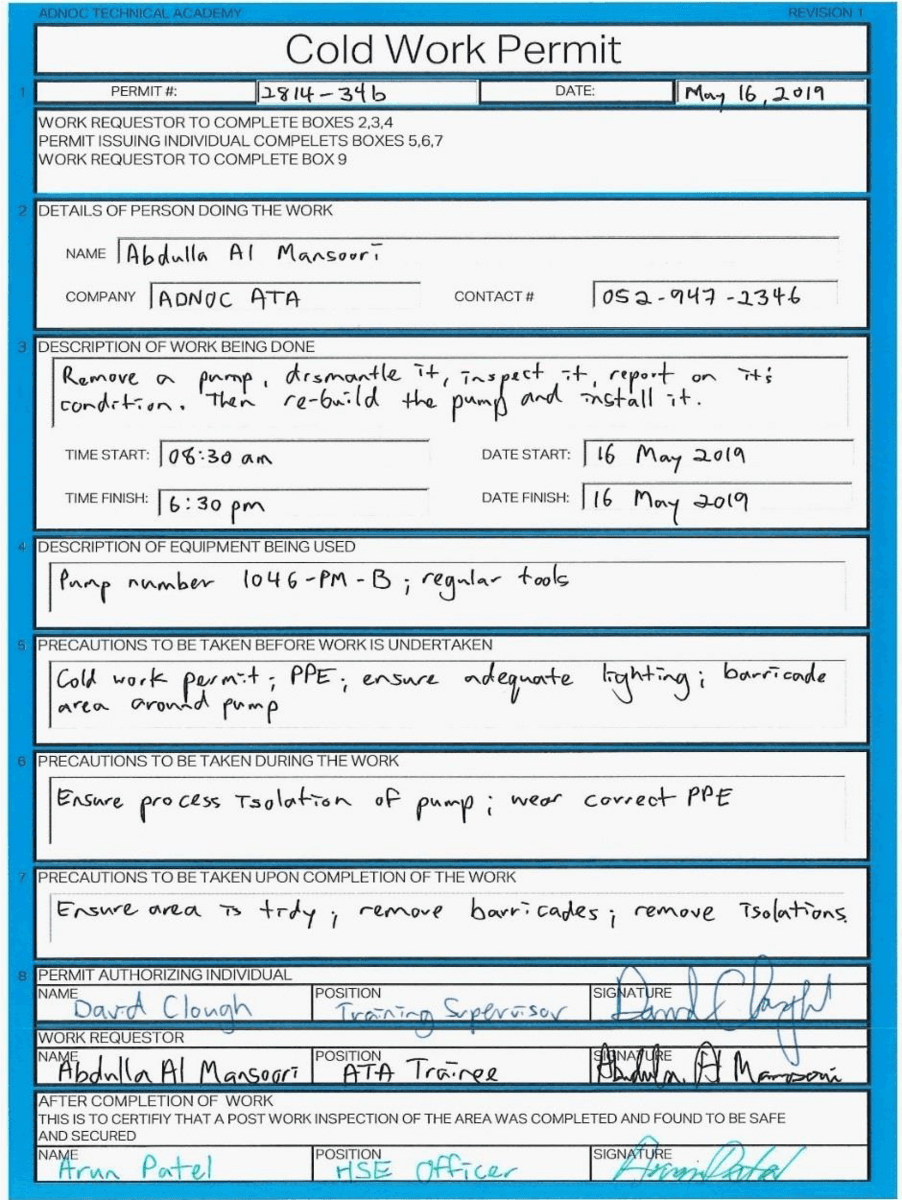
The work requestor’s position is ______.
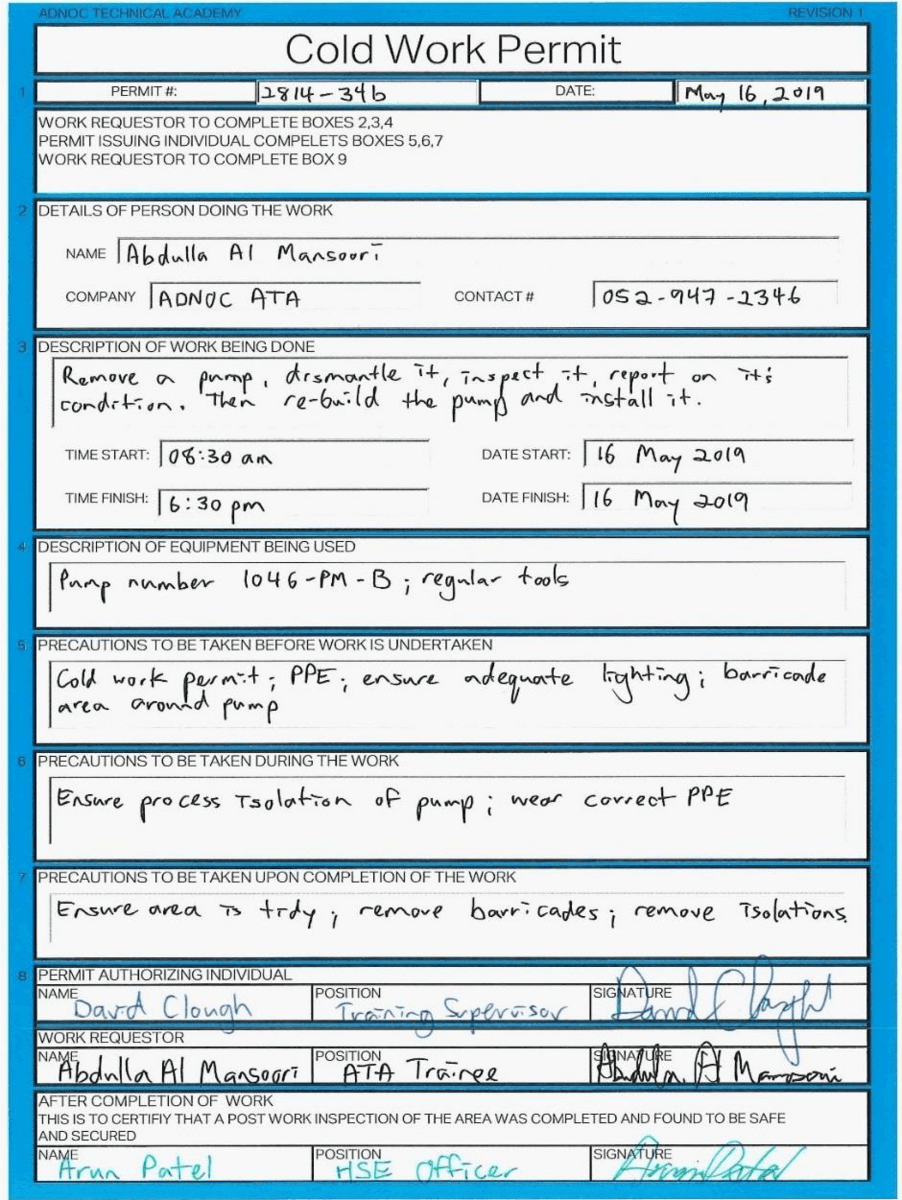
A precaution to be taken during the work is to ensure ______ ofthe pump.
 • Agriculture is growing of crops and keeping of animals. • People who practice agriculture are called farmers. • Agriculture is very important to the family. Benefits to the family • It provides food. • It provides money. • Agriculture gives us medicine. • It provides jobs. • Agriculture gives us transport and power. • It helps most families become self sufficient. • Farm tools are instruments used on farms to make work easier. • They are usually handheld and are used frequently when practicing agricultural activities. • Farm tools are light in weight, easy to handle and are suited to the strength of the farmer Name of tool Picture Use Watering can For fine watering of seed beds bucket Carrying manure, fertilizer,seed and ripe crops Name of tool Picture Use Sickle Cutting grass and harvesting of cereals like rice and wheat Slasher Cutting down tall grass and weeds USES OF FARM TOOLS Name of tool Picture Use Garden trowel Transplanting seedlings and making planting holes Hand fork Shallow cultivation of soil Aerating the soil USES OF FARM TOOLS Name of tool Picture Use Shovel Loading and offloading soil or manure into a wheelbarrow, scotch cart or truck Spade Digging and turning over of moist soil USES OF FARM TOOLS Name of tool Picture Use Garden fork Loosening and turn soil Garden line Marking straight ridges and garden beds USES OF FARM TOOLS Name of tool Picture Use wheelbarrow Moving items around the farm Items such as soil, mulch, animal feed. Etc Knapsack sprayer Spraying pesticides and herbicides Spraying fertilizers on crops. • An inventory is a record of the things that you have. • This is a list of tools issued out and tools received back and from whom Inventory of farm tools Inventory record sheets Created by Date Name of tool Sheet Tool numbenumber Description r Location Quantity Spade 1/15 Black,wooden handle Store room 2 SAFETY IN AGRICULTURE • Agricultural activities can be dangerous. • Hazards involved results in injury, disability and death of people and animals. • The hazards are usually caused by physical injury and chemical poisoning. Common hazards in Agriculture 1. physical injury These include: • Injury caused by accidents during use of farm tools, equipment and machinery. • Misuse and improper storage of farm tools and equipment. • Being kicked by animals. • Drowning in farm pond, pool or dam. Common hazards in Agriculture 2 . Chemical poisoning These include: • Spraying without protective clothing. • Eating or smoking when spraying chemicals. • Dumping toxic chemical left overs on land and in water. • Eating agriculture produces without prior permission from adults. • Pesticides, herbicides and fertilizers pollute water sources and kill animals. Chemical poisoning Ways of preventing common agricultural hazards 1. Wear protective clothing such as gloves, gumboots, respirator, hat and overalls. 2. Do not eat, drink or smoke when spraying. 3. Dispose off all chemical remains safely. 4. Bury or burn empty chemical containers and chemical left overs. 5. Wash thoroughly with running water and soap after using chemicals. 6. Do not spray during windy days. 7. Handle tools the right way. 8. Fence farm ponds and dams. Ways of preventing common agricultural hazards Climate and Landuse Seasons of Zimbabwe Seasons of Zimbabwe Definition of terms • A season is a time of the year with almost the same weather patterns. • Weather is the state of the atmosphere at a particular time at a particular place. • it is the daily condition of air around us. • Seasons are determined by rainfall and temperature. Seasons of Zimbabwe • There are four seasons in Zimbabwe , which are: 1.The rain season 2.Post rain season 3.Cool dry season 4.Hot dry season Seasons of Zimbabwe 1.The rain season ( summer) • It is also called the hot- wet season. • The season begins in mid November to mid March. • The period is rainy and hot. • Dams and rivers fill up. Seasons of Zimbabwe 2 . The post rain season ( autumn ) • It starts mid March – May • The days are bright and sunny. • The leaves change from green to red, orange, yellow or brown before falling. • In addition, there is less sunlight because the days are shorter. • It is the harvesting period of most crops. Seasons of Zimbabwe 3. The cold dry season ( winter ) • It begins mid May – mid August • The mornings, evenings and nights are very cold. • Has short days and long nights. Seasons of Zimbabwe 4 . The hot season (spring ) • It begins mid August – mid November. • The days are very hot with cool nights. • A season for trees to develop new shoots. Summer Activities Agricultural activities done during the rain season includes: • Ploughing and planting of summer crops for example maize, cotton. • Weeding • Pest and disease control • Applying fertilizers. • Weekly dipping of animals because ticks, lice and mites would be many. • Harvesting of summer crops • Preparing fireguards. A fireguard is a fire break. • Beginning of the planting of wheat, barley and oats. Winter Activities • Planting of winter crops such as wheat, barley and oats. • Harvesting and selling of summer crops continues. • Constructing frost barriers for frost sensitive crops such as tomatoes. • Vaccinating animals against blackleg. • Supplementary feeding of grazing animals. • Dosing of animals to kill internal parasites. Spring Activities • Shelling and threshing of grain crops. • Dry planting of summer crops. • Carrying manure to fields. • Ploughing and harrowing. • Making planting holes Soil Components •Soil is made up of 4 components: 1)Mineral matter 2)Organic matter 3)Soil water 4)Soil air Why Do Leaves Change Color? So Many Colors. Why are the leaves on trees different colors? What makes them change color? Making Food. Leaves use sunlight, water, and air to make food for the tree. This way of making food is called photosynthesis. A chemical that helps leaves make food also makes them green.Photosynthesis is important to animals as well as plants. Some animals eat plants. Other animals eat those animals. Without photosynthesis, neither kind of animal would have food. Summer. Summer is playtime. For the leaves of many trees, however, it's work, work, work! The Sun is shining. The leaves are making food for the trees. The trees store any extra food deep inside. The stored food will help them get through winter. Leaves are green in summer because they are making food. Leaves also have orange, yellow, or brown colors inside them. During summer, those other colors are hidden by the green color. Fall. Many places get colder in fall. The days get shorter, and the nights get longer. Trees get less sunlight, so photosynthesis slows down.Over time, leaves stop making the green chemical, so they lose their green color. When that happens, the hidden orange, yellow, and brown colors start to show. Leaves also start making a red color at this time. Once it gets cold enough to freeze at night, the trees drop their leaves. They do this to keep themselves safe. If the leaves freeze while still on the trees, the trees can be hurt. Winter. Trees that drop their leaves are bare in winter. They use the stored food to get through the cold days and colder nights. Spring. Spring comes before long. Ice and snow melt, and the rains come. The Sun shines, and tiny leaves grow from branches. Once again, the leaves use sunlight, water, and air to make food. The cycle begins again.A shoemaker, by no fault of his own, had become so poor that at last he had nothing left but leather for one pair of shoes. So in the evening, he cut out the shoes which he wished to begin to make the next morning, and as he had a good conscience, he lay down quietly in his bed, commended himself to God, and fell asleep. In the morning, after he had said his prayers, and was just going to sit down to work, the two shoes stood quite finished on his table. He was astounded, and knew not what to say to it. He took the shoes in his hands to observe them closer, and they were so neatly made that there was not one bad stitch in them, just as if they were intended as a masterpiece. Soon after, a buyer came in, and as the shoes pleased him so well, he paid more for them than was customary, and, with the money, the shoemaker was able to purchase leather for two pairs of shoes. He cut them out at night, and next morning was about to set to work with fresh courage; but he had no need to do so, for, when he got up, they were already made, and buyers also were not wanting, who gave him money enough to buy leather for four pairs of shoes. The following morning, too, he found the four pairs made; and so it went on constantly, what he cut out in the evening was finished by the morning, so that he soon had his honest independence again, and at last became a wealthy man. Now it befell that one evening not long before Christmas, when the man had been cutting out, he said to his wife, before going to bed, "What think you if we were to stay up to-night to see who it is that lends us this helping hand?" The woman liked the idea, and lighted a candle, and then they hid themselves in a corner of the room, behind some clothes which were hanging up there, and watched. When it was midnight, two pretty little naked men came, sat down by the shoemaker's table, took all the work which was cut out before them and began to stitch, and sew, and hammer so skilfully and so quickly with their little fingers that the shoemaker could not turn away his eyes for astonishment. They did not stop until all was done, and stood finished on the table, and they ran quickly away. Next morning the woman said, "The little men have made us rich, and we really must show that we are grateful for it. They run about so, and have nothing on, and must be cold. I'll tell thee what I'll do: I will make them little shirts, and coats, and vests, and trousers, and knit both of them a pair of stockings, and do thou, too, make them two little pairs of shoes." The man said, "I shall be very glad to do it;" and one night, when everything was ready, they laid their presents all together on the table instead of the cut-out work, and then concealed themselves to see how the little men would behave. At midnight they came bounding in, and wanted to get to work at once, but as they did not find any leather cut out, but only the pretty little articles of clothing, they were at first astonished, and then they showed intense delight. They dressed themselves with the greatest rapidity, putting the pretty clothes on, and singing, "Now we are boys so fine to see, Why should we longer cobblers be?" Then they danced and skipped and leapt over chairs and benches. At last they danced out of doors. From that time forth they came no more, but as long as the shoemaker lived all went well with him, and all his undertakings prospered.Where Is It? Russia is a very big country. It is the largest country in the world almost twice as big as the United States. Russia is part of both Europe and Asia. Moscow is the capital of Russia. It is a big city in the European part of the country. More than twelve million people live there. The Russian president lives in a famous group of buildings in Moscow. People. Most people in Russia live and work in cities. The main language is Russian. In the country, jobs have to do with the land and the sea. For example, many people fish, mine oil and coal, and cut trees for wood. Sports such as soccer and ice hockey are popular in Russia. Russia is famous for music and a kind of dance show called ballet. Swan Lake is a famous Russian ballet. Land. The land in Russia is mainly low flatlands, high flatlands, and mountains. The deepest lake in the world, Lake Baikal, is in Russia. Russia has frozen flatlands in the north and wide grassy lands in the south. In between are huge forests. Russia is a cold country, and it is home to the coldest village in the world. But many places in Russia also have beautiful summers. History. In the past, czars, or emperors, ruled Russia. During that time, the peasants in Russia were unhappy. They didn't like the way the czars ruled the people. They fought in 1917 to change their country's ways. After the fight, Russia took control of a group of other nearby countries. Together they formed the Union of Soviet Socialist Republics (USSR). The USSR had many problems, so it broke up in 1991. Today, Russia has a president. Celebrations. Many people celebrate Christmas and Easter in Russia. On Easter, they eat cakes and paint hard-boiled eggs. Russian Easter egg Russians also have a holiday to celebrate the end of winter. For this holiday, people eat pancakes with butter. They also have fun with sleigh rides and snowball fights. Food. A popular soup in Russia is famous around the world. People make the soup from beets and other vegetables. Beets are red, so the soup also has a red color. Many Russians like a homemade drink. The drink has a sour flavor. Conclusion Russia is home to both crowded cities and wild forests. Russia has a long, rich history and many interesting things to do. The Russian people value the traditions of their beautiful homeland.Amazing Antarctica The Seventh Continent. Give a globe a spin. On it you can easily find six continents. Now look at the bottom of the globe. There you will find continent number seven: Antarctica. People did not find Antarctica until about two hundred years ago. Since then, we have learned a lot about this amazing place. Antarctica is the coldest continent. It is also the continent with the strongest winds. Less rain and snow fall in Antarctica than in any other continent. Freezing Antarctica Water covers most of Earth. Almost all of it is salt water. Most of the fresh water on Earth is frozen in the ice in Antarctica. Snow does not melt during the cold summers there. The ice builds up over many years. Life on and Around Antarctica The freezing weather in Antarctica makes it a dangerous place to live. Most plants and animals can be found near the coasts or in the sea. There are no trees, but there are other plants, such as moss. Penguins and seals are some of the larger animals in the icy waters of Antarctica. A Playground for Scientists People have taken steps to make sure that scientists can study in Antarctica. Many countries send scientists to study in Antarctica. Some work there all year, even during the cold winter. Others work only in summer. Many kinds of scientists come to Antarctica. They study animals, ice, and many other things. Many kinds of scientists come to Antarctica. They study animals, ice, and many other things. Thousands of visitors also come to learn about Antarctica each year. Conclusion. People do not know a lot about Antarctica. The cold, ice, wind, and rough seas make it a difficult place to visit. However, people around the world know how important it is to protect and study Antarctica.Write personal questions for a1-a2 kids after they read: Incredible Places to Stay Introduction. Do you want to see some of the world's most amazing hotels? Let's go! Sliding with Sharks. The first stop on your tour is Las Vegas, Nevada. At the Golden Nugget, you can ride a waterslide. It takes you through a shark tank. A Cool Place to Stay. The next stop is the Hôtel de Glace (O-tel DEH GLAHS) in Canada. Many parts of the hotel are made of ice. The ice melts away in the spring. Each winter, it takes a lot of work to build the hotel again. Breakfast with Giraffes. From Canada, you'll travel to Kenya. Giraffes live in the forests around a hotel called Giraffe Manor. Every morning, the giraffes come to the hotel to eat. If you stay there, you can feed them! In the Trees. The next stop on your tour is Sweden. The Treehotel is made up of many tree houses. The Mirrorcube has glass all around it. This tree house blends in with the woods. One tree house looks like a big bird's nest. The UFO tree house looks as if it is from outer space. A Room Without a View. When you are in Sweden, stop at the Sala Silvermine Hotel. When you get there, you can stay in the deepest hotel room in the world! It is a long way down to your room. Dress in warm clothes because it is very cold in the mine. Sleeping with Fish. Your last stop is Jules' Undersea Lodge in Florida. You have to swim down to reach your room! When you are ready to eat, you can even have pizza. Someone from the hotel will swim it down to you. Conclusion. It is time to go back home now. Each incredible hotel is more than just a place to stay for the night. At each one, you will have a lot of fun!Think about the geography and location of the city or town you live in. Are there bodies of water like rivers and lakes or a coast nearby? Perhaps you live in a place with vast open fields suitable for farming or raising livestock. The natural environment is important when understanding how cities and towns developed. The earliest North American colonies depended on their natural environment. The type of soil, climate, length of seasons, and proximity to bodies of water all played a role in how each colony prospered. By the 1700’s, the American colonies grew into three distinct regions. The New England, Middle, and Southern regions each had different geographical and cultural characteristics that determined the development of their economy, society, and relationships to each other. The New England Colonies included Connecticut, Rhode Island, Massachusetts, and New Hampshire. The geography of this region featured dense forests and hills. Combined with the hard rocky land, cold climate and long winters, New England was a poor area for large farming operations. However, many colonists known as "yeoman farmers" had small family-owned farms that grew a variety of crops. Many other colonists relied on fishing and whaling off the New England coast. Others settled in small towns and became craftsmen or merchants. The forests provided excellent lumber for building boats and homes for the growing population. Many of the settlers to the New England Colonies were Puritans, hardworking, and very religious. Close families and strong communities were very important to them. The Middle Colonies included Pennsylvania, Delaware, New York, and New Jersey. The geography of this region featured a warmer climate with fertile soil, flat land, easily navigable rivers, and wide valleys making it perfect for farming and growing crops. Wealthy farmers grew cash crops and raised livestock. Mining and trading were also important aspects of the economy here. Over time, cities grew, and urban merchants sold and traded goods with people throughout the other colonies. Compared to other regions, the people of the middle colonies supported religious freedom and tolerance and had a diverse population with settlers arriving from many areas in Europe. The Southern Colonies included the first English colony of Virginia, and grew to include Maryland, North Carolina, South Carolina, and Georgia. The geography included rich, fertile soil with broad coastal plains that made it possible for large plantations to grow tobacco, rice, and indigo. Most of these plantations featured a labor force of enslaved Black people. These enslaved men, women, and children had few, if any, rights and often saw their families torn apart at the whim of the plantation owner. Enslaved children were even put to work as young as age three, weeding fields, carrying drinking water, or helping in the home. Smaller farms owned by subsistence farmers also existed across the Southern Colonies. Often, the people working these would grow crops for their families with little left over to sell or trade. Indentured servants also arrived in the South who would work for 5-7 years in exchange for their passage to North America. The Church of England (also known as the Anglican Church) was the dominant religion in the region. Most settlers to the South did not come for religious freedom like they did in the northern colonies. Therefore, they often maintained their allegiance to the established Church of England. Look out! You ... (fall) off the chair! are going to fall (prediction) It's so warm in my room now. I ... (open) the window. will open (unplanned decision) Shall I ........ (open ) the window? open (suggestion) I can't come to you with on Sunday because my parents ... (come) to stay with me. are coming (arrangement) On Monday ..... (play) football. I'm playing (play) We.............(see) that heavy bags for you. shall lift (offer) Don't be lazy, you .. (enter) the gym without sports shoes. won't enter (prediction) I promise, I ... (not tell) you parents! won't tell (promise) I think Susy ... (become) an architect one day, because she is really good at maths and drawing. will become (prediction) I promise I ... (be) there. will be (promise) I .... go running in the morning! will (spontaneous decision) Bank workers .............. (call) the police. are going to call (prediction) I ... help you with the shopping. will (offer) She ......... (dance) on a disco tonight. is going to dance (prediction) Lisa ........... (see) a sea this evening. is going to see (plan) I hope I ....my homework by 5 o'clock. will do (prediction) I promise I .......... (call). will call (promise) A-We don't have any bread. B- I know. I __________________ get some from the shop. a) am going to b) will will A: I'm really cold. B: I __________________ turn the heating on. a) am going to b) will will A: Are you going to John's party tonight? B: Yes. Are you going too? I __________________ give you a lift. a) am going to b) will will A: Why do you need to borrow my suitcase? B: I __________________ visit my mother in Scotland next month. a) am going to b) will am going to A: What are your plans after you leave university? B: I __________________ work in a hospital in Africa. I leave on the 28th. a) am going to b) will am going to (The phone rings) A: I __________________ get it! a) am going to b) will will A: Are you ready to order? B: I can't decide ... Okay, I __________________ have pasta, please. a) am going to b) will will A: Are you busy tonight? Would you like to have coffee? B: Sorry. I __________________ go to the library. I've been planning to study all day. a) am going to b) will am going to A: Why are you carrying a hammer? B: I __________________ put up some pictures. a) am going to b) will am going to