Loading...


Comprehension abilities!
Quiz by Angie Alejandra Lopez Silguero
Customize this quiz to suit your class
Instantly translate to 100+ languages
Tag the questions with any skills you have. Your dashboard will track each student's mastery of each skill.
Give this quiz to my class
What is the advertisement about?

Rescuing cats from the website.
Selling animals online.
Offering to take care of cats and dogs
Finding some losing cats and dogs
Who is the target of this ads?

New family
Rescued animals
Veterinarian
Pets lovers
What is the advertisement about?

Who is the target of this ads?

What kind of text is this?

What is the purpose of the postcard?

What does the message mean?

What does the message mean?

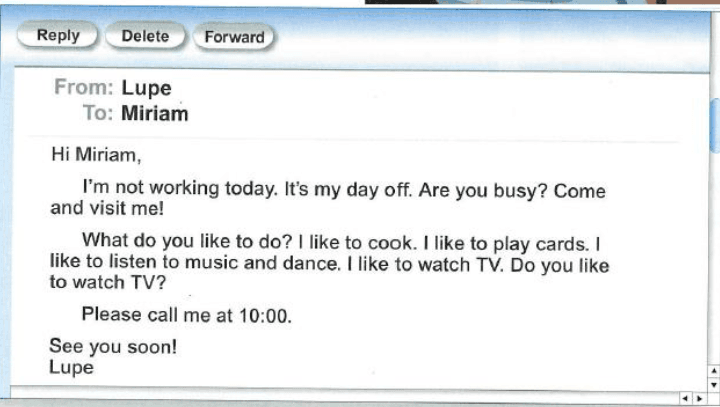
What is the purpose of the email?

Choose one activity that Lupe DOES NOT mention in the email:
What is this advertisement about?

The event will be on Monday morning

What kind of food does the restaurant offer?

The red letters indicate:

This is a:

The cheapest meal is the:

The party will be until night

The party will last:

Where can you find this warning?

Where can you find this?

Where can you find this?

 ILLINOIS PROFESSIONAL TEACHING STANDARDS (2013) Standard 1 - Teaching Diverse Students – The competent teacher understands the diverse characteristics and abilities of each student and how individuals develop and learn within the context of their social, economic, cultural, linguistic, and academic experiences. The teacher uses these experiences to create instructional opportunities that maximize student learning. Knowledge Indicators – The competent teacher: 1A) understands the spectrum of student diversity (e.g., race and ethnicity, socioeconomic status, special education, gifted, English language learners (ELL), sexual orientation, gender, gender identity) and the assets that each student brings to learning across the curriculum; 1B) understands how each student constructs knowledge, acquires skills, and develops effective and efficient critical thinking and problem-solving capabilities; 1C) understands how teaching and student learning are influenced by development (physical, social and emotional, cognitive, linguistic), past experiences, talents, prior knowledge, economic circumstances and diversity within the community; 1D) understands the impact of cognitive, emotional, physical, and sensory disabilities on learning and communication pursuant to the Individuals with Disabilities Education Improvement Act (also referred to as “IDEA”) (20 USC 1400 et seq.), its implementing regulations (34 CFR 300; 2006), Article 14 of the School Code [105 ILCS 5/Art.14] and 23 Ill. Adm. Code 226 (Special Education); 1E) understands the impact of linguistic and cultural diversity on learning and communication; 1F) understands his or her personal perspectives and biases and their effects on one’s teaching; and 1G) understands how to identify individual needs and how to locate and access technology, services, and resources to address those needs. Performance Indicators – The competent teacher: 1H) analyzes and uses student information to design instruction that meets the diverse needs of students and leads to ongoing growth and achievement; 1I) stimulates prior knowledge and links new ideas to already familiar ideas and experiences; 1J) differentiates strategies, materials, pace, levels of complexity, and language to introduce concepts and principles so that they are meaningful to students at varying levels of development and to students with diverse learning needs; 1K) facilitates a learning community in which individual differences are respected; and 1L) uses information about students’ individual experiences, families, cultures, and communities to create meaningful learning opportunities and enrich instruction for all students. Standard 2 - Content Area and Pedagogical Knowledge – The competent teacher has in-depth understanding of content area knowledge that includes central concepts, methods of inquiry, structures of the disciplines, and content area literacy. The teacher creates meaningful learning experiences for each student based upon interactions among content area and pedagogical knowledge, and evidence-based practice. Knowledge Indicators – The competent teacher: 2A) understands theories and philosophies of learning and human development as they relate to the range of students in the classroom; 2B) understands major concepts, assumptions, debates, and principles; processes of inquiry; and theories that are central to the disciplines; 2C) understands the cognitive processes associated with various kinds of learning (e.g., critical and creative thinking, problem-structuring and problem-solving, invention, memorization, and recall) 2 and ensures attention to these learning processes so that students can master content standards; 2D) understands the relationship of knowledge within the disciplines to other content areas and to life applications; 2E) understands how diverse student characteristics and abilities affect processes of inquiry and influence patterns of learning; 2F) knows how to access the tools and knowledge related to latest findings (e.g., research, practice, methodologies) and technologies in the disciplines; 2G) understands the theory behind and the process for providing support to promote learning when concepts and skills are first being introduced; and 2H) understands the relationship among language acquisition (first and second), literacy development, and acquisition of academic content and skills. Performance Indicators – The competent teacher: 2I) evaluates teaching resources and materials for appropriateness as related to curricular content and each student’s needs; 2J) uses differing viewpoints, theories, and methods of inquiry in teaching subject matter concepts; 2K) engages students in the processes of critical thinking and inquiry and addresses standards of evidence of the disciplines; 2L) demonstrates fluency in technology systems, uses technology to support instruction and enhance student learning, and designs learning experiences to develop student skills in the application of technology appropriate to the disciplines; 2M) uses a variety of explanations and multiple representations of concepts that capture key ideas to help each student develop conceptual understanding and address common misunderstandings; 2N) facilitates learning experiences that make connections to other content areas and to life experiences; 2O) designs learning experiences and utilizes assistive technology and digital tools to provide access to general curricular content to individuals with disabilities; 2P) adjusts practice to meet the needs of each student in the content areas; and 2Q) applies and adapts an array of content area literacy strategies to make all subject matter accessible to each student. Standard 3 - Planning for Differentiated Instruction – The competent teacher plans and designs instruction based on content area knowledge, diverse student characteristics, student performance data, curriculum goals, and the community context. The teacher plans for ongoing student growth and achievement. Knowledge Indicators – The competent teacher: 3A) understands the Illinois Learning Standards (23 Ill. Adm. Code 1.Appendix D), curriculum development process, content, learning theory, assessment, and student development and knows how to incorporate this knowledge in planning differentiated instruction; 3B) understands how to develop short- and long-range plans, including transition plans, consistent with curriculum goals, student diversity, and learning theory; 3C) understands cultural, linguistic, cognitive, physical, and social and emotional differences, and considers the needs of each student when planning instruction; 3D) understands when and how to adjust plans based on outcome data, as well as student needs, goals, and responses; 3E) understands the appropriate role of technology, including assistive technology, to address student needs, as well as how to incorporate contemporary tools and resources to maximize student learning; 3 3F) understands how to co-plan with other classroom teachers, parents or guardians, paraprofessionals, school specialists, and community representatives to design learning experiences; and 3G) understands how research and data guide instructional planning, delivery, and adaptation. Performance Indicators – The competent teacher: 3H) establishes high expectations for each student’s learning and behavior; 3I) creates short-term and long-term plans to achieve the expectations for student learning; 3J) uses data to plan for differentiated instruction to allow for variations in individual learning needs; 3K) incorporates experiences into instructional practices that relate to a student’s current life experiences and to future life experiences; 3L) creates approaches to learning that are interdisciplinary and that integrate multiple content areas; 3M) develops plans based on student responses and provides for different pathways based on student needs; 3N) accesses and uses a wide range of information and instructional technologies to enhance a student’s ongoing growth and achievement; 3O) when planning instruction, addresses goals and objectives contained in plans developed under Section 504 of the Rehabilitation Act of 1973 (29 USC 794), individualized education programs (IEP) (see 23 Ill. Adm. Code 226 (Special Education)) or individual family service plans (IFSP) (see 23 Ill. Adm. Code 226 and 34 CFR 300.24; 2006); 3P) works with others to adapt and modify instruction to meet individual student needs; and 3Q) develops or selects relevant instructional content, materials, resources, and strategies (e.g., project-based learning) for differentiating instruction. Standard 4 - Learning Environment – The competent teacher structures a safe and healthy learning environment that facilitates cultural and linguistic responsiveness, emotional well-being, self-efficacy, positive social interaction, mutual respect, active engagement, academic risk-taking, self-motivation, and personal goal-setting. Knowledge Indicators – The competent teacher: 4A) understands principles of and strategies for effective classroom and behavior management; 4B) understands how individuals influence groups and how groups function in society; 4C) understands how to help students work cooperatively and productively in groups; 4D) understands factors (e.g., self-efficacy, positive social interaction) that influence motivation and engagement; 4E) knows how to assess the instructional environment to determine how best to meet a student’s individual needs; 4F) understands laws, rules, and ethical considerations regarding behavior intervention planning and behavior management (e.g., bullying, crisis intervention, physical restraint); 4G) knows strategies to implement behavior management and behavior intervention planning to ensure a safe and productive learning environment; and 4H) understands the use of student data (formative and summative) to design and implement behavior management strategies. Performance Indicators – The competent teacher: 4I) creates a safe and healthy environment that maximizes student learning; 4J) creates clear expectations and procedures for communication and behavior and a physical setting conducive to achieving classroom goals; 4K) uses strategies to create a smoothly functioning learning community in which students assume responsibility for themselves and one another, participate in decision-making, work collaboratively and independently, use appropriate technology, and engage in purposeful learning activities; 4 4L) analyzes the classroom environment and makes decisions to enhance cultural and linguistic responsiveness, mutual respect, positive social relationships, student motivation, and classroom engagement; 4M) organizes, allocates, and manages time, materials, technology, and physical space to provide active and equitable engagement of students in productive learning activities; 4N) engages students in and monitors individual and group-learning activities that help them develop the motivation to learn; 4O) uses a variety of effective behavioral management techniques appropriate to the needs of all students that include positive behavior interventions and supports; 4P) modifies the learning environment (including the schedule and physical arrangement) to facilitate appropriate behaviors and learning for students with diverse learning characteristics; and 4Q) analyzes student behavior data to develop and support positive behavior. Standard 5 - Instructional Delivery – The competent teacher differentiates instruction by using a variety of strategies that support critical and creative thinking, problem-solving, and continuous growth and learning. This teacher understands that the classroom is a dynamic environment requiring ongoing modification of instruction to enhance learning for each student. Knowledge Indicators – The competent teacher: 5A) understands the cognitive processes associated with various kinds of learning; 5B) understands principles and techniques, along with advantages and limitations, associated with a wide range of evidence-based instructional practices; 5C) knows how to implement effective differentiated instruction through the use of a wide variety of materials, technologies, and resources; 5D) understands disciplinary and interdisciplinary instructional approaches and how they relate to life and career experiences; 5E) knows techniques for modifying instructional methods, materials, and the environment to facilitate learning for students with diverse learning characteristics; 5F) knows strategies to maximize student attentiveness and engagement; 5G) knows how to evaluate and use student performance data to adjust instruction while teaching; and 5H) understands when and how to adapt or modify instruction based on outcome data, as well as student needs, goals, and responses. Performance Indicators – The competent teacher: 5I) uses multiple teaching strategies, including adjusted pacing and flexible grouping, to engage students in active learning opportunities that promote the development of critical and creative thinking, problem-solving, and performance capabilities; 5J) monitors and adjusts strategies in response to feedback from the student; 5K) varies his or her role in the instructional process as instructor, facilitator, coach, or audience in relation to the content and purposes of instruction and the needs of students; 5L) develops a variety of clear, accurate presentations and representations of concepts, using alternative explanations to assist students’ understanding and presenting diverse perspectives to encourage critical and creative thinking; 5M) uses strategies and techniques for facilitating meaningful inclusion of individuals with a range of abilities and experiences; 5N) uses technology to accomplish differentiated instructional objectives that enhance learning for each student; 5O) models and facilitates effective use of current and emerging digital tools to locate, analyze, evaluate, and use information resources to support research and learning; 5P) uses student data to adapt the curriculum and implement instructional strategies and materials according to the characteristics of each student; 5 5Q) uses effective co-planning and co-teaching techniques to deliver instruction to all students; 5R) maximizes instructional time (e.g., minimizes transitional time); and 5S) implements appropriate evidence-based instructional strategies. Standard 6 - Reading, Writing, and Oral Communication – The competent teacher has foundational knowledge of reading, writing, and oral communication within the content area and recognizes and addresses student reading, writing, and oral communication needs to facilitate the acquisition of content knowledge. Knowledge Indicators – The competent teacher: 6A) understands appropriate and varied instructional approaches used before, during, and after reading, including those that develop word knowledge, vocabulary, comprehension, fluency, and strategy use in the content areas; 6B) understands that the reading process involves the construction of meaning through the interactions of the reader's background knowledge and experiences, the information in the text, and the purpose of the reading situation; 6C) understands communication theory, language development, and the role of language in learning; 6D) understands writing processes and their importance to content learning; 6E) knows and models standard conventions of written and oral communications; 6F) recognizes the relationships among reading, writing, and oral communication and understands how to integrate these components to increase content learning; 6G) understands how to design, select, modify, and evaluate a wide range of materials for the content areas and the reading needs of the student; 6H) understands how to use a variety of formal and informal assessments to recognize and address the reading, writing, and oral communication needs of each student; and 6I) knows appropriate and varied instructional approaches, including those that develop word knowledge, vocabulary, comprehension, fluency, and strategy use in the content areas. Performance Indicators – The competent teacher: 6J) selects, modifies, and uses a wide range of printed, visual, or auditory materials, and online resources appropriate to the content areas and the reading needs and levels of each student (including ELLs, and struggling and advanced readers); 6K) uses assessment data, student work samples, and observations from continuous monitoring of student progress to plan and evaluate effective content area reading, writing, and oral communication instruction; 6L) facilitates the use of appropriate word identification and vocabulary strategies to develop each student’s understanding of content; 6M) teaches fluency strategies to facilitate comprehension of content; 6N) uses modeling, explanation, practice, and feedback to teach students to monitor and apply comprehension strategies independently, appropriate to the content learning; 6O) teaches students to analyze, evaluate, synthesize, and summarize information in single texts and across multiple texts, including electronic resources; 6P) teaches students to develop written text appropriate to the content areas that utilizes organization (e.g., compare/contrast, problem/solution), focus, elaboration, word choice, and standard conventions (e.g., punctuation, grammar); 6Q) integrates reading, writing, and oral communication to engage students in content learning; 6R) works with other teachers and support personnel to design, adjust, and modify instruction to meet students’ reading, writing, and oral communication needs; and 6S) stimulates discussion in the content areas for varied instructional and conversational purposes. Standard 7 - Assessment – The competent teacher understands and uses appropriate formative and summative assessments for determining student needs, monitoring student progress, measuring student 6 growth, and evaluating student outcomes. The teacher makes decisions driven by data about curricular and instructional effectiveness and adjusts practices to meet the needs of each student. Knowledge Indicators – The competent teacher: 7A) understands the purposes, characteristics, and limitations of different types of assessments, including standardized assessments, universal screening, curriculum-based assessment, and progress monitoring tools; 7B) understands that assessment is a means of evaluating how students learn and what they know and are able to do in order to meet the Illinois Learning Standards; 7C) understands measurement theory and assessment-related issues, such as validity, reliability, bias, and appropriate and accurate scoring; 7D) understands current terminology and procedures necessary for the appropriate analysis and interpretation of assessment data; 7E) understands how to select, construct, and use assessment strategies and instruments for diagnosis and evaluation of learning and instruction; 7F) knows research-based assessment strategies appropriate for each student; 7G) understands how to make data-driven decisions using assessment results to adjust practices to meet the needs of each student; 7H) knows legal provisions, rules, and guidelines regarding assessment and assessment accommodations for all student populations; and 7I) knows assessment and progress monitoring techniques to assess the effectiveness of instruction for each student. Performance Indicators – The competent teacher: 7J) uses assessment results to determine student performance levels, identify learning targets, select appropriate research-based instructional strategies, and implement instruction to enhance learning outcomes; 7K) appropriately uses a variety of formal and informal assessments to evaluate the understanding, progress, and performance of an individual student and the class as a whole; 7L) involves students in self-assessment activities to help them become aware of their strengths and needs and encourages them to establish goals for learning; 7M) maintains useful and accurate records of student work and performance; 7N) accurately interprets and clearly communicates aggregate student performance data to students, parents or guardians, colleagues, and the community in a manner that complies with the requirements of the Illinois School Student Records Act [105 ILCS 10], 23 Ill. Adm. Code 375 (Student Records), the Family Educational Rights and Privacy Act (FERPA) (20 USC 1232g) and its implementing regulations (34 CFR 99; December 9, 2008); 7O) effectively uses appropriate technologies to conduct assessments, monitor performance, and assess student progress; 7P) collaborates with families and other professionals involved in the assessment of each student; 7Q) uses various types of assessment procedures appropriately, including making accommodations for individual students in specific contexts; and 7R) uses assessment strategies and devices that are nondiscriminatory, and take into consideration the impact of disabilities, methods of communication, cultural background, and primary language on measuring knowledge and performance of students. Standard 8 - Collaborative Relationships – The competent teacher builds and maintains collaborative relationships to foster cognitive, linguistic, physical, and social and emotional development. This teacher works as a team member with professional colleagues, students, parents or guardians, and community members. Knowledge Indicators – The competent teacher: 8A) understands schools as organizations within the larger community context; 7 8B) understands the collaborative process and the skills necessary to initiate and carry out that process; 8C) collaborates with others in the use of data to design and implement effective school interventions that benefit all students; 8D) understands the benefits, barriers, and techniques involved in parent and family collaborations; 8E) understands school- and work-based learning environments and the need for collaboration with all organizations (e.g., businesses, community agencies, nonprofit organizations) to enhance student learning; 8F) understands the importance of participating on collaborative and problem-solving teams to create effective academic and behavioral interventions for all students; 8G) understands the various models of co-teaching and the procedures for implementing them across the curriculum; 8H) understands concerns of families of students with disabilities and knows appropriate strategies to collaborate with students and their families in addressing these concerns; and 8I) understands the roles and the importance of including students with disabilities, as appropriate, and all team members in planning individualized education programs (i.e, IEP, IFSP, Section 504 plan) for students with disabilities. Performance Indicators – The competent teacher: 8J) works with all school personnel (e.g., support staff, teachers, paraprofessionals) to develop learning climates for the school that encourage unity, support a sense of shared purpose, show trust in one another, and value individuals; 8K) participates in collaborative decision-making and problem-solving with colleagues and other professionals to achieve success for all students; 8L) initiates collaboration with others to create opportunities that enhance student learning; 8M) uses digital tools and resources to promote collaborative interactions; 8N) uses effective co-planning and co-teaching techniques to deliver instruction to each student; 8O) collaborates with school personnel in the implementation of appropriate assessment and instruction for designated students; 8P) develops professional relationships with parents and guardians that result in fair and equitable treatment of each student to support growth and learning; 8Q) establishes respectful and productive relationships with parents or guardians and seeks to develop cooperative partnerships to promote student learning and well-being; 8R) uses conflict resolution skills to enhance the effectiveness of collaboration and teamwork; 8S) participates in the design and implementation of individualized instruction for students with special needs (i.e., IEPs, IFSP, transition plans, Section 504 plans), ELLs, and students who are gifted; and 8T) identifies and utilizes community resources to enhance student learning and to provide opportunities for students to explore career opportunities. Standard 9 - Professionalism, Leadership, and Advocacy – The competent teacher is an ethical and reflective practitioner who exhibits professionalism; provides leadership in the learning community; and advocates for students, parents or guardians, and the profession. Knowledge Indicators – The competent teacher: 9A) evaluates best practices and research-based materials against benchmarks within the disciplines; 9B) knows laws and rules (e.g., mandatory reporting, sexual misconduct, corporal punishment) as a foundation for the fair and just treatment of all students and their families in the classroom and school; 9C) understands emergency response procedures as required under the School Safety Drill Act [105 ILCS 128/1], including school safety and crisis intervention protocol, initial response 8 actions (e.g., whether to stay in or evacuate a building), and first response to medical emergencies (e.g., first aid and life-saving techniques); 9D) identifies paths for continuous professional growth and improvement, including the design of a professional growth plan; 9E) is cognizant of his or her emerging and developed leadership skills and the applicability of those skills within a variety of learning communities; 9F) understands the roles of an advocate, the process of advocacy, and its place in combating or promoting certain school district practices affecting students; 9G) understands local and global societal issues and responsibilities in an evolving digital culture; and 9H) understands the importance of modeling appropriate dispositions in the classroom. Performance Indicators – The competent teacher: 9I) models professional behavior that reflects honesty, integrity, personal responsibility, confidentiality, altruism and respect; 9J) maintains accurate records, manages data effectively, and protects the confidentiality of information pertaining to each student and family; 9K) reflects on professional practice and resulting outcomes; engages in self-assessment; and adjusts practices to improve student performance, school goals, and professional growth; 9L) communicates with families, responds to concerns, and contributes to enhanced family participation in student education; 9M) communicates relevant information and ideas effectively to students, parents or guardians, and peers, using a variety of technology and digital-age media and formats; 9N) collaborates with other teachers, students, parents or guardians, specialists, administrators, and community partners to enhance students’ learning and school improvement; 9O) participates in professional development, professional organizations, and learning communities, and engages in peer coaching and mentoring activities to enhance personal growth and development; 9P) uses leadership skills that contribute to individual and collegial growth and development, school improvement, and the advancement of knowledge in the teaching profession; 9Q) proactively serves all students and their families with equity and honor and advocates on their behalf, ensuring the learning and well-being of each child in the classroom; 9R) is aware of and complies with the mandatory reporter provisions of Section 4 of the Abused and Neglected Child Reporting Act [325 ILCS 5/4]; 9S) models digital etiquette and responsible social actions in the use of digital technology; and 9T) models and teaches safe, legal, and ethical use of digital information and technology, including respect for copyright, intellectual property, and the appropriate documentation of sources.Teaching English Introduction to the course: Language learning and teaching A 2 Characteristics of the language learners: Studying a system that aligns with international standards. A3 Cognitive factors in language learning: Addressing questions and obtaining necessary information regarding phenomena such as transfer, interference, and generalization; A4 Inductive and deductive language learning: ability and intelligence; and the phenomenon of systematic forgetting A5 Language learning methods and strategies: Familiarizing with foreign language learning methods, strategies for learning foreign languages, and communication strategies A6 International Assessment System of language skills in CEFR, IELTS, TOEFL: effective methods and strategies used to improve language skills (listening, reading, writing, speaking) A7 Psychological factors in language learning: Exploring various psychological factors such as self-esteem, shyness, risk-taking, anxiety, attitude, and motivation A8 The effectiveness of authentic materials during the learning process: The role of tasks and games in teaching foreign languages A9 Errors in language learning: Discussing types of errors, identifying and describing errors, causes of errors, and fossilized errors A10 Error correction or error analysis approaches: developing students' ability to apply their knowledge in practicing error correction A11 Age-related factors in language learning: Exploring types of comparisonand contrast, focusing on topics such as the age hypothesis and bilingualism, and providing a detailed explanation of these concepts A12 Teaching grammar: Studying grammar teaching methods; deductive and inductive approaches in grammar teaching; A13 Teaching grammar through context: linguistic intuition; language phenomena; using grammatical dictionaries; analyzing grammatical tasks; and designing exercises, tasks, and tests through completing grammarbased activities. A14 Teaching vocabulary. Seeking answers to questions such as 'What is a word?' and 'What does it mean to learn a word?' A15 Teaching vocabulary in context: teaching lexical units/phrases/collocations; introducing new vocabulary; using corpus data for pedagogical purposes; developing students' vocabulary learning strategies A16 Assessing vocabulary tasks: designing vocabulary tasks, exercises, and tests. In international assessment systems such as CEFR, IELTS, and TOEFL, grammar accuracy and lexical resource A 17 Teaching pronunciation: Understanding the importance of pronunciation for successful communication; teaching stress; teaching intonation A18 Modern technologies in teaching pronunciation A19 Error correction methods: watching to various experiences in this area and analyzing video lessons from international experts in the field A20 Analysis of skill integration in language learning: Understanding the stages of developing skill integration; integration of the four language skills; task-based integration; and project-based integration. A21 Teaching listening comprehension A22 Modern technologies in teaching listening comprehension A23 Teaching Speaking A24 Modern technologies in teaching Speaking A25 Teaching Reading A26 Modern technologies in teaching Reading A27 Teaching Writing A28 Modern technologies in teaching Writing A29 The role and importance of translation in teaching a foreign language A30 Module 2. International standards for teaching and assessment Classroom Language: The teacher's actions; the teacher's voice; the teacher's intonation; using the foreign language in the classroom A31 Foreign language environment: asking questions in the foreign language, giving instructions in the foreign language, providing oral explanations in the foreign language, and issues related to the use of the native language in the foreign language class. A 32 Designing curriculum: Studying, analyzing, and working with curricula designed for schools, lyceums, and colleges. A33 Planning lessons and the structure of lesson plans: determining thesequence of lessons, objectives, tasks, and expected outcomes; choosing the lesson structure for planning A34 Designing tasks for different stages of the lesson: Starting the lesson; concluding the lesson; connecting tasks within the lesson A35 Time management: allocating appropriate time for tasks during the lesson; and providing homework assignments A36 Educational materials and resources: Effective use of existing educational materials and resources; anticipating and addressing potential issues Planning and adapting materials: to the situation during teaching and working on lesson planning for groups of students with different abilities. A37 Classroom research: Stages of classroom research, data collection, analysis, and planning; creating/preparing the materials needed for data collection; distinguishing between the positive and negative aspects of the research A38 Data analysis: creating/preparing the materials needed for data collection; distinguishing between the positive and negative aspects of the research. A39 Peer lesson observation: Observing lessons; conducting interviews; questionnaires for teachers and students; maintaining a daily record; discussing problematic situations/events; notes and other aspects; the process of lesson observation: stages of observation; presenting observation results both orally and in writing. A40 Educational materials and national values: important tool for implementing and promoting educational standards, as well as national values. A41 Differences between methods of teaching foreign languages: practical application of modern methods in language teaching; foreign experiences in language teaching: the grammar-translation method; the method of conducting lessons entirely in the foreign language; the audio-linguistic method; and communicative methods. A42 Methods used in the local environment and their analysis: Discussion of the positive and negative aspects of various methods; language and culture; teaching/learning processes; the role of the native language in learning a foreign language; and the psychological foundations of foreign language teaching. A43 Teaching a foreign language through computer technologies A44 Types of independent work and its implementation A45 Principles of Assessment in foreign language teaching А46 Issues in Language Assessment А47 Alternatives in Assessment А48 Test methods. Methods and criteria for assessing language aspects: written expression, reading, listening comprehension, speaking, А49 integrating language skills: vocabulary; grammar; alternative forms of assessment; planning assessment; critical analysis; principles for designingtest tasks: scientific rigor, consistency, conciseness, clarity, informality, logical sequence, and systematic approach. А50 Foreign language for ESP. Studying and analyzing needs; setting objectives for teaching a foreign language in a specific field or professional area; defining teaching approaches in curriculum development; and discussing topics related to these areas. А51 Selecting textbooks, materials and resources А52 Content-based Instruction (CBI) А53 Strategies-based Instruction А54 Lifelong Learning: Teacher development, PreSETT, InSETT А55 The Role of Teaching Practice A56 Organization and implementation of compulsory and non-compulsory course process in foreign language teaching A57 Organization in and outclass activities A58 Defining the goals and content of foreign language teaching at various levels of the education system in the Republic of Uzbekistan: evaluating educational materials; adapting educational materials; creating educational materials; and discussing the role of the foreign language teacher in specialized fields to gain relevant information. A59 The role of independent study skills: foreign language focused on reading, research and study skills; make revision questions. incclude mcq question. answer the question. true falseAuteur Theory is a way of looking at films that state that the director is the “author” of a film. A film is a reflection of the director’s artistic vision; so, a movie directed by a given filmmaker will have recognizable, recurring themes and visual queues that inform the audience who the director is (think a Hitchcock or Tarantino film) and shows a consistent artistic identity throughout that director’s filmography. The 3 Components of Auteur Theory Andrew Sarris, film critic for The New York Times, expanded on Truffaut’s writing and set out a more comprehensive definition for auteurs according to three main criteria: technical competence, distinguishable personality, and interior meaning. 1. Technical competence: Auteurs must be at the top of their craft in terms of technical filmmaking abilities. Auteurs always have a hand in multiple components of filmmaking and should be operating at a high level across the board. 2. Distinguishable personality: What separates auteurs from other technically gifted directors is their unmistakable personality and style. When looking at an auteur’s collected works, you can generally see shared filming techniques and consistent themes being explored. One of the primary tenets of auteur theory is that auteurs make movies that are unmistakably theirs. This is in sharp contrast with the standard studio directors of the era who were simply translating script to screen with little interrogation of the source material or editorial input. 3. Interior meaning: Auteurs make films that have layers of meaning and have more to say about the human condition. Films made by auteurs go beyond the pure entertainment-oriented spectacles produced by large studios, to instead reveal the filmmakers unique perspectives and ruminations on life. https://www.masterclass.com/articles/film-101-what-is-an-auteur#3ClNjwO6Gkgjd8ix2Cm5qI Who is the author of a TV program? It seems like it ought to be an easy question to answer, but it is not. There are, of course, scriptwriters, who are the literal authors of episodes in the sense of generating words that an actor eventually speaks, but in a soap opera or a sitcom there may be a dozen or more scriptwriters working on dialogue as the months go by. Is any one of them truly responsible for the overall tenor of the show, or are they just following rigid guidelines set down by other scriptwriters ahead of them? And the script is just the blueprint of an episode anyway. Actors, production designers, directors, videographers, editors, and on and on, are all necessary to construct an episode from that blueprint. Should we call one of them the author? And, at a more basic level, should we even bother looking for authors in television? Do viewers need to know who created a program in order to enjoy it? What does it add to our appreciation or understanding of television if we assign authorship of a program to an individual? In the closely related medium of the cinema, questions such as these have been answered by the auteur theory, which stems from the French word for “author,” auteur. Its basic precept is that a single individual is, and should be, the “author” of a work in order for it to be a good, artistically valuable work. A book, poem, film, or television show should express this individual’s personality, his “vision” (the masculine pronoun is significant; auteurist studies almost all focus on men). This notion stems from the nineteenth-century Romantic image of the author as a figure who sits alone in a dingy room, scratching out angst-ridden poems with a quill pen. The tormented, misunderstood author or artist is a cherished character type that can be traced back to the poet Lord Byron (1788–1824) and observed in numerous portrayals of demented painters, musicians, and writers in television programs and other media. Consider this: Have you ever seen or read a story about a creative person who wasn’t somehow strange or crazy? The auteur theory originated in French film criticism of the 1950s, where it was initially theorized that auteurs could be drawn from the ranks of producers, directors, scriptwriters, actors, and other filmmaking personnel.1 However, the vast bulk of auteurist film criticism has been about directors: Alfred Hitchcock, John Ford, and Quentin Tarantino, among many others.Chapter 7 - Review Data and Decision Making *Glow bus due at midnight, name and student number: answer questions using content in class People have created wonderful things for centuries, and management Management can be traced as far back as 500 bc when the ancient Sumerians used written records to improve government and business activities Why is it important to lean from the past Not to repeat our mistakes Classical management approaches Scientific management Administrative Principles Bureaucratic organisation Behavioural Management Approaches Follett’s Organizations as communities The Hawthorne studies Maslow’s theory of human needs Mcgregor’s Theory x and Theory Y Argyris Personality and organisation Modern Management foundations Organises as systems Contingency thinking Quality management Quantitative and analysis and tools Evidence-based management Contributions Frederick Taylor - Father of Scientific management He noticed that workers often did their jobs with wasted motions and without a constant approach. His resulted in inefficiency and low performance He believed the problem could be fixed if workers were taught to do their jobs in the best ways and ten were helped and guided by supervisors Four guiding principles of scientific management Rules of motion, standardized work and proper working conditions Select workers with the right abilities Train workers and give them incentives Support workers by planning and smoothing the way as they do their work Frank and Lillian Gilbreth Pioneered use of motitono studies as a management tool In one famous case, the gilbreaths cut down the number of motions used by bricklayers adn tripled their productivity Contributions from scientific management Make results-based compensation a performance incentive Carefully design jobs with efficient work methods Carefully select workers with the ability to perform the job Trian workers to execute activities to the best of their abilities Train supervisors to support workers so they can perform jobs to the best of their abilities Classical Management Adiminstative principle (Henro Fayol) 1919, after a career in French industry, Henri F published “adminisration Industrielle et Generale” (General and industrial management) in which we out like his views on the management of organiztion and workers Rules and duties in management Foresight - to complete a plan of action for the future Organization - To provide and mobilize resources to implement the plan Common- to lead, select and evaluate workers to get the best work toward the plan Coordination- to fit diverse efforts together and ensure information is shared and problems solved Control- to make sure things happen according to plan and to take necessary corrective action Classical management Bureacratic organiztion (Max Weber) Max weber (Bureaucrativ organization) - late 19th century German political economist who had a major impact in the fields of management and sociology Bureaucratic Organization An ideal, intentionally rational adn very efficient form of organization Based on the principles of logic, order and legitimate authority Characteristics of BO Clear division of labour Clear hierarchy of authority Formal rules and procedure Impersonality Careers based on merit What are some disadvantages of bureaucracy Takes a long time for problems to become solved bec there are procedures and there is a chain of people in command Having the power Rules have to follow Excessive paperwork or “red tape” Slowness in handling problems Rigidity in the face of shifting needs Resistance to change Employee apathy Behavioural Management Approaches (focus on understanding the elements that affect human behaviour in organisations) Follett’s Organizations as communites Mary park follett contributed to the transition from classical thinking inot behavioural management Groups and human cooperation Groups allow individuales too combine their talents for a greater good Organizations are cooperating “communites” of managers adn workers Managers job is to help people copperate and achive an integration of goals and intrests Forward-looking managment insight: Making every emploee an owner creates a sense of collective responsibility Prescursor of employrr ownership, profit sharing and gain sharing Buniess problems invovle a varity of inter realted factors Prescursor of systems thinking Private profits realtive to public good Precursor of managerial ethics and social respinsibility Hawthorne studies Took place at western electric chicago plan, a tran led by Harvards Elton Mayo set out to learn how econmic incentives and workplace conditions affected workers output Maing objective Intial study examined how ecomoin incentives adn physical conditions affected worker output (productivity) No consistent relationship found During experientmetn they had 2 groups The expertiant groups (impoved wokring ocnditions ) The control group ( no changes to original working conidtions) No consitant relationship found, perfomance in both groups increased even after removing incentives Social setting and human relations Concluded New “social setting” led workers to do good job Good “Human relations” = higher productivity The contect - The Great Depression (1929-1940) Employee attitudes and groups processes Osme thinsf satisifed some workers but not others People resticited output to adhere to groups norms (Avoid layoffs) Lessons from he hawthrone stufirs Social and human concerns are keys to prductivity Hawthrone effect - People who are singled out for special attention perform as expected Maslow’s Theory of human needs Human needs The work of psychologist Abraham Maslow in the area if human “needs,” also has had a major impact in the behavioual apporach to management Maslow’s hierarchy of human needs Self actualization needs Higherst level: need foe self fulfillment to grow and use abilites to fullest and most creative extent Esteem needs Needs fro esteem in eyes of others need for respect, prestige, recognition; need for self esteem, personal sense of competence, mastery Social needs Need for love, affection, sense of belongingness in ones relationship either other people Safett needs Need for security, protection and stability in teh events of day to day life Physiological needs Most basic of all human needs: need for biological maintence; food, water and phydical well being Principles Defict principle: A satidifed need is not a motivator of behaviour Progress principles: A need becomes a motivator once the preceding lower-level need is satisfied Both principles cease to operate at self actulilzation level McGregor’s Theories Thepry x assumes that workers; Dislike work Lack ambition Are irresponsible Resist change Prefer to be led Theoyry y assumes that workers are Willing to work Willing to accept responsibility Capable of self control Capable of self direction Imaginative and creative According to McGregor, Managers create: Self fulfilling prophecies Implications of Theory x and y Theory x managers: Create situations where workers become dependent, passive and reluctant Theory y managers create situations where workers respond with initiative and high performance Central to notions of empowerment and self management Argyris’s theory of adult personality Classical management principles and practices inhibit worker maturation and are inconsistent with the mature adult personality Management practices should accommodate the mature personality: Increasing task responsibility Increasing task variety Using participative decision making Modern Management Foundation Quantitative analysis and Tools Analytics: the use of large data bases and mathematics to solve problems and make informed decision using systematic analysis Organization as systems System Collection of interrelated parts that function together to achieve a common purpose Subsystem A smaller component of a larger system Open systems Organisations that interact with their environment Contingency thinking Tires to maths managerial responses with problem (situation) No “one best way” to manage The “appropriate way to to manage depends on the situations Quality management Qality anc competitive advantafe are linked Total quality managment (TQM) Comprehensive approach to contiou impovment on teh entire organization ISO certification Gloval quality management standards Refine and upgrade quality to meet ISO requirments Evidednce Based Managment Making management decision on “hard facts” about what really works ComprehensioncompréhensionComprehension questionsCOMPRÉHENSION AUDITIVE 2ÈME PARTIEL FRANÇAIS III