Loading...


Computers With Mister S Content Review: 2023-24
Quiz by Peter Skerritt
Customize this quiz to suit your class
Instantly translate to 100+ languages
Tag the questions with any skills you have. Your dashboard will track each student's mastery of each skill.
Give this quiz to my class
It's okay to use only one hand when carrying a Chromebook.
Sitting up straight, keeping two feet on the floor, and keeping your Chromebook on the center of your desk are examples of... what?
Block programming
Typing skills
Daily exercise
Proper posture
It's okay to use only one hand when carrying a Chromebook.
Sitting up straight, keeping two feet on the floor, and keeping your Chromebook on the center of your desk are examples of... what?
Seeing which of these on social media is an example of oversharing?
In computer programming, performing a command or process over and over again is called a... what?
A list of steps to complete a task is called a(n)... what?
The process of finding and fixing problems in a computer program is called... what?
Which of these is a search engine?
iOS is the operating system used by which of these devices?
Choose the most secure password.
Choose the best algorithm that gets Steve to chop down the tree.
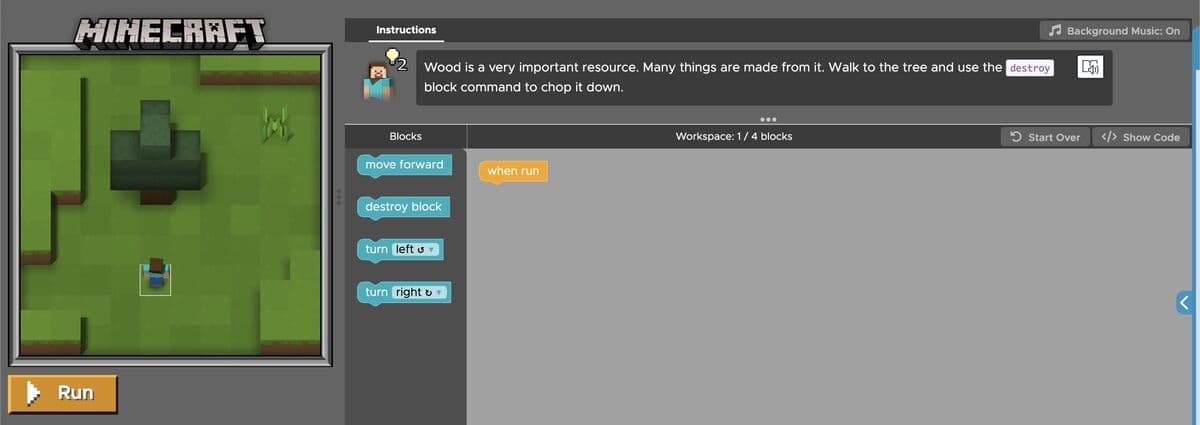
Debug the program by choosing the correct block sequence below.

Which Amazon website would serve Germany?
Which part of an email does the sender write the message they want to send?
Which email client, or program, does SICS use?
Which of these is NOT an operating system?
What does the CTRL+C shortcut do?
Which of these keys is located on the home row?
A ban is when a website or platform permanently removes a user's account.
Which of these Google apps is used for presentations?
It's okay to use the same password over and over again because it's easy to remember.
Which of these social media platforms was created by Mark Zuckerberg?
Justin.tv went on to become which popular streaming site in June of 2011?
What does clicking on this symbol do in a web browser?

Which of these is NOT a web browser?
Restarting your device can be helpful if the internet connection drops.
Revolutionising Education: Unleash AI to Spark Joy in the Classroom. What is Artificial Intelligence (AI)? • Definition: AI involves creating computer systems that can perform tasks typically requiring human intelligence. These include learning, reasoning, problem-solving, perception, and language understanding. • Examples in Everyday Life: From personal assistants like Siri and Alexa to more complex applications like predictive analytics in healthcare and autonomous driving. Two Types Artificial Intelligence (AI) • Generative AI: refers to a type of artificial intelligence technology that can generate new content, such as text, images, music, and videos. It leverages advanced algorithms to understand and replicate patterns from existing data, allowing it to create original outputs that mimic human-like creativity. Examples include models that can write like a human, generate realistic images from textual descriptions, or compose music. • Large Language Models: are a subset of Generative AI specifically designed to understand and generate human language. These models are trained on vast amounts of text data, which enable them to perform a variety of language-based tasks such as translation, summarization, answering questions, and even engaging in conversation. Notable examples include OpenAI's ChatGPT, Google Bard, and Microsoft Bing. AI in Education? • Enhancing Learning: AI can personalise learning based on individual student needs by adapting materials and pacing. • Automating Tasks: AI can automate administrative tasks like lesson planning and scheduling, allowing educators more time to focus on teaching and building relationships. Ethical Considerations? • Privacy and Security: Ensuring student data is protected and not misused. • Bias and Fairness: Developing AI systems that provide equal opportunities for all students and do not inherit or amplify biases. • Transparency and Accountability: Making AI decisions in education understandable and subject to checks and balances. Our Top 10 AI For Educators • Classroom conductor – ChatGPT - A versatile AI that assists teachers with emails, lesson plans, generating quiz questions, and example student pieces. • Digital Design Dynamo – Canva - With its AI Magic Media app, Canva helps create engaging visuals and videos, making digital design accessible. • Maetstro of Music – Suno - Instantly generates songs on any lesson topic or converts your lyrics into music, enhancing learning with tunes. • Teacher’s AI Ally – School AI - Focused on educator needs, it features tools for creating interactive exit tickets and engaging chat bots. • Differentiator – Diffit - Transforms PDFs and YouTube videos into differentiated worksheets and activities across languages and reading levels. • Quiz Master – Quizalize - Turns any content into quizzes or games, engaging students with interactive challenges based on lesson material. • Presentation Pro – Gamma - Helps create stunning presentations quickly, ideal for classroom use or professional meetings. • Interactive Lesson Launcher – Cruipod - Quickly generates interactive presentations for classroom use, integrating activities seamlessly into lessons. • Note-Taking Ninja – LLava - Produces study notes and quiz questions from any photo or image, simplifying study material generation. • Creative Story Spinner – StroyWizard - Enables teachers to create custom stories incorporating elements from their own classrooms, linking imagination with academic achievement.Phrasal Verbs with ComputersNew Trends in Agriculture Extension approaches Extension has been, and still is, under attack from a wide spectrum of politicians and economists over its cost and financing. As a result, Extension Systems have had to make changes, by restating the system’s mission, developing a new vision for the future, and formulating plans for the necessary transition to achieve the desired change. 1. Privatization of Agricultural Extension Service Privatization: Process of funding and delivering the extension services by private individual or organization is called Private Extension. Concept: Privatization of extension refers to services rendered in rural area & allied aspects of extension personnel working in private agencies or organization for which farmers are expected to pay a fee & it can be viewed as supplementary or alternative to public extension services (Sarvanan & Shivalinge 1980). Privatization approaches ➢ Share cropping system ➢ Village extension contract system ➢ Public extension through private delivery ➢ Service for vouchers Strengths of Private Extension System ➢ More demand - driven rather than supply – driven ➢ High quality of services in terms of satisfying information needs of clientele, trained manpower, sustained finances and resource allocation ➢ Provides for an information mix and choices available to farmers ➢ Enhanced efficiency of staff ➢ Assure continuous supply and quality agricultural products ➢ More effective because farmer can select an adviser who is the best able to help ➢ Healthy competition among service provider will lead to better quality and lower costs for service Weakness of Private Extension System ➢ Concentrate on area having favorable physical environment ➢ More face-to-face contacts (person oriented) ➢ Increased dependence of farmers and hence exploitation ➢ No education role ➢ Deprivation of small farmers ➢ Hamper the free flow of information 2. Cyber Extension or e-extension Concepts Cyber space: it is the imaginary or virtual space of computers connected with each other on Networks, across the Globe. Cyber extension: it means 'using the power of online networks, computer communications and digital interactive multimedia to facilitate dissemination of agriculture technology. Cyber Extension thus can be defined as the extension over cyber space. Important tools of cyber extension E-Mail, Telnet, File Transfer Protocol (FTP), Gopher, Archie and World Wide Web (WWW) Strengths of Cyber Extension ➢ Access to the astounding information and continuously available ➢ Information rich and instantaneously available of information ➢ Interactive communication ➢ The information is available from any point on the globe ➢ Communication is dynamic ➢ Cut steps from traditional process ➢ Save money, time and effort ➢ Multiplicity of purpose Issues and Concerns of Cyber Extension ➢ Lack of Reliable Telecom Infrastructure in Rural Areas ➢ Erratic or no Power Supply ➢ Lack of ICT Trained manpower (willing to serve) in Rural Areas ➢ Lack of content (locally relevant and in local languages) ➢ Lack of Information Services to Rural Clientele ➢ Low Purchasing power of the Rural communities ➢ Lack of Holistic Approaches ➢ Issues of Sustainability Application of cyber extension ➢ Village information shops Dr. M.S. SwaminathanResearch Foundation, Chennai ➢ Information villagers MANAGE in Ranga Reddy District in Andhra pradesh ➢ Gyandoot net initiative of District Dhar, Madhya Pradesh. ➢ Warna wired village of National Informatics Center (NIC) in Kolhapur- Sangli Districts of Maharashtra 3. Market-Led-Extension (MLE) Concepts Market: A congregation of prospective buyers & sellers with a common motive of trading a particular commodity. Extension: It is the spreading/reaching out to the mass Market-led-extension: Agriculture & economics coupled with extension is the perfect blend for reaching at the door steps of common man with the help of technology. Dimensions of market-led extension ➢ Marketing mix: A planned mix of the controllable elements of a product's marketing plan commonly termed as 4Ps: product, price, place, and promotion. These four elements are adjusted until the right combination is found that serves the needs of the product's customers, while generating optimum income. ➢ Marketing plan: A marketing plan is a comprehensive document that outlines a business and marketing efforts for the coming year. It describes business activities involved in accomplishing specific marketing objectives within a set time frame. A marketing plan also includes a description of the current marketing position of a business, a discussion of the target market and a description of the marketing mix that a business will use to achieve their marketing goals. ➢ Market Intelligence: It is the information relevant to a company’s markets, gathered and analyzed specifically for the purpose of accurate and confident decision making. Market intelligence includes the process of gathering data from the company’s external environment, whereas the business intelligence process is primarily based on internal recorded events – such as sales, shipments and purchases. ➢ Market oriented production ➢ Use of Technology Strengths of market-led extension ➢ SWOT analysis of the market ➢ Organization of Farmers’ Interest Groups (FIGs) ➢ Enhancing the interactive and communication skills of the farmers ➢ Establishing marketing and agro-processing linkages ➢ Advice on product planning ➢ Educating the farming community ➢ Direct marketing ➢ Acquiring complete market intelligence ➢ Publication of agricultural market information Production of video films of success stories ➢ Challenges to market-led extension ➢ Gigantic size of extension system ➢ Information technology Diverse conditions ➢ Market intelligence ➢ Reforms in agricultural extension system Government Initiatives ➢ Central warehousing Corporation-1965 ➢ MSP by Commission for Agricultural Cost and Price (CACP) ➢ Food Corporation of India ➢ Then some others as: Cotton Corporation of India (CCI), Jute Corporation of India (JCI), National Dairy Development Board (NDDB), Agriculture and Processed food Export Development Authority (APEDA) etc. 4. Farmer--Led-Extension (FLE) Farmer--led-extension is defined as 'the provision of training by farmers to farmers, often through the creation of a structure of farmer promoters and farmer trainers' (Scarborough et al., 1997). Philosophy and principles ➢ Farmers and local institutions (e.g. producer organizations or village leaders) should play a key role in selecting farmer-trainers and monitoring and evaluating them. This helps make the programmes more accountable to the community or groups that they serve. ➢ Farmer-trainers are ‘of the community’; they communicate in local languages and are more sensitive to local cultures, mannerisms, farming practices, and farmers’ needs. ➢ Farmer-trainers should be selected on the basis of their skills and interest in sharing information, not just on their farming expertise. ➢ Farmer-trainers need strong linkages with and support from development agents (whether government, non-government organization (NGO), or private), the people who train and backstop them. Farmer-trainers generally serve as a complement to existing extension systems, rather than being a substitute for them. ➢ Facilitating organizations and local institutions need to be proactive in ensuring that women as well as men become farmer-trainers. ➢ Simple and appropriate reference materials should be made available to the farmer trainers. Essential Elements of Farmer--led-extension ➢ The group ➢ The Field ➢ The Facilitator ➢ The curriculum ➢ Programme leader ➢ Financing Special features of Farmer--led-extension ➢ All learning is field based & it is primary venue for learning ➢ FLE group learning constantly over the experimentation period ➢ FLE promotes healthy decisions & quality decisions ➢ Farmers conduct their own field studies with comparisons or treatments ➢ Facilitates Farmer-to-Farmer communication ➢ Field staff serve as facilitators ➢ FLE is a unique way to educate farmers ➢ It is an effective platform for sharing of experiences and collectively solving agriculture related problems. 5. Expert system Expert system is an intelligent computer program that uses knowledge and inferences procedures to solve problems (Daniel Hunt, 1986). Objectives of developing expert system ➢ To enhance the performance of agricultural extension personnel and farmer ➢ To make farming more efficient and profitable ➢ To reduce the time required in solving the problems ➢ To maintain the expert system by continuously upgrading the database Advantages of expert system ➢ Solves critical problems by making logical deductions without taking much time ➢ It combines experimental and conventional knowledge with the reasoning skills of specialists ➢ To enhance the performance of average worker to the level of an expert Limitations of expert system ➢ Expensive computer program ➢ Mostly developed not in regional languages ➢ Requires AC power and internet connection all the time ➢ Complex software requires computer skilled personnel Modules of expert system in agriculture ➢ COMAX: Integrated crop management in cotton ➢ SOYEX: Soybean oil extraction expert system ➢ PLANT/ds: Diagnosis of soybean diseases ➢ MAIZE: Maize expert system for field crop management ➢ SEMAGI: Weed control decision making in sunflowers ➢ Rice Crop Doctor: Developed by National Institute of Agricultural Extension Management (MANAGE) Difference between conventional and expert system of extension Conventional Extension ➢ Universal approachability of same information is a problem ➢ Information is given whatever is available without considering needs and resources ➢ No Cost benefit analysis ➢ Information flow depends on availability of agent ➢ Require users to draw their own conclusion from facts Expert System of Extension ➢ Universal approachability of same information is possible ➢ Information is chosen based on their needs and resources ➢ Cost benefit analysis ➢ Information through Cyber Cafe at any place at any time ➢ Conclusion is drawn based on the decision given by the expertComplete with used to, didn't use to, comparatives and superlatives Cars __________________ (be) much simpler, but now they are __________________ (advanced) with electric and autonomous features. Computers ______________ (be) much larger and slower, but now they are __________ (small) and __________ (fast) than before. Social media ______________ (be) a way to connect with friends, but now it is one of the __________________ (popular) platforms for businesses and influencers. Televisions __________________ (have) bulky, heavy screens, but now they are __________________ (slim) and ______________ (light) with __________________ (good) picture quality. Cell phones __________________ (be) basic flip phones, but now they have __________________ (modern) features like facial recognition. Communication __________________ (rely) on landlines and snail mail, but now text messaging and email are ______________ (fast) and ______________ (easy). Robots __________________ (not be) common in healthcare, but now they are used in some of ______________________ (advanced) industries like healthcare. Means of transportation ________________ (include) cars or planes, but now they are the ________________ (fast) and ________________ (efficient). Medicine ________________ (be) limited to natural remedies, but now we have ______________________ (advanced) technology like robotic surgery. Daily tasks ________________ (take) more time and effort, but now gadgets are ______________________ (convenient) and ______________________ (time-saving). The film industry ________________ (use) digital effects, but now it has some of ______________ (progressive) technology for creating special effects. Light ________________ (not come) from LED bulbs, but now they are the ______________________ (energy-efficient) and ______________________ (long-lasting). The internet ______________________ (be) slow, but now we have the ________________ (fast) connections for streaming. Fashion ______________________ (not be) mass-produced, but now it is one of ______________________ (accessible) industries with online shopping. Music __________ (be) streamed online, but now it is __________ (convenient) to access through apps and devices.Computers have completely changed the way we live, learn, and work. We now live in the Information Age, a time when finding and sharing information is easier than ever before. With just a few clicks, we can learn about history, science, cooking, or almost anything we want. However, using computers too much can have negative effects, especially on our brains. Some studies show that people’s attention span is getting shorter because they are used to quick information. It can also be harder to remember things when we always rely on our phones instead of thinking deeply for ourselves. To keep your brain strong and healthy, it is important to take regular breaks from screens. Reading books, going for walks, and having face-to-face conversations can help. Technology is a wonderful tool, but it’s important to use it wisely and not let it replace real-world experiences.Match the word to its synonym level B1 CEFR. Use the vocabulary exactly adverb precisely except that aside from exist verb to be real existing adjective real, current Example: Flying cars are not practical with existing technology. existence noun reality Example: The existence of black holes has been confirmed by indirect observation. extraordinary adjective unusual feature noun important part of something Example: The Ramon Crater is a unique feature of the Negev Desert. feedback noun reaction figure noun shape Example: I can’t tell if that figure in the shadows is a man or a woman. figure out verb understand Example: I just can’t figure out how the magician did that amazing trick. financial adjective related to money Example: Her family is having financial problems so they can’t travel overseas this year. finance verb pay for Example: If I can’t get a loan from the bank, I won’t be able to finance a new apartment. finance noun money Example: An expert in finance predicts a global recession. finding/findings noun discoveries; results of a study Example: According to the findings of the police investigation, this is the gun which fired the fatal bullet. flexibility noun willingness to change flexible adjective adjusts easily Example: I’d prefer to meet on Monday morning but I can be flexible depending upon your schedule. flood noun a lot of water flood verb to cover with too much water flu noun type of sickness focus on/upon verb pay attention to Example: You should focus on your schoolwork if you want to improve your grades. focus noun attention People with attention deficit disorder lose focus easily. frequency noun how often frequent adjective very often Example: Hanah is a frequent customer and everyone at the store knows her. fresh adjective new Example: We need some fresh ideas if we’re going to solve this problem. frighten verb scare from preposition position, starting point gain verb make an increase, profit, earn Example: I have nothing to gain by choosing sides so I shall remain neutral. gain noun profit, amount earned generate verb create, make Example: Chat GPT can generate text written in any style you choose. guidance noun help, advice hopeful adjective optimistic, having a positive outlook Example: The farmers are hopeful that we will have rain this winter. hopefully adjective with luck ideal adjective best, most preferable Example: Nuclear power may not be an ideal solution to global warming, but it’s certainly worth considering. illness noun sickness, disease illustrate verb draw pictures illustration noun picture, image Example: Children’s storybooks have colorful illustrations. image noun picture, especially on film or television Example: The mother of the pop singer cried when she first saw her daughter’s image on television. in preposition within, inside, into in terms of regarding Example: That company makes a great product but they’re lacking in terms of customer service. in actual fact in truth Example: The mayor says the city is a safe place to live, but in actual fact the violent crime rate is very high. in connection with about Example: Police arrested four men in connection with the robbery. in that case if that is true Example: Billy Bob: “Traffic could be heavy tomorrow.” Peggy Sue: “In that case, we better leave early.” in the meantime while, during Example: The new computers won’t arrive until next week, but we can keep using the old ones in the meantime. initial adjective first Example: Her initial reaction to that song was negative, but over time she’s come to like it. initially adverb at first instruction noun teaching, order Example: Most new electronic devices come with a set of instructions. intelligence noun smartness Example: Since you have a degree from a good university, I assume you have sufficient intelligence to understand this problem. intelligent adjective smart Example: Joe isn’t very intelligent, but he is a kind person with a warm heart. interest noun attraction Example: Yossi has little interest in politics, whereas his wife goes to all the protests and demonstrations. interest verb to attract Example: Sports don’t really interest me, but my brother is a big basketball fan. introduce verb to show something new Example: Today in class I will introduce the basic concepts of literary analysis. invest verb to put money into something in order to earn money Example: Joe invested in cryptocurrency and lost a lot of money. investor noun one who puts money into something in order to earn money Example: Venture capitalists are investors who put money into risky start-up businesses. investment noun putting money into something in order to earn money Example: Buying real estate in Israel is a very safe investment because the value never goes down. investigate verb research, study Example: The police collected evidence to investigate the murder. investigation noun study Example: The police don’t have a suspect for the murder as the investigation isn’t finished yet. investigator noun detective Example: Detective Schmendrick is the lead investigator for the murder case. just about almost Example: I’m just about done here so I’ll be there shortly. keep on doing verb continue Example: You’re crazy if you keep on doing the same thing and expect different results. kind of type of Example: What kind of dog is that, a poodle? knowledge noun awareness Example: John failed the test due to lack of knowledge of the material. lack verb not having, missing Example: John failed the test due to lack of knowledge of the material. landscape noun the view of the land likely adjective, adverb probably Example: When we learn from our mistakes, we’re not likely to forget. limited adjective restricted Example: We should go to the store today because the sale is for a limited time only. limitation noun restriction little adjective small, not a lot Example: She always tells the truth. I have little reason to doubt her. look at verb see Example: People used to read newspapers on the train. Nowadays they just look at their phones. low adverb to a small amount or level Example: I have to charge my phone because the battery is running low. material noun documents, information Example: We have a lot of material to cover before the end of the semester. meaning noun significance mean verb to have significance or purpose means noun form of, by the use of Example: They communicate by means of radio. measure noun step Example: The teacher took measures to prevent cheating during the test mention verb to say, point out Example: The coach said the team played very well today but didn’t mention any player specifically. miss verb (1) fail to catch (2) wishing to see somebody Examples: (1) The football player kicked the ball but missed the goal. (2) Wow, it’s good to see you! I’ve missed you so much! misunderstand verb understand incorrectly Example: I’m afraid I misunderstood the instructions. Could you repeat them please? more or less approximately, somewhat, to a varying degree Example: This is more or less a religious neighborhood, though there are a few secular families. must modal verb have to naturally adverb as expected, normally nature noun (1) open air (2) character Examples: (1) We like to go hiking in nature reserves. (2) Pit bulls are aggressive by nature.Of the 7 billion people on Earth roughly 0:02 6 billion own a cell phone which is 0:05 pretty shocking given that only 4 and2 0:07 billion have access to a working toilet 0:09 so how are these popular gadgets 0:11 changing your body and brain If you're 0:13 looking down at your phone right now 0:15 your spine angle is equivalent to that 0:17 of an 8-year-old child sitting on your 0:19 neck which is fairly significant 0:21 considering people spend an average of 0:23 4.7 hours a day looking at their phone 0:26 this combined with the length of time 0:28 spent in front of computers has led to 0:30 an increase in the prevalence of myopia 0:32 or nearsightedness in North America in 0:34 the 1970s about one quar of the 0:36 population had myopia where today nearly 0:39 half do and in some parts of Asia 80 to 0:41 90% of the population is now nearsighted 0:44 and it can be hard to put your phone 0:46 down take for example the game Candy 0:48 Crush as you play the game you achieve 0:50 small goals causing your brain to be 0:52 rewarded with little bursts of dopamine 0:54 and eventually you're rewarded in the 0:56 game with new content this novelty also 0:58 gives little bursts of dopamine and 1:00 together create what is known as a 1:01 compulsion Loop which just happens to be 1:04 the same Loop responsible for the 1:05 behaviors associated with nicotine or 1:07 cocaine our brains are hardwired to make 1:10 us novelty seeking and this is why apps 1:12 on our phones are designed to constantly 1:14 provide us with new content making them 1:16 hard to put down as a result 93% of 1:19 young people aged 18 to 29 report using 1:21 their smartphone as a tool to avoid 1:23 boredom as opposed to other activities 1:26 like reading a book or engaging with 1:27 people around them this has created a 1:29 new term nomophobia the fear or anxiety 1:32 of being without your phone we also see 1:35 a change in brain patterns Alpha rhythms 1:37 are commonly associated with wakeful 1:39 relaxation like when your mind wanders 1:41 off whereas gamma waves are associated 1:44 with conscious attentiveness and 1:46 experiments have shown that when a cell 1:47 phone is transmitting say during a phone 1:49 call the power of these Alpha Waves is 1:52 significantly boosted meaning phone 1:54 Transmissions can literally change the 1:56 way your brain functions your smartphone 1:58 can also disrupt your sleep the screen 2:00 emits a blue light which has been shown 2:02 to alter our circadian rhythms 2:03 diminishing the time spent in deep Sleep 2:06 which is linked to the development of 2:07 diabetes cancer and obesity Studies have 2:10 shown that people who read on their 2:11 smartphone at night have a harder time 2:13 falling asleep and produce less 2:15 melatonin a hormone responsible for the 2:17 regulation of sleep wake Cycles Harvard 2:20 medical school advises the last 2 to 3 2:22 hours before bed be technology free so 2:24 pick up a book before bed instead of 2:26 course smartphones also completely 2:28 change our ability to access information 2:30 most notably in poor and minority 2:32 populations 7% of Americans are entirely 2:35 dependent on smartphones for their 2:37 access to the internet a 2014 study 2:40 found that the majority of smartphone 2:41 owners use their phone for online 2:43 banking to look up medical information 2:45 and searching for jobs so while phones 2:47 are in no way exclusively bad and have 2:50 been part of a positive change in the 2:51 world there's no denying that they are 2:53 changing us but many successful people 2:56 have now decided to take smartphone 2:58 vacations in order to increase 3:00 productivity in our new ASAP thought 3:01 video we break down the top six reasons 3:04 you should take a smartphone vacation 3:06 and how it could benefit your life right 3:08 now and subscribe for more weekly 3:09 science videosGot it ✅ I’ll create 4 simple sections of assignments based on these two pages (1.1 What is a network? and 1.2 Network connections). Total marks = 25. Suitable for Oxford International Primary Computing Grade 5. --- Assignment – Computer Networks Grade 5 – Total Marks: 25 --- Section A: Choose the Correct Answer (6 marks) Circle the correct option. Each question = 2 marks. 1. A group of computers connected together is called a: a) Website b) Network c) Software 2. Which type of network connects computers inside a school? a) LAN b) WAN c) Wi-Fi 3. To use a network safely, you need: a) A strong password b) A printer c) A hotspot --- Section B: Fill in the Blanks (6 marks) Each correct answer = 2 marks. 1. We can use a network to share files and ________. 2. A wireless connection is also called ________. 3. Network ________ help devices work together. --- Section C: Short Answer Questions (7 marks) 1. Write two advantages of using a network. (2 marks) 2. What is the difference between a wired connection and a wireless connection? (2 marks) 3. Write one rule to keep your password safe. (1 mark) 4. Create a strong password example using numbers and symbols. (2 marks) --- Section D: Activity / Problem Solving (6 marks) 1. Web Valley School has 60 network connections. Each cable is 50 meters long. How many meters of cable are used in total? (2 marks) 2. Convert your answer into kilometers. (2 marks) 3. Why is it important to hide or lock network equipment? (2 marks) --- ✅ Total = 25 marks --- Would you like me to also make a teacher’s marking guide with answers and mark distribution?