
placeholder image to represent content

Continuous Class Test Surgery and Microbiology 19 Dec 2024

Quiz by Abhijit

Our brand new solo games combine with your quiz, on the same screen

Correct quiz answers unlock more play!

New Quizalize solo game modes
20 questions
Show answers
  • Q1
    In your clinical posting, you notice a patient newly diagnosed with human immunodeficiency virus (HIV). The patient asks what would determine the actual development of acquired immunodeficiency syndrome (AIDS). The your response is based on the knowledge that what is a diagnostic criterion for AIDS?
    Presence of HIV antibodies
    White blood cell (WBC) count below 5000/µL
    CD4 +T cell count below 200/µL
    Presence of oral hairy leukoplakia
    60s
  • Q2

    A 34-year-old woman presents to the clinic after recently being diagnosed with human immunodeficiency virus (HIV) following a routine screening test.

    She reports feeling well and denies fever, weight loss, night sweats, or gastrointestinal issues. She had genital herpes in past. She has had multiple sexual partners in the past, with inconsistent condom use. She has no history of intravenous substance use. 

    Temperature is 37°C (98.6°F), pulse is 80/min, respiratory rate is 18/min, blood pressure is 132/84 mmHg, and oxygen saturation is 99% on room air. Physical examination is unremarkable. 

    Laboratory results are reviewed and confirm the diagnosis of HIV infection with antibodies to HIV-1 detected on an HIV-1/HIV-2 antibody differentiation immunoassay. CD4 count is 500 cells/µL. Viral load is pending. Hepatitis B and C and pregnancy testing is negative. 

    What is the best next step in management?

    Start two nucleoside reverse transcriptase inhibitors (NRTIs) and an integrase strand transfer inhibitor (INSTI)
    Begin protease inhibitor (PI) monotherapy
    Await viral load results and start antiretroviral therapy (ART) if >5000 copies/mL  

    Perform confirmatory HIV Western blot testing

    Start two non-nucleoside reverse transcriptase inhibitors (NNRTIs) 
    60s
  • Q3

    A 28-year-old woman presents to the primary care clinic for a routine check-up. She reports feeling well and has no concerns. The patient is sexually active with one partner and uses condoms regularly. She does not have fever, fatigue, weight loss, night sweats, vaginal discharge, or gastrointestinal issues.

    Her past medical history is unremarkable, and she has no known chronic illnesses. For the last three months, the patient has been using intravenous opiates. Vitals are within normal limits. There is no pharyngeal erythema, oral lesions or cervical lymphadenopathy.

     Cardiopulmonary examination is within normal limits. No rashes are seen on the skin. 

    Which of the following is the best next step in management?

    CD4 counts
    HIV Western blot testing
    Qualitative HIV-1 nucleic acid test (NAT)
    HIV-1/2 antigen/antibody combination immunoassay
    60s
  • Q4
    What about Oral hairy leukoplakia is true?
    Usually occurs on cheeks Tongue
    It can be scrapped off easily
    Appears as black plaques with hair-like projections
    Caused by EBV
    60s
  • Q5

    A patient presents to a local clinic complaining of unilateral weakness on the right side and diplopia. He has a history of AIDS, with a recent CD4+ T cell count of 52 cells/microL. MRI of the head shows multifocal white matter lesions.  Cerebrospinal fluid PCR is positive for a non-enveloped, double-stranded DNA virus.

    Which of the following is the most likely cause of this patient’s presentation?
    Cerebral toxoplasmosis
    Primary multifocal leukoencephalopathy

    Herpes encephalitis

    Cytomegalovirus encephalitis
    Primary CNS lymphoma
    60s
  • Q6
    A 32-year-old primigravid woman at 34-weeks of gestation comes to the office for her first visit. She has not had vaginal bleeding or cramping. The patient has a history of intravenous drug use, including heroin. She does not use tobacco or alcohol. The patient had sexual intercourse with an HIV-infected individual one year ago and did not receive post-exposure prophylaxis. The patient’s blood type is AB positive. Temperature is 37.0°C (98.6°F), pulse is 99/min, respirations are 20/min, and blood pressure is 110/75 mmHg. Physical examination reveals anterior and posterior cervical lymphadenopathy. Ultrasound confirms a 34-week intrauterine pregnancy. The toxicology screen is negative. After birth, which of the following is the most appropriate diagnostic investigation to obtain for suspected neonatal human immunodeficiency virus (HIV)?
    HIV Antigen-antibody immunoassay
    Anti-D immunoglobulin assay
    No further workup for the mother or fetus
    Nucleic acid amplification test for HIV RNA
    60s
  • Q7
    A 65-year-old man comes with three weeks of a dry cough, shortness of breath, and fever. The patient has noted significant weight loss (10 lb) over the last nine months. He has dyslipidemia, HIV, and CMV retinitis. The patient is noncompliant with antiretroviral therapy (tenofovir-emtricitabine and dolutegravir and atorvastatin). The patient is sexually active with men and uses condoms inconsistently. The patient does not use intravenous drugs, alcohol, or tobacco. The patient owns two parrots and a cat. Temperature is 38.11°C (100.0°F), pulse is 121/min, respirations are 26/min, and blood pressure is 98/75 mmHg, SpO2 is 89% on room air. The patient is using accessory muscles of respiration. Physical examination reveals anterior and posterior cervical lymphadenopathy. Oral examination reveals white, mucosal plaques on the lateral aspect of the tongue that cannot be scraped off with a tongue depressor. Rales are present in the bilateral anterior lung fields. A CT of the patient’s chest is depicted below.  CD4 count is 157 cells/microL. Which of the following organisms is the most likely etiology of this patient’s current disease process?
    Pneumocystis jiroveci
    Mycobacterium avium
    Cytomegalovirus
    Cryptococcus neoformans
    60s
  • Q8
    A 22-year-old man comes to the clinic with a history of fatigue and a sore throat that began three days ago. The patient is sexually active and uses condoms inconsistently. Temperature is 38.11°C (100.6°F), pulse is 99/min, respirations are 20/min, and blood pressure is 120/75 mmHg. Physical examination reveals anterior and posterior cervical lymphadenopathy. Oral examination reveals mucocutaneous ulcers on the tongue, oral mucosa and palate, and white mucosal plaques. Pharyngeal edema and hyperemia are present without exudates or tonsillar enlargement. He is found to be HIV-2 positive with a CD4 count of 500 cells/microL. The patient is initiated on therapy with an integrase inhibitor. Which of the following therapies was most likely provided?
    Efavirenz
    Indinavir
    Dolutegravir

    Tenofavir

    Zidovudine
    60s
  • Q9
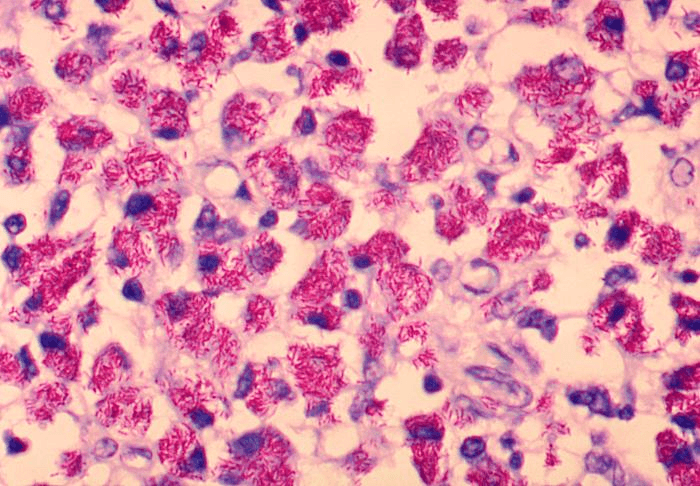
    A 35-year-old man comes with a two-week history of fever, night sweats, abdominal pain, and diarrhea. Three years ago, the patient was diagnosed with HIV-AIDS and refused treatment. He does not have a history of travel outside the United States. Vitals are normal. Physical examination reveals conjunctival pallor, anterior, cervical, inguinal, and axillary lymphadenopathy. Oral examination reveals white, mucosal plaques on the lateral aspect of the tongue that cannot be scraped off. Laboratory studies: Hemoglobin is 9g/dL, WBC:13,100 /mm3, Platelets: 100,000/mm3, Alkaline phosphatase: 207 U/L, Lactate dehydrogenase (LDH): 421 U/L, CD4+T cell: 42 cell/microL, HIV viral RNA quantity: 4851 copies/ml and Interferon gamma release assay (IGRA) is undetectable. CT of the abdomen and pelvis reveals ascites, mesenteric and periaortic lymphadenopathy, and bowel wall thickening. A biopsy specimen of an axillary lymph node is shown below. Which of the following is the most likely diagnosis?
    Question Image
    Mycobacterium avium infection
    Pneumocystis jirovecii infection
    Latent tuberculosis
    Toxoplasmosis gondii infection
    60s
  • Q10
    A man comes to his physician regarding the initiation of pre-exposure prophylaxis (PReP) therapy for HIV. The physician prescribes a medication that inhibits the reverse transcriptase enzyme found in HIV. Which of the following HIV genes is involved in producing this enzyme?
    pol
    vpu
    env
    gag
    60s
  • Q11
    A group of researchers is studying cells resistant to infection by HIV. They notice there is a mutation in the protein CCR5 that confers immunity. Which of the following HIV proteins is unable to bind to host cells because of this mutation?
    Integrase
    Gp120

    Gp160

    p17
    P24
    60s
  • Q12
    A patient with human immunodeficiency virus (HIV) is educated about health promotion activities. What should the nurse inform the patient the importance of these activities is all except?
    Delaying disease progression
    Helping to cure the HIV infection
    Enabling an increase in self-care activities
    Preventing disease transmission
    60s
  • Q13
    In your clinical posting, you are attending a patient who is recently diagnosed human immunodeficiency virus (HIV)-positive. The resident is educating the patient about CD4 T cells. Which statement will be a part of the resident’s teaching?
    "HIV will destroy your CD4 cells and overwhelm your body."
    "Immune problems occur when your CD4 level is greater than 500 CD4 T cells/mm3."
    "Your immune system is healthy as long as you have CD4 cells."
    "HIV produces CD4 cells to cause your infections."
    60s
  • Q14
    A 58-year-old diabetic and hypertensive individual with a history of chronic kidney disease presents to the physician to discuss the option of kidney transplantation. The patient developed renal failure secondary to glomerulosclerosis 15 years ago. The patient underwent a successful kidney transplantation 10 years ago from a related donor, but the transplant failed and was removed three years ago. The patient is currently on hemodialysis. After significant deliberation, the patient undergoes a kidney transplantation from a non-related donor. Eight hours after the surgery, the patient develops chills, malaise, and fever. Temperature is 38.5°C (101.3°F), blood pressure is 104/70, and pulse is 102/minute. The patient has not made urine in the past five hours. The surgeon suspects complications with the transplanted organ, and the patient is brought back to the operating room. On open laparotomy, the transplanted kidney appears mottled and cyanotic. Which of the following best describes the pathophysiology of this patient’s condition?
    Mixed type II and IV hypersensitivity reaction
    Type I hypersensitivity reaction
    Type II hypersensitivity reaction
    Type IV hypersensitivity reaction

    Type III hypersensitivity reaction

    60s
  • Q15
    A 25-year-old individual is brought to the emergency department by a friend after the patient was stabbed in the abdomen in a bar fight. Upon arrival, the patient’s temperature is 36.4°C (97.5°F), pulse is 116/min and blood pressure is 108/80 mmHg.  The patient has facial pallor with a visible stab wound in the left upper quadrant of the abdomen. The patient is immediately resuscitated in the emergency department and is given 2 units of blood. Several minutes after the transfusion, the patient begins having severe itching and scattered hives all over their body. The patient’s blood pressure drops to 60/40. The transfusion is immediately stopped; the patient is given fluids, antihistamines, and intramuscular epinephrine, and the patient’s blood pressure begins to normalize. Which of the following is most likely to be found on further evaluation of this patient’s blood serum?
    Circulating antibody-antigen complexes
    Presence of Anti-IgE antibodies
    Bacterial contamination of the transfused blood

    Hypocalcaemia

    Presence of Anti-IgA antibodies
    60s

Teachers give this quiz to your class