Tag the questions with any skills you have. Your dashboard will track each student's mastery of each skill.
Give this quiz to my class
Q 1/59
Score 0
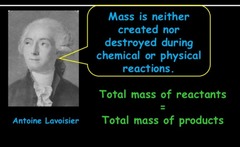
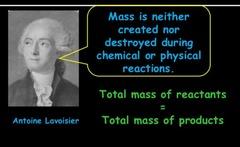
This states that the mass of what you end with is always the same as the mass of what you started with. Mass is NEVER destroyed or created during a physical or chemical change.
20
The Law of Conservation of Gases
The Law of Conservation of Solids
The Law of Conservation of Mass/Matter
The Law of Conservation of Life
Q 2/59
Score 0
You can classify substances based on their physical and chemical properties. It is more difficult to classify based on ___ properties because you would have to change the substance.
30
physical
chemical
59 questions
Q.
This states that the mass of what you end with is always the same as the mass of what you started with. Mass is NEVER destroyed or created during a physical or chemical change.
1
20 sec
Q.
You can classify substances based on their physical and chemical properties. It is more difficult to classify based on ___ properties because you would have to change the substance.
2
30 sec
Q.
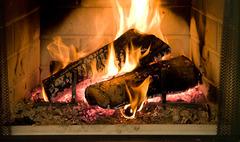
Sign of a chemical or physical change: production of heat
3
30 sec
Q.
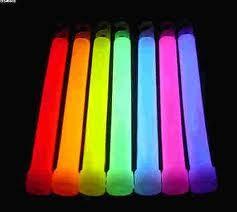
Sign of a chemical or physical change: production of light
4
30 sec
Q.
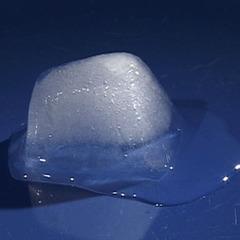
Sign of a chemical or physical change: change of state Example. an ice cube melting into water
5
30 sec
Q.
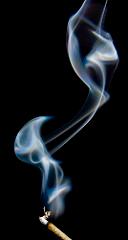
Sign of a chemical or physical change: production of smoke
6
20 sec
Q.
Sign of a chemical or physical change: sawing a piece of wood in half
7
20 sec
Q.
How easily something will burn; a chemical property
8
20 sec
Q.
Sign of a chemical or physical change: an old car that has rusted
9
20 sec
Q.
The shine of metal; physical property
10
20 sec
Q.
The ability of a metal to be shaped into something else without breaking; physical property
11
20 sec
Q.
The ability of a metal to be drawn into wires; physical property
12
20 sec
Q.
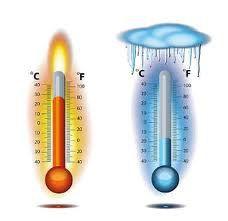
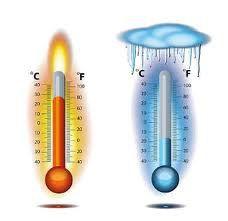
freezing point of water on the Celsius scale
13
20 sec
Q.
freezing point of water on the Fahrenheit scale
14
20 sec
Q.
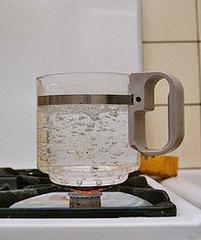
boiling point of water on the Celsius scale
15
20 sec
Q.
boiling point of water on the Fahrenheit scale
16
30 sec
Q.
The temperature at which water boils is called its ___.
17
20 sec
Q.
The temperature at which water freezes is called its ___.
18
20 sec
Q.
Particles of matter move ___ as higher temperatures are applied.
19
20 sec
Q.
In this state of matter, molecules of the substance are moving very quickly. They totally fill the space of the container. They exert pressure in all directions.
20
20 sec
Q.
In this state of matter, molecules of the substance have a very definite geometric shape/form; hardness. The molecules only vibrate.
21
20 sec
Q.
In this state of matter, molecules of the substance have broken away from each other and are sliding past one another. They take the shape of the container. They have the ability to flow.
22
20 sec
Q.
This state of matter is found in the interior of stars, neon lamps, fluorescent lamps, and lightning. It results when atoms in a gas become electrically charged.
23
20 sec
Q.
This is the attraction the particles of fluid have for each other and causes them to pull toward one another. This creates the "skin" of the fluid.
24
20 sec
Q.
The buoyancy of an object depends on these 2 things.
25
30 sec
Q.
How tightly packed the particles in an object are
26
20 sec
Q.
The density of a material will stay the same as long as these 2 factors stay the same.
27
30 sec
Q.
Anything that has mass and volume (takes up space)
28
20 sec
Q.
TRUE or FALSE: Whatever you weigh on the Earth, you will weigh the same amount on the moon.
29
10 sec
Q.
TRUE or FALSE: Your mass will be the same on Earth as it is on Jupiter.
30
10 sec
Q.
The amount of matter (STUFF) in an object.
31
20 sec
Q.
The measure of how strongly gravity pulls on an object.
32
20 sec
Q.
The measure of how much space matter takes up.
33
20 sec
Q.
The resistance to sinking; the upward force that keeps things afloat.
34
20 sec
Q.
Tells us if an object has a north and south pole and attracts certain object.
35
20 sec
Q.
Tells us whether or not objects conduct or insulate electricity.
36
20 sec
Q.
Tells us whether or not objects conduct or insulate heat energy.
37
20 sec
Q.
measures mass
38
10 sec
Q.
measures liquid volume
39
10 sec
Q.
measures mass
40
10 sec
Q.
measures weight
41
10 sec
Q.
measures liquid volume
42
10 sec
Q.
measures mass
43
10 sec
Q.
Mathematical formula used to determine the volume of a cube or a rectangular prism.
44
20 sec
Q.
Units used to measure mass
45
20 sec
Q.
Units used to measure liquid volume
46
20 sec
Q.
A procedure used to determine the volume of an unusually shaped object by placing it in a graduated cylinder of liquid to see how far the column of water rises.
47
20 sec
Q.
Volumes of solids are usually measured in this unit.
48
20 sec
Q.
1 cubic cm = 1 ___
49
20 sec
Q.
A change in the identity of a substance due to the chemical properties of that substance. A NEW SUBSTANCE(S) ARE FORMED AS A RESULT.
50
30 sec
Q.
The physical properties of a substance change, but the IDENTITY OF THE SUBSTANCE DOES NOT CHANGE.
51
30 sec
Q.
Any CHARACTERISTIC of a material that can be observed or measured without changing the identity of the material.
52
30 sec
Q.
Any CHARACTERISTIC that gives a substance the ability to undergo a change that results in a new substance.
53
30 sec
Q.
These are the 2 properties related in the measurement of density.
54
30 sec
Q.
Ability to react with oxygen, ability to react with light, ability to react with water are all examples of ___ .
55
20 sec
Q.
1,000 grams = ____ kilogram
56
20 sec
Q.
1,000 ____ = 1 liter
57
20 sec
Q.
This piece of equipment is used to find the mass of objects by comparing the amount of matter in a sample to standard amounts.
58
20 sec
Q.
This property of matter measures how hot/cold the object is.