Loading...


Cranial Nerve Lecture Questions
Quiz by Jenny Ousley
Tag the questions with any skills you have. Your dashboard will track each student's mastery of each skill.
When a physician examines the corneal reflex in a patient, they rapidly touch the cornea with a wisp of cotton that causes the eyelid to rapidly shut. As with most reflexes, one is testing both the afferent information that is carried back to the central nervous system and the reflex motor response. What specific cranial nerve branches are responsible for both the afferent and efferent parts of the corneal reflex?
A 53 y/o woman has paralysis of the right side of her face that produces an expressionless and dropping appearance. She is unable to close her right eye, has difficulty chewing and drinking, perceives sounds as annoyingly intense in her right ear, and experiences some pain in her right external auditory meatus. Physical exam reveals loss of the blink reflex in the right eye on stimulation of either cornea and loss of taste from the anterior ⅔ of the tongue on the right. The inability to close the right eye is the result of involvement of which of the following?
A 53 y/o banker develops paralysis on the right side of his face, which produces an expressionless and drooping appearance. He is unable to close the right eye and also has difficulty chewing and drinking. Examination shows loss of the blink reflex in the right eye to stimulation of either right or left cornea. Lacrimation appears normal on the right side, but salivation is diminished and taste is absent on the anterior ⅔ of the tongue. There is no complaint of hyperacusis. Audition and balance appear to be normal. Where is the lesion located?
A patient is observed to suffer from hypoglossal hemiplegia. There is atrophy of the tongue on the right side and deviation of the protruded tongue to the right. In addition, the patient exhibits upper motor neuron paralysis on the left side of the body. Deviation of the tongue toward the right involves which one of the following?
A woman is found to have internal (medially directed) strabismus of the left eye, paralysis of the muscles of facial expression on the left side, hyperacusis of the left ear, and loss of taste from the anterior ⅔ of her tongue on the left. Her mouth is somewhat drier than normal. In addition, there is lack of tearing in her left eye, and a blink reflex cannot be elicited from the stimulation of either the right or left cornea. She has upper motor neuron paralysis of the right side of her body. Internal strabismus results from paralysis of which one of the following cranial nerves?
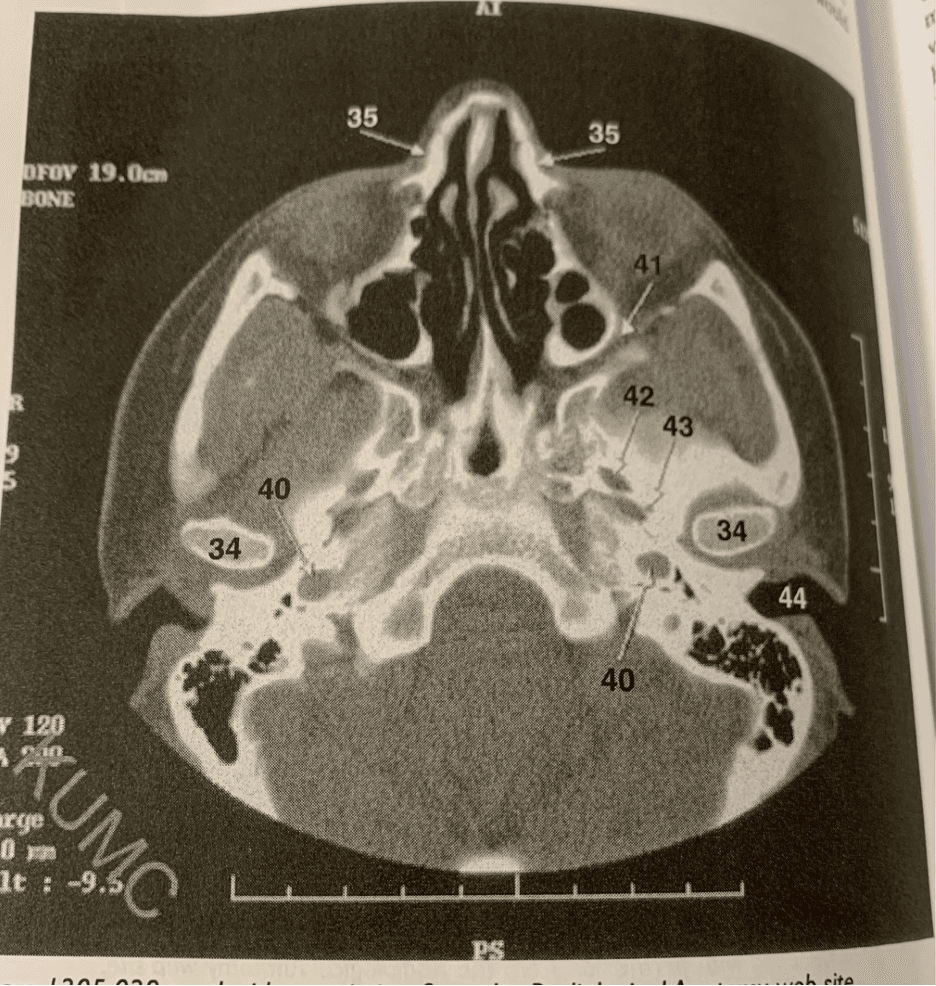
A 42 y/o M is involved in a motor vehicle accident which causes a fracture to the base of the skull with compression of the structure that passes through foramen 42. Which of the following actions would most likely be lost or weakened?
A 32 y/o F was brought into the ED from a car accident. She was conscious, but had been knocked unconscious for a couple of minutes by the force of a car that had run a stop sign, broad-siding her vehicle. She has a hematoma over the parietal bone on the left side of her head. She complains of a stiff neck and tilts her head slightly to the right. While performing a cranial nerve examination, it is noted that her left eye has difficulty moving inferiorly from a fully Adducted horizontal position, when she looks down at her feet. A head CT is ordered with specific imaging of which one of the following cranial nerves?
An 87 y/o M is having difficulty swallowing and often chokes on his food. You check his gag reflex by touching the posterior ⅓ of his tongue and palatine tonsil area. Which one of the following cranial nerves provides the afferent limb of the gag reflex?
A 73 y/o M presents because of repeated biting of his tongue and cheek and difficulty chewing. The left side of his tongue is somewhat swollen and he has two different cuts on it. His left cheek is slightly less full over the angle of the mandible compared to the right side. He has very little sensation over his left mandible, along the side of his head, and on the left side. taste sensation on his tongue is normal. He also complains of slight dryness on the left side of his mouth. The rest of his cranial nerve exam is normal. A head CT is ordered because his physician suspects which one of the following?
A 93 y/o nursing home patient is seen during morning rounds. She is quite upset because she awoke with double vision and an inability to open her left eye completely. Her physician performs a complete cranial nerve exam. Her left eye, under her drooping eyelid, is dilated and rotated down and outward. It lacks the normal pupillary reflex. There is no evidence of papilledema in either eye. The rest of the cranial nerve exam is normal. Which one of the following is the most likely explanation for this condition?
A 68 y/o F presents to the ENT clinic because of a small lump on her right side of her face just anterior to her ear. At first it is thought to be an enlarged lymph node, but careful examination of her ear and scalp fails to confirm the diagnosis. The small lump appears to be within the superficial portion of the parotid salivary gland, anterior to the external ear and posterior to the masseter muscle. A needle biopsy of the lump is performed and sent for pathological assessment. The diagnosis is a pleomorphic adenoma of the parotid gland. The tumor needs to be surgically removed. Which one of the following is a serious potential risk of the surgical resection procedure?