Loading...


DIAGNOSTIC EXAMINATION IN DISASTER READINESS AND RISK REDUCTION (PART 1)
Quiz by YSABEL ANGELA EMBILE
Tag the questions with any skills you have. Your dashboard will track each student's mastery of each skill.
Which refers to the serious disruption of the functioning of a community or a society involving widespread human, material, economic, or environmental losses and impacts which exceeds the ability of the affected community or society to cope using its own resources?
Which of the following is NOT true about disasters?
Ms. Selina, a key official in the province of Marquesa that is recently hit by a strong typhoon, seemed to be unwilling to assume her roles and responsibilities in protecting rights and providing basic services to the people in their community. Which risk factor underlying disaster is displayed in such a situation?
Brgy. Hulsan is a community that suffers multiple sorts of flooding every year. In most cases, part of the affected communities are forced to leave their homes and livelihoods to search for better living conditions. As an effect of a disaster, this is as example of _____________.
Calamities are phenomena that cause great damage in a community infrastructure, its people and their properties. To avoid the damaging effects of disasters, Engr. Winston ensures that building projects meet the structural safety, fire protection and assures compliance with required building regulations and standards. Which of the perspectives of disaster is closely related to the job of Engr. Winston?
Which best describes an economic vulnerability?
What does the statement “Vulnerability is hazard specific” mean?
Urban areas, especially the cities, have been hit hardest by Covid-19. Why have big cities around the world become coronavirus hotspots?
Which of the following communities is the most vulnerable to hazards?
Joey, an MDRRMO employee and a resident of the municipality of Silaw, conducts a study about the devastation the residents experience due to their exposure to frequent flooding. His study revealed that exposure in high-hazard areas is climbing. He concluded that if this trend is not reversed, disaster risk is bound to increase. He sought the help of their department head to submit his findings to their municipal mayor. He recommended that the residents should work together to reduce exposure and build capacity and resilience. How can they reduce exposure to hazards?
The ammonia leak at the TP Marcelo Ice Plant and Cold Storage left two people dead and dozens hospitalized in Navotas on February 3, 2021. Which category of man-made hazard such an incident belongs?
In which of the following situations could a physical event become a natural hazard?
Sofia’s teacher made an instruction that they have to draw the scenario that she will dictate to the class. This is the scenario that her teacher dictated.
"There are ten houses in Sitio Amco. Five of the houses made of medium-built materials are unroofed, some with collapsed walls and extensive damage to doors and windows. Three houses of first-class materials are partially damaged. There are six trees surrounding the houses and the twigs of some trees are broken. The clouds look grey and it’s raining a lot. "
What can Sofia conclude from drawing the scenario that her teacher dictated?
Every year, millions of people are affected by disasters around the world. The vulnerability of a community depends on multiple factors. How can we reduce damage caused by different kinds of hazards ?
Natural disasters are traumatic and horrific events that can completely change the course of people’ s lives and can cause Post-Traumatic Stress Disorder (PTSD). This disorder falls under which effect of disaster?
Which earthquake-related hazard results when a heavy load on top of the sediment body either sinks or tilts as the sediment could no longer hold the load, such as what happened in Dagupan City during the July 16, 1990 earthquake?
To mitigate the effect of the tsunami, the community should be aware of the natural signs that they might observe. The natural signs of an approaching tsunami are the following EXCEPT
What does it mean by the statement, “Earthquakes don’t kill people, buildings do”?
When an earthquake is strong, it is generally felt by most people. Some are frightened while some run outdoors and panic. If you were walking on your way home from school and suddenly, a strong earthquake occurred, what appropriate action should you do to avoid getting hurt?
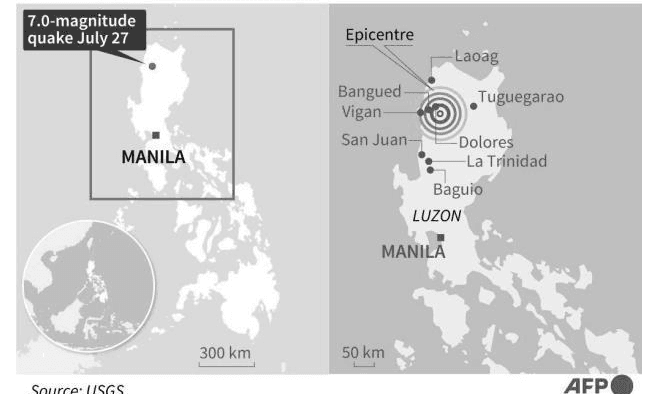
The map shows the areas affected by the earthquake that struck the northern Philippines on July 27, 2022. If the 7.0-magnitude quake had its epicenter in Abra, where would most likely a strong ground shaking must have been felt?
I. Laoag, Ilocos Norte II. La Trinidad, Benguet III. Metro Manila IV. Vigan, Ilocos Sur
Lava flows rarely threaten human life because lava usually moves slowly. But why are they still dangerous?
When Mount Pinatubo erupted in 1991, it produced high-speed avalanches of pyroclastic flows and a cloud of volcanic ash. The passing of typhoon Diding (Yunya) prompted flows of mud and debris, into the major river channels, affecting the communities downstream. Which refers to the rapidly flowing thick mixture of volcanic sediments and water, usually triggered by intense rainfall during typhoons, monsoons and thunderstorms?
It is important to observe warning signs of volcanic unrest so that people can evacuate on time and to minimize injuries and casualties. People living near volcanoes may notice unusual volcanic activities before a volcano erupts. Which is NOT a premonitory event before a volcanic eruption?
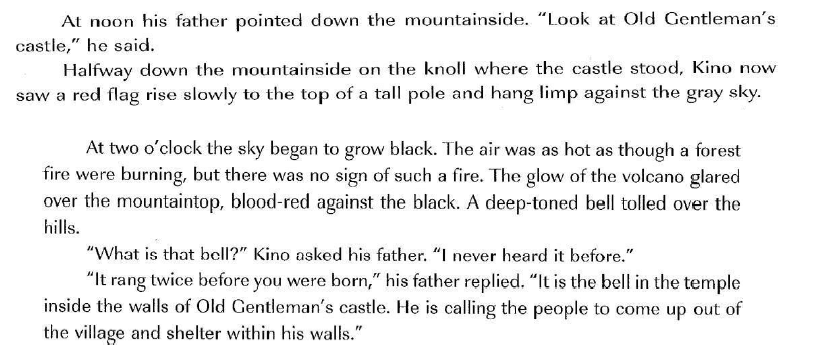
Read the excerpt from the Japanese folktale, The Wave by Pear S. Buck and answer the question that follows. What does the red flag and bell serve in the story?
Examine the map of the Philippines showing areas with risk to volcanic eruption. Which do you think is the province that falls under high risk to volcanic eruption?

Diwata noticed some unusual changes around their property, such as discolored water, wilting vegetation and structural cracks in walls and floors. She concluded that there might be a developing __________________ .
Human-induced sinkholes are consequences of land-use practices, specifically, water-pumping and construction. Other types of human- induced sinkholes could result from ____________
Landslide can happen anytime during a heavy and prolonged rainfall. The following are impending signs of rainfall- induced landslide EXCEPT
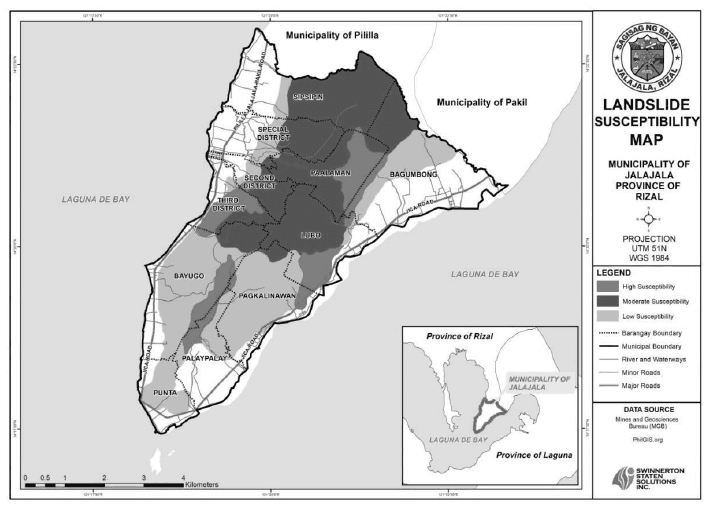
Below is the Landslide Susceptible Map of Jala Jala, Rizal Province. Which of the following areas have low susceptibility to landslides?
If you are caught outside at the time of volcanic eruption, what is the best thing you should do to keep you protected from volcanic ash falls?
You and your family plan to build your dream house on a mountainside with magnificent views and breath of fresh air. How can you ensure the safety of your mountain home from landslides?
Sheena is watching her favorite noontime show when a flash report appeared. An orange rainfall advisory is raised in some areas, including their town, as an effect of the Inter Tropical Convergence Zone (ITCZ). She learned from the report that the amount of rainfall is expected to be between 15 mm and 30 mm within one hour. What hydrometeorological hazard could become a definite threat in communities under the orange alert?
Your family visited your relatives who were displaced due to a tornado that hit their village. Your two younger sisters said that they don’t know what a tornado is. Even if you have not yet experienced devastation caused by a tornado, what would you tell your sisters to help them recognize impending signs of a tornado?
While reading your book on Disaster Management, you saw different hydrometeorological hazard maps. You noticed that your province is at high risk to typhoons and heavy rainfall but at low risk to flooding. What can you infer about this?
The major services provided by Philippine Atmospheric, Geophysical & Astronomical Services Administration (PAGASA) include the provision of weather forecast, tropical cyclone warnings, flood bulletins and rainfall advisories. Various instruments are used for monitoring possible occurrence of weather disturbances. How useful is the Weather Surveillance Radar in monitoring weather and hydrometeorological hazards?
One of the reasons why fire happens during Christmas season is due to overheating of Christmas lights. Which is NOT a way by which such fires can be prevented?
The Bureau of Fire Protection Operational Procedures Manual has a list of the common causes of fire. Which does NOT belong to the group?
What should you do when your clothes accidentally catch fire?
To operate the fire extinguisher, the acronym P.A.S.S. is often used to help us remember to ____________.
What is the one thing you should practice with your family during your home fire escape plan?
Team Charlie is properly oriented on the Prioritized Evacuation Movement of Personnel, Pupils/Students, and properties out of the school and into safe areas. The members of the team know that the evacuation movement shall be in accordance with some provisions. What should be the first priority of the team in the evacuation movement in the school?
Trisha works in the department that is in control of the recovery that includes the actions and measures taken after a disaster. She is part of the work to rebuild, restore and improve the living conditions of the affected communities while reducing the risks of disaster. Which government agency is the overall in charge of this task?
Which is NOT part of the rehabilitation measures after a disaster?
One of the importance of Disaster Risk Reduction is the the conduct of capacity building on disaster resilience, trainings, and simulation exercises as part of the disaster preparedness and response activities. Which government agency is the overall in-charge of these activities?
The following are the significant roles of the Department of Education in the Philippine Disaster Risk Management System EXCEPT
Community-Based Disaster Risk Reduction and Management (CBDRRM) engages communities not only in Disaster Risk Reduction but also in all phases of the disaster management cycle. It aims to create resilient communities which are able to reduce their vulnerabilities and exposure and at the same time enhance their capacities to before, during and after a disaster. What Filipino tradition/spirit can be shown in CBDRRM?
Under Section 284 of Republic Act (RA) No. 7160 or the Local Government Code (LGC) of 1991, LGUs (Local Government Units) are entitled to a forty percent (40%) share of the national internal revenue taxes (NIRT). Through RA 10121, LGUs are now able to use 5% of the Internal Revenue Allotment (IRA) to support Disaster Risk Reduction Management (DRRM) activities that include training, preparedness programs and the purchase of response and rescue equipment. If the municipality of Polarisa has an IRA of Php. 23,000,000, how much can the LGU use for DRRM programs?
Janella is writing some important information about her barangay including the number of families, landmarks, establishments and list of emergency hotlines, while her sister, Janellica is drawing the complete map of their barangay with the main roads, waterways and possible evacuation areas. What are they making?
A strong typhoon moving at 180 km/h is expected to hit Aurora within 18 hours. In preparation for the typhoon that is heading towards their province, Jefferson and his family, checked the condition of their house and made the necessary repairs. They decided to make their family survival kit that could last for at least 3 days or 72 hours. What are the items that must be included in their 72-hour survival kit?
Which strengthens the Philippine disaster risk reduction and management system, providing for the national disaster risk reduction and management framework and institutionalizing the national disaster risk reduction and management plan, appropriating funds therefor and for other purposes?
Des and Art were walking on their way home from school when a strong earthquake suddenly occurred. What is NOT an appropriate action during this time?
Most volcanoes provide warnings before an eruption. Magmatic eruptions involve the rise of magma toward the surface. How can we tell when a volcano is going to erupt?
Although volcanoes are dangerous when in eruptive stage, there are still also many benefits that man can derive from a volcano when it is quiet. In what ways do volcanoes provide benefit to man?
Reduce your ash exposure during a volcanic eruption by doing the following EXCEPT
A sinkhole nearby your place was discovered a year ago and lately, you observed that people began to dump different kinds of solid and liquid wastes into the sinkhole. Do you think sinkhole dumping is a good idea? Why?
Ground shaking, a loud ocean roar, or the water receding unusually far exposing the sea floor are all nature’s warnings that a _______ may be coming.
If you are caught outside during a thunderstorm, with no safe shelter nearby, which of the following actions does NOT help you reduce your risk?
John Philee was in his vehicle during a tornado. He pulled over and wanted to instantly seek shelter in a sturdy building. However, he knew it was not possible at that moment. What do you think should John do as his last resort?
What is the one thing you should practice with your family during your home fire escape plan?
Recovering from a disaster is usually a gradual process and safety is a primary consideration, as are mental and physical well-being. Which of the following steps should you take to start your life, your home and your community get back to normal after a disaster?