Loading...


DIAGNOSTIC TEST IN MATHEMATICS 10
Quiz by James Robin Dela Cruz
Customize this quiz to suit your class
Instantly translate to 100+ languages
Tag the questions with any skills you have. Your dashboard will track each student's mastery of each skill.
Give this quiz to my class

A
D
C
B

B
A
C
D



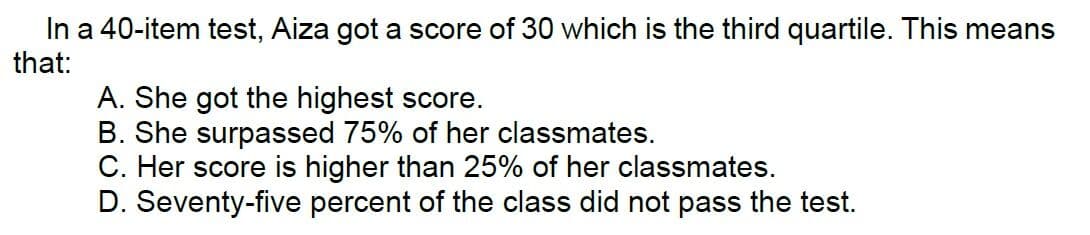





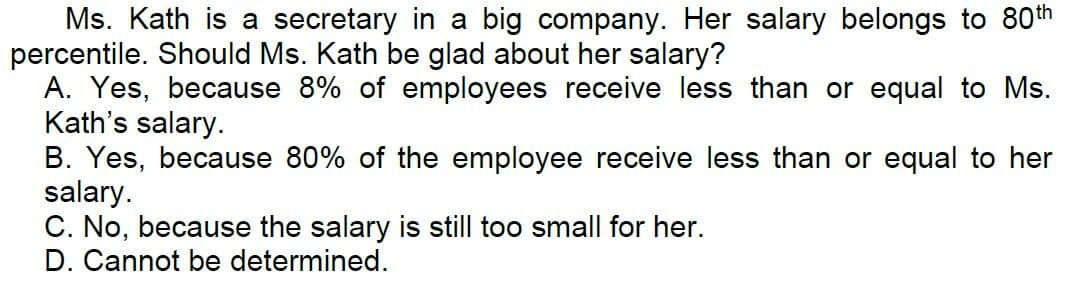 Instructions: Please answer the following questions to test your understanding of aptitudes and interests. 1. What are Core Drivers (Talents) in the context of aptitudes and interests? a) Abilities that are developed through education b) Natural gifts that predict job effectiveness and contentment c) Interests that change over time d) Personality traits 2. Determine how effective and satisfied you'll be doing a particular kind of work. a) Visual Comparison Speed b) Numerical Reasoning c) Spatial Visualization d) Sequential Reasoning 3. Which Core Driver is associated with the knack for organizing things in a sequential and systematic manner? a) Visual Comparison Speed b) Numerical Reasoning c) Spatial Visualization d) Sequential Reasoning 4. What is the primary role of Space Planners in careers? a) They are responsible for interior design b) They read maps and blueprints c) They generate creative ideas d) They manage financial accounts 5. Which Core Driver relates to the ability to mentally translate two-dimensional images into three-dimensions? a) Visual Comparison Speed b) Numerical Reasoning c) Spatial Visualization d) Sequential Reasoning 6. What type of individuals are known as 3D Visualizers? a) Those who excel in visual art b) People who can quickly process numerical data c) Individuals who can mentally create 3D models from 2D representations d) Creative writers 7. How do Brainstormers differ from Concentrated & Focused individuals in terms of generating ideas? a) Brainstormers generate more ideas b) Concentrated & Focused individuals generate more ideas c) They generate ideas at the same rate d) Both groups struggle to generate ideas 8. What is the primary advantage of having high Visual Comparison Speed? a) It helps in artistic endeavors b) It is useful in complex mathematical problems c) It aids in tasks requiring clerical detail and accuracy d) It enhances spatial visualization 9. Which career is NOT associated with the Core Driver: Visual Comparison Speed? a) Fire Inspector b) Astronomer c) Creative Writer d) Orthoptist 10. What is the main focus of Numerical Reasoning? a) Identifying numerical patterns and trends b) Analyzing historical data c) Solving abstract problems d) Communicating effectively 11. Which Core Driver involves the ability to rapidly draw conclusions from seemingly unrelated pieces of information? a) Numerical Reasoning b) Idea Generation c) Spatial Visualization d) Inductive Reasoning 12. What is the primary characteristic of Diagnostic Problem Solvers? a) They follow a logical step-by-step method of problem-solving b) They rely on specific information and observed experience c) They intuitively leap to conclusions based on limited information d) They are meticulous and deliberate in decision-making 13. What is the role of Fact Checkers in the problem-solving process? a) They intuitively provide solutions b) They rely on specific information and observed experience c) They enjoy acquiring new information and learning d) They make conclusions based on limited facts 14. In what type of role are Abstract Thinkers most comfortable? a) Counseling b) Law c) Marketing d) Construction 15. How can understanding your Core Drivers benefit collaborative work? a) It allows individuals with similar aptitudes to work together more effectively b) It creates conflicts within the team c) It doesn't affect collaborative work d) It makes collaboration more challenging 16. Which Core Driver is associated with processing complex mathematical problems logically? a) Visual Comparison Speed b) Numerical Reasoning c) Sequential Reasoning d) Idea Generation 17. What are Collaborative Planners more likely to do in a team project? a) Lead the team b) Create individual pieces of a project c) Solve abstract problems d) Generate creative ideas 18. How can understanding your aptitudes and interests help you make informed career choices? a) It guarantees job satisfaction b) It allows you to align your career with your strengths c) It helps you choose any career at random d) It has no impact on career decisions 19. Which Core Driver affects whether your thoughts go in several directions at once or follow single ideas more readily? a) Visual Comparison Speed b) Numerical Reasoning c) Idea Generation d) Inductive Reasoning 20. What is the primary characteristic of Idea Contributors? a) They generate creative ideas b) They discuss the big picture and next steps c) They are highly focused and detailed d) They follow a logical step-by-step approach 21. What is the role of Space Planners in the problem-solving process? a) They intuitively provide solutions b) They rely on specific information and observed experience c) They quickly organize information d) They create abstract plans 22. Which Core Driver is linked to the ability to see relationships in seemingly unrelated pieces of information? a) Spatial Visualization b) Inductive Reasoning c) Idea Generation d) Visual Comparison Speed 23. Which career is NOT associated with the Core Driver: Numerical Reasoning? a) Statistician b) Survey Researcher c) Chef d) Actuary 24. What are Core Drivers, and why are they important in the context of aptitudes and interests? a) They are educational qualifications b) They are interests that change over time c) They are natural gifts that predict job effectiveness and contentment d) They are personality traits 25. How can understanding your Core Drivers benefit collaborative work? a) It allows individuals with similar aptitudes to work together more effectively b) It creates conflicts within the team c) It doesn't affect collaborative work d) It makes collaboration more challenging Answers: b) Natural gifts that predict job effectiveness and contentment a) Visual Comparison Speed d) Sequential Reasoning b) They read maps and blueprints c) Spatial Visualization c) Individuals who can mentally create 3D models from 2D representations a) Brainstormers generate more ideas c) It aids in tasks requiring clerical detail and accuracy c) Creative Writer a) Identifying numerical patterns and trends d) Inductive Reasoning c) They intuitively leap to conclusions based on limited information b) They rely on specific information and observed experience b) Law a) It allows individuals with similar aptitudes to work together more effectively b) Numerical Reasoning b) Create individual pieces of a project b) It allows you to align your career with your strengths c) Idea Generation b) They discuss the big picture and next steps c) They quickly organize information b) Inductive Reasoning c) Chef c) They are natural gifts that predict job effectiveness and contentment a) It allows individuals with similar aptitudes to work together more effectivelyCan you make a multiple choice of test questions regarding this information given which is Curriculum from Different Points of View There are many definitions of curriculum. Because of this, the concept of curriculum is sometimes characterized as fragmentary, elusive and confusing. However, the numerous definitions indicate dynamism that connotes diverse interpretations of what curriculum is all about. The definitions are influenced by models of thought, pedagogies, political as well as cultural experiences. Let us study some of these definitions. 1. Traditional Points of View of Curriculum In early years of the 20th century, the traditional concepts held of the “curriculum is that it is a body of subjects or subject matter prepaid by the teachers for the student’s to learn”. It was synonymous to the “course of study” and “syllabus” Robert M. Hutchins views curriculum as “permanent studies” where the rules of grammar, reading, rhetoric and logic and mathematics for basic education are emphasized. Basic education should emphasize the 3 Rs and college education should be grounded on liberal education. On the other, Arthur Bestor as an essentialist, believes that the mission of the school should be intellectual training, hence curriculum should focus on the fundamental intellectual disciplines of grammar, literature and writing. It should also include mathematics, science, history and foreign language. The definition leads us to the view of Joseph Schwab that discipline is the sole source of curriculum. Thus in our education system, curriculum is divided into chunks of knowledge we call subject areas in basic education such as English, Mathematics, Science, Social Studies and others. In college, discipline may include humanities, sciences, language and many more. To Phoenix, curriculum should consist entirely of knowledge which comes from various disciplines. Academic discipline became the view of what curriculum is after the cold war and the race to space. Joseph Schwab, a leading curriculum theorist coined the term discipline as a ruling doctrine for curriculum development. Curriculum should consist only of knowledge which comes from disciplines which is the sole source. Thus curriculum can be viewed as a field of study. It is made up of its foundations (philosophical, historical, psychological and social foundations); domains of knowledge as well as its research theories and principles. Curriculum is taken as scholarly and theoretical. It is concerned with broad historical, philosophical and social issues and academics. Most of the traditional ideas view curriculum as written documents or a plan of action in accomplishing goals. 2. Progressive Points of View of Curriculum On the other hand, to a progressivist, a listing of school subjects, syllabi, course of study, and a list of courses or specific discipline do not make a curriculum. These can only be called curriculum if the written materials are actualized by the learner. Broadly speaking, curriculum is defined as the total learning experiences of the individual. This definition is anchored on John Dewey’s definition of experience and education. He believed that reflective thinking is a means that unifies curricular elements. Thought is not derived from action but tested by application. Caswell and Campbell viewed curriculum as “all experiences children have under the guidance of teachers”. This definition is shared by Smith, Stanley and Shores when they defined “curriculum as a sequence of potential experiences set up in the schools for the purpose of disciplining children and youth in group ways of thinking and acting”. Marsh and Willis on the other hand view curriculum as all the “experiences in the classroom which are planned and enacted by the teacher, and also learned by the students”. Points of View on Curriculum Development From the various definitions and concepts presented, it is clear that curriculum is a dynamic process. Development connotes changes which are systematic. A change for the better means any alteration, modification or improvement of existing condition. To produce positive changes, development should be purposeful, planned and progressive. This is how curriculum evolves. Let us look at the two models of curriculum development and concepts of Ralph Tyler and Hilda Taba. Ralph Tyler Model: Four Basic Principles. This is also popularly known as Tyler’s Rationale. He posited four fundamental questions or principles in examining any curriculum in schools. These four fundamental principles are as follows: 1. What educational purposes should the school seek to attain? 2. What educational experiences can be provided that are likely to attain these purposes? 3. How can these educational experiences be effectively organized? 4. How can we determine whether these purposes are being attained or not? In summary, Tyler’s Model show that in curriculum development, the following considerations should be made: (1) Purpose of the school, (2) Educational experiences related to the purposes, (3) Organization of the experiences, and (4) Evaluation of the experiences. On the other hand, Hilda Taba improved on Tyler’s Rationale by making a linear model. She believed that teachers who teach or implement the curriculum should participate in developing it. Her advocacy was commonly called the grassroots approach. She presented seven major steps to her model where teachers could have a major input. These steps are as follows: 1. Diagnosis of learner’s needs and expectations of the larger society. 2. Formulation of learning objectives. 3. Selection of learning content. 4. Organization of learning content. 5. Selection of learning experiences. 6. Organization of learning activities. 7. Determination of what to evaluate and the means of doing it. Thus as you look into curriculum models, the three interacting processes in curriculum development are planning, implementing and evaluating. Types of Curriculum Operating in Schools From the various concepts given, Allan Glatthorn(2000) describes seven types of curriculum operating in the schools. These are (1) Recommended curriculum- proposed by scholars and professional organizations. (2) Written Curriculum- appears in school, district, division or country documents. (3) Taught Curriculum- what teacher’s implement or deliver in the classrooms and schools. (4) Supported Curriculum- resources-textbooks, computers, audio- visual materials which support and help in the implementation of the curriculum. (5) Assessed Curriculum- that which is tested and evaluated. (6) Learned Curriculum- which the students actually learn and what is measured and (7) Hidden Curriculum- the unintended curriculum. 1. Recommended Curriculum- Most of the school curricula are recommended. The curriculum may come from a national agency like the Department of Education, Commission on Higher Education (CHED), Department of Science and Technology (DOST) or any professional organization who has stake in education. For example the Philippine Association for Teacher Education (PAFTE) or the Biology Teacher Association (BIOTA) may recommend a curriculum to be implemented in the elementary or secondary education. 2. Written Curriculum- This includes documents, course of study or syllabi handed down to the schools, districts, division, departments or colleges for implementation. Most of the written curricula are made by curriculum experts with participation of teachers. These were pilot-tested or tried out in sample schools or population. Example of this is the Basic Education Curriculum (BEC). Another example is the written lesson plan of each classroom teacher made up of objectives and planned activities of the teacher. 3. Taught Curriculum- The different planned activities which are put into action in the classroom compose the taught curriculum. These are varied activities that are implemented in order to arrive at the objectives or purposes of the written curriculum. These are used by the learners with the guidance of teachers. Taught curriculum varies according to the learning styles of students and the teaching styles of teachers. 4. Supported Curriculum- In order to have a successful teaching, other than the teacher, there must be materials which should support or help in the implementation of a written curriculum. These refer to the support curriculum that includes material resources such as textbooks, computers, audio-visual materials, laboratory equipment, playgrounds, zoos and other facilities. Support curriculum should enable each learner to achieve real and lifelong learning. 5. Assessed Curriculum- This refers to a tested or evaluated curriculum. At the duration and end of the teaching episodes, series of evaluations are being done by the teachers to determine the extent of teaching or to tell if the students are progressing. This refers to the assessed curriculum. Assessment tools like pencil-and-paper tests, authentic instruments like portfolio are being utilized. 6. Learned Curriculum- This refers the learning outcomes achieved by the students. Learning outcomes are indicated by the results of the tests and changes in behavior which can either be cognitive, affective or psychomotor. 7. Hidden Curriculum- This is the unintended curriculum which is not deliberately planned but may modify behavior or influenced learning outcomes. There are lots of hidden curricula that transpire in the schools. Peer influence, school environment, physical condition, teacher-learner interaction, mood of the teachers and many other factors made up the hidden curriculum.Diagnostic Test in Science 5DIAGNOSTIC TEST IN ENGLISH 5Diagnostic Test in CLVE 5Diagnostic Test in Gen MathDiagnostic Test in Science 10DIAGNOSTIC TEST IN MAPEH 5