Loading...


Dynamic Planet Final Mock Assessment
Quiz by Jason Wang
Customize this quiz to suit your class
Instantly translate to 100+ languages
Tag the questions with any skills you have. Your dashboard will track each student's mastery of each skill.
Give this quiz to my class
How much of the world’s freshwater is concentrated in the great lakes?
30%
22%
24%
21%
Which of the following correctly describes a Meromictic Lake?
A lake that has uniform temperature from top to bottom at least once a year
A lake which has layers of water that do not mix
A lake that has layers mix at least once per year
None of the above
How much of the world’s freshwater is concentrated in the great lakes?
Which of the following correctly describes a Meromictic Lake?
Which of the following is an example of lithification?
Which of the following are formed through meander bend cutoffs, channel avulsions (abandonment of an entire channel segment), or mid-channel deposition and subsequent vegetation?
What type of drainage pattern is this:

What is the difference between porosity and permeability in rocks?
Which type of valley is characterised by steep sides that curve at the base of the valley wall?
Which of the following options best explains why spring overturning may occur if warm water tends to be less dense?
You are a geologist in the scablands in Washington state when you observe some of the debris seems to have a reversed grading to them - finer sediment is found at higher elevation along a slope and coarse gravels are found at the bottom. Knowing the geologic history of this region (downstream from major glaciers during the last glaciation), best explains these features?
A paper boat travels at the same speed as a river along the thalweg of a river 4 meters wide. It takes 15 minutes traveling at 0.4 m/s to traverse a straight line distance of 240 meters. What is the approximate sinuosity of the river?
Flash flooding is much more of a concern in regions that went through prolonged drought. Which of the following best explains the most important factor?
Darcy’s Law would be valid for which of the following situations?
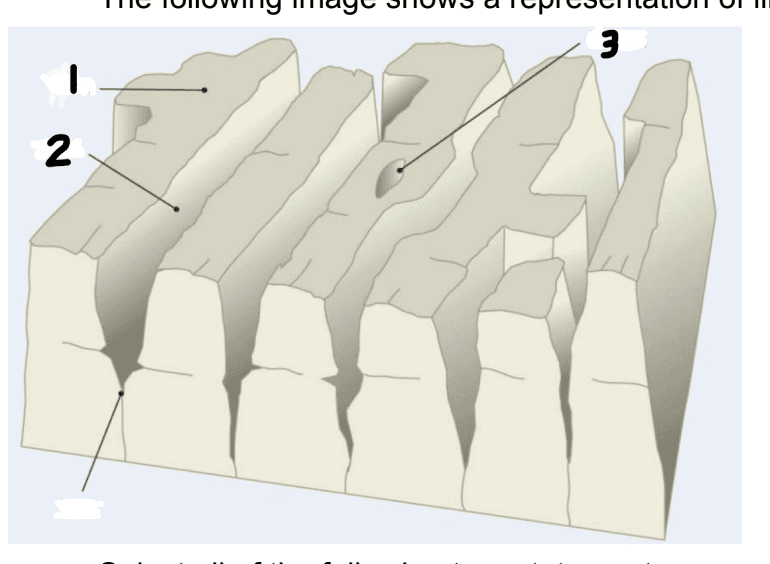
Limestone pavement is a karst feature of exposed limestone. The following image shows a representation of limestone pavement. Select all of the following true statements.
a. Feature 1 is an example of a grike, a section of pavement separated from adjacent segments. b. Grikes develop along joints in limestone.
c. Feature 3 is an example of a karren.
d. Karrens grow in size predominantly through chemical weathering by water.
e. Karrens have the potential to hold a colony of soil in the far future.
A bog with a relatively low pH compared to nearby river fed lakes is likely to be best described by which of the following?
What type of delta is this best categorized as?

At an elevation of 400 meters, the water table is 30 meters below the ground. At an elevation of 350 meters, the water table is 20 meters below the ground. The straight overland distance between the two points of measurement is 2 km. What is the average hydraulic gradient assuming the water table in this region is in some sort of equilibrium?
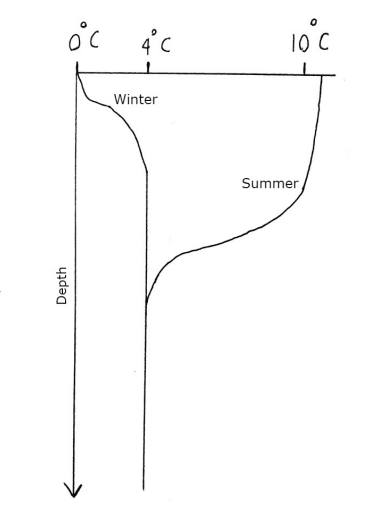
Poisson Lake has different thermoclines during winter and summer as shown in the figure above. Based on the information given, what stratification does Poisson Lake have?
What is the difference between a marsh and a swamp?
The depressions occupied by the lakes depicted in the figure above were pri- marily formed by .

Which biome is most likely to have karst topography?
Which of the following is true concerning riverine ice formation and breakup?
What is the main source of the naturally occurring dissolved load in sediment?
Paludification and terrestrialization refer to opposing processes that lead to the creation of what type of wetland?
What is Dynamic Planet?
Earlier in 2019 there was a lot of femicide uh girls being killed by their boyfriends because they did one or two things there are also cultures of if there is violence in terms of a marital relationship that that is fine if there's a marital rape that that is fine so you find such situations being normalized and it being also a taboo to speak about those issues the 2030 agenda for sustainable development is grounded in respect for human rights and the power of people to change the world every individual on the planet has the right to health and well-being in all aspects of their sexuality their body and their reproductive choices ensuring these rights is integral to addressing poverty education violence against women and gender equality sexual and reproductive health rights are agreed in international law they were fought for by courageous women's rights activists and advocates across a broad range of professional fields and frontline experiences by movements of all ages levels and backgrounds they are still being fought for while progress has been made globally many barriers remain especially for those most marginalized excluded or discriminated against human rights are central to delivering the 17 sustainable development goals in the sustainable development agenda indeed each sdg target is simultaneously a metric and a claim for human rights the interplay between these political commitments and human rights obligations is particularly important when it comes to achieving sexual and reproductive health rights for decades human rights-based tactics have been used to drive progress in this episode of right to a better world experts share challenges they have faced and tactics they have used to address them the challenges they describe occur in settings all around the world the strategies used are ones that they have found to be successful in their own settings viewers are encouraged to learn from these experiences and consider how tactics could be adapted to their own context when sexual and reproductive health begins with equality the discussions decisions programs and policies which follow can build towards a future where every individual is not only born free but lives free and equal in dignity and rights without violence or discrimination the time to take action is now violence against women is any act that results in or is likely to result in physical sexual or psychological harm or suffering to women this includes threats of such acts coercion or arbitrary deprivation of liberty in public or private life it happens everywhere in every country in the home in communities at work and at school crises including health and humanitarian crises frequently contribute to higher rates of violence against women violence against women is directed at women because of their status as women the consequences are dire jeopardizing women's health including sexual and reproductive health and mental health hampering their ability to participate fully in society causing tremendous physical and psychological suffering for both women and their children the majority of women survivors of violence do not disclose or seek any type of services efforts to address violence against women must recognize the many different contexts in which it occurs and the many different forms it can take the majority of violence against women is committed by an intimate partner her current or previous boyfriend or husband globally around 30 of women have experienced physical and or sexual violence by an intimate partner in their lifetime this increases the risk of acquiring an sti or in some regions hiv by 1.5 fold when a woman is experiencing violence especially from her partner she's really unable to keep safe from hiv men have power to decide how when and where sex should be done and the woman is at risk of being infected because she cannot say no schools are another setting where violence against girls can take place assault and harassment during their commute bullying sexual harassment and mental or physical abuse on school property are all challenges across various country contexts this has a direct impact on girls access to inclusive quality education a target of sdg4 and an indirect impact on many of their other human rights young girls are taking advantage of at a very young age and they do not understand the choices and the avenues whereby they can exercise their rights when it comes to sexual productive health and rights and so you find a lot of dropouts and a lot of girls also going through a lot of traumatic experiences that would be avoided if they had guidance promoting a safe and secure working environment for all is a cornerstone of sdg 8. this includes a workplace free from sexual harassment and violence but for many women especially women migrant workers and others in precarious employment this is far from reality so we went to naivasha which is a flower farm and we've met the informal workers the casual liberals working for the flower farms when for example the sexual violence cases are reported companies don't take them very seriously a wide range of tactics have been used to prevent and address violence against women and girls and to recognize it as a fundamental violation of human rights prevention of intimate partner violence is possible when interventions are informed by evidence of what works we started out by describing the problem we've now moved to research on what works what are the kinds of interventions that are successful both for preventing the problem from happening in the first place and also from interventions to respond the respect women framework on preventing violence against women developed by the who un women ohchr and other international agencies promotes seven strategies which focus on relationship skills strengthening empowerment of women services for health justice police and social sector poverty reduction environments made safer including schools workplaces and public spaces child and adolescence abuse prevented and transformation of gender attitudes beliefs and norms this action-oriented framework can enable policy makers and health implementers to design plan implement monitor and evaluate interventions and programs to prevent violence against women we have come a long way for sure we still have some ways to go and we need to do more to stop this violence from happening in the first place this involves addressing the social norms that still prevail in many settings that make this form of violence acceptable women are not exposed to gender-based violence by accident all because of an inbuilt vulnerability violence against women is rooted in discriminatory social norms and power dynamics dismantling these underlying causes of violence against women and girls is at the heart of achieving gender equality and empowering all women and girls as set out in the targets and indicators of sdg 5 ensuring healthy lives in sdg3 and reducing inequalities in sdg 10. women and men are valued differently society has heap privileges on the men while the women are looked at as subordinate power is not only the problem but also the solution to preventing violence against women we are making it personal everyone connects with power every day people living with power or grappling with power they find themselves within this whole conversation if you're working to create gnome change there has to be change at all levels strategies to raise awareness in communities about violence against women and girls are critical as there is still a lot of stigma and shame which inhibits many women and girls from talking about it intervention is like a big complicated word sometimes it's just about talking about dialogue i mean the fact that we went into schools and just began a conversation with parents um bringing them together in the school along with the school personnel and then having the conversation start from there and we also sort of train providers within schools to appropriately refer children to health facilities for care what we found was that this dialogue began to spark other conversations in the community and i guess they just felt that oh it's actually okay to talk about this openly rather than pretend that nothing is going on sassa is a community mobilization approach to prevent violence against women and hiv and aids it is activist led it's not workshop heavy based it comes away from the traditional programming of organizations going to do things themselves instead they support activists who do the activities with their friends and neighbors health systems play a critical role in responding to violence wherever it occurs supporting health workers to respond appropriately to violence as well as ensuring their work environment enables them to provide safe effective and quality survivor centred care are important strategies for better addressing violence against women and girls um we came to learn not to ask direct questions not to give our opinion or our judgment on them and let her speak and once with that flow starts once that connection is established that doctor-patient relationship emotionally is established she will actually tell you the whole history legal frameworks to promote enforce and monitor equality and non-discrimination on the basis of sex are an important sdg 5 indicator but putting laws in place does not automatically make them effective there are existing protections for women in the workplace or for individuals in the workplace in relation to harassment but we know from our call for evidence that they are not actually addressing the problem the recommendations that we developed included government implementing a mandatory duty for employers to take preventative steps to address harassment in the workplace so what we would like to see is government implement a much stronger legislative duty it has taken decades of struggle by the women's rights movement to persuade the international community to view violence against women as a human rights concern and a sustainable development priority not a private matter governments have obligations to respect protect and fulfill the right to a life free of violence and to provide for sanctions when they fail when seeking accountability the priority consideration must always be the safety and well-being of survivors respecting their wishes and autonomy and supporting them to make informed choices about the type of justice they want context is vitally important there are many strategies to hold perpetrators accountable including strategic litigation and public campaigns when the teachers impregnate the girls that means the system has failed and okay what they do is they blacklist the teachers and they are always removed from the payroll but we think that is not enough the case that was quite interesting is where one of the judges she did find a ruling against the teacher service commission the commission that is responsible for hiring teachers asking them that they must take responsibility and they were ordered to pay compensation to the girls who had gotten pregnant while in school the justice police issue came about a few years back when a young girl was raped and the punishment for her being ripped was that harappa she was gang-ripped and therapists were told to slash grass feminist organizations and young women organizations came back to the police and the police commissioner to ask and request that the people who are found to be perpetrators should be punished according to our constitution and according to the laws of the land and those are very big campaigns to get better justice so consequently they were jailed but also it was a sign that the system the police system had to be checked in terms of when someone reports a case any case of violence what happens and how is it followed through the maria pedra is another example of litigation that became a political mobilizer so this was a case from the inter-american commission that really galvanized a change in public policy a huge change because it was a case that addressed gender-based violence intimate partner violence it called on responsibility of brazil also for not having prevented this kind of violence the reality of a case that says you have the right to not be bruised you have the right to be free of physical psychological violence it's powerful it can change women's lives investing in autonomous women's movements has been one of the most important drivers of changes in laws and policies to address violence against women over the past 40 years according to data from over 70 countries women organizing to advance women's status define the very concept of violence against women raised awareness of the issue and put it on national and global policy agendas often we thought that it takes generations or centuries to change working intensely with the communities we can actually see change coming violence against women and girls is a violation of fundamental human rights to life and to physical and psychological integrity not to be tortured or treated in an inhuman and degrading way to respect for private and family life and the right not to be discriminated against this understanding is more than theoretical human rights-based tactics can offer a practical route to addressing systemic challenges across all the circumstances where violence against women and girls occurs including but not limited to at the hands of their partners at school and in the workplace by using evidence-informed prevention strategies addressing power relations and social norms community mobilizing and dialogue supporting health systems and professionals putting in place strong legal frameworks accessing justice and ending impunity feminist organizing and mobilizing every individual can help to deliver the 2030 agenda for sustainable development building a world in which women and girls are free from all forms of violence and discrimination [Music] youLesson 1: Continental Drift Theory and the Evidences that support the Theory Continental drift describes one of the earliest ways geologists thought continents moved over time. Today, the theory of continental drift has been replaced by the science of plate tectonics. The theory of continental drift is most associated with the scientist Alfred Wegener. In the early 20th century, Wegener published a paper explaining his theory that the continental landmasses were “drifting” across the Earth, sometimes plowing through oceans and into each other. He called this movement continental drift. Pangaea Wegener was convinced that all of Earth’s continents were once part of an enormous, single landmass called Pangaea. Wegener, trained as an astronomer, used biology, botany, and geology describe Pangaea and continental drift. For example, fossils of the ancient reptile mesosaurus are only found in southern Africa and South America. Mesosaurus, a freshwater reptile only one meter (3.3 feet) long, could not have swum the Atlantic Ocean. The presence of mesosaurus suggests a single habitat with many lakes and rivers. Wegener also studied plant fossils from the frigid Arctic Archipelago of Svalbard, Norway. These plants were not the hardy specimens adapted to survive in the Arctic climate. These fossils were of tropical plants, which are adapted to a much warmer, more humid environment. The presence of these fossils suggests Svalbard once had a tropical climate. Finally, Wegener studied the stratigraphy of different rocks and mountain ranges. The east coast of South America and the west coast of Africa seem to fit together like pieces of a jigsaw puzzle, and Wegener discovered their rock layers “fit” just as clearly. South America and Africa were not the only continents with similar geology. Wegener discovered that the Appalachian Mountains of the eastern United States, for instance, were geologically related to the Caledonian Mountains of Scotland. Pangaea existed about 240 million years ago. By about 200 million years ago, this supercontinent began breaking up. Over millions of years, Pangaea separated into pieces that moved away from one another. These pieces slowly assumed their positions as the continent we recognize today. Today, scientists think that several supercontinents like Pangaea have formed and broken up over the course of the Earth’s lifespan. These include Pannotia, which formed about 600 million years ago, and Rodinia, which existed more than a billion years ago. Tectonic Activity Scientists did not accept Wegener’s theory of continental drift. One of the elements lacking in the theory was the mechanism for how it works—why did the continents drift and what patterns did they follow? Wegener suggested that perhaps the rotation of the Earth caused the continents to shift towards and apart from each other. (It doesn't.) Today, we know that the continents rest on massive slabs of rock called tectonic plates. The plates are always moving and interacting in a process called plate tectonics. The continents are still moving today. Some of the most dynamic sites of tectonic activity are seafloor spreading zones and giant rift valleys. In the process of seafloor spreading, molten rock rises from within the Earth and adds new seafloor (oceanic crust) to the edges of the old. Seafloor spreading is most dynamic along giant underwater mountain ranges known as mid-ocean ridges. As the seafloor grows wider, the continents on opposite sides of the ridge move away from each other. The North American and Eurasian tectonic plates, for example, are separated by the Mid-Atlantic Ridge. The two continents are moving away from each other at the rate of about 2.5 centimeters (1 inch) per year. Rift valleys are sites where a continental landmass is ripping itself apart. Africa, for example, will eventually split along the Great Rift Valley system. What is now a single continent will emerge as two—one on the African plate and the other on the smaller Somali plate. The new Somali continent will be mostly oceanic, with the Horn of Africa and Madagascar its largest landmasses. The processes of seafloor spreading, rift valley formation, and subduction (where heavier tectonic plates sink beneath lighter ones) were not well-established until the 1960s. These processes were the main geologic forces behind what Wegener recognized as continental drift.New Trends in Agriculture Extension approaches Extension has been, and still is, under attack from a wide spectrum of politicians and economists over its cost and financing. As a result, Extension Systems have had to make changes, by restating the system’s mission, developing a new vision for the future, and formulating plans for the necessary transition to achieve the desired change. 1. Privatization of Agricultural Extension Service Privatization: Process of funding and delivering the extension services by private individual or organization is called Private Extension. Concept: Privatization of extension refers to services rendered in rural area & allied aspects of extension personnel working in private agencies or organization for which farmers are expected to pay a fee & it can be viewed as supplementary or alternative to public extension services (Sarvanan & Shivalinge 1980). Privatization approaches ➢ Share cropping system ➢ Village extension contract system ➢ Public extension through private delivery ➢ Service for vouchers Strengths of Private Extension System ➢ More demand - driven rather than supply – driven ➢ High quality of services in terms of satisfying information needs of clientele, trained manpower, sustained finances and resource allocation ➢ Provides for an information mix and choices available to farmers ➢ Enhanced efficiency of staff ➢ Assure continuous supply and quality agricultural products ➢ More effective because farmer can select an adviser who is the best able to help ➢ Healthy competition among service provider will lead to better quality and lower costs for service Weakness of Private Extension System ➢ Concentrate on area having favorable physical environment ➢ More face-to-face contacts (person oriented) ➢ Increased dependence of farmers and hence exploitation ➢ No education role ➢ Deprivation of small farmers ➢ Hamper the free flow of information 2. Cyber Extension or e-extension Concepts Cyber space: it is the imaginary or virtual space of computers connected with each other on Networks, across the Globe. Cyber extension: it means 'using the power of online networks, computer communications and digital interactive multimedia to facilitate dissemination of agriculture technology. Cyber Extension thus can be defined as the extension over cyber space. Important tools of cyber extension E-Mail, Telnet, File Transfer Protocol (FTP), Gopher, Archie and World Wide Web (WWW) Strengths of Cyber Extension ➢ Access to the astounding information and continuously available ➢ Information rich and instantaneously available of information ➢ Interactive communication ➢ The information is available from any point on the globe ➢ Communication is dynamic ➢ Cut steps from traditional process ➢ Save money, time and effort ➢ Multiplicity of purpose Issues and Concerns of Cyber Extension ➢ Lack of Reliable Telecom Infrastructure in Rural Areas ➢ Erratic or no Power Supply ➢ Lack of ICT Trained manpower (willing to serve) in Rural Areas ➢ Lack of content (locally relevant and in local languages) ➢ Lack of Information Services to Rural Clientele ➢ Low Purchasing power of the Rural communities ➢ Lack of Holistic Approaches ➢ Issues of Sustainability Application of cyber extension ➢ Village information shops Dr. M.S. SwaminathanResearch Foundation, Chennai ➢ Information villagers MANAGE in Ranga Reddy District in Andhra pradesh ➢ Gyandoot net initiative of District Dhar, Madhya Pradesh. ➢ Warna wired village of National Informatics Center (NIC) in Kolhapur- Sangli Districts of Maharashtra 3. Market-Led-Extension (MLE) Concepts Market: A congregation of prospective buyers & sellers with a common motive of trading a particular commodity. Extension: It is the spreading/reaching out to the mass Market-led-extension: Agriculture & economics coupled with extension is the perfect blend for reaching at the door steps of common man with the help of technology. Dimensions of market-led extension ➢ Marketing mix: A planned mix of the controllable elements of a product's marketing plan commonly termed as 4Ps: product, price, place, and promotion. These four elements are adjusted until the right combination is found that serves the needs of the product's customers, while generating optimum income. ➢ Marketing plan: A marketing plan is a comprehensive document that outlines a business and marketing efforts for the coming year. It describes business activities involved in accomplishing specific marketing objectives within a set time frame. A marketing plan also includes a description of the current marketing position of a business, a discussion of the target market and a description of the marketing mix that a business will use to achieve their marketing goals. ➢ Market Intelligence: It is the information relevant to a company’s markets, gathered and analyzed specifically for the purpose of accurate and confident decision making. Market intelligence includes the process of gathering data from the company’s external environment, whereas the business intelligence process is primarily based on internal recorded events – such as sales, shipments and purchases. ➢ Market oriented production ➢ Use of Technology Strengths of market-led extension ➢ SWOT analysis of the market ➢ Organization of Farmers’ Interest Groups (FIGs) ➢ Enhancing the interactive and communication skills of the farmers ➢ Establishing marketing and agro-processing linkages ➢ Advice on product planning ➢ Educating the farming community ➢ Direct marketing ➢ Acquiring complete market intelligence ➢ Publication of agricultural market information Production of video films of success stories ➢ Challenges to market-led extension ➢ Gigantic size of extension system ➢ Information technology Diverse conditions ➢ Market intelligence ➢ Reforms in agricultural extension system Government Initiatives ➢ Central warehousing Corporation-1965 ➢ MSP by Commission for Agricultural Cost and Price (CACP) ➢ Food Corporation of India ➢ Then some others as: Cotton Corporation of India (CCI), Jute Corporation of India (JCI), National Dairy Development Board (NDDB), Agriculture and Processed food Export Development Authority (APEDA) etc. 4. Farmer--Led-Extension (FLE) Farmer--led-extension is defined as 'the provision of training by farmers to farmers, often through the creation of a structure of farmer promoters and farmer trainers' (Scarborough et al., 1997). Philosophy and principles ➢ Farmers and local institutions (e.g. producer organizations or village leaders) should play a key role in selecting farmer-trainers and monitoring and evaluating them. This helps make the programmes more accountable to the community or groups that they serve. ➢ Farmer-trainers are ‘of the community’; they communicate in local languages and are more sensitive to local cultures, mannerisms, farming practices, and farmers’ needs. ➢ Farmer-trainers should be selected on the basis of their skills and interest in sharing information, not just on their farming expertise. ➢ Farmer-trainers need strong linkages with and support from development agents (whether government, non-government organization (NGO), or private), the people who train and backstop them. Farmer-trainers generally serve as a complement to existing extension systems, rather than being a substitute for them. ➢ Facilitating organizations and local institutions need to be proactive in ensuring that women as well as men become farmer-trainers. ➢ Simple and appropriate reference materials should be made available to the farmer trainers. Essential Elements of Farmer--led-extension ➢ The group ➢ The Field ➢ The Facilitator ➢ The curriculum ➢ Programme leader ➢ Financing Special features of Farmer--led-extension ➢ All learning is field based & it is primary venue for learning ➢ FLE group learning constantly over the experimentation period ➢ FLE promotes healthy decisions & quality decisions ➢ Farmers conduct their own field studies with comparisons or treatments ➢ Facilitates Farmer-to-Farmer communication ➢ Field staff serve as facilitators ➢ FLE is a unique way to educate farmers ➢ It is an effective platform for sharing of experiences and collectively solving agriculture related problems. 5. Expert system Expert system is an intelligent computer program that uses knowledge and inferences procedures to solve problems (Daniel Hunt, 1986). Objectives of developing expert system ➢ To enhance the performance of agricultural extension personnel and farmer ➢ To make farming more efficient and profitable ➢ To reduce the time required in solving the problems ➢ To maintain the expert system by continuously upgrading the database Advantages of expert system ➢ Solves critical problems by making logical deductions without taking much time ➢ It combines experimental and conventional knowledge with the reasoning skills of specialists ➢ To enhance the performance of average worker to the level of an expert Limitations of expert system ➢ Expensive computer program ➢ Mostly developed not in regional languages ➢ Requires AC power and internet connection all the time ➢ Complex software requires computer skilled personnel Modules of expert system in agriculture ➢ COMAX: Integrated crop management in cotton ➢ SOYEX: Soybean oil extraction expert system ➢ PLANT/ds: Diagnosis of soybean diseases ➢ MAIZE: Maize expert system for field crop management ➢ SEMAGI: Weed control decision making in sunflowers ➢ Rice Crop Doctor: Developed by National Institute of Agricultural Extension Management (MANAGE) Difference between conventional and expert system of extension Conventional Extension ➢ Universal approachability of same information is a problem ➢ Information is given whatever is available without considering needs and resources ➢ No Cost benefit analysis ➢ Information flow depends on availability of agent ➢ Require users to draw their own conclusion from facts Expert System of Extension ➢ Universal approachability of same information is possible ➢ Information is chosen based on their needs and resources ➢ Cost benefit analysis ➢ Information through Cyber Cafe at any place at any time ➢ Conclusion is drawn based on the decision given by the expertMake a test, with answers best on the following: Conduct an investigation to provide evidence that living things are made of cells; either one cell or many different numbers and types of cells. Supporting Content LS1.A: Structure and Function • All living things are made up of cells, which is the smallest unit that can be said to be alive. An organism may consist of one single cell (unicellular) or many different numbers and types of cells (multicellular). (MS-LS-1.1) Further Explanation: Emphasis is on developing evidence that living things are made of cells, distinguishing between living and non-living things, and understanding that living things may be made of one cell or many and varied cells. In multicellular organisms, the body is a system of multiple interacting subsystems. These subsystems are groups of cells that work together to form tissues and organs that are specialized for particular body functions. (MS-LS-1.3) Further Explanation: Emphasis is on the conceptual understanding that cells form tissues and tissues form organs specialized for particular body functions. Examples could include the interaction of subsystems within a system and the normal functioning of those systems. Organisms reproduce, either sexually or asexually, and transfer their genetic information to their offspring. (MS-LS-1.4) • Living things share certain characteristics. (These include response to environment, reproduction, energy use, growth and development, life cycles, made of cells, etc.) (MS-LS1.4) Further Explanation: Examples should include both biotic and abiotic items, and should be defended using accepted characteristics of life. Plants, algae (including phytoplankton), and many microorganisms use the energy from light to make sugars (food) from carbon dioxide from the atmosphere and water through the process of photosynthesis, which also releases oxygen. These sugars can be used immediately or stored for growth or later use. (MS-LS-1.5) Further Explanation: Emphasis is on tracing movement of matter and flow of energy. Supporting Content LS1.C: Organization for Matter and Energy Flow in Organisms • Within individual organisms, food moves through a series of chemical reactions (cellular respiration) in which it is broken down and rearranged to form new molecules, to support growth, or to release energy. (MS-LS-1.6) Further Explanation: Emphasis is on describing that molecules are broken apart and put back together and that in this process, energy is released and on understanding that the elements in the products are the same as the elements in the reactants. Organisms, and populations of organisms, are dependent on their environmental interactions both with other living things and with nonliving factors. (MS-LS-2.1) • In any ecosystem, organisms and populations with similar requirements for food, water, oxygen, or other resources may compete with each other for limited resources, access to which consequently constrains their growth and reproduction. (MS-LS-2.1) • Growth of organisms and population increases are limited by access to resources. (MS-LS-2.1) Further Explanation: Emphasis is on cause and effect relationships between resources and growth of individual organisms and the numbers of organisms in ecosystems during periods of abundant and scarce resources. Similarly, predatory interactions may reduce the number of organisms or eliminate whole populations of organisms. Mutually beneficial interactions, in contrast, may become so interdependent that each organism requires the other for survival. Although the species involved in these competitive, predatory, and mutually beneficial interactions vary across ecosystems, the patterns of interactions of organisms with their environments, both living and nonliving, are shared. (MS-LS-2.2) Further Explanation: Emphasis is on predicting consistent patterns of interactions in different ecosystems in terms of the relationships among and between organisms and abiotic components of ecosystems. Examples of types of interactions could include competitive, predatory, and mutually beneficial. Food webs are models that demonstrate how matter and energy is transferred between producers, consumers, and decomposers as the three groups interact within an ecosystem. Transfers of matter into and out of the physical environment occur at every level. Decomposers recycle nutrients from dead plant or animal matter back to the soil in terrestrial environments or to the water in aquatic environments. The atoms that make up the organisms in an ecosystem are cycled repeatedly between the living and nonliving parts of the ecosystem. (MS-LS-2.3) Further Explanation: Emphasis is on describing the conservation of matter and flow of energy into and out of various ecosystems, and on defining the boundaries of the system. Ecosystems are dynamic in nature; their characteristics can vary over time. Disruptions to any physical or biological component of an ecosystem can lead to shifts in all its populations. (MSLS-2.5) Further Explanation: Emphasis is on recognizing patterns in data and making warranted inferences about changes in populations, and on evaluating empirical evidence supporting arguments about changes to ecosystems. Biodiversity describes the variety of species found in Earth’s terrestrial and oceanic ecosystems. The completeness or integrity of an ecosystem’s biodiversity is often used as a measure of its health. (MS-LS-2.6) Supporting Content LS4.D: Biodiversity • Changes in biodiversity can influence humans’ resources, such as food, energy, and medicines, as well as ecosystem services that humans rely on—for example, water purification and recycling. (MS-LS-2.6) Supporting Content ETS1.B: Developing Possible Solutions • There are systematic processes for evaluating solutions with respect to how well they meet the criteria and constraints of a problem. (MS-LS-2.6) Further Explanation: Examples of ecosystem services could include water purification, nutrient recycling, and prevention of soil erosion. Examples of design solution constraints could include scientific, economic, and social considerations. Genes are located in the chromosomes of cells, with each chromosome pair containing two variants of each of many distinct genes. Each distinct gene chiefly controls the production of specific proteins, which in turn affects the traits of the individual. Structural changes to genes (mutations) can result in changes to proteins, which can affect the structures and functions of the organism and thereby change traits. (MS-LS-3.1) Supporting Content LS3.B: Variation of Traits • In addition to variations that arise from sexual reproduction, genetic information can be altered because of mutations. Though rare, mutations may result in significant changes to the structure and function of proteins. Changes can be beneficial, harmful, or neutral to the organism. (MS-LS-3.1) Further Explanation: Emphasis is on conceptual understanding that changes in genetic material may result in making different proteins. Organisms reproduce, either sexually or asexually, and transfer their genetic information to their offspring. (MS-LS-3.2) Supporting Content LS3.A: Inheritance of Traits • Variations of inherited traits between parent and offspring arise from genetic differences that result from the subset of chromosomes (and therefore genes) inherited. (MS-LS-3.2) Supporting Content LS3.B: Variation of Traits • In sexually reproducing organisms, each parent contributes half of the genes acquired (at random) by the offspring. Individuals have two of each chromosome and hence two alleles of each gene, one acquired from each parent. These versions may be identical or may differ from each other. (MS-LS-3.2) Further Explanation: Emphasis is on using models such as simple Punnett squares and pedigrees, diagrams, and simulations to describe the cause and effect relationship of gene transmission from parent(s) to offspring and resulting genetic variation. The collection of fossils and their placement in chronological order is known as the fossil record and documents the change of many life forms throughout the history of the Earth. Anatomical similarities and differences between various organisms living today and between living and once living organisms in the fossil record enable the classification of living things. (MS-LS-4.1, MS-LS-4.2) Further Explanation: Emphasis is on finding patterns of changes in the level of complexity of anatomical structures in organisms and the chronological order of fossil appearance in the rock layers. The collection of fossils and their placement in chronological order is known as the fossil record and documents the change of many life forms throughout the history of the Earth. Anatomical similarities and differences between various organisms living today and between living and once living organisms in the fossil record enable the classification of living things. (MS-LS-4.1, MS-LS-4.2) Further Explanation: Emphasis is on explanations of the relationships among organisms in terms of similarity or differences of the gross appearance of anatomical structures. Scientific genus and species level names indicate a degree of relationship. (MS-LS-4.3) Further Explanation: Emphasis is on inferring general patterns of relatedness among structures of different organisms by comparing diagrams, pictures, specimens, or fossils. Natural selection leads to the predominance of certain traits in a population, and the suppression of others. (MS-LS-4.4) Further Explanation: Emphasis is on using concepts of natural selection, including overproduction of offspring, passage of time, variation in a population, selection of favorable traits, and heritability of traits. In artificial selection, humans have the capacity to influence certain characteristics of organisms by selective breeding. One can choose desired parental traits determined by genes, which are then passed to offspring. (MS-LS-4.5) Further Explanation: Emphasis is on identifying and communicating information from reliable sources about the influence of humans on genetic outcomes in artificial selection (such as genetic modification, animal husbandry, gene therapy), and on the influence these technologies have on society as well as the technologies leading to these scientific discoveries. Adaptation by natural selection acting over generations is one important process by which species change over time in response to changes in environmental conditions. Traits that support successful survival and reproduction in the new environment become more common; those that do not become less common. Thus, the distribution of traits in a population changes. (MS-LS-4.6) Further Explanation: Emphasis is on using mathematical models, probability statements, and proportional reasoning to support explanations of trends in changes to populations over time. Examples could include Peppered Moth population changes before and after the industrial revolution. Dynamic Dynamic MarkingsDynamic Pricing in the Digital Age - Starter QuizDynamic and Resilient Ecosystems